Career Development: Actionable Strategies and Success Stories for Accelerated Professional Growth

Passive tenure no longer guarantees upward mobility in highly competitive corporate ecosystems. Professionals who rely solely on years of service often find themselves bypassed for promotions by those who actively direct their own paths. This passive approach to career development carries severe consequences, including skill obsolescence, flatlined earning potential, and chronic professional stagnation. Without a deliberate strategy to audit capabilities and acquire high-leverage competencies, even seasoned specialists risk becoming redundant as market demands shift. To avoid this trajectory, professionals must transition from passive participants to strategic architects of their own value. This comprehensive guide provides an actionable roadmap to accelerate professional trajectory and secure sustainable advancement. We establish the critical distinctions between functional skill acquisition and external title progression, outline a systematic three-step execution framework, and analyze real-world corporate case studies of rapid upward mobility. Additionally, this analysis details how forward-thinking organizations can restructure their internal talent pathways and management practices to foster high-retention, high-performance cultures.
Understanding Career Development vs. Professional Growth
Defining Career Development: Why It Matters for Personal Achievement
Career development is a continuous, structured process of managing learning, work, and transitions to achieve a personally rewarding future. It transforms passive tenure into active self-direction, allowing professionals to align their daily efforts with strategic milestones that directly influence long-term personal achievement and sustained job satisfaction.
Relying on passive longevity within a single role often results in skill stagnation and vulnerability to organizational restructuring. Active career development, however, empowers individuals to consistently acquire high-value competencies that match evolving industry demands. This structured approach builds a resilient professional identity that remains marketable irrespective of market volatility.
Career Development vs. Career Growth: The Key Differences
Career development represents the continuous internal process of acquiring skills, behaviors, and competencies to expand professional capability. In contrast, career growth refers to the external, macro-level progression of an individual's career trajectory, characterized by measurable markers such as promotions, title changes, salary increases, and heightened authority.
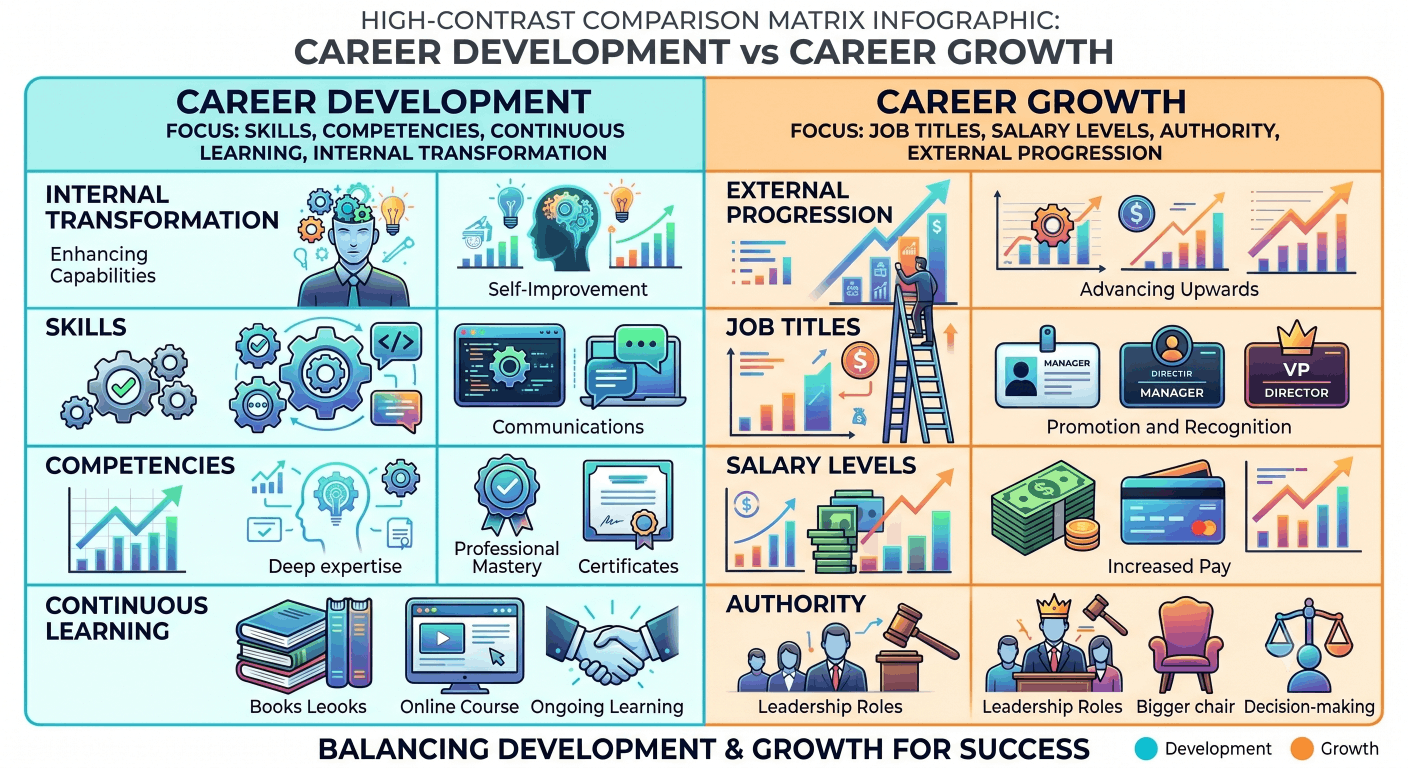
| Metric | Career Development (Internal Evolution) | Career Growth (External Progression) |
|---|---|---|
| Primary Focus | Competency acquisition, behavioral adjustment, and skill diversification. | Title advancement, compensation increases, and expanded authority. |
| Nature of Process | Continuous, self-directed, and micro-level learning loops. | Periodic, organizationally-sanctioned, and macro-level achievements. |
| Measurement | Mastery of technical tools, leadership capabilities, and strategic acumen. | Promotions, organizational hierarchy tier, and budget size. |
| Control Level | High; driven entirely by individual initiative and discipline. | Moderate to Low; influenced by market conditions and internal headcount budgets. |
Working professionals seeking upward mobility must recognize that sustained career growth is a direct consequence of continuous career development. Without systematic skill acquisition, efforts to secure promotions often stall due to capability gaps. By focusing on internal capability transformation, professionals naturally establish the prerequisite value required to unlock external advancement opportunities.
The Step-by-Step Career Development Process
Step 1: Self-Assessment and Defining Personal Achievement Goals
A structured self-assessment begins with a rigorous SWOT analysis to evaluate current professional standing. This exercise requires objective analysis of technical capabilities, workflow inefficiencies, industry opportunities, and external market threats. Professionals must evaluate where their existing expertise aligns with high-value market needs to establish meaningful advancement targets.
Once the current state is documented, individuals must define explicit long-term milestones. This alignment ensures that daily operational efforts directly contribute to larger personal achievement metrics. The resulting goals serve as a strategic compass, preventing aimless lateral movement and driving focused, intentional progression.
- Strengths: Proprietary certifications, specialized domain expertise, and high-level cross-functional influence.
- Weaknesses: Technical skill gaps, limited exposure to financial decision-making, or narrow industry networks.
- Opportunities: Emerging technological shifts, regional market expansions, or departmental leadership vacancies.
- Threats: Automation of repetitive tasks, industry consolidation, or shifting regulatory frameworks.
Step 2: Skill Gap Analysis and Upskilling
Executing a skill gap analysis involves comparing current capabilities with the exact requirements of desired senior roles. Professionals should review target job descriptions, analyze peer profiles on professional networks, and identify recurring credential requirements. This data-driven audit highlights specific deficiencies that must be addressed through targeted training.
Modern upskilling initiatives must balance deep technical proficiency with high-leverage cognitive capabilities. In modern corporate environments, technical literacy must be paired with operational planning, financial literacy, and data analysis. Acquiring these diversified capabilities ensures that professionals remain highly competitive as business architectures evolve.
Step 3: Designing an Actionable Career Development Plan
An effective plan translates career goals into a structured, highly measurable roadmap. This document must bifurcate objectives into immediate operational targets and long-term strategic milestones. Establishing concrete check-ins ensures that progress remains consistent despite daily workplace demands.
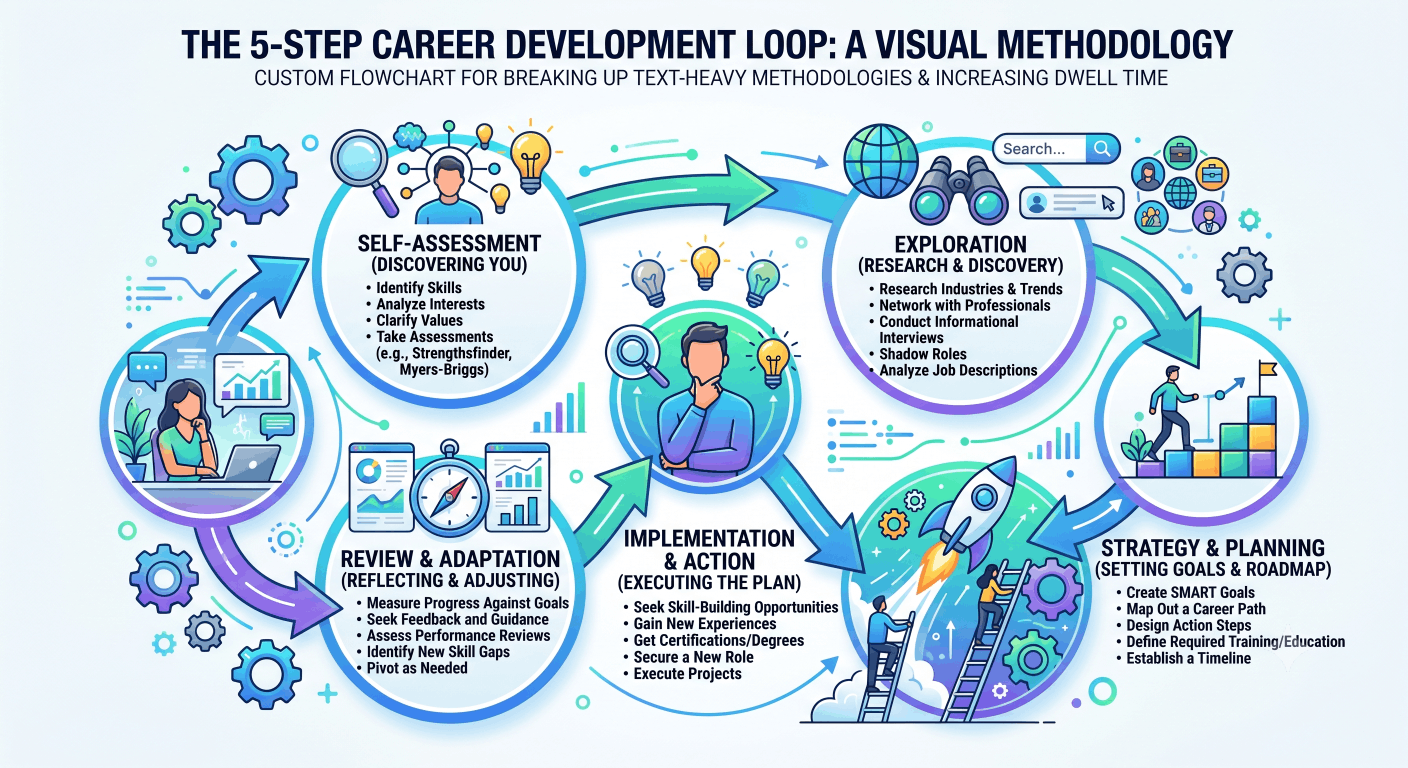
Accountability loops and quantifiable progress metrics must govern the execution of this developmental roadmap. Each developmental phase requires explicit key performance indicators, such as completed certifications, hours of mentorship, or successful pilot projects. This structural discipline ensures that professional growth remains a metrics-driven reality rather than an abstract aspiration.
- Phase I (Months 1–3): Complete specialized technical certifications and establish peer-to-peer feedback loops.
- Phase II (Months 4–6): Initiate lateral cross-functional projects to build adjacent operational skills.
- Phase III (Years 1–3): Cultivate executive sponsorship and target direct operational management responsibilities.
- Phase IV (Years 4–5): Secure high-level leadership positions and contribute to enterprise-wide strategic planning.
High-Impact Career Advancement Strategies
Developing High-Value Leadership Skills Regardless of Title
Leadership skills are not exclusive to those holding managerial titles; they are demonstrated through individual contribution. Individual contributors can cultivate strategic decision-making, emotional intelligence, and conflict resolution within their existing responsibilities. By proactively managing project risks and coordinating peer workflows, professionals demonstrate executive readiness early on.
Volunteering for cross-functional initiatives represents an effective method for showcasing leadership without formal authority. Spearheading enterprise-wide software deployments or driving interdepartmental process improvements builds cross-functional credibility. This internal exposure positions the professional as a proactive problem-solver capable of managing organizational complexity.
Acquiring Crucial Industry Insights to Stay Competitive
Cultivating deep industry insights requires structured, continuous learning beyond standard daily tasks. Professionals must actively review sector-specific regulatory updates, market analysis reports, and technological breakthroughs. This continuous ingestion of market intelligence transforms employees from transactional executioners into strategic advisors.
Utilizing these insights during strategic planning meetings demonstrates high-value business acumen. When a professional connects micro-level projects to macro-level market trends, executive leadership takes notice. This ability to contextualize daily operations within broader market changes defines true subject matter expertise.
Strategic Networking and Sponsorship
Building a sustainable career trajectory requires a clear distinction between casual networking and strategic advocacy. While traditional networking expands peer-level contacts, strategic sponsorship secures advocates who actively champion an individual's advancement behind closed doors. Cultivating these high-level relationships requires a consistent demonstration of high performance and alignment with executive goals.
Mentors offer guidance and tactical advice, whereas sponsors possess the corporate capital to award promotions and high-visibility projects. To attract potential sponsors, professionals must deliver measurable business value and maintain visibility outside their immediate teams. Aligning development goals with the strategic pain points of organizational leaders is the fastest path to sponsorship.
Success Stories in Business: Professional Development Case Studies
Case Study 1: Pivoting Career Paths via Targeted Upskilling
In this scenario, a mid-level legacy systems administrator faced career stagnation due to a declining demand for on-premises infrastructure management. To counter this threat, the professional executed a highly targeted career development plan focused on cloud architecture and automation tools. This strategic pivot required dedicated study, hands-on lab environments, and industry-standard cloud certifications.
This upskilling initiative enabled the professional to transition into a high-growth DevOps engineering role within a major financial services enterprise. The transition resulted in a forty percent increase in compensation and long-term career security. This success story in business demonstrates how proactive capability transformation neutralizes technological displacement risks.
Case Study 2: Fast-Tracking to Leadership Through Executive Mentorship
A senior software engineer struggled to secure a promotion to engineering manager despite possessing excellent technical capabilities. The professional joined a structured internal corporate mentorship program to address non-technical development goals, specifically focusing on conflict resolution and strategic communication. Under the guidance of an operations director, the engineer acquired critical business leadership skills.
The mentor acted as a sponsor, advocating for the engineer's inclusion in high-visibility corporate steering committees. Within eighteen months, the individual contributor was promoted to Director of Engineering, managing a cross-functional team of thirty developers. This case study highlights how targeted executive advocacy can bypass traditional corporate tenure requirements.
Case Study 3: Overcoming Professional Stagnation in a Matrixed Organization
An operations specialist felt overlooked inside a highly matrixed multinational corporation where vertical progression paths were highly congested. Rather than accepting stagnation, the specialist actively engaged in lateral corporate moves across different departments. This intentional strategy broadened their internal operational perspective and built a robust network across separate business units.
By synthesizing operational methodologies from different divisions, the specialist developed a novel workflow optimization framework that reduced regional overhead by fifteen percent. This achievement resulted in the creation of a specialized, high-impact regional lead position tailored specifically to their broad expertise. This professional development case study proves that non-linear career advancement strategies can yield significant upward mobility in complex corporate structures.
How Organizations Can Optimize Career Development for Retention
Implementing Formal Career Pathing and Mentorship Programs
Organizations that establish structured developmental pathways significantly reduce attrition while maximizing workforce output. When employees visualize clear, competency-based progression steps, their commitment to the organization deepens. Providing these internal developmental maps prevents top talent from seeking advancement opportunities with competitors.
HR departments should integrate executive coaching, peer mentoring, and professional progression webinars into their standard employee offerings. These developmental initiatives signal that the enterprise is actively invested in the long-term success of its workforce. The resulting increase in engagement directly enhances overall organizational performance and talent retention.
Leveraging Career Development Questions in Performance Reviews
Transforming annual performance reviews into collaborative development planning sessions requires a fundamental shift in managerial communication. Managers should move away from purely retrospective performance evaluations and focus heavily on forward-looking growth opportunities. Asking targeted, future-oriented questions helps align employee aspirations with organizational operational needs.
These collaborative discussions should produce concrete developmental commitments that are revisited during quarterly check-ins. This continuous feedback loop ensures that employees remain focused on skill acquisition and professional development throughout the operating year. This structured dialogue builds a highly capable, adaptive workforce ready to meet future market challenges.
- "What specific technical or leadership capabilities do you aim to acquire during the upcoming fiscal quarter?"
- "Which lateral roles or departmental rotations would help broaden your understanding of our business operations?"
- "How can the leadership team better align your current project assignments with your long-term career advancement strategies?"
- "What external resources or professional training programs would most effectively accelerate your current skill acquisition?"
Unlocking Sustainable Career Advancement
Career development is the linchpin of professional growth, enabling working professionals to navigate the complexities of modern corporate ecosystems effectively. By adopting a structured approach to career development, individuals can transform passive tenure into active self-direction, aligning daily efforts with strategic milestones that directly influence long-term personal achievement and sustained job satisfaction. The consequences of inaction are severe, including skill obsolescence, flatlined earning potential, and chronic professional stagnation. To avoid this trajectory, professionals must prioritize continuous learning, skill acquisition, and strategic networking. By doing so, they can establish a resilient professional identity that remains marketable irrespective of market volatility. Through iCertGlobal's certification training programs, working professionals can validate their expertise, upskill their teams, and advance their careers, driving internal conversions and cementing domain authority. Validate your expertise and accelerate your career with iCertGlobal's certification training programs today.


.webp)


.webp)





Write a Comment
Your email address will not be published. Required fields are marked (*)