
In 2026, the volume of data generated by the global network of connected sensors and systems is projected to reach a staggering 175 zettabytes. This explosion of information underscores the undeniable reality that modern technology depends entirely on the symbiotic relationship between massive data sets and intelligent hardware.
Big Data is the engine that transforms raw information from IoT devices into actionable intelligence through high-speed processing and advanced analytical modeling. It provides the computational framework necessary to store, manage, and interpret the massive streams of unstructured data produced by billions of connected sensors across various industries.
In this article, you will learn:
- The technical convergence of data ecosystems and smart hardware.
- How architectural layers manage massive information flows.
- Industry-specific use cases of predictive and prescriptive modeling.
- Strategies for scaling infrastructure to meet modern storage demands.
- The role of edge computing in reducing latency for critical systems.
- Future trends in autonomous decision-making and AI integration.
The Symbiotic Relationship Between Data and Connected Systems 🔗
The current industrial era is defined by a deep integration of hardware and software. While billions of units currently monitor everything from soil moisture to cardiac rhythms, the true value resides in the back-end systems that digest this information. Without the capacity to process these massive datasets, the hardware remains a collection of disconnected components.
Big Data refers to massive, unstructured and complicated data sets that are of huge importance to businesses because they cannot be treated with traditional data processing software. These data sets are characterized by their extreme volume, the velocity at which they are created, and the diverse variety of formats they encompass.
The technical marriage of these fields allows organizations to move past simple monitoring. Instead of merely knowing that a machine is operating, leaders can now predict when a component will fail with high precision. This transition from reactive to proactive management is the hallmark of a mature digital strategy.
The Architecture of Information Flow 🏗️
To understand how these systems function at scale, one must look at the structural layers that facilitate the movement of information. It is not a single path but a sophisticated pipeline designed for speed and reliability.
- The perception layer employs sensors to capture physical signals from the environment.
- Local gateways perform initial filtering to remove noise and redundant signals.
- Transmission protocols move the refined packets to centralized or distributed clusters.
- Distributed processing engines like Spark or Flink organize the incoming streams.
- Analytic models apply statistical patterns to identify anomalies or trends.
- The application layer presents these findings through executive dashboards or automated triggers.
This sequential flow ensures that only high-value information reaches the decision-making stage. By filtering data at the source, organizations can significantly reduce the cost of storage while maintaining the integrity of their insights.
Enhancing Operational Intelligence Through Data Collection & Processing 💡
Effective management of a sensor network requires more than just connectivity; it requires a deep understanding of Big Data Fundamentals to ensure the system can scale. As the number of endpoints grows, the complexity of managing the information increases exponentially.
Data Collection & Processing involves the systematic gathering of information from diverse sensors and its subsequent refinement into a structured format suitable for analysis. This procedure includes cleaning, normalization, and the application of algorithms to ensure that the resulting insights are accurate, consistent, and ready for strategic decision-making.
The use of distributed ledgers and decentralized storage is also becoming more common. This approach addresses the security concerns inherent in a massive network of endpoints. When information is distributed rather than centralized, the risk of a single point of failure is mitigated, providing a more stable foundation for enterprise operations.
Expert Insight: Professionals should focus on the "Veracity" of the information. In a network of thousands of sensors, a single malfunctioning unit can skew the results of an entire model. Robust validation checks at the ingestion point are non-negotiable for maintaining high standards.
Real-World Case Study: Predictive Maintenance in Aviation ✈️
A prominent global airline recently overhauled its maintenance protocol by integrating a high-density sensor network across its fleet. Previously, engine components were replaced based on fixed schedules or visible wear. This method often led to unnecessary downtime or, in rare cases, unexpected failures.
By implementing a system that monitors heat, vibration, and pressure in real-time, the airline began collecting terabytes of information every hour. Using advanced modeling, they identified subtle vibration patterns that preceded mechanical issues by over 100 hours of flight time.
The result was a 25% reduction in unscheduled maintenance and a significant improvement in fuel efficiency. This example highlights how the marriage of hardware and information processing moves beyond theory into tangible financial gains.
The Shift Toward Edge Computing ⚡
One of the most significant changes in the current tech climate is the movement of processing power closer to the source. While cloud clusters provide massive storage, the latency involved in sending information back and forth can be a bottleneck for time-sensitive applications.
Edge computing allows for immediate analysis. In an autonomous vehicle, for instance, a delay of even a few milliseconds can have dire consequences. By processing the most critical information locally, the system can react instantly while sending less urgent diagnostic data to the cloud for long-term storage.
This hybrid approach optimizes bandwidth and ensures that the system remains responsive under all conditions. It is a critical component for any professional looking to build a resilient and scalable network.
Internet of Things in Smart City Development 🌆
Metropolitan areas are increasingly turning to these technologies to manage urban growth. From traffic management to waste disposal, the applications are vast. In a smart city, the goal is to improve the quality of life for residents while reducing the environmental footprint.
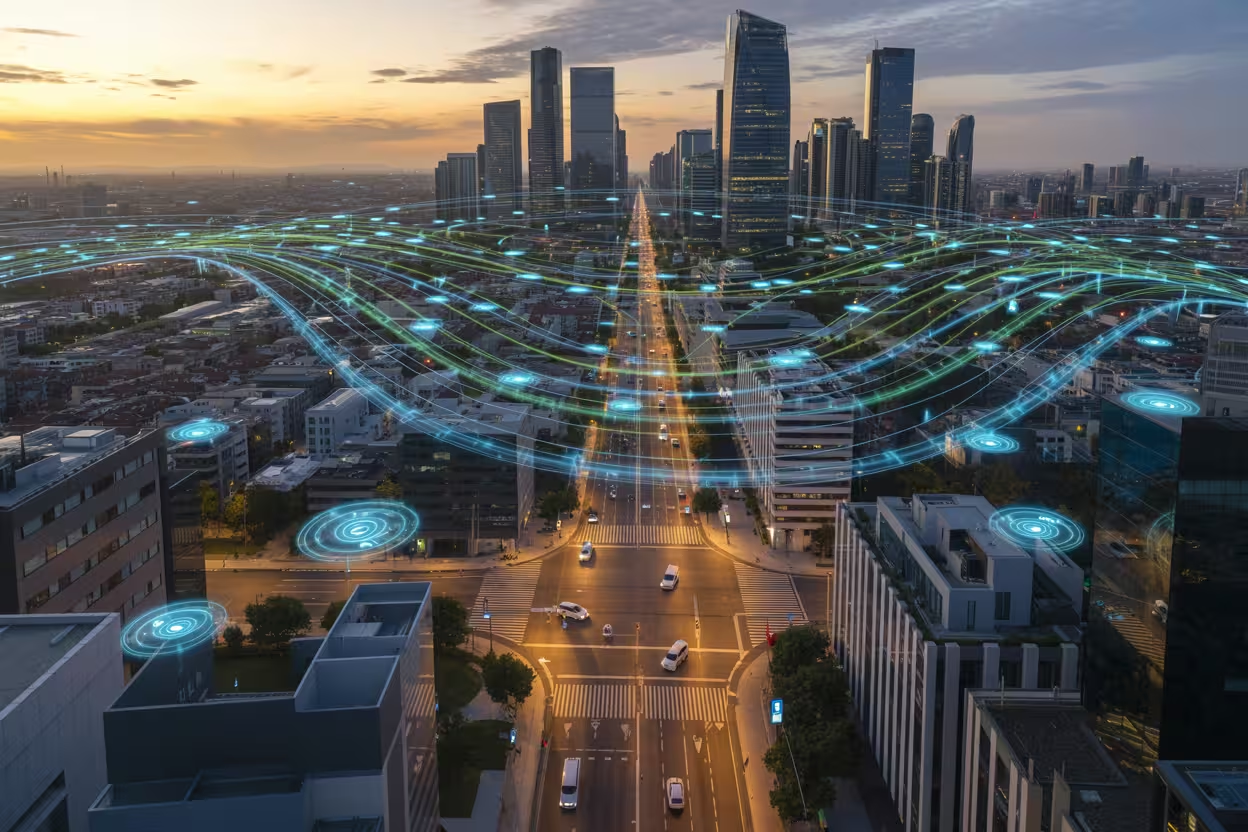
A practical use case is found in smart water management systems. Sensors placed throughout the city's pipe network can detect leaks by analyzing pressure drops that are too small for human detection. When this information is processed alongside historical consumption patterns, the city can pinpoint the exact location of a leak, saving millions of gallons of water annually.
Furthermore, intelligent street lighting systems use motion sensors to adjust brightness based on pedestrian and vehicle traffic. This does not just save energy; it also provides valuable information on how citizens move through the city, informing future urban planning decisions.
Strategic Framework for Implementation 📝
For leaders looking to integrate these technologies, a structured approach is necessary. Success is rarely about the hardware itself but about the strategy behind the information it produces.
- Define the specific business problem that requires real-time information.
- Select sensors that provide the necessary precision for the identified goal.
- Establish a secure transmission protocol that protects sensitive information.
- Build a scalable storage solution that can grow with the network.
- Develop or deploy analytical models that translate raw signals into clear actions.
- Create a feedback loop where the system's actions are monitored and refined.
By following this sequence, organizations can avoid the common pitfall of collecting information for its own sake without a clear path to value.
Overcoming the Challenges of Heterogeneous Data 🔄
One of the primary hurdles in this field is the variety of formats. Sensors from different manufacturers often use proprietary protocols, making it difficult to create a unified view. Professionals must invest in middleware solutions that can translate these various signals into a common language.
Data normalization is a critical step in this process. Without it, the analytical engine will struggle to compare information from different sources. For example, temperature readings in different units or time stamps from different time zones must be standardized before they can be used in a global model.
The ability to handle this variety is what separates a basic monitoring system from a world-class analytics platform. It requires a deep understanding of both hardware limitations and software capabilities.
Conclusion 🏁
By leveraging the core characteristics of Big Data, IoT platforms can efficiently manage and analyze the enormous flow of data generated by connected devices across industries.The convergence of Big Data and the Internet of Things is more than a trend; it is the foundation of the modern industrial world. By turning every physical object into a source of information, we are gaining an unprecedented level of visibility into our systems and environments.
The challenge for professionals is no longer how to collect information, but how to use it. As we move further into 2026, the focus will shift toward autonomous systems that can not only predict issues but also take corrective action without human intervention. Staying ahead of this curve requires a commitment to understanding the deep technical structures that power these connections.
The top 7 Big Data applications you encounter daily—from smart devices to online services—highlight how staying adaptable and continuously upskilling can keep you ahead in a data-driven world.For any upskilling or training programs designed to help you either grow or transition your career, it's crucial to seek certifications from platforms that offer credible certificates, provide expert-led training, and have flexible learning patterns tailored to your needs. You could explore job market demanding programs with iCertGlobal; here are a few programs that might interest you:







Write a Comment
Your email address will not be published. Required fields are marked (*)