Hybrid Project Management: The Enterprise Blueprint for PMO Leaders and IT Directors

Enterprise PMO leaders and IT directors face an increasingly polarized operational mandate: deliver massive, high-risk infrastructure changes with absolute predictability while simultaneously enabling software engineering teams to iterate rapidly. Forcing complex capital projects into rigid sequential lifecycles or unstructured agile sprints creates systemic misalignment across the entire portfolio. Continuing down a dogmatic, single-framework path leads directly to cost overruns, missed regulatory deadlines, and friction between executive governance and development teams. To survive this friction, modern organizations are shifting toward Hybrid Project Management as a highly structured, scalable operational standard. This comprehensive guide serves as the definitive enterprise blueprint to build, customize, and govern this dual-delivery framework. We examine the exact mechanics of blending Waterfall and Agile lifecycle phases, establishing robust cross-functional KPIs, and aligning CapEx and OpEx financial reporting with agile team execution to ensure predictable portfolio health.
The Evolution of Modern Project Delivery
The Limits of Pure Waterfall Project Management in Dynamic Markets
The classic predictive framework operates on the premise that requirements remain static from initiation to deployment. In fast-moving industries, this rigid structure prevents teams from adjusting to sudden competitor movements or shifts in customer requirements. Consequently, organizations risk delivering a product that conforms to initial specifications but fails to meet current market demands.
Furthermore, the sequential nature of this model pushes integration and user acceptance testing to the final stages of the project lifecycle. This delayed validation frequently uncovers architectural flaws or scope gaps when corrective action is most expensive. The resulting budget overruns and schedule slippages undermine the predictability that predictive delivery promises.
The Scalability and Governance Challenges of Pure Agile Methodology
While adaptive frameworks excel at the team level, they often struggle when applied to enterprise-wide portfolios. Decentralized prioritization can lead to fragmented delivery, where individual teams optimize local backlogs at the expense of strategic corporate objectives. Without structured milestones, PMO leaders struggle to coordinate dependencies across multiple business units.
Financial compliance also poses a substantial obstacle when relying solely on decentralized, iterative processes. Traditional capital capitalization procedures require clear upfront definitions of asset scope to categorize expenditures correctly. Purely adaptive teams, with their fluctuating scopes and continuous change cycles, frequently create friction during capital expenditure audits.
Why a Hybrid Project Management Framework is Essential for Enterprise Demands
A hybrid project management framework is essential for enterprise demands because it provides structural governance for budgeting and architecture while allowing execution teams to iterate rapidly. This dual-track approach mitigates risk, satisfies regulatory compliance, and ensures business agility within predictable timelines.
This synthesis serves as a translator between executive stakeholders and operational delivery teams. Executive leadership retains the long-term predictability required for strategic planning, resource forecasting, and compliance. Meanwhile, development teams retain the autonomy to adapt, innovate, and deliver incremental value through iterative cycles.
Deconstructing the Hybrid Project Management Framework
The Agile Waterfall Hybrid Approach: Structuring the Blend of Predictability and Agility
The Agile Waterfall Hybrid Approach operates by separating the project lifecycle into strategic steering phases and tactical execution loops. High-level initiation, system architecture design, and final integration follow structured milestone gates to ensure quality and compliance. Conversely, the intermediate creation of software, systems, or assets is executed in iterative cycles to maximize delivery speed.
This dual-mode execution ensures that high-risk dependencies are mitigated before significant capital is committed. By establishing clear phase-gate reviews, the enterprise PMO can verify that iterative development remains aligned with the overarching strategic roadmap. The resulting structure delivers the rigorous oversight of predictive planning alongside the rapid feedback loops of adaptive execution.
Incorporating Lean Project Management to Eliminate Waste in Resource Allocation
Integrating Lean Project Management within this architecture directly addresses resource utilization in complex enterprise portfolios. The primary objective is to identify and eliminate non-value-added activities, such as excessive documentation, administrative delays, and overprocessing. By optimizing the flow of information and resources, organizations maximize the value delivered per unit of cost.
To operationalize these efficiencies, PMO leaders apply specific core principles across the hybrid lifecycle:
- Establish continuous feedback channels to minimize rework and idle times between phase transitions.
- Limit work-in-progress across cross-functional teams to reduce context-switching overhead and cognitive fatigue.
- Standardize governance reports to eliminate administrative duplication between development leads and executive sponsors.
Utilizing Kanban Methodology for Real-Time Task Execution and Flow
Execution teams utilize Kanban Methodology to visualize operational workflows and manage task dispatching. By mapping work items on physical or digital boards, teams maintain total transparency over active development pipelines. This visualization immediately highlights bottlenecks, allowing resource managers to reallocate capacity before schedules slip.
Furthermore, this model introduces quantitative control metrics like cycle time and throughput to track delivery health. These operational data points allow PMO planners to refine their high-level Waterfall milestone projections based on historical execution capacity rather than subjective estimates. Consequently, long-term planning becomes highly empirical and significantly more reliable.
Hybrid Lifecycle Matrix
The following matrix demonstrates exactly how predictive and adaptive practices merge within a unified hybrid framework across key project lifecycle phases:
| Project Phase | Waterfall Element | Agile Element | Hybrid Synthesis Outcome |
|---|---|---|---|
| 1. Initiation & Planning | Fixed budget baseline, scope definition, regulatory mapping | High-level backlog creation, theme identification | Approved budget and architectural constraints paired with prioritized backlog |
| 2. Execution | Stage-gate monitoring, scheduled dependency management | Two-week sprint iterations, daily standups, retrospective | Iterative software releases tested continuously within fixed infrastructure phases |
| 3. Closing & Release | End-to-end user acceptance testing, formal sign-off | Retrospectives, release burn-down evaluation | Regulatory-compliant production deploy coupled with retrospective optimization |
How to Customize and Implement a Hybrid Project Management Methodology
Phase 1: High-Level Requirements, Budgeting, and Architecture (The Waterfall Foundation)
Implementing a customized hybrid framework requires establishing a predictive foundation during the project initiation phase. Teams define the overarching business case, compliance mandates, and absolute budgetary boundaries using traditional structural practices. This ensures that the strategic scope is locked, preventing uncontrolled scope creep during subsequent development cycles.
During this initial phase, the architectural runway must be designed and verified to support modular execution. Infrastructure requirements, database schemas, and integration APIs are mapped out to prevent downstream developmental dependencies. The deliverables of this phase constitute the hard boundary within which iterative development operates:
- Comprehensive system requirements document and regulatory compliance map.
- Total cost of ownership baseline and capitalized budget approval.
- Architectural design document detailing core system integrations.
Phase 2: Iterative Development, Testing, and Continuous Delivery (The Agile Execution)
Once the baseline is secured, the execution phase transitions to an iterative delivery model. The high-level scope is decomposed into a product backlog, which is prioritized based on business value and architectural dependencies. Development teams then execute these requirements in fixed-duration sprints, typically lasting two to four weeks.
Continuous integration and automated testing pipelines are deployed to maintain software quality throughout each cycle. By testing incremental builds continuously, teams discover defects early when remediation costs are minimal. This continuous feedback loop ensures that the product remains functional, reducing integration risks in the final phase.
Phase 3: Integration, Compliance, and Release Management
The final phase of the framework returns to a predictive structure to manage deployment risks. Individual increments developed during the sprint cycles are integrated into a single release candidate for end-to-end testing. This phase focuses on verification, ensuring the system conforms to regulatory requirements and enterprise security policies.
Operational readiness reviews and user training programs are conducted sequentially to prepare the business for deployment. This structured approach prevents premature releases that could disrupt core operations or violate security compliance. The transition back to sequential governance provides the absolute assurance required for enterprise deployment.
Key Performance Indicators (KPIs) for Tracking Hybrid Project Health
Monitoring a hybrid project requires metrics that bridge predictive milestone progress with adaptive velocity. Standard tracking tools must combine Earned Value Management (EVM) for budget and overall schedule health with agile delivery metrics. This dual-lens reporting provides a holistic view of project performance to both executive boards and technical teams.
The following table details the core metrics that PMO leaders should monitor to maintain balanced governance:
| KPI Metric | Measurement Focus | Reporting Cycle | Strategic Value |
|---|---|---|---|
| Schedule Variance (SV) | Deviation from the baseline Waterfall critical path | Monthly | Identifies long-term trajectory risks early |
| Sprint Velocity Trend | Consistency of story points delivered per iteration | Bi-weekly | Forecasts feature delivery timelines for upcoming sprints |
| Defect Leakage Rate | Percentage of bugs found after sprint completion | Per release phase | Monitors the effectiveness of continuous integration testing |
| CapEx Allocation Ratio | Ratio of capitalized software development costs to operational expenses | Quarterly | Ensures alignment with portfolio financial depreciation goals |
Scaling Agile in Large Enterprises via Hybrid PMO Governance
Navigating the Shift: Blending Supportive, Controlling, and Directive PMO Functions
Managing governance while scaling Agile in large enterprises requires a PMO that adapts its functional stance based on project context. The PMO acts supportively by providing development teams with agile coaching and standardized delivery tooling. Concurrently, it maintains controlling and directive functions to ensure overall compliance and alignment with enterprise strategy.
This balanced stance protects developer autonomy while preserving strict fiscal and legal oversight. By serving as a governance translator, the PMO allows decentralized development units to operate without losing connection to corporate mandates. This ensures organizational alignment across all levels of the enterprise.
Financial Alignment: Managing CapEx and OpEx in a Scaling Agile Environment
Financial operations in a scaling Agile environment require careful accounting of capital expenditures (CapEx) and operational expenses (OpEx). Under traditional frameworks, capitalization is straightforward due to fixed delivery gates. When software is built iteratively, financial teams must establish clear guidelines to capitalize development hours while expensing maintenance activities.
To resolve this, PMO leaders map sprint activities directly to specific asset categories. Time spent on architecture, feature coding, and testing is capitalized as asset development. Conversely, research, backlog refinement, and post-release support are classified as operational expenses, maintaining strict regulatory compliance during audits.
Tooling and Infrastructure: Unifying Jira, Azure DevOps, and Enterprise Portfolio Management Tools
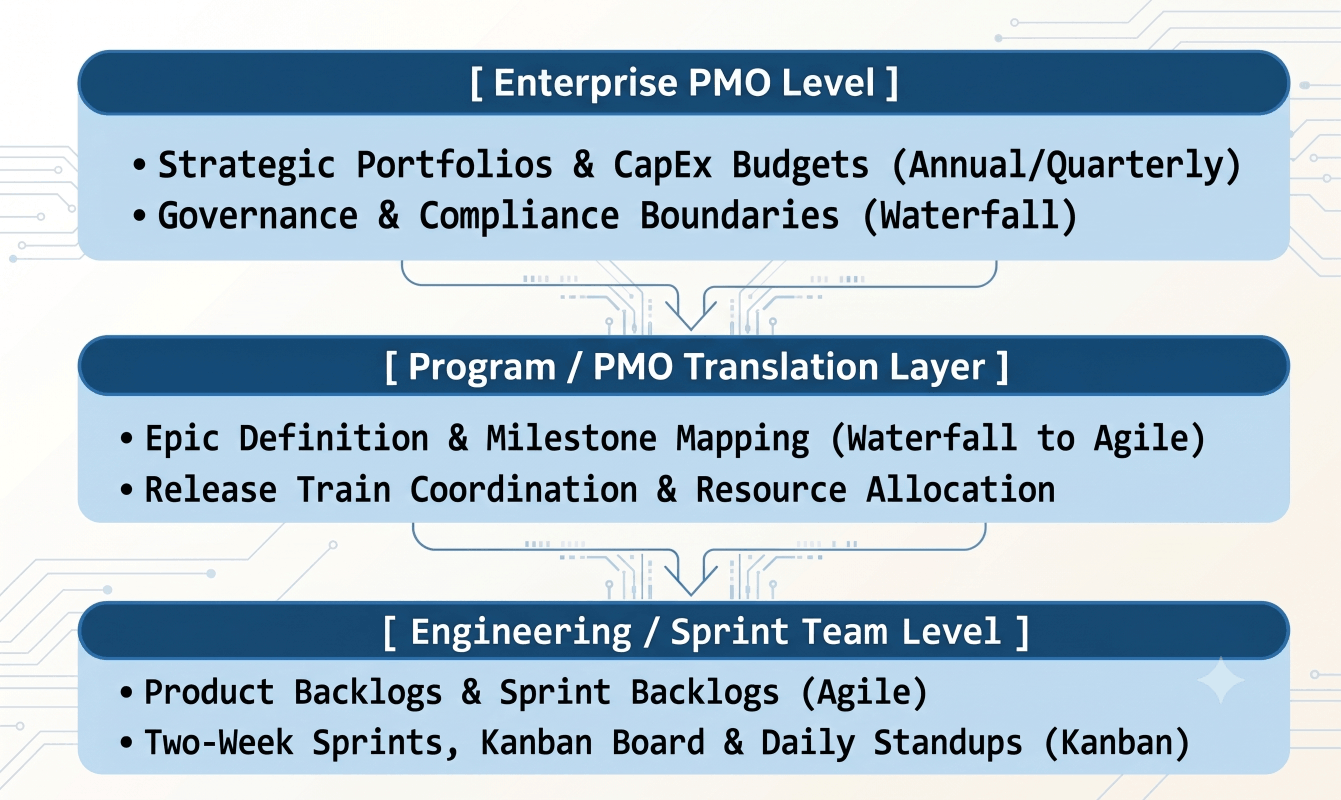
Unifying the enterprise tooling stack is essential for maintaining accurate, real-time portfolio visibility. Development teams typically utilize operational tools such as Jira or Azure DevOps to manage their daily work items. Strategic decision-makers, however, require high-level progress tracking within enterprise portfolio management platforms like ServiceNow or Clarity PPM.
Establishing automated synchronization between these platforms ensures data integrity without manual overhead. By mapping developer tasks and story points directly to strategic milestones, PMO leaders maintain a single source of truth. This integration eliminates administrative status reporting and provides executive boards with real-time operational metrics.
Governance Flow Diagram
Enterprise Case Studies: Hybrid Project Management in Action
Case Study 1: Large-Scale ERP Deployment (Legacy Infrastructure meets Modern Software Sprints)
A multinational manufacturing corporation undertook a major upgrade of its core ERP platform. The legacy database infrastructure, physical server provisioning, and supplier contracts required strict predictive management due to high capital costs. In contrast, the custom user-facing analytics dashboard was developed using two-week agile sprints to ensure rapid feedback.
This hybrid structure allowed the database migration to meet strict security protocols without delaying user-facing feature delivery. The project concluded within the baseline budget, and user adoption rates increased by 40% due to the iterative design process. This demonstrates how legacy environments benefit from combined delivery approaches.
Case Study 2: Regulatory Compliance in FinTech (Strict Governance meets Rapid Feature Iteration)
A rapid-growth financial technology firm launched a consumer lending application under strict federal regulations. Compliance structures, risk assessment frameworks, and audit logs were planned and executed using sequential milestones to ensure zero legal liability. Concurrently, the consumer mobile interface was designed and updated continuously through iterative development cycles.
The integration phase successfully verified all regulatory requirements before the official release, preventing potential compliance penalties. The firm launched the application three months ahead of schedule, capturing critical market share while maintaining compliance. This case highlights how rapid innovation can safely coexist with rigorous regulatory control.
Harnessing the Power of Hybrid Project Management for Enterprise Success
Hybrid Project Management offers a structured approach to blending the predictability of Waterfall with the agility of adaptive frameworks, optimizing control, speed, and quality. By adopting a hybrid framework, organizations can mitigate risk, satisfy regulatory compliance, and ensure business agility within predictable timelines. As a trusted authority in professional certification, iCertGlobal empowers project managers, PMO leaders, and IT directors to validate their expertise and advance their careers through comprehensive certification training programs. To unlock the full potential of Hybrid Project Management and drive enterprise success, enroll in iCertGlobal's Hybrid Project Management certification program today and discover a new standard of project delivery excellence.


.webp)
.webp)





Write a Comment
Your email address will not be published. Required fields are marked (*)