Industry Research Methodology: A Data-Driven Guide for Modern Researchers

Modern industry research has transitioned from subjective, qualitative assessments to rigorous, quantitative data pipelines. Relying on legacy heuristics to predict market direction or structural shifts introduces unacceptable risk to corporate strategy and capital allocation. When organizations base high-stakes decisions on lagging indicators, they face catastrophic project overruns, miscalculated market sizing, and critical blind spots regarding competitor positioning. To mitigate these operational vulnerabilities, modern analysts require a standardized, empirical approach to sectoral evaluation. This guide provides an actionable, data-driven methodology for executing high-fidelity sector analysis. We establish a robust operational framework utilizing FAIR data principles, quantitative predictive modeling—such as CAGR and time-series forecasting—and systematic competitor mapping. Furthermore, we examine domain-specific applications within construction and IT project management to demonstrate how empirical intelligence mitigates risk. By bridging academic scientific rigor with corporate execution, researchers and project leaders can transform raw, disparate datasets into highly accurate forecasting models and strategic commercial intelligence.
The Evolution of Industry Research: Transitioning to Data-Driven Methodologies
Modern commercial intelligence has evolved past qualitative evaluations and legacy heuristics. Organizations increasingly rely on empirical, quantitative pipelines to evaluate sector health and predict market vectors. This transition ensures that capital allocation decisions rest on verifiable, auditable datasets rather than subjective market sentiment.
Why Intuition Fails: The Rise of Data-Driven Decision-Making (DDDM)
Intuition fails in industry research because subjective assessments lack empirical validation, leading to cognitive biases and inaccurate forecasting. Transitioning to Data-Driven Decision-Making (DDDM) leverages automated pipelines, big data analytics, and statistical modeling to provide objective, repeatable insights that significantly mitigate operational risks.
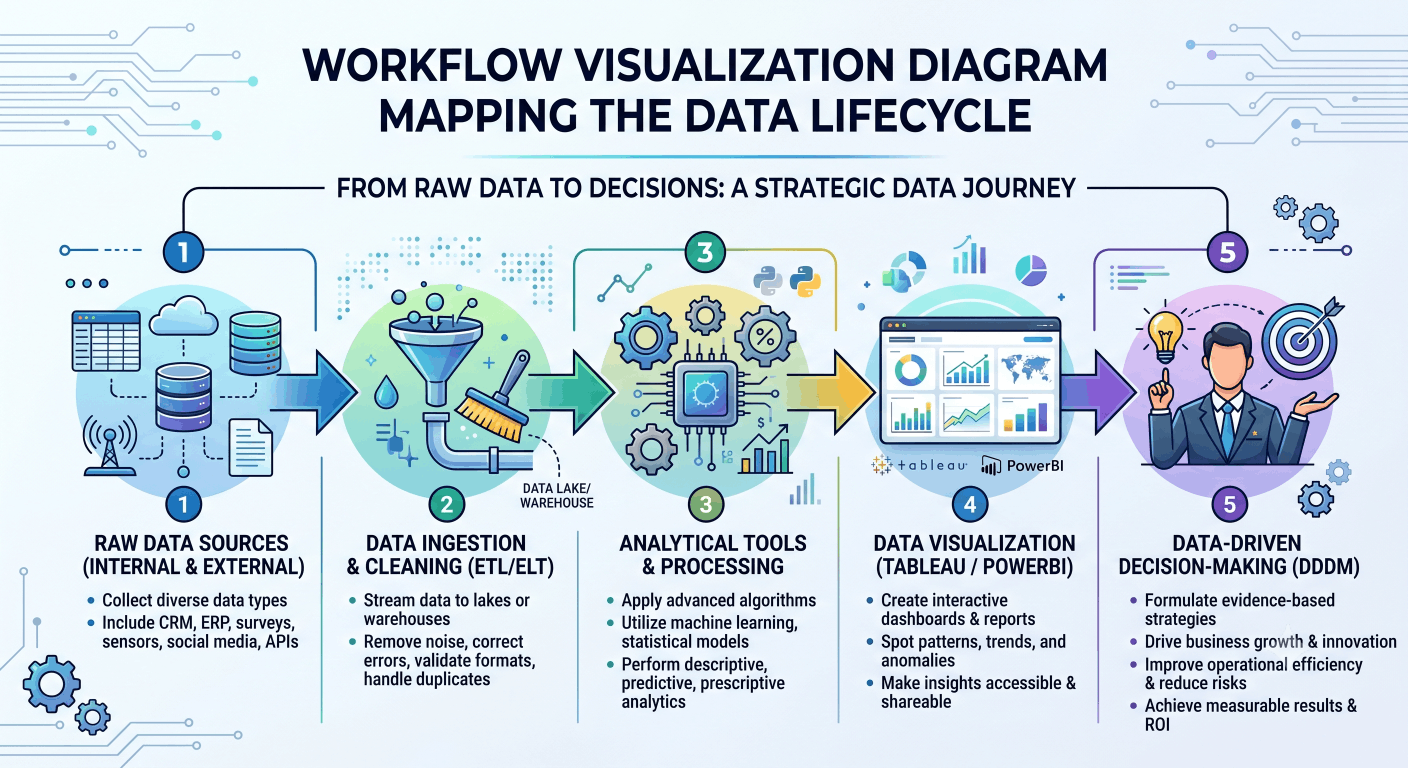
Historically, executive leadership relied on retrospective observations and subjective business projections. Modern data science methodologies bypass these limitations by processing real-time telemetry, structured enterprise resource planning (ERP) data, and external market indicators. Automated web scrapers and specialized API integrations feed centralized data warehouses, transforming unstructured public filings into normalized datasets. Consequently, decision-makers can identify market opportunities with statistical significance rather than relying on qualitative assumptions.
Bridging Academic Rigor and Actionable Market Research
Enterprise researchers must synthesize academic validation frameworks with the rapid operational demands of the corporate sector. Applying scientific reproducibility and peer-review protocols to market studies minimizes the risk of confirmation bias. To ensure data integrity, modern corporate intelligence units adopt standardized architectures that align with global research criteria.
Implementing the FAIR data framework within proprietary research networks ensures long-term utility across business units:
- Findable: Assign persistent identifiers and rich metadata to all primary research assets.
- Accessible: Store compiled market intelligence in centralized, secure repositories with clear access protocols.
- Interoperable: Utilize standardized schemas and vocabularies so external APIs can exchange information without friction.
- Reusable: Maintain detailed documentation regarding data origin, cleaning procedures, and modeling assumptions.
Core Pillars of Modern Industry Analysis
Deconstructing sector evaluations requires clear boundaries between distinct research disciplines. Effective corporate planning isolates customer-specific feedback from structural, macro-level constraints and specific competitor capabilities.
| Analytical Pillar | Operational Focus | Primary Data Sources | Strategic Value |
|---|---|---|---|
| Market Research | Consumer behavior, demand elasticity, and target demographics | Surveys, transactional databases, and focus groups | Optimizes product-market fit and local positioning |
| Industry Analysis | Macroeconomic forces, supply chains, and regulatory shifts | Government databases, trade associations, and econometric indexes | Identifies long-term structural threats and expansion risks |
| Competitor Analysis | Peer performance, pricing strategies, and capability deficits | Financial filings, patent registries, and marketing telemetry | Uncovers market share gaps and defensive strategies |
Comprehensive Market Research: Defining Boundaries and Demographics
Defining target market boundaries requires isolating specific consumer demographics and purchasing behaviors. Researchers monitor transactional databases to map elastic demand patterns across varying economic cycles. Primary data collection leverages randomized sampling and automated consumer feedback loops to capture raw sentiment.
Macro-Level Industry Analysis: Structural and Economic Indicators
Macro-level assessments identify structural forces that govern overall sector profitability and resilience. Researchers systematize these external factors by applying quantitative weightings to traditional qualitative frameworks.
- PESTLE Quantification: Assigning vulnerability scores to political, economic, social, technological, legal, and environmental metrics.
- Porter’s Five Forces Scoring: Utilizing supplier concentration ratios, barrier-to-entry cost indexes, and substitute price-performance ratios to calculate competitive intensity.
- Economic Exposure Modeling: Simulating the impact of tax policy shifts or trade tariffs on domestic production costs.
Micro-Level Competitor Analysis: Identifying Market Position and Capability Gaps
Strategic positioning requires continuous tracking of competitor capacities, financial health, and product developments. Modern analysts deploy automated web-scraping scripts to monitor changes in competitor pricing matrices and job boards, structuring the compiled intelligence into dynamic databases to identify capability gaps.
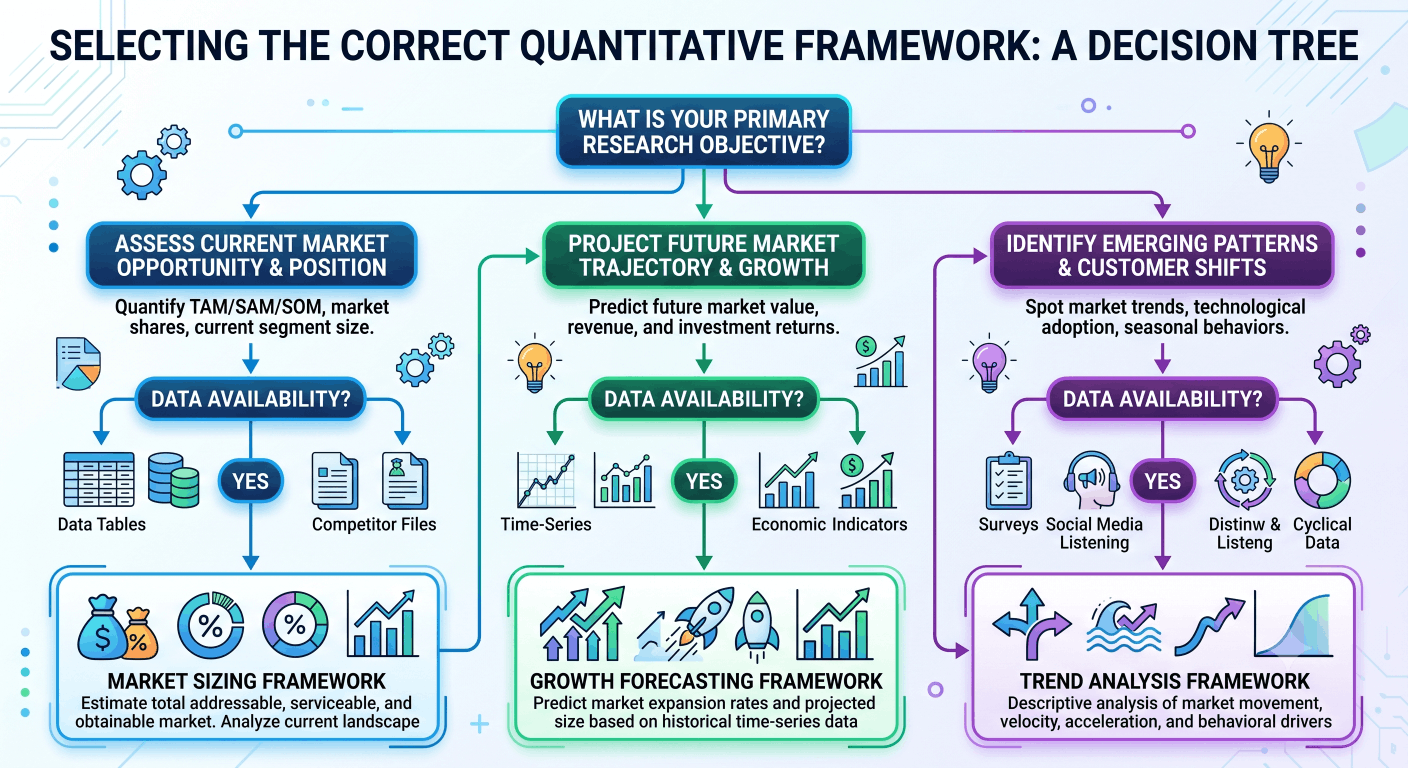
Quantitative Frameworks: Market Sizing, Growth Forecasting, and Trend Analysis
Rigorous predictive modeling transforms historical data points into actionable future projections.
Market Sizing: Bottom-Up vs. Top-Down Estimation Techniques
Market Sizing estimates the financial potential of an industry using top-down or bottom-up calculations. Researchers define three key layers: Total Addressable Market (TAM), Serviceable Addressable Market (SAM), and Serviceable Obtainable Market (SOM) to calculate potential with precision.
Growth Forecasting: Predictive Modeling and Statistical Extrapolation
Researchers utilize Compound Annual Growth Rate (CAGR) calculations to establish baseline trajectories and advanced time-series forecasting (ARIMA) to account for seasonal variations. Specialized adjustments such as Scenario Testing and Monte Carlo simulations allow for stress-testing growth projections against market volatility.
Trend Analysis: Spotting Disruptive Shifts Before They Occur
Trend analysis distinguishes long-term structural changes from short-term market fads by tracking patent filings, venture capital allocation, and search query velocity.
Domain-Specific Applications: Case Studies in Project Management
Construction Industry Research: Mitigating Risk and Project Overruns
Project management offices integrate regional producer price indexes (PPI) and global logistics bottleneck data to forecast material escalations and labor shortages.
| Project Metric | Legacy Reactive Planning | Empirical Data-Driven Planning |
|---|---|---|
| Material Procurement | Spot market rates | Futures contracts based on trend analysis |
| Risk Management | Generic contingency % | Monte Carlo simulations |
IT Project Management Research: Navigating Agile Scaling
IT leaders track engineering telemetry—such as change failure rates, deployment frequency, and mean time to recovery (MTTR)—to optimize technical workflows and scale agile frameworks with high statistical accuracy.
Building a Data-Driven Decision-Making Framework
Establishing a repeatable operational pipeline requires enforcing FAIR data principles and utilizing advanced analytics tools like Python (Pandas/NumPy) and R for reproducible statistical modeling.
Harnessing the Power of Data-Driven Industry Research
By embracing a data-driven approach to industry research, researchers can unlock new levels of strategic insight and competitive advantage. The ability to analyze complex market trends, identify emerging opportunities, and predict potential risks is crucial in today's fast-paced business environment. Through the application of quantitative frameworks, such as market sizing, growth forecasting, and trend analysis, organizations can make informed decisions that drive growth and profitability.
By leveraging industry research methodologies and staying up-to-date with the latest trends and best practices, professionals can validate their expertise and advance their careers. To stay ahead of the curve, consider enrolling in iCertGlobal's certification training programs, designed to equip researchers with the skills and knowledge needed to excel in the field of industry research.


.webp)


.webp)





Write a Comment
Your email address will not be published. Required fields are marked (*)