PMP Certification Maintenance Guide: How to Renew Your PMP and Earn 60 PDUs

Earning your Project Management Professional (PMP) credential is a career-defining achievement, but safeguarding that status requires strategic long-term planning. Managing your ongoing PMP Certification Maintenance represents a continuous commitment to professional relevance rather than a one-time exam milestone. Allowing this credential to lapse triggers an immediate transition into suspended status, eroding professional credibility and forcing practitioners to face the exhaustive, costly process of retaking the entire exam. Relying on last-minute, unaligned coursework to salvage status often leads to rejected submissions and wasted financial investments. This comprehensive guide provides an actionable roadmap to fulfill the 3-year Continuing Certification Requirements (CCR) cycle efficiently. We break down the exact parameters of the 60 Professional Development Unit (PDU) requirement—including the specific balance of the PMI Talent Triangle®—and deliver step-by-step instructions to log hours, manage potential audits, and maintain active standing with confidence.
Introduction to PMP Certification Maintenance
Why Ongoing Professional Development is Critical for Project Management Professionals
Ongoing professional development is critical for project management professionals because it ensures their skills align with evolving industry standards, protects organizational investments, and validates their expertise. Active credential maintenance preserves professional credibility, prevents suspension, and elevates long-term earning potential in competitive markets.
Active Certification Maintenance serves as verifiable proof that a practitioner remains aligned with modern project execution standards. Organizations rely on these validated skills to mitigate risks, manage budgets, and steer complex enterprise-wide transformations. Keeping the credential active signals dedication to continuous improvement and commands higher compensation.
Allowing the PMP credential to expire triggers an immediate transition into a one-year suspended status. During suspension, practitioners cannot use the PMP designation, which can damage professional credibility. Restoring a lapsed credential requires retaking the entire exam, incurring substantial registration fees, prep time, and administrative overhead.
Understanding the 3-Year Continuing Certification Requirements (CCR) Cycle
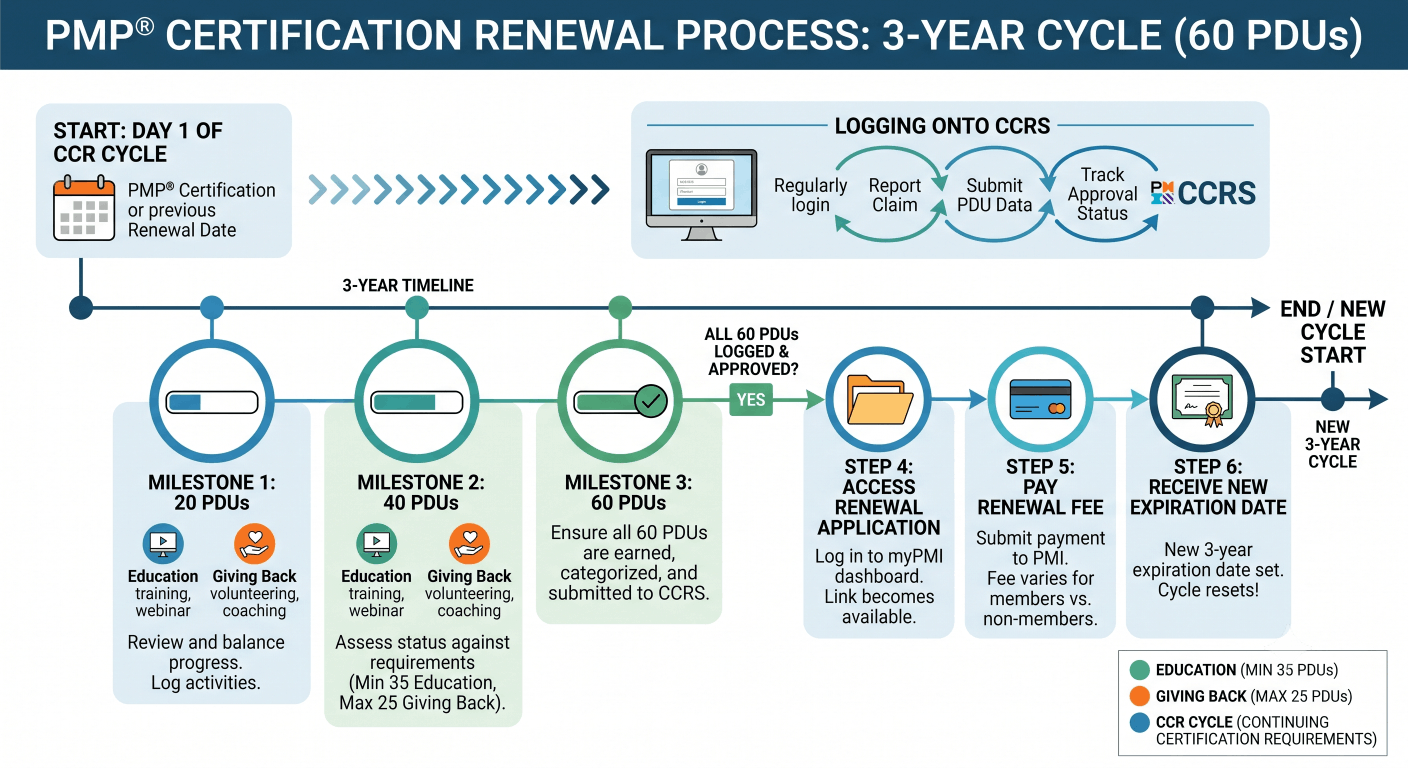
The 3-year Continuing Certification Requirements (CCR) cycle is a structured renewal timeline that begins immediately upon passing the PMP exam. Project management professionals must accumulate and report 60 Professional Development Units (PDUs) within this three-year window to successfully maintain their active credential status.
The renewal cycle runs on a strict three-year timeline, anchoring to the exact date the candidate passed the PMP exam. This milestone date resets automatically for another three years upon the completion of all renewal criteria. Practitioners can track their specific cycle expiration directly through the online dashboard.
Accumulating 60 PDUs over three years is the core mandate for How to Maintain PMP Certification. One PDU corresponds to one hour of structured learning, volunteer work, or industry contribution. This requirement ensures that practitioners do not stagnate but continually refine their professional methodologies.
PMP Certification Renewal Requirements: Earning the 60 PDUs
Decoding the PMI Talent Triangle®
The PMI Talent Triangle is a professional development framework that aligns project management skills with modern organizational needs. It categorizes learning into three core technical and leadership domains: Ways of Working, Power Skills, and Business Acumen, ensuring a well-rounded approach to certification maintenance.
The redesigned framework addresses the multidimensional demands of enterprise leadership. This structure balances technical execution with human-centric and strategic leadership capabilities.
| Pillar | Core Focus | Practical Enterprise Example |
|---|---|---|
| Ways of Working | Mastering diverse project execution frameworks and technical methodologies. | Implementing Agile, Hybrid, or Predictive models for IT infrastructure upgrades. |
| Power Skills | Developing interpersonal influence, collaborative communication, and leadership capabilities. | Facilitating cross-functional conflict resolution during resource allocation shortages. |
| Business Acumen | Aligning operational workflows with macro-level strategic goals and business models. | Conducting a regulatory compliance analysis for a software deployment lifecycle. |
Category 1: Education Requirements (Minimum 35 PDUs Required)
PMP Certification Renewal Requirements dictate that a minimum of 35 PDUs must come from educational activities. These education credits must align with the PMI Talent Triangle, requiring at least eight PDUs in each of the three foundational development areas to secure approval.
The 35-PDU education requirement enforces balanced professional development. Practitioners must acquire a minimum of eight PDUs in Ways of Working, eight in Power Skills, and eight in Business Acumen. The remaining eleven educational units are elective, allowing professionals to customize their study focus.
Education PDUs can be gathered through diverse, structured channels:
- Formal PMP Continuing Education Courses: Structured classes provided by authorized educators.
- Online or Digital Media: On-demand webinars, educational podcasts, and video presentations.
- Academic Education: Completing university courses focused on strategic or technical project management.
.png)
Category 2: Giving Back to the Profession (Maximum 25 PDUs Allowed)
Category 2 focuses on Giving Back to the Profession, permitting practitioners to earn a maximum of 25 PDUs toward their renewal. These optional units are accumulated through active project management practice, volunteer leadership, mentoring, and creating original educational content for the community.
While sharing knowledge is highly encouraged, PMI caps these contributions at 25 PDUs to maintain an education-first approach. Practitioners cannot use excess giving-back hours to bypass the mandatory education minimums. This cap ensures the credential remains anchored in continuous active learning.
Working in a full-time project management role yields a maximum of eight PDUs per cycle. This recognition acknowledges that daily, hands-on enterprise leadership refines execution capabilities. These hours must be logged accurately under the practitioner subcategory.
Contribution Channels:
- Creating Content: Writing whitepapers, presenting technical webinars, or building operational templates.
- Volunteering: Assisting local chapters or participating in global standard-setting committees.
- Mentoring: Coaching junior team members or training peers on agile transition frameworks.
Step-by-Step Guide: How to Maintain PMP Certification
Step 1: Earn and Track Your PDU Activities
To maintain PMP certification, practitioners must systematically earn and track educational and professional development units throughout their cycle. Logging these hours incrementally prevents year-three bottlenecks, ensures high-quality data retention, and simplifies verification through the official online system.
Attempting to accumulate 60 PDUs in the final weeks of a cycle causes unnecessary administrative stress and risks non-compliance. A superior approach involves tracking activities quarterly, ensuring a steady accumulation of units. Maintaining a digital log sheet with course titles, dates, and provider names simplifies the eventual reporting process.
The Continuing Certification Requirements System (CCRS) is PMI’s official online management portal. To log an activity, log in, navigate to the dashboard, and select "Report Claim." Enter the training provider code or manually enter course descriptions, aligning each activity with the corresponding Talent Triangle pillar.
Step 2: Access and Submit the PMP Renewal Application
Once the online system confirms you have logged the required 60 PDUs, you will unlock the renewal application. Access your member profile dashboard to complete the electronic submission, which prompts the review phase that verifies your overall compliance with the credential program.
The CCRS system monitors your incoming credits in real-time. The moment the threshold of 60 validated PDUs is crossed, the portal triggers an automated renewal notification. This notification unlocks the formal renewal application link within the user portal.
Practitioners click the renewal notification to review their logged credits. The interface presents a summarized breakdown of the Talent Triangle criteria to ensure all sub-category rules are satisfied. After confirming the logged metrics, the application advances to the payment step.
Step 3: Pay the PMP Renewal Fee and Confirm Compliance
The final step in PMP renewal requires paying the processing fee and formally accepting the ethical guidelines. Completing this secure payment updates your active credential status immediately, shifting the target expiration date ahead by three years on your official profile.
The financial cost of certification maintenance differs depending on your PMI membership status.
| Membership Status | Renewal Processing Fee | Key Advantage |
|---|---|---|
| PMI Member | $60 USD | Reduced transactional cost; direct access to free resource libraries. |
| Non-Member | $150 USD | Standard baseline processing; no active membership benefits. |
Before checkout, applicants must complete a digital signature affirming their commitment to the PMI Code of Ethics and Professional Conduct. This agreement mandates honesty, responsibility, respect, and fairness in all professional project actions. Once submitted, a confirmation email is sent with the updated credential timeline.
High-Value Strategies for PMP Continuing Education
Selecting Approved PMP Continuing Education Courses
Practitioners select approved PMP Continuing Education Courses by verifying the provider's official training credentials. Choosing programs offered by Authorized Training Partners (ATPs) guarantees that course hours are pre-aligned with the PMI Talent Triangle, resulting in automated credit approvals and minimized audit risks.
Not all educational courses meet the stringent requirements of PMI. Authorized Training Partners undergo rigorous quality checks, ensuring their course material is current and accurate. Selecting unapproved third-party vendors requires manual reporting, which increases the likelihood of long review cycles or rejected claims.
Ensure selected courses display pre-allocated PDU values for each leg of the Talent Triangle. For example, a modern leadership course might offer 4 Power Skills PDUs and 4 Business Acumen PDUs. Automated claiming processes are only possible when these ratios are explicitly mapped by the training provider.
How to Earn 60 Free PDUs for PMP Renewal
You can earn 60 free PDUs for PMP renewal by leveraging standard PMI member benefits and digital platforms. Utilizing self-directed learning options, including educational podcasts and automated webinars on partner sites, allows practitioners to meet their continuing education requirements without incurring extra costs.
Active PMI members gain access to thousands of on-demand webinars on ProjectManagement.com. Watching these digital broadcasts earns automated education credits that sync directly with your dashboard. This integrated approach saves hundreds of dollars while keeping your methods current.
Self-directed study is an acceptable method to claim educational credits. Listening to project management podcasts during commutes or reading standard industry textbooks counts toward the requirements. You must document these hours manually, tracking the study dates, topics, and total time spent.
Audits and Compliance: Navigating the PMI CCR Handbook
Documentation Standards for PDU Auditing
Documentation standards for PDU auditing require practitioners to preserve structured evidence of all completed educational and giving-back activities. Valid proof includes completion certificates, formal registration records, course syllabi, volunteer logs, and official endorsement letters from project sponsors or senior management.
Preparing for an audit means keeping meticulous records of every logged event. For education PDUs, keep registration confirmations, course agendas, and certificates of completion. For giving-back activities, keep letters from local chapters or documentation showing your practitioner status.
Practitioners must retain their physical or digital evidence for a minimum of 18 months after their active three-year renewal cycle ends. If PMI selects your profile for a retroactive review, you must produce these files promptly. Failure to supply structured documentation can lead to immediate credential suspension.
Action Plan: If Your PMP Renewal is Selected for Audit
If your renewal is selected for audit, execute a structured action plan by immediately compiling your retained evidence. Submit the documentation online through the official dashboard, ensuring your records verify the logged hours to guarantee swift approval and protect your credential status.
Audit selection is entirely randomized and can happen at any point during or immediately following your cycle. It is not an indication of wrongdoing, but rather a standard compliance mechanism. The process pauses your renewal application until the submitted proof is verified.
Execute the following response protocol:
- Review the Audit Notice: Identify the specific claimed activities that require formal validation.
- Retrieve Saved Records: Gather matching certificates, syllabi, or letters of recommendation.
- Upload to the Portal: Submit PDF files through the audit submission portal within the designated timeframe.
- Confirm Status Update: Monitor email updates to verify that your active status has been fully restored.
Unlocking Long-Term Career Advancement through Proactive PMP Certification Maintenance
By prioritizing PMP certification maintenance, project management professionals can safeguard their credential, enhance their career prospects, and drive business growth. The 60 PDU requirement serves as a catalyst for continuous learning, ensuring that practitioners stay abreast of industry trends and best practices. As the project management landscape evolves, the importance of ongoing professional development cannot be overstated. By investing in PMP certification maintenance, individuals can future-proof their careers, increase their earning potential, and make a lasting impact on their organizations. To validate expertise, upskill teams, or advance careers, enroll in iCertGlobal's comprehensive certification training programs, designed to help project management professionals achieve their goals and stay ahead of the curve.


.webp)
.webp)





Write a Comment
Your email address will not be published. Required fields are marked (*)