

Kathy Rogers
Director at Resolve It, Inc.
I am a Project Management Professional and Lean Six Sigma Green Belt with extensive experience in Change Management and fundraising.

In-Person & Live Online Classes
Train with experts through live sessions, practical case studies, and the latest PMBOK® framework - trusted by 30,000+ PMP professionals worldwide.

Your PMP Isn't a Certificate. It's Your Non-Negotiable Pass to Senior Roles
Aligned with the updated PMP exam, launched on July 9, 2026, and the PMBOK® Guide – Eighth Edition, our training helps you tackle real-world project challenges. Through practical case studies, role-plays, and simulations, you’ll learn to apply predictive, agile, and hybrid project management approaches. Build the practical skills to lead teams, manage change and risk, control scope creep, resolve conflicts, and meet stakeholder expectations across industries such as IT, finance, and healthcare. Prepare for the PMP exam with full-length mock exams based on the current 2026 Examination Content Outline (ECO).
Everything you need to know about PMP certification at a glance.
| Fact | Details |
|---|---|
| Issued By | PMI (Project Management Institute) |
| Active Certifications | 1.2 million+ globally |
| Countries Recognized | 214 countries |
| Experience Required | 3–5 years of project leadership |
| Education Required | 35 contact hours |
| Exam Questions | 180 questions |
| Exam Duration | 230 minutes |
| Renewal | 60 PDUs every 3 years |
| Average Salary Increase | +33% globally |
The Credential That Ends the Gatekeeping
Get an opportunity to work with global teams and international projects across different countries and industries.
A sound knowledge of AI, agile practices, and sustainability helps you navigate the evolving landscape of project management.
Apply hybrid, agile, and predictive methodologies in real-world scenarios. Deliver value consistently by managing project elements like scope, cost, risk, stakeholders, and time.
Collaborate with cross-functional teams, adapt to changing project requirements, and build the ability to cope with real-world challenges.
Project Managers with a Project Management certification earn a better salary than their non-certified peers. This important credential also offers them an opportunity to transition to senior and leadership positions.
50 sample questions, the PMBOK® 8th-edition ECO cheat sheet, and a 5-week study plan — one PDF.
Delivered to your inbox in under a minute. Unsubscribe anytime.
Your PMP® Exam Prep Kit is on its way.
More Than a Course-It's Your Career Accelerator
35 contact hours of live, instructor-led training that meets PMI's education requirement.
2,000+ practice questions, each with a full explanation, mapped to the 2026 ECO.
Take full-length mock exams covering People, Process, and Business Environment at the current weightings.
Prepare for the PMP exam 2026 with a structured 5-week study plan, weekly instructor touchpoints, and regular live doubt-clearing/Q&A sessions.
Our experts review your experience documentation before submission.
15+ ready-to-use PM templates(charter, RAID log, risk register, stakeholder map, schedule, and more).
If you are wondering how to jump-start your PMP exam preparation—and whether you can realistically balance it with your full-time job—you have come to the right place. This comprehensive, mentor-guided PMP® Certification Course bridges the gap between busy professionals and exam success. You will gain direct, regular access to industry experts to clear your doubts, alongside a curated suite of premium learning materials engineered to help you pass the PMP exam on your very first attempt.
If you are preparing now, you are preparing for a different exam than anyone who tested before 9 July 2026. Most study material still reflects the old outline. This course is built to the current one.
What changed with the July 2026 update:
Our curriculum, mocks, and question bank are mapped to the 2026 ECO and PMBOK® 8th Edition — so you study the exam you will actually sit.
From Knowledge to Actionable Intelligence
Scenario-based questions that mirror the real exam. Get your score plus a weak-area report.
We only use your email to send the simulator and your results.
Check your inbox for the login link.
Ideal Candidates for PMP Certification
This certification training is ideal for:
You can enrol for the PMP certification program to sharpen your project management skills and lead projects across diverse industries. The training helps professionals develop skills required to manage project scope, cost, and schedule. Most importantly, it enables professionals to deliver project outcomes that meet the stakeholder requirements and align with organizational goals.
The Step-by-Step System for First-Attempt Success
To apply for the PMP® certification exam, you must meet one of the following eligibility paths:
The PMP certification is respected globally because it provides a standardized benchmark for professional project management expertise. PMI has established clear and rigorous requirements that validate the experience, knowledge, and skills of professionals seeking to advance their project management careers. The PMP certification is recognized worldwide as a leading credential that demonstrates a professional’s ability to manage projects effectively and deliver successful outcomes across industries.
Answer four quick questions to see which PMI eligibility path fits you.
Experience needed, by education
Experience means leading or directing projects, within the last 8 years. Every path also needs 35 hours of PM education, or the CAPM® certification.
Your eligibility path is in your inbox.
Indicative check based on published PMI criteria. PMI makes the final decision when you apply.
Learn from certified experts with 15+ years of experience
I am a Project Management Professional and Lean Six Sigma Green Belt with extensive experience in Change Management and fundraising.
PMP Certified, MBA professional who is passionate about education and serving the community.
Small businesses are constantly searching for new sources of revenue to increase business profits.
Program Manager in charge of supporting PMO for Global Financial Service: Americas, Asia, and Europe.
Certified agile coach with 18+ years of experience guiding enterprises through Scrum, Kanban, and hybrid delivery transformations.
I am an energetic Project Management Corporate Trainer with a passion for teaching project management.
Specialist in project risk and schedule management, helping teams deliver complex programs on time and within budget.
Seasoned program director who has led Fortune 500 portfolios and mentored thousands of project professionals worldwide.
Comprehensive curriculum covering all exam domains
Syllabus, batch dates and exam-voucher offer in one email
Module-by-module syllabus, upcoming batch dates, and the current ATP exam-voucher discount — sent to your inbox.
Curriculum, batch dates and fee breakdown are heading to your inbox.
Upskill your teams with globally recognized PMP training.
Train your entire project management team with a customized PMP program designed around your organization's schedule, industry, and learning goals. If you manage a team of project managers — or if your organization is scaling its PMO — a group PMP training program delivers significantly better results when compared to individual training. Our corporate PMP certification training includes a dedicated instructor assigned to your team, custom scheduling that works around your business calendar, and a single account manager who handles all enrollment, progress tracking, and reporting. You get visibility into every learner's mock exam performance and completion status in real time. We work with companies in IT, construction, finance, healthcare, consulting, and manufacturing. Our smallest team programs start at 5 seats; enterprise programs have run for 200+ participants across multiple geographies.
Get a custom quote for your organization's training needs.
Demand for PMP Certified Professionals
GDP risk due to potential PM talent shortages by 2027
Increased agile transformation metrics requiring qualified leadership across tech domains.
Critical organizational role driving project portfolio management and governance.
Senior leadership positions requiring extensive experience and strategic vision.
While project management skills are highly transferable, earning your PMP credential opens direct pathways to elite leadership roles. Because the PMP validation is so rigorous, organizations are willing to pay a premium for certified talent.
Note: Salaries vary based on geographic location, industry, and years of practical experience.
PMP-certified project managers consistently out-earn non-certified peers. According to PMI's Earning Power: Project Management Salary Survey:
Demand is structural, not a fad. PMI's Global Project Management Talent Gap report projects the world will need up to 30 million new project professionals by 2035, against roughly 40 million working today. In the U.S., the Bureau of Labor Statistics projects project-management-specialist roles to grow about 6% from 2024–2034, faster than the average occupation. (Sources: PMI Talent Gap 2025; U.S. BLS.)
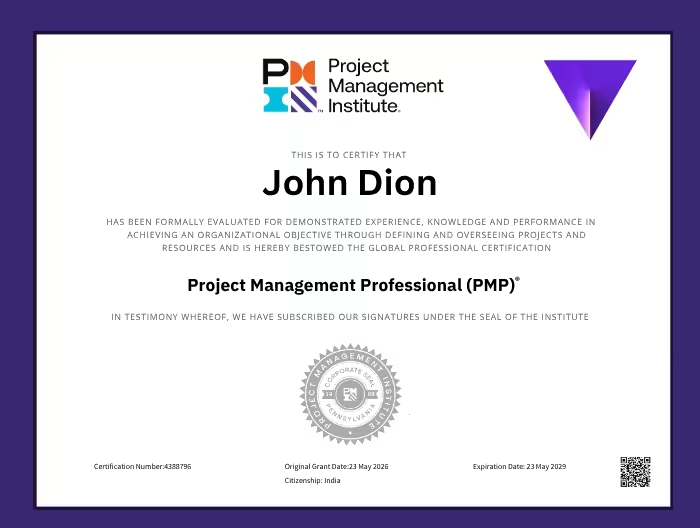
Earn an industry-recognized credential upon successful completion
Validate your project management skills with an industry-recognized certification.
Upon successful completion of our PMP course, you will receive an official PMI-authorized certificate that is relevant across diverse industries. This certification validates your knowledge of modern project management practices, leadership skills, Agile and hybrid delivery approaches, and your ability to manage projects successfully in dynamic business environments.
Earning this credential demonstrates your commitment to continuous learning and career growth in project management.
Join the next batch that fits your timezone


Explore PMP exam, training, and certification costs quickly.
| COST ITEM | PMI MEMBER COST | NON-MEMBER COST | NOTES |
|---|---|---|---|
|
Exam Fee |
≈ US$405 |
≈ US$555 |
PMI’s listed PMP exam fee; actual pricing can vary by region/taxes. |
|
Retake Fee |
≈ US$275 |
≈ US$375 |
Applies if you need to take the PMP exam again after an unsuccessful attempt. |
|
Renewal Fee |
≈ US$60 |
≈ US$150 |
PMP renewal is separate from PMI membership renewal; renewal requires meeting PMI’s CCR/PDU requirements. |
|
PMI Membership |
≈ US$129/year* |
US$0 |
Membership is optional. It can provide discounts on certification and other PMI products/services. |
|
Training Fees |
≈ $1999.00 (Classroom Training) ≈ $899.00 (Live Online Training) |
≈ $1999.00 (Classroom Training) ≈ $899.00 (Live Online Training) |
Current training price |
| ELEMENT | DETAIL |
|---|---|
|
Total questions |
180 (170 scored + 10 unscored pretest) |
|
Time |
240 minutes (4 hours) |
|
Breaks |
Two optional 10-minute breaks |
|
Domains |
People (33%), Process (41%), Business Environment (26%) |
|
Approaches |
Predictive, agile, and hybrid across all domains |
|
Question types |
Multiple choice, multiple response, matching, hotspot, drag-and-drop, case studies |
|
Delivery |
Pearson VUE test center or online proctoring |
|
PMI exam fee |
US$675 non-member / US$445 member (verify current fee for your region) |
Key Benefits of PMP Certification Training for Professionals and Organizations
Develop practical skills required to plan, manage, and deliver project outcomes that align with stakeholder expectations and business goals.
The PMP certification opens doors to leadership roles and higher-paying opportunities across industries.
Individuals holding a PMP certification can earn 20–30% more than their non-certified peers, particularly in project-driven careers.
Adding this globally recognized credential to your resume demonstrates your knowledge and expertise in leading successful projects.
Gain the practical expertise needed to adapt to changes, mitigate risks, and effectively overcome project challenges.
PMP-trained employees help organizations establish clear project goals, allocate resources efficiently, and maintain realistic timelines.
Professionals develop the ability to identify potential risks early and implement effective strategies to minimize their impact.
PMP-certified team members can manage schedules effectively and ensure projects are completed on time.
The training improves communication and collaboration among teams, stakeholders, and clients for better project execution.
Organizations benefit from improved cost control, reduced risks, and higher-quality project outcomes.
Our Certified Training Experts are available across the globe.
Online PMP training has become a popular and effective way to prepare for the PMP exam. The best programs now offer flexible study options, expert guidance, practice exams, and strong exam support. But every learner is different. Some people prefer live classes, some want to study at their own pace, and others need a fast-track option. Here are the three main ways to complete your PMP certification training online.
Everything you need to know about our training options and support
The latest PMP® exam aligns with modern project management practices reflected in the PMBOK® Guide – 8th Edition and the PMI Examination Content Outline (ECO).
Exam StructureHear from our successful graduates
"Exceptional PMP Training Experience with iCertGlobal I recently completed the PMP training by iCertGlobal, and I must say it was an outstanding experience. The instructor demonstrated a deep understanding of project management principles and brought real-world experience to the table. The training material's provided were comprehensive and well-organized, offering valuable insights and practical tips. I would highly recommend iCertGlobal to anyone looking for professional PMP Training.. "

"iCertGlobal provided a great learning experience with clear, well organised courses. The trainers were knowledgeable, and the support team was responsive to all my questions. The study material was comprehensive, which helped me pass my certification exam with ease. Highly recommended for anyone looking to get certified. "
"iCertGlobal is the best Certificate Training Organization. you will get good instructor and they will improve leaning sills and give the real time experience examples due to that you will get pass in first try. "
"The course content, exam prep questions, interactive Q&A, and real-life examples made attending this PMP Project Management training class worth my time and money. The support from iCertGlobal was exceptional and I would like to thank them for accepting my request of meeting the trainer post the session for clearing my doubts."
"I had a good learning experience with icertGlobal and it had been an amazing development journey. Actually, I accidentally bumped into iCertGlobal while searching for an online course for preparing my PMP examination. With positive reviews all over the internet and quick responses to my questions, I was flabbergasted enough to sign-up immediately. The instructor-led PMP preparatory course helped me both offline and online preparations. All the high-quality materials written in simple layman language was enough to grasp the gist of various topics. The instructors were very knowledgeable as they imparted not only their wealth of experiences but also real life examples. Thanks a lot iCertGlobal for imbibing this great learning experience. "
"Thank you for your great course, great support, rapid response and excellent service."
Book a free 15-minute counselling call — we'll map your eligibility, timeline, and salary ROI.
Free · 15 minutes · No obligation
An advisor will call you in your chosen slot.
Our PMP certification training is available in major cities worldwide
Stay updated with the latest insights and trends in project management
Discover real PMP certification scholarships and financial aid options. Learn how to reduce your exam fees and advance...
Master cross-cultural leadership skills to manage global teams, pass certifications, and advance your international career. Learn key strategies...
Master your Program Management Professional interview with these top 50 PgMP interview questions and answers. Prove your strategic...
Our experts are ready to help you with any questions about courses, admissions, or career paths. Get personalized guidance from industry professionals.

Live online and classroom training in PMP, ITIL, Agile, Six Sigma and more, with exam support included.
Subscribe to our newsletter for the latest updates on certifications and training opportunities.
Search iCertGlobal for certifications, courses and articles.

"PMI®", "PMBOK®", "PMP®", "CAPM®" and "PMI-ACP®" are registered marks of the Project Management Institute, Inc. | "CSM", "CST" are Registered Trade Marks of The Scrum Alliance, USA. | COBIT® is a trademark of ISACA® registered in the United States and other countries.
Latest exam updates, PMBOK® 8th edition highlights, and the strategy to pass on your first attempt.
Check your inbox for the free guide.


