



Risk Management Professional (PMI-RMP) Training Overview
You are typically the individual in every project discussion who identifies potential hazards before they escalate. You alert teams to potential budget overruns, resource conflicts, and technical obstacles, yet without a formal risk management certification, your crucial insights are frequently dismissed. In contrast, Certified Risk Management Professionals (PMI-RMP) are highly regarded for their strategic foresight. They spearhead risk workshops, counsel organizational leadership, and earn a premium for proactively averting issues rather than merely reacting to them. Your professional transformation begins here. This program is not simply another course that provides a list of risk identification methods. Our PMI-RMP Training Program was developed by senior professionals who actively manage substantial project and program risk portfolios across various finance, energy, and IT industries. They have successfully navigated regulatory bodies, hesitant CFOs, and intense audits, ensuring you learn how to apply the risk management framework within practical business environments. You will advance beyond theoretical concepts to develop strategic advisory skills. You'll learn to execute quantitative analysis using Monte Carlo simulations, formulate effective risk management strategies, and construct a dynamic risk register that informs critical decision-making. The PMI-RMP certification confirms your technical proficiency ?but the true benefit lies in transitioning from being viewed as the project pessimist to becoming the most relied-upon risk management analyst and advisor. This Risk Management course is perfectly suited for seasoned Project Managers, Business Analysts, and Line Managers who seek to specialize in this most vital project discipline. Flexible evening and weekend cohorts, along with recorded sessions, ensure you can pursue your training while maintaining your current employment. You will acquire templates for quantitative analysis, risk register formats, and region-specific case studies involving supply chain, regulatory, and market risk. Furthermore, you receive continuous expert support for the PMI-RMP application process, helping you meticulously document your risk management experience. Master the globally recognized risk management definition?identifying, assessing, and controlling project risks?and advance your career with a credential that demonstrates you don't just manage projects, you safeguard them.
PMI-RMP Training Course Highlights
Official PMI-Authorized Training Partner
Study with absolute confidence, knowing that your training curriculum strictly adheres to the official standards set by the Project Management Institute (PMI) for the Risk Management Professional credential.
Taught by Risk Management Veterans
Realize your full professional capability by learning from expert instructors who are practicing, RMP-certified risk managers, not merely generalist educators.
Flexible Schedule for Specialists
Select a training schedule that accommodates your demanding professional commitments, with choices including weekday-evening sessions, weekend-only classes, or intensive bootcamps.
Performance-focused Training
Achieve mastery of advanced concepts such as Monte Carlo analysis and decision trees through practical, hands-on laboratory exercises and personalized performance evaluation.
Exhaustive Practice Materials
Pinpoint and improve your weaker areas using an extensive question bank of over 1500 items and multiple mock examinations specifically tailored to replicate the PMI-RMP exam structure.
24x7 Expert Guidance & Support
Feel completely secure, as certified risk management experts are available around the clock to address your complex questions and provide comprehensive assistance at every stage of the program.
Corporate Training

Ready to transform your team?
Get a custom quote for your organization's training needs.
Upcoming Schedule


Skills You Will Gain In Our PMI-RMP Training Program
Quantitative Risk Analysis
Move beyond mere speculation. You will master Monte Carlo simulations, sensitivity analysis, and decision tree modeling to furnish stakeholders with predictions based on data and calculated contingency reserves.
Advanced Qualitative Analysis
You will develop sophisticated organizational structures for prioritizing risks. Learn specific techniques for assessing risk urgency, proximity, and interconnectedness to ensure resources are focused on the most critical areas.
Risk Response Strategy
Go beyond the elementary actions of Mitigate, Avoid, Transfer, and Accept. You will learn to devise proactive strategies for capitalizing on opportunities (Exploit, Enhance, Share) and when the "Escalate" response is appropriate.
Risk Governance & Frameworks
Learn how to design and execute a comprehensive project risk management plan that is consistent with the organization's overarching strategy, clearly defining roles, responsibilities, and a formal escalation process.
Stakeholder Risk Appetite Analysis
Master the crucial capability of identifying and appropriately managing stakeholders' tolerance for risk. Learn to articulate risk exposure using terminology that executives readily comprehend and act upon.
Facilitating Risk Workshops
Acquire the necessary skills to lead highly effective workshops for risk identification and analysis involving diverse teams, ensuring thorough capture of risks and securing commitment for the proposed response plans.
Who This Program Is For
PMP-Certified Project Managers
Program & Portfolio Managers
Dedicated Risk Managers
Senior Project Leaders
Business Analysts
Project Sponsors & Executives
If you hold accountability for navigating project uncertainty and safeguarding successful outcomes, this focused program is meticulously engineered to transform you into a recognized expert.
PMI-RMP Certification Training Program Roadmap


Why get PMI-RMP-certified?
Become an In-Demand Specialist
Elevate your career beyond general project management to become a recognized, highly sought-after expert in the specialized field of risk.
Increase Your Earning Potential
Be qualified for more competitive compensation packages and gain eligibility for senior positions in areas like risk management, project assurance, and strategic planning.
Lead Complex Projects Confidently
Acquire the self-assurance and the proven methodologies necessary to successfully guide complex, high-stakes projects through periods of considerable uncertainty.
Eligibility and Pre-requisites
The PMI-RMP is a specialized certification intended for professionals who can demonstrate verified, hands-on experience in the discipline of project risk management. PMI has established rigorous criteria to guarantee that every professional who is certified possesses a solid foundation in both practical experience and formal education. The following points detail the requirements you must meet to qualify for the examination.
Project Risk Management Education: Our comprehensive course fully satisfies the mandatory formal training requirement (30 or 40 hours) set by PMI.
Experience (with a Bachelor's Degree): You must have a four-year degree plus a minimum of 3,000 hours (approximately 2 years) of experience working in a project risk management capacity within the past 5 years.
Experience (with a Diploma): You must hold a secondary degree or diploma along with a minimum of 4,500 hours (approximately 3 years) of experience working in a project risk management role within the past 5 years.
Detailed Documentation: For a complete, comprehensive breakdown of the process for documenting your project hours and other specific requirements, please consult our detailed Frequently Asked Questions section.
Meet the Instructors
Kathy Rogers
Zahn Patin
Rufus Alexander, M.B.A., PM
Tim McDermott, PMP
Norman Wilson, PMP, PMI-ACP
Kathy Rogers
Zahn Patin
Rufus Alexander, M.B.A., PM
Tim McDermott, PMP
Norman Wilson, PMP, PMI-ACP
Kathy Rogers
Zahn Patin
Rufus Alexander, M.B.A., PM
Tim McDermott, PMP
Norman Wilson, PMP, PMI-ACP
Course Modules & Curriculum
Lesson 1: Facilitating Risk Identification
Learn advanced Risk Management techniques such as the Delphi method, Nominal Group Technique, and SWOT analysis. Build a detailed risk register using the risk management framework?a critical skill for PMI-RMP professionals and those pursuing risk management certification.
Lesson 2: Advanced Qualitative Risk Analysis
Master how to thoroughly assess and prioritize risks using tools like Probability and Impact Matrices and various risk categorization methods. Strengthen your risk management strategies and analytical skills to perform at the level of a top-tier risk management analyst.
Lesson 1: Data Gathering & Representation
Learn the proper methods for collecting highly accurate data for Risk Management. Conduct expert interviews and utilize probability distributions such as triangular and beta to accurately represent project uncertainty?this is essential for mastering the risk management framework and preparing for PMI-RMP certification.
Lesson 2: Monte Carlo & Sensitivity Analysis
Run powerful simulations to accurately model the combined impact of multiple risks on project objectives. Master Monte Carlo analysis to generate probabilistic forecasts for both cost and schedule, and utilize Tornado diagrams to precisely identify the most critical risks.
Lesson 3: Decision Tree & EMV Analysis
Utilize decision trees and Expected Monetary Value (EMV) analysis to consistently make informed, data-driven project decisions. Strengthen your understanding of the risk management definition and apply it practically to select the optimal project path in environments of uncertainty.
Lesson 1: Planning & Implementing Risk Responses
Learn the process for creating and effectively implementing successful Risk Management response plans. Master advanced risk management strategies for both threats (Avoid, Mitigate, Transfer, Escalate) and opportunities (Exploit, Enhance, Share, Escalate) within the risk management framework?a key area of focus for PMI-RMP certification.
Lesson 2: Controlling Risks & Monitoring Triggers
Establish processes to continuously monitor, audit, and control all project risks in real time. Learn to correctly identify risk triggers, reassess existing risks, and ensure that response plans are executed properly. Strengthen your practical skills as a risk management analyst and deepen your understanding of the risk management definition through hands-on application.
Lesson 1: Risk Reporting & Governance
Learn the techniques to communicate critical risk information effectively to all hierarchical levels of the organization. Develop professional risk dashboards and reports that offer clear, concise insights into the project's overall risk exposure, thereby assisting stakeholders in making informed decisions.
Lesson 2: RMP Exam Strategy & Final Review
Develop proven test-taking strategies specifically designed for the PMI-RMP examination format. Learn how to meticulously dissect complex situational questions, manage your available time effectively, and fully consolidate your knowledge across all five domains for guaranteed first-attempt success.
PMI-RMP Certification & Exam FAQ
Customer Testimonials
Exceptional PMP Training Experience with iCertGlobal I recently completed the PMP training by iCertGlobal, and I must say it was an outstanding experience. The instructor demonstrated a deep understanding of project management principles and brought real-world experience to the table. The training material's provided were comprehensive and well-organized, offering valuable insights and practical tips. I would highly recommend iCertGlobal to anyone looking for professional PMP Training..

John Anderson
iCertGlobal provided a great learning experience with clear, well organised courses. The trainers were knowledgeable, and the support team was responsive to all my questions. The study material was comprehensive, which helped me pass my certification exam with ease. Highly recommended for anyone looking to get certified.
James Walsh
iCertGlobal is the best Certificate Training Organization. you will get good instructor and they will improve leaning sills and give the real time experience examples due to that you will get pass in first try.
Andy Moran
The course content, exam prep questions, interactive Q&A, and real-life examples made attending this PMP Project Management training class worth my time and money. The support from iCertGlobal was exceptional and I would like to thank them for accepting my request of meeting the trainer post the session for clearing my doubts.
Tim Malone
I had a good learning experience with icertGlobal and it had been an amazing development journey. Actually, I accidentally bumped into iCertGlobal while searching for an online course for preparing my PMP examination. With positive reviews all over the internet and quick responses to my questions, I was flabbergasted enough to sign-up immediately. The instructor-led PMP preparatory course helped me both offline and online preparations. All the high-quality materials written in simple layman language was enough to grasp the gist of various topics. The instructors were very knowledgeable as they imparted not only their wealth of experiences but also real life examples. Thanks a lot iCertGlobal for imbibing this great learning experience.
Jason Walter
Thank you for your great course, great support, rapid response and excellent service.
Hoda Alavi
My trainer made the materials relatable and easy to understand. It was fun being in class everyday.
Cassandra Corn
Amazing trainer who was very supportive.

Shanna Pilgrim
Trainer was well versed in the subject matter and got the impression the gentleman was professional and educated within standards and procedures for PMI.
Anthony Zamora
The Training was good and customer service was perfect.
Maka Diakhate
Trainer was knowledgeable and lesson's pace was just right.

Roger Gonzales
Trainer (Bruce) was very excellent in delivery and presentation. He provided me with all the tools required to be successful in the PMP exams with lots of quiz questions on all topics reviewed.
Bashiru Ojibara
The trainer, Emad was top notch and very knowledgeable. He is up to date with all current versions and is great in 1:1 Training.

Jonathan Obien
Thank you for your great course, great support, rapid response and excellent service

Hoda Alavi
Marc had very good knowledge and he was able to explain the material and provide guidance to get ready for the test.

Roque Montesino
Excellent Course. Zahn was a great instructor and the course material definitely will help me pass the PMP Exam

Jared Nelson
Great teacher, went out of his way in every possible aspect.
Radiah Sims
Customer service provided by Robin was great as he was very responsive and the trainer, John, was very good at relating the content to my industry.

Jason D Niebauer
Course & Support
RISK MANAGEMENT PROFESSIONAL Training in Other Cities
Related Blogs
Stay updated with the latest insights and trends in your field
Decision Making in Management: Process, Types & Importance
Master the process of decision making in management. Learn key types and frameworks to boost your leadership skills...
PgMP Certification Requirements 2026: Eligibility & Process
Meet the 2026 PgMP certification requirements. Learn the exact experience, eligibility criteria, and application steps to advance your...
What Is a Product? Simple Meaning and Easy
Learn the core product meaning, types, and real-world examples. Master these business fundamentals to accelerate your career in...
Complete List of all 49 PMP Project Management
Master all 49 PMP project management processes. Pass your exam on the first try and advance your career...
Before You Enroll in PMI-CPMAI, Read This First
Before you take the PMI-CPMAI, learn how mastering project management ai can elevate your career, validate your skills,...
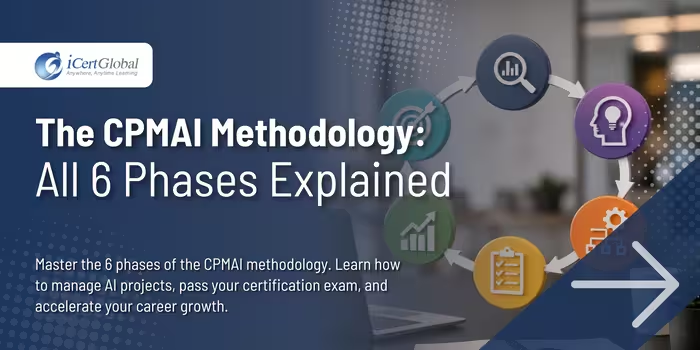
The CPMAI Methodology: All 6 Phases Explained
Master the 6 phases of the CPMAI methodology. Learn how to manage AI projects, pass your certification exam,...
What Is PMI-CPMAI? The AI Certification for PMs
Advance your career with the PMI-CPMAI certification. Discover how to manage ethical AI projects, master the methodology, and...
PMP Exam Cost in the USA: Full Budget
Plan your PMP exam cost budget. Learn about USA certification fees, PMI membership savings, prep course rates, and...
New PMP Exam 2026: Everything That Changed
Master the new PMP exam 2026. Learn about the July 9 updates, PMBOK 8th Edition changes, and how...
What is the PMI CPMAI Salary Potential in
Want to maximize your earning potential? Discover the average PMI CPMAI salary, job ROI, and how to command...



