Your procedures are established. You operate a Service Desk, monitor Incidents, and handle Changes. So, why is Information Technology still viewed as an expenditure? Because you lack the oversight required to continually enhance performance. The ITIL CSI Certification is intended for the professional who rejects complacency. It is concrete evidence that you comprehend how to review and upgrade service provision across Service Strategy, Design, Transition, and Operation. This course is not focused on grasping a single procedure. ITIL Continual Service Improvement is the strategic framework that envelops the entire Service Lifecycle. The majority of IT departments in your region - particularly those managing significant outsourcing contracts - fail to embed continuous improvement, resulting in recurrent problems and flat performance. This credential equips you with the exact methodology to implement the ITIL 7 Step Improvement process, guaranteeing that all decisions are supported by data. The employment sector does not reward mere adherence; it rewards results. By mastering the CSI module, you acquire the expertise to define, quantify, and examine metrics that genuinely connect IT performance with overall business goals. You will learn how to maintain the ITIL CSI register, transforming a simple collection of concepts into an organized, prioritized program of modification. Stop depending on unsupported stories; begin directing with measurable information. We developed this for the managerial staff who intend to formalize change. Regardless of your location, our instruction delivers the precise, metric-oriented methods required to validate IT expenditure and promote ongoing maturity.
ITIL CSI Certification Overview Bangalore
Your ITIL CSI Qualification Isn't a Certificate. It's Your Directive for Maximizing Efficiency
Why get ITIL Continual Service Improvement-certified?
The Qualification That Ends Exclusion
Quit being ignored.
The ITIL CSI Certification confirms you possess the tactical oversight skills required to spearhead assessment and enhancement projects.
Access Optimization Positions.
This credential acts as an essential screen for high-level appointments focused on expense reduction, organizational maturity, and service excellence.
Finish the Framework.
Gain 3 credits toward your ITIL Expert designation, finalizing the vital strategic element of the ITIL framework phases.
ITIL Continual Service Improvement Training Course Highlights
Beyond Standard Training - It's Your Professional Catalyst
Central Lifecycle Component
Achieves 3 credits necessary for your ITIL Expert accreditation, finalizing your compulsory ITIL lifecycle components.
Comprehend the Deming Loop
Thorough exploration of the ITIL Deming Cycle (Plan-Do-Check-Act) and its practical use in the ITIL Improvement Process.
Measurement-Based Planning
Discover how to establish Critical Success Factors (CSFs), Key Performance Indicators (KPIs), and baselines that harmonize service measurements with real organizational objectives.
Inter-Process Integration Focus
Intensive instruction on how the ITIL Continual Service Improvement process connects with and enhances every distinct lifecycle phase.
Proficiency with the ITIL CSI Register
Learn the required format and utilization of the ITIL CSI register to govern, monitor, and determine the priority of improvement projects.
Assessment Accuracy
Engage in practice using graded simulated tests designed for the scenario-based, multiple-choice structure of the Intermediate ITIL Lifecycle CSI examination.
Skills You Will Gain In Our ITIL CSI Program
Transitioning Concepts into Practical Insights
Who This Program Is For
Suitable Aspirants for the ITIL CSI Certification
This certification training is ideal for:
If you are responsible for financial efficiency and delivering value within your IT department, this ITIL CSI Certification aligns perfectly with your role requirements.
ITIL CSI Certification Training Program Roadmap
The Systematic Approach to Achieving Success on Your Initial Attempt
Eligibility and Pre-requisites for ITIL CSI Certification
Prerequisites for the ITIL Continual Service Improvement Module
This is a module at the Intermediate Lifecycle level. The entry requirements are rigorous:
Course Modules
Comprehensive curriculum covering all exam domains
Principles and Foundation
Lesson 1: Introduction to Continual Service Improvement
Define the purpose, scope, and objectives of CSI and its essential link to the entire Service Lifecycle (the ITIL Lifecycle CSI approach).
Lesson 2: Continual Service Improvement Principles
Master the guiding principles of CSI, including governance, ownership, the ITIL Improvement Process approach, and the role of the Deming Cycle ITIL.
Lesson 3: The Role of Governance
Understand how IT governance, knowledge management, and the ITIL CSI register enable CSI activities and secure strategic buy-in.
The 7-Step Improvement Process
Lesson 1: Steps 1 & 2: Define What to Measure
Master the process of identifying the improvement strategy, defining CSFs, KPIs, and baselines that align with business vision and current IT capability.
Lesson 2: Steps 3, 4, & 5: Data Management
Learn the mandatory activities for gathering, processing, and analyzing raw data to transform it into meaningful information and knowledge (the DIKW model).
Lesson 3: Steps 6 & 7: Action & Review
Master the steps for presenting and using information (reporting) and implementing the actual improvement actions to set a new baseline.
Methods and Techniques
Lesson 1: Assessments and Gap Analysis
Detailed training on how to conduct service and process maturity assessments, benchmarking, and root cause analysis to identify improvement opportunities.
Lesson 2: Service Measurement and Reporting
Deep dive into different measurement types (technology, process, service) and how to create effective service reports that compel action.
Lesson 3: Organizational Change Enablement
Understand the human and cultural challenges of implementing CSI and the communication strategies needed to gain buy-in for change.
Organizing for CSI
Lesson 1: Roles and Responsibilities
Define the roles, skills, and organizational structures required to enforce the ITIL Improvement Process, including the CSI Manager and the CSI Coordinator.
Lesson 2: Technology Considerations
Review the tools and technology needed to support the CSI activities, particularly for automated data gathering, analysis, and reporting.
Lesson 3: Challenges, CSFs, and Risks
Analyze the common challenges, critical success factors, and risks associated with implementing and maintaining the ITIL Continual Service Improvement process.
Implementation and Exam Strategy
Lesson 1: Implementing CSI
Practical guidance on planning and implementing CSI initiatives, integrating them with organizational change management and Service Transition.
Lesson 2: Scenario Analysis & Scoring Mastery
Intensive review of mock exams, dissecting the case studies and drilling the 5/3/1/0 scoring system for the ITIL CSI exam questions.
Lesson 3: Final ITIL Lifecycle CSI Synthesis
Final strategy session focusing on the interconnectivity of the ITIL lifecycle modules and a final self-assessment for certification readiness.
Corporate Training
Tailored programs for teams with enterprise support

Ready to transform your team?
Get a custom quote for your organization's training needs.
Upcoming Schedule
Join the next batch that fits your timezone
Course & Support
Everything you need to know about our training options and support
Plan: Corresponds to Steps 1, 2, 3 (Defining the metrics, compiling information).
Do: Implemented during the information compilation and processing stages.
Check: Relates to Steps 4, 5, 6 (Analyzing the information, presenting the findings).
Act: Step 7 (Implementing the necessary corrective measures and restarting the cycle).
Customer Testimonials
Hear from our successful graduates
"Exceptional PMP Training Experience with iCertGlobal I recently completed the PMP training by iCertGlobal, and I must say it was an outstanding experience. The instructor demonstrated a deep understanding of project management principles and brought real-world experience to the table. The training material's provided were comprehensive and well-organized, offering valuable insights and practical tips. I would highly recommend iCertGlobal to anyone looking for professional PMP Training.. "

John Anderson
"iCertGlobal provided a great learning experience with clear, well organised courses. The trainers were knowledgeable, and the support team was responsive to all my questions. The study material was comprehensive, which helped me pass my certification exam with ease. Highly recommended for anyone looking to get certified. "
James Walsh
"iCertGlobal is the best Certificate Training Organization. you will get good instructor and they will improve leaning sills and give the real time experience examples due to that you will get pass in first try. "
Andy Moran
"The course content, exam prep questions, interactive Q&A, and real-life examples made attending this PMP Project Management training class worth my time and money. The support from iCertGlobal was exceptional and I would like to thank them for accepting my request of meeting the trainer post the session for clearing my doubts."
Tim Malone
"I had a good learning experience with icertGlobal and it had been an amazing development journey. Actually, I accidentally bumped into iCertGlobal while searching for an online course for preparing my PMP examination. With positive reviews all over the internet and quick responses to my questions, I was flabbergasted enough to sign-up immediately. The instructor-led PMP preparatory course helped me both offline and online preparations. All the high-quality materials written in simple layman language was enough to grasp the gist of various topics. The instructors were very knowledgeable as they imparted not only their wealth of experiences but also real life examples. Thanks a lot iCertGlobal for imbibing this great learning experience. "
Jason Walter
"Thank you for your great course, great support, rapid response and excellent service."
Hoda Alavi
"My trainer made the materials relatable and easy to understand. It was fun being in class everyday. "
Cassandra Corn
"Amazing trainer who was very supportive. "

Shanna Pilgrim
"Trainer was well versed in the subject matter and got the impression the gentleman was professional and educated within standards and procedures for PMI. "
Anthony Zamora
"The Training was good and customer service was perfect. "
Maka Diakhate
"Trainer was knowledgeable and lesson's pace was just right."

Roger Gonzales
"Trainer (Bruce) was very excellent in delivery and presentation. He provided me with all the tools required to be successful in the PMP exams with lots of quiz questions on all topics reviewed. "
Bashiru Ojibara
"The trainer, Emad was top notch and very knowledgeable. He is up to date with all current versions and is great in 1:1 Training. "

Jonathan Obien
"Thank you for your great course, great support, rapid response and excellent service"

Hoda Alavi
"Marc had very good knowledge and he was able to explain the material and provide guidance to get ready for the test. "

Roque Montesino
"Excellent Course. Zahn was a great instructor and the course material definitely will help me pass the PMP Exam "

Jared Nelson
"Great teacher, went out of his way in every possible aspect. "
Radiah Sims
"Customer service provided by Robin was great as he was very responsive and the trainer, John, was very good at relating the content to my industry. "

Jason D Niebauer
ITIL Continual Service Improvement Training in Other Cities
Our ITIL Continual Service Improvement certification training is available in major cities worldwide
Related Blogs
Stay updated with the latest insights and trends in project management
ITIL 4 Foundation vs Practitioner: Certification Path Explained
Compare ITIL 4 Foundation vs Practitioner. Discover which certification aligns with your career goals, boosts your salary, and...
Top 10 IT Service Management Best Practices for
Master the top 10 ITSM best practices for modern businesses. Transform your service desk with proven frameworks to...
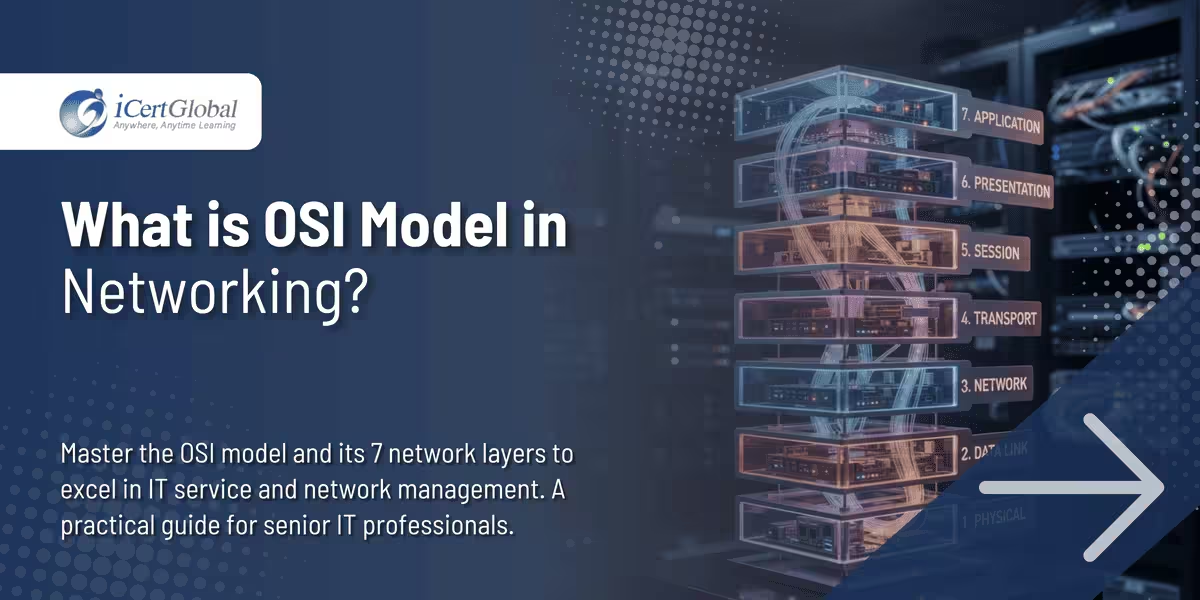
What is OSI Model in Networking
Master the OSI model and its 7 network layers to excel in IT service and network management. A...
7 Strong Advantages of ITIL Certification
Learn the top benefits of ITIL certification and how it boosts your IT career and organizational value....
Ensuring Tech Support Functions in Businesses
Learn how businesses keep their technology like computers and internet running well with ITSM and ITIL....
The Importance of COBIT in IT Management
Learn what COBIT is and why it matters for managing technology in businesses. ...



