You already possess your Foundation certificate. Excellent. So does almost everyone else. But you remain stuck in the daily grind, observing your team overwhelmed by incidents, clashing with change advisory boards that reject nearly everything, and contending with processes that appear fine in documentation but fail when implemented. You are familiar with the what of ITIL, but you are grappling with the how. That is precisely why you are still designated a "Service Desk Lead" while others are advancing to "Service Delivery Managers" with salaries that are 40% higher. The sector is saturated with "paper-certified" professionals who can parrot definitions but become ineffective when asked to genuinely improve a workflow. Employers are weary of them. They seek individuals capable of solving problems. They desire people who can utilize the "CSI approach" and genuinely translate it into reduced costs and quicker resolution times. Your resume is passed over because you appear to be just another ordinary IT support staff member. That ends now. This is not another tedious series of lectures focused on terminology. Our ITIL Practitioner Training Program is created by experienced ITSM consultants who have successfully overhauled malfunctioning IT departments in the local area's largest tech parks and financial hubs. They do not merely teach you the "Guiding Principles"?they show you how to apply them to dismantle unnecessary bureaucracy, simplify change management, and compel your organization to prioritize value. We developed this for the working professional who contends with genuine chaos. We eliminate the theoretical excess and concentrate on the "Adopt and Adapt" methodology. You?ll learn how to navigate Organizational Change Management (OCM) to manage reluctance from resistant teams, utilize metrics that actually resonate with your CIO, and implement improvements that draw attention to your work. Whether you are aiming for the legacy ITIL v3 Practitioner concepts or the modern ITIL 4 practice modules, this training closes the gap between knowing the vocabulary and speaking the language of leadership.
ITIL Practitioner Certification Overview
Your ITIL Practitioner Isn't a Certificate. It's Your Non-Negotiable Pass to Senior Roles
Why get ITIL Practitioner-certified?
The Credential That Ends the Gatekeeping
Stop Being Overlooked
Recruiters are actively searching for senior-level ITSM professionals who can drive real change. Position yourself as the expert they can't ignore.
Bridge Theory and Practice
Prove that you can apply ITSM frameworks effectively in real-world environments?ending the debate between textbook knowledge and practical execution.
Unlock Specialist Salaries
Demonstrate your ability to deliver measurable ROI through service improvement and step confidently into high-paying specialist roles.
ITIL Practitioner Training Course Highlights
More Than a Course?It's Your Career Accelerator
PeopleCert Accredited Training
Learn with complete assurance knowing your program complies with the rigorous global standards established by Axelos and PeopleCert.
Real-World "Adopt & Adapt" Focus
Stop committing inflexible processes to memory. Learn how to tailor the framework to your specific IT environment in your region, whether you are in a startup or a multinational corporation.
Battle-Tested Instructors
Learn from ITSM architects who have not merely passed the exam, but have spearheaded major service improvement plans for Fortune 500 companies.
Focus on Organizational Change Management
Master the essential soft skills that technical courses often overlook?how to manage resistance, stakeholders, and office politics during significant transitions.
Metric-Driven Improvement
Learn to establish Critical Success Factors (CSFs) and KPIs that validate your contribution to the business using concrete data.
24/7 Implementation Support
Facing a challenge in your actual job? Our experts are available around the clock to help you apply the knowledge you acquire to your real-world professional tasks.
Skills You Will Gain In Our ITIL Practitioner Training Program
From Knowledge to Actionable Intelligence
Who This Program Is For
Ideal Candidates for ITIL Practitioner Certification
This certification training is ideal for:
If you have already earned your Foundation certificate and are prepared to stop being a junior administrator and begin directing service improvements, this course is the essential next step in your career.
ITIL Practitioner Certification Training Program Roadmap
The Step-by-Step System for First-Attempt Success
Eligibility and Pre-requisites
For ITIL Practitioner Certification
This certification serves as the link between the entry-level and the expert level. It is based on the assumption that you already possess fundamental knowledge.
Course Modules
Comprehensive curriculum covering all exam domains
Module 1: The CSI Approach & Improvement
Lesson 1: The CSI Model in Action
Stop treating improvement as a one-time project. Learn the 7-step Continual Service Improvement (CSI) approach. You will master how to identify the vision, assess where you are now, define where you want to be, and execute the plan. This is the core engine of the ITIL Practitioner certification.
Lesson 2: Metrics that Matter
Most IT teams measure the wrong things. Learn to distinguish between Critical Success Factors (CSFs) and Key Performance Indicators (KPIs). Understand how to build a metrics hierarchy that links technical operational data to high-level business goals.
Lesson 3: The Improvement Register
Move beyond ad-hoc fixes. Learn to build and manage a formal Improvement Register (CIR). You will learn how to prioritize improvements based on ROI and business impact, ensuring you are always working on the most valuable tasks.
Module 2: The 9 Guiding Principles
Lesson 1: Focus on Value & Design for Experience
Learn to ruthlessly cut any activity that doesn't add value to the customer. Understand the "Design for Experience" principle to ensure your services aren't just functional, but usable and intuitive for the end-user.
Lesson 2: Start Where You Are & Work Holistically
Stop trying to "rip and replace" everything. Learn to assess current capabilities and build upon them. Master the art of "Working Holistically" to see the end-to-end service, preventing siloed improvements that break things downstream.
Lesson 3: Iterative Progress & Collaboration
Big bang implementations fail. Learn to "Progress Iteratively with Feedback" to deliver quick wins and adjust course. innovative ways to "Collaborate and Promote Visibility" to break down walls between Dev, Ops, and the Business.
Module 3: Organizational Change Management (OCM)
Lesson 1: Understanding Resistance
Change fails because of people, not technology. Learn the psychology of change resistance. You will explore frameworks to identify stakeholders' fears and motivations, allowing you to navigate the "human side" of IT projects.
Lesson 2: Stakeholder Management & Analysis
Not all stakeholders are equal. Learn to map your stakeholders based on power and interest. specific strategies for engaging difficult stakeholders who have the power to block your initiatives.
Lesson 3: Communication Strategies
Bad communication kills projects. Learn to design effective communication plans that deliver the right message, to the right person, at the right time, using the right medium.
Module 4: Toolkit & Application
Lesson 1: Adopt and Adapt
The most critical skill. Learn how to take the rigid ITIL books and adapt them to your specific environment?whether you are a 10-person startup or a massive banking GCC.
Lesson 2: Case Study Deep Dive
The exam is scenario-based. We spend this lesson dissecting complex, real-world case studies. You will apply the principles and CSI approach to solve these scenarios, mirroring the actual exam format.
Lesson 3: Exam Drill & Strategy
Master the open-book exam format. Learn time management, keyword recognition, and how to quickly reference your materials to answer situational questions correctly.
Module 5: Future-Proofing Your Career
Lesson 1: Integrating with Agile & DevOps
ITIL doesn't live in a vacuum. Learn how the Practitioner concepts align with Agile and DevOps. See how "Progress Iteratively" matches Agile sprints, and how "Collaborate" aligns with DevOps culture.
Lesson 2: The Path to Expert
Understand how this certification fits into your broader journey toward ITIL Expert or ITIL 4 Managing Professional. Plan your next steps for maximum career impact.
Lesson 3: Final Assessment
A full-length, timed mock exam under strict conditions to validate your readiness and identify any final areas for review.
Corporate Training
Tailored programs for teams with enterprise support

Ready to transform your team?
Get a custom quote for your organization's training needs.
Upcoming Schedule
Join the next batch that fits your timezone


Course & Support
Everything you need to know about our training options and support
Customer Testimonials
Hear from our successful graduates
"Exceptional PMP Training Experience with iCertGlobal I recently completed the PMP training by iCertGlobal, and I must say it was an outstanding experience. The instructor demonstrated a deep understanding of project management principles and brought real-world experience to the table. The training material's provided were comprehensive and well-organized, offering valuable insights and practical tips. I would highly recommend iCertGlobal to anyone looking for professional PMP Training.. "

John Anderson
"iCertGlobal provided a great learning experience with clear, well organised courses. The trainers were knowledgeable, and the support team was responsive to all my questions. The study material was comprehensive, which helped me pass my certification exam with ease. Highly recommended for anyone looking to get certified. "
James Walsh
"iCertGlobal is the best Certificate Training Organization. you will get good instructor and they will improve leaning sills and give the real time experience examples due to that you will get pass in first try. "
Andy Moran
"The course content, exam prep questions, interactive Q&A, and real-life examples made attending this PMP Project Management training class worth my time and money. The support from iCertGlobal was exceptional and I would like to thank them for accepting my request of meeting the trainer post the session for clearing my doubts."
Tim Malone
"I had a good learning experience with icertGlobal and it had been an amazing development journey. Actually, I accidentally bumped into iCertGlobal while searching for an online course for preparing my PMP examination. With positive reviews all over the internet and quick responses to my questions, I was flabbergasted enough to sign-up immediately. The instructor-led PMP preparatory course helped me both offline and online preparations. All the high-quality materials written in simple layman language was enough to grasp the gist of various topics. The instructors were very knowledgeable as they imparted not only their wealth of experiences but also real life examples. Thanks a lot iCertGlobal for imbibing this great learning experience. "
Jason Walter
"Thank you for your great course, great support, rapid response and excellent service."
Hoda Alavi
"My trainer made the materials relatable and easy to understand. It was fun being in class everyday. "
Cassandra Corn
"Amazing trainer who was very supportive. "

Shanna Pilgrim
"Trainer was well versed in the subject matter and got the impression the gentleman was professional and educated within standards and procedures for PMI. "
Anthony Zamora
"The Training was good and customer service was perfect. "
Maka Diakhate
"Trainer was knowledgeable and lesson's pace was just right."

Roger Gonzales
"Trainer (Bruce) was very excellent in delivery and presentation. He provided me with all the tools required to be successful in the PMP exams with lots of quiz questions on all topics reviewed. "
Bashiru Ojibara
"The trainer, Emad was top notch and very knowledgeable. He is up to date with all current versions and is great in 1:1 Training. "

Jonathan Obien
"Thank you for your great course, great support, rapid response and excellent service"

Hoda Alavi
"Marc had very good knowledge and he was able to explain the material and provide guidance to get ready for the test. "

Roque Montesino
"Excellent Course. Zahn was a great instructor and the course material definitely will help me pass the PMP Exam "

Jared Nelson
"Great teacher, went out of his way in every possible aspect. "
Radiah Sims
"Customer service provided by Robin was great as he was very responsive and the trainer, John, was very good at relating the content to my industry. "

Jason D Niebauer
ITIL Practitioner Training in Other Cities
Our ITIL Practitioner certification training is available in major cities worldwide
Related Blogs
Stay updated with the latest insights and trends in project management
ITIL 4 Foundation vs Practitioner: Certification Path Explained
Compare ITIL 4 Foundation vs Practitioner. Discover which certification aligns with your career goals, boosts your salary, and...
Top 10 IT Service Management Best Practices for
Explore the top 10 IT service management best practices for modern business, from ITIL 5 and AI automation...
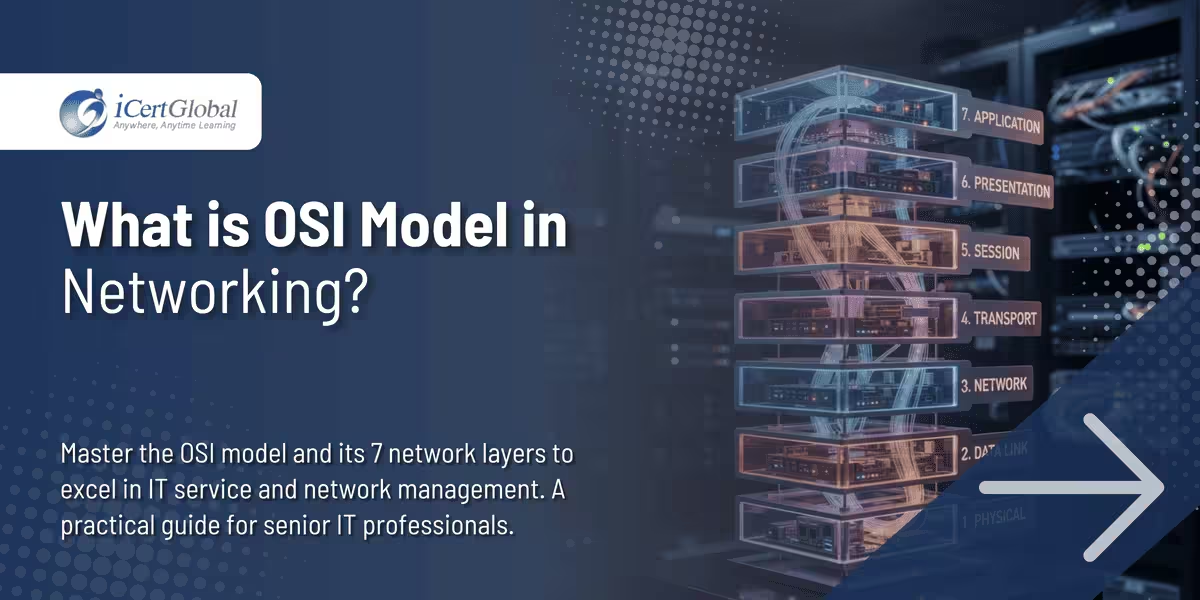
What is OSI Model in Networking
Master the OSI model and its 7 network layers to excel in IT service and network management. A...
7 Strong Advantages of ITIL Certification
Learn the top benefits of ITIL certification and how it boosts your IT career and organizational value....
Ensuring Tech Support Functions in Businesses
Learn how businesses keep their technology like computers and internet running well with ITSM and ITIL....
The Importance of COBIT in IT Management
Learn what COBIT is and why it matters for managing technology in businesses. ...



