You are probably trapped in a pattern of making excessive promises and failing to deliver sufficiently. The sales team markets a high-end solution, but your allocated funds only allow for the creation of a less expensive one. You are the individual confronting frustrated business leaders who assert "the system is sluggish," yet you lack the evidence to refute this because your SLAs are indistinct. You are overseeing suppliers who deplete your finances because your contracts lack enforceability. You are an operational casualty. SOA-certified professionals are commercial strategists. While others are merely "receiving directives" from the organization, ITIL SOA professionals are formulating the Service Portfolio, determining the Return on Investment for every request, and governing suppliers with the strictness of a purchasing manager. Talent acquisition specialists for Service Delivery and BRM positions in local captive centers and regional fin-tech firms seek experts, not agreeable managers; they look for Service Level Management specialists capable of converting technical data into monetary value for the business. This is not an educational session on being courteous to customers. Our ITIL Service Offerings and Agreements training is an intensive commercial preparation. We eliminate the unnecessary notion that "the customer is always correct" and concentrate on the practicalities of value. You will discover how to construct a Service Catalog that limits users to precisely what they fund, how to project Demand so unexpected traffic surges do not catch you off guard, and how to implement Financial Management so every piece of infrastructure has an associated billing identifier.2 We developed this curriculum for the Service Level Managers, Business Relationship Managers, and Catalog Owners who are weary of the disorder. Whether you are engaging with internal parties or external customers, this training grants you the organizational power to declare, "That falls outside the defined scope," and refer to the binding agreement. You will master the optimization of ITIL Portfolio Management to guarantee you are investing in valuable services and discontinuing those that are unproductive.
ITIL SOA Training Program Overview
Your ITIL SOA Certification Is More Than Just a Document. It's Your Commercial Safeguard.
Why Pursue ITIL SOA Certification?
The Qualification That Grants Access
Demonstrate Business Acumen
Establish that your capabilities extend beyond technical knowledge. Show organizational leadership that you comprehend Profit & Loss (P&L), contractual agreements, and overall business strategy.
Curtail Financial Loss
Employ your SOA skills to pinpoint unnecessary expenditure within vendor agreements and identify unauthorized or uncharged service consumption, thereby improving financial efficiency.
Attain Advanced Positions
Become eligible for lucrative senior roles, such as "Chief of Service Delivery" and "Vendor Management Lead," which specifically demand validated, certified competence.
ITIL SOA Training Course Highlights
Exceeding a Standard Course?It Represents Your Commercial Resources
PeopleCert Accredited
We operate as an Authorized Training Organization (ATO). Your 4 credits are certain to apply toward the total required for the ITIL Capability Stream.
Commercial Focus
Unlike technically-oriented modules, SOA emphasizes the "Business of IT"?Capital, Agreements, and Contracts.3
Practical SLA Workshops
We do not merely recite terminology. We assess actual (with identity concealed) failed SLAs to illustrate precisely where vulnerabilities exist.
Examination-Driven Approach
The SOA exam contains extensive scenario questions.4 We furnish a dedicated ITIL SOA study guide to assist you in analyzing intricate business situations and identifying the optimal solution.
Supplier & Finance Proficiency
Gain expertise in the two most overlooked areas of ITIL?Supplier Management and Financial Management?which are vital for advancement to leadership positions.5
24/7 Expert Assistance
Struggling with an elaborate financial structure or a contract penalty provision? Our specialists are available continuously to clarify the specifications.
Skills You Will Acquire In Our ITIL SOA Training Program
From Understanding to Practical Execution
Who This Program Is Suited For
Optimal Participants for ITIL SOA Certification
This certification training is ideal for:
If your duties involve the "Commercial" aspect of IT?including legal arrangements, budgetary oversight, service listings, and client relationships?then this Capability module is your essential career benchmark.
ITIL SOA Certification Training Program Roadmap
The System for Successful First-Attempt Completion
Eligibility and Pre-requisites
ITIL SOA Requirements
This particular module is categorized as an advanced Capability module. It is based on the assumption that you already grasp the fundamentals of the service lifecycle.
Course Modules
Comprehensive curriculum covering all exam domains
Service Portfolio & Catalog Management
Lesson 1: Service Portfolio Management
Define the strategy. Learn to manage the Service Pipeline (future), Service Catalog (live), and Retired Services. Understand how to build a Business Case for new investments.
Lesson 2: Service Catalog Management
Build the menu. Learn to structure the ITIL Catalog Management process. Differentiate between the "Business Service Catalog" (what the user sees) and the "Technical Service Catalog" (what IT supports).
Lesson 3: Service Structures
Understand service relationships. Learn how to map dependencies so you know exactly which server supports which business process.
Service Level Management (SLM)
Lesson 1: SLAs, OLAs, and Underpinning Contracts
Master the documents. Learn the difference between a Service Level Agreement (Customer), Operational Level Agreement (Internal Team), and Underpinning Contract (Vendor).
Lesson 2: Negotiating and Monitoring
The art of the deal. Learn to negotiate realistic targets (SLAM charts) and set up monitoring to catch breaches before the customer does.
Lesson 3: Service Improvement Plans (SIP)
Fix it. Learn the formal process for initiating a SIP when a service consistently fails to meet its targets.
Demand & Financial Management
Lesson 1: Demand Management
Analyze the load. Learn to identify Patterns of Business Activity (PBA) and User Profiles.17 Use "Differential Charging" to influence behavior (e.g., cheaper processing at night).
Lesson 2: Financial Management Basics
Speak the language of money. Learn the concepts of Budgeting, Accounting, and Charging.
Lesson 3: ROI and Value
Prove the worth. Learn to calculate the Return on Investment (ROI) and Total Cost of Ownership (TCO) for IT services.18
Supplier & Business Relationship Management
Lesson 1: Supplier Management
Control the supply chain. Learn to categorize suppliers (Strategic, Tactical, Commodity, Operational) and manage their performance against the contract.19
Lesson 2: Business Relationship Management (BRM)
The bridge. Learn to identify customer needs, ensure high levels of satisfaction, and handle complaints strategically.
Lesson 3: Exam Strategy
Review ITIL SOA exam questions. Learn to handle the "Gradient Scoring" questions and manage your time during the 90-minute test.20
Corporate Training
Tailored programs for teams with enterprise support

Ready to transform your team?
Get a custom quote for your organization's training needs.
Upcoming Schedule
Join the next batch that fits your timezone
Course & Support
Everything you need to know about our training options and support
Customer Testimonials
Hear from our successful graduates
"Exceptional PMP Training Experience with iCertGlobal I recently completed the PMP training by iCertGlobal, and I must say it was an outstanding experience. The instructor demonstrated a deep understanding of project management principles and brought real-world experience to the table. The training material's provided were comprehensive and well-organized, offering valuable insights and practical tips. I would highly recommend iCertGlobal to anyone looking for professional PMP Training.. "

John Anderson
"iCertGlobal provided a great learning experience with clear, well organised courses. The trainers were knowledgeable, and the support team was responsive to all my questions. The study material was comprehensive, which helped me pass my certification exam with ease. Highly recommended for anyone looking to get certified. "
James Walsh
"iCertGlobal is the best Certificate Training Organization. you will get good instructor and they will improve leaning sills and give the real time experience examples due to that you will get pass in first try. "
Andy Moran
"The course content, exam prep questions, interactive Q&A, and real-life examples made attending this PMP Project Management training class worth my time and money. The support from iCertGlobal was exceptional and I would like to thank them for accepting my request of meeting the trainer post the session for clearing my doubts."
Tim Malone
"I had a good learning experience with icertGlobal and it had been an amazing development journey. Actually, I accidentally bumped into iCertGlobal while searching for an online course for preparing my PMP examination. With positive reviews all over the internet and quick responses to my questions, I was flabbergasted enough to sign-up immediately. The instructor-led PMP preparatory course helped me both offline and online preparations. All the high-quality materials written in simple layman language was enough to grasp the gist of various topics. The instructors were very knowledgeable as they imparted not only their wealth of experiences but also real life examples. Thanks a lot iCertGlobal for imbibing this great learning experience. "
Jason Walter
"Thank you for your great course, great support, rapid response and excellent service."
Hoda Alavi
"My trainer made the materials relatable and easy to understand. It was fun being in class everyday. "
Cassandra Corn
"Amazing trainer who was very supportive. "

Shanna Pilgrim
"Trainer was well versed in the subject matter and got the impression the gentleman was professional and educated within standards and procedures for PMI. "
Anthony Zamora
"The Training was good and customer service was perfect. "
Maka Diakhate
"Trainer was knowledgeable and lesson's pace was just right."

Roger Gonzales
"Trainer (Bruce) was very excellent in delivery and presentation. He provided me with all the tools required to be successful in the PMP exams with lots of quiz questions on all topics reviewed. "
Bashiru Ojibara
"The trainer, Emad was top notch and very knowledgeable. He is up to date with all current versions and is great in 1:1 Training. "

Jonathan Obien
"Thank you for your great course, great support, rapid response and excellent service"

Hoda Alavi
"Marc had very good knowledge and he was able to explain the material and provide guidance to get ready for the test. "

Roque Montesino
"Excellent Course. Zahn was a great instructor and the course material definitely will help me pass the PMP Exam "

Jared Nelson
"Great teacher, went out of his way in every possible aspect. "
Radiah Sims
"Customer service provided by Robin was great as he was very responsive and the trainer, John, was very good at relating the content to my industry. "

Jason D Niebauer
ITIL Service Offerings and Agreements Training in Other Cities
Our ITIL Service Offerings and Agreements certification training is available in major cities worldwide
Related Blogs
Stay updated with the latest insights and trends in project management
ITIL 4 Foundation vs Practitioner: Certification Path Explained
Compare ITIL 4 Foundation vs Practitioner. Discover which certification aligns with your career goals, boosts your salary, and...
Top 10 IT Service Management Best Practices for
Master the top 10 ITSM best practices for modern businesses. Transform your service desk with proven frameworks to...
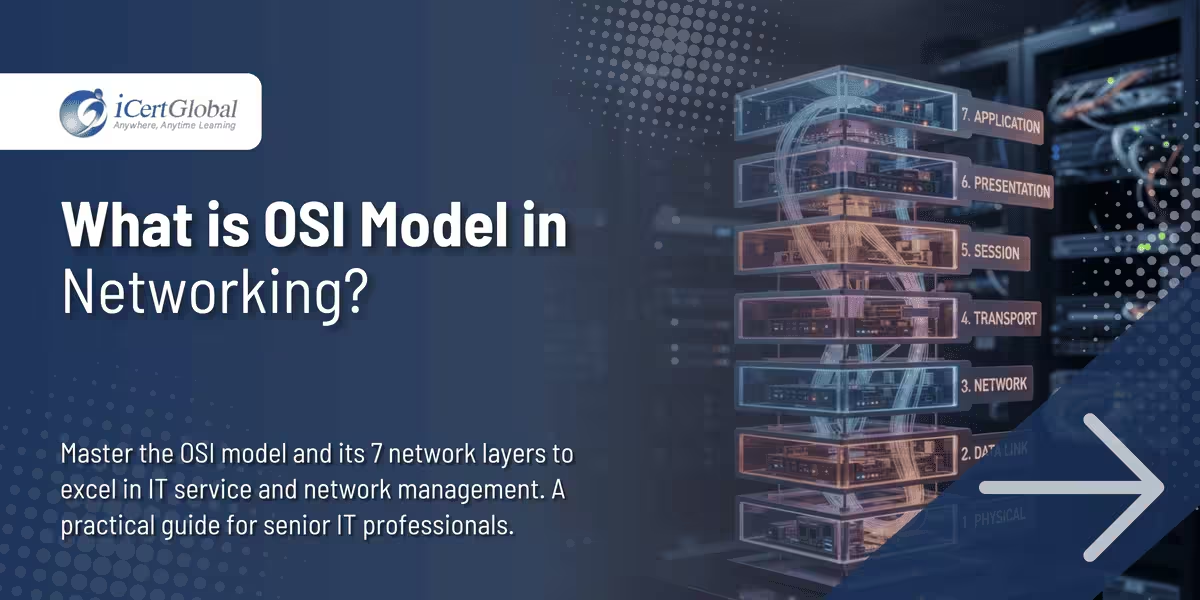
What is OSI Model in Networking
Master the OSI model and its 7 network layers to excel in IT service and network management. A...
7 Strong Advantages of ITIL Certification
Learn the top benefits of ITIL certification and how it boosts your IT career and organizational value....
Ensuring Tech Support Functions in Businesses
Learn how businesses keep their technology like computers and internet running well with ITSM and ITIL....
The Importance of COBIT in IT Management
Learn what COBIT is and why it matters for managing technology in businesses. ...



