
Your current services are operational, but are they the appropriate services? Is their funding structured effectively? The organization assesses IT based not on system availability, but on its contribution to value. If you cannot explain the ITIL Service Strategy in terms of client results, strategic resources, and monetary payback, you function as a cost center, not a collaborative partner. The ITIL Service Strategy Certification provides definitive evidence that you can look beyond technical aspects and operate at the overarching business level. This program is structured to eradicate the 'order-taker' mindset. It instructs you on the exact principles and practices necessary to delineate a service provider's specific standing in the marketplace. You will learn how to approach the four critical Service Strategy practices, including Demand Management ITIL (controlling client workload) and IT Financial Management (justifying IT expenditure). This learning module represents the central intelligence of the entire Service Lifecycle. The employment sector requires that advanced IT positions - such as CIOs, Enterprise Architects, and Strategic Planners - hold the ITIL SS credential. Without this, you lack the accredited, standardized knowledge required to secure capital and implement effective market-driven strategies common in competitive business environments in your region. Cease accepting budget limitations; begin demanding investment based on validated strategy. We developed this for professionals who grasp that market positioning and securing funds are paramount. The instruction delivers scenario-based application of the four core practices, ensuring your understanding directly translates into optimized, measurable business strategy.
ITIL Service Strategy Certification Overview Your Region
Your ITIL Service Strategy Isn't a Certificate. It's Your Mandate for Relevance
Why get ITIL SS-certified?
The Qualification That Eliminates Barriers
Cease developing services without a business rationale
The ITIL Service Strategy Certification confirms you possess the strategic understanding to validate all IT spending.
Access Senior Management Positions
This qualification acts as a crucial filter for leadership roles focused on IT Governance, Strategy, and IT Financial Management.
Finalize the Lifecycle
Obtain 3 credits toward your ITIL Expert status, confirming your proficiency in the critical ITIL Lifecycle SS stage.
ITIL Service Strategy Training Course Highlights
Beyond Standard Training - It's Your Professional Catalyst
Core Lifecycle Module
Secures 3 credits toward your ITIL Expert standing, fulfilling an essential requirement of the ITIL Lifecycle SS pathway.
Master the Four Processes
Extensive exploration of IT Financial Management, Demand Management ITIL, Service Portfolio Management, and Service Strategy Management.
Strategic Integration
Intensive instruction on how ITIL Service Strategy processes govern all following lifecycle phases (Design, Transition, Operation).
Value Justification Focus
Acquire expertise in methods for communicating service value utilizing utility, warranty, and client resources - the foundation of the benefit of ITIL Service Strategy.
ITIL SS Exam Precision
Practice using scored practice tests that mirror the scenario-based, multiple-choice structure needed to succeed on the Intermediate examination.
Service Provider Types
Comprehend the three categories of service providers (In-house, Outsourced, Shared) and the unique approaches each must employ.
Skills You Will Gain In Our ITIL SS Program
From Conceptual Understanding to Practical Application
Ideal Participants for ITIL SS Certification
This certification training is ideal for:
If your duties require you to validate the investment worth of ITIL Service Strategy and influence the trajectory of the IT department, this certification is essential.
ITIL SS Certification Training Program Roadmap
The Systematic Path to Success on Your First Try
Eligibility and Pre-requisites for ITIL Service Strategy Certification
ITIL SS Certification
This is an Intermediate Lifecycle unit. The mandates are stringent:
ITIL Service Strategy Course Modules
Comprehensive curriculum covering all exam domains
Principles and Foundation
Lesson 1: Purpose and Objectives of Service Strategy
Define the scope and critical goal of ITIL Service Strategy definition and its role in translating business objectives into strategic IT goals.
Lesson 2: Service Provider Types, Value, and Assets
Master the concepts of Utility, Warranty, Value, and the four Service Assets (Management, Organization, Process, Knowledge) that justify IT existence.
Lesson 3: The 4 Ps of Strategy
Understand how to define and manage Perspective, Position, Plan, and Pattern to establish a unique market presence.
Core Strategy Processes
Lesson 1: Service Strategy Management
Master the governance, principles, and activities required to establish and maintain the service provider's strategy.
Lesson 2: IT Financial Management
Deep dive into budgeting, accounting, and charging - the mandatory processes for funding services and ensuring cost transparency.
Lesson 3: Demand Management ITIL
Learn to analyze, forecast, and influence customer demand patterns to optimize capacity and reduce risk of resource bottlenecks.
Strategic Processes and Relationships
Lesson 1: Service Portfolio Management
Master the full lifecycle of the Service Portfolio (Define, Analyze, Approve, Charter), ensuring services align with business goals and available resources.
Lesson 2: Business Relationship Management (BRM)
Understand the strategic role of BRM in maintaining a healthy relationship between IT and the business, ensuring needs are captured and expectations are managed.
Lesson 3: Strategy Challenges, CSFs, and Risks
Analyze the common risks (e.g., funding, lack of business alignment) and Critical Success Factors (CSFs) unique to the ITIL Lifecycle SS stage.
Implementation and Governance
Lesson 1: Strategic Change Management
Review the approach to strategic change, linking it to the overall Service Lifecycle and ensuring governance consistency.
Lesson 2: Technology and Architecture
Examine how technology, architecture, and sourcing strategies are developed to support the overall ITIL Service Strategy Certification goals.
Lesson 3: Organizational Development and Governance
Understand the required organizational design and governance structures (e.g., policy, controls) to enforce the service strategy.
Exam Strategy and Final Synthesis
Lesson 1: Review of ITIL Service Strategy processes
Targeted review of the four core processes, focusing on their inputs, outputs, and interfaces with Service Design and Service Transition.
Lesson 2: Conquering the 5/3/1/0 Scoring System
Specific, focused training on identifying the 'best' answer (5 points) and eliminating the 'distractor' (0 points) on the closed-book exam.
Lesson 3: Final ITIL SS exam papers Strategy
Final mock exam execution, time management drills, and self-assessment against the exam requirements to ensure readiness.
Corporate Training
Tailored programs for teams with enterprise support

Ready to transform your team?
Get a custom quote for your organization's training needs.
Upcoming Schedule
Join the next batch that fits your timezone


Course & Support
Everything you need to know about our training options and support
Customer Testimonials
Hear from our successful graduates
"Exceptional PMP Training Experience with iCertGlobal I recently completed the PMP training by iCertGlobal, and I must say it was an outstanding experience. The instructor demonstrated a deep understanding of project management principles and brought real-world experience to the table. The training material's provided were comprehensive and well-organized, offering valuable insights and practical tips. I would highly recommend iCertGlobal to anyone looking for professional PMP Training.. "

John Anderson
"iCertGlobal provided a great learning experience with clear, well organised courses. The trainers were knowledgeable, and the support team was responsive to all my questions. The study material was comprehensive, which helped me pass my certification exam with ease. Highly recommended for anyone looking to get certified. "
James Walsh
"iCertGlobal is the best Certificate Training Organization. you will get good instructor and they will improve leaning sills and give the real time experience examples due to that you will get pass in first try. "
Andy Moran
"The course content, exam prep questions, interactive Q&A, and real-life examples made attending this PMP Project Management training class worth my time and money. The support from iCertGlobal was exceptional and I would like to thank them for accepting my request of meeting the trainer post the session for clearing my doubts."
Tim Malone
"I had a good learning experience with icertGlobal and it had been an amazing development journey. Actually, I accidentally bumped into iCertGlobal while searching for an online course for preparing my PMP examination. With positive reviews all over the internet and quick responses to my questions, I was flabbergasted enough to sign-up immediately. The instructor-led PMP preparatory course helped me both offline and online preparations. All the high-quality materials written in simple layman language was enough to grasp the gist of various topics. The instructors were very knowledgeable as they imparted not only their wealth of experiences but also real life examples. Thanks a lot iCertGlobal for imbibing this great learning experience. "
Jason Walter
"Thank you for your great course, great support, rapid response and excellent service."
Hoda Alavi
ITIL Service Strategy Training in Other Cities
Our ITIL Service Strategy certification training is available in major cities worldwide
Related Blogs
Stay updated with the latest insights and trends in project management
ITIL 4 Foundation vs Practitioner: Certification Path Explained
Compare ITIL 4 Foundation vs Practitioner. Discover which certification aligns with your career goals, boosts your salary, and...
Top 10 IT Service Management Best Practices for
Explore the top 10 IT service management best practices for modern business, from ITIL 5 and AI automation...
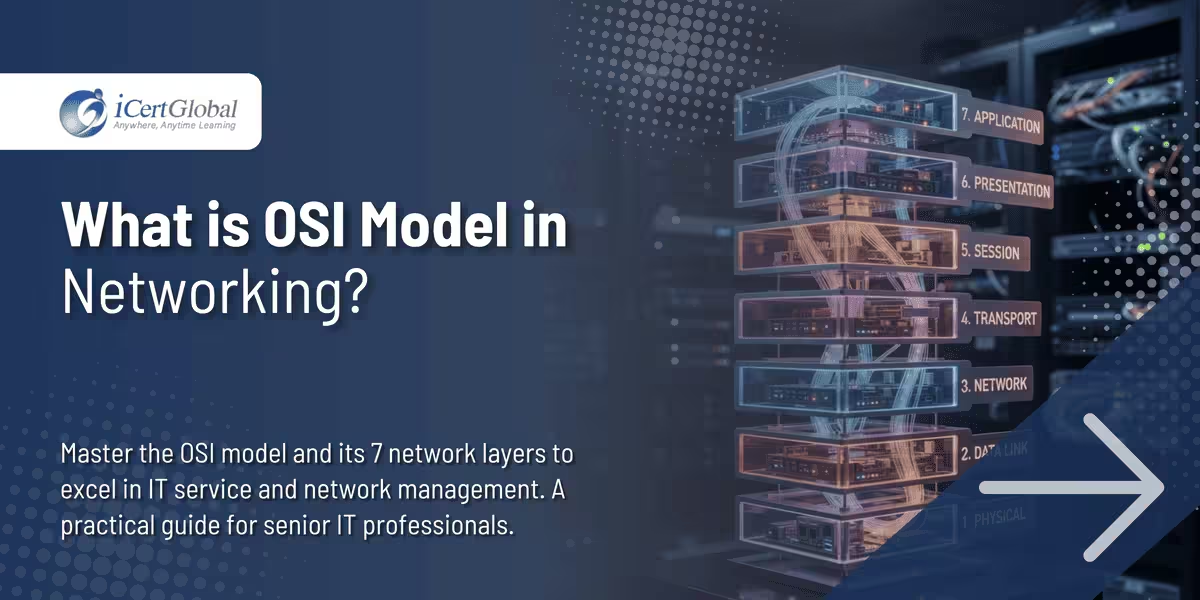
What is OSI Model in Networking
What is OSI model in networking? Learn the 7 layers, protocols, devices, how data flows, and how OSI...

