





Before You Enroll in PMI-CPMAI, Read This First
Before you take the PMI-CPMAI, learn how mastering project management ai can elevate your career, validate your skills,
Stop being stuck in mid-level roles. Get the certification that validates your experience and accelerates your path to a senior BA.
You're not a beginner anymore. You've been gathering requirements, modeling workflows, collaborating with stakeholders, and driving outcomes for years - but you're stuck in the mid-level analyst loop. You're seen as dependable, but when senior business analyst roles, lead analyst positions, or higher-paying transformation projects open up, they go to professionals who have the credential that formally validates analytical leadership ability. Your resume never even gets past the HR keyword screen without "CCBA". That ends now. This isn't another course that just makes you memorize the BABOK Guide. Our CCBA Training Program is built by practicing CBAP professionals who have worked through the exact business analysis career path you're on - navigating ambiguous requirements, conflicting stakeholders, shifting priorities, and real organizational politics. They've structured this training to teach you the BABOK framework as it actually applies in real work environments - where information is unclear, timelines clash, and stakeholder alignment is earned, not given. Unlike certification mills that only coach you to pass the exam, we build lead analyst capability. You will learn how to: 1. Conduct formal solution evaluations and present clear, data-driven recommendations to decision-makers. 2. Prepare compelling business cases that justify investment and resource allocation. 3. Use advanced analysis techniques to break down complex business problems and design solutions that deliver measurable value. The CCBA certification proves your experience - but the real transformation happens when you return to work with the confidence and authority to take full ownership of requirements on major initiatives and step into senior analyst and solution leadership roles. This program is built specifically for practicing Business Analysts with 2-5 years of experience who are ready to move beyond execution and into strategic impact. Weekday evening and weekend batches ensure your current job doesn't suffer. Sessions are fully interactive and recorded for review. And beyond the training, you get: 1. Business case templates and solution assessment frameworks 2. Case studies from Green Bay, WI fintech and e-commerce environments 3. 24/7 expert support 4. Step-by-step IIBA application guidance We even help you correctly document your 3,750 hours of business analysis experience - ensuring your CCBA application gets approved so you can focus on clearing the exam and accelerating your career. This is more than a certification program. It's your opportunity to step out of the mid-level cycle - and into high-impact work, leadership visibility, and career-defining roles.
Learn with confidence knowing our CCBA training program is officially endorsed by the International Institute of Business Analysis (IIBA) and provides the required 21 PDUs.
Unlock your potential with expert mentors who are practicing CBAP-certified professionals guiding you with real-world business analysis experience.
Choose from evening weekday batches, weekend-only classes, or a full 4-day CCBA bootcamp designed for working professionals.
Master the CCBA exam concepts quickly with 35 hours of structured, interactive learning supported by 10+ full-length exam simulators and personalized performance reviews.
Strengthen your preparation with 1500+ CCBA-specific practice questions, mock tests, and BABOK-aligned scenario-based drills mirroring the real exam.
Stay confident with continuous mentor support - from documenting your 3,750 BA experience hours for application approval to final exam-day readiness.
Earning the Certification of Capability in Business Analysis (CCBA) Certification requires a strong foundation in business analysis techniques, stakeholder analysis, and documentation. Business Analysts in Green Bay, WI, who seek CCBA certification must possess a deep understanding of requirements gathering, analysis, and management.
Effective requirements elicitation involves identifying stakeholders, defining their needs, and documenting requirements through techniques like gap analysis and use-case modeling. By mastering these skills, CCBA-certified professionals can ensure that projects meet the needs of all stakeholders and deliver successful outcomes.

Get a custom quote for your organization's training needs.
The CCBA Certification Training Program emphasizes practical application of business analysis concepts. Students learn to apply stakeholder analysis and requirements management to real-world projects, leading to improved decision-making and enhanced project outcomes.
Throughout the course, participants work on case studies that simulate business analysis scenarios, facilitating hands-on learning and development of practical skills. As learners engage with the course material, they develop the capacity to synthesize complex information and create effective solutions.
By honing their ability to analyze data, identify patterns, and make informed decisions, CCBA-certified professionals can drive innovation and improvement within their organizations. In the CCBA Certification Training Program, participants gain essential skills in stakeholder engagement, requirements documentation, and change management, equipping them to navigate complex projects with confidence.
Stop gathering vague requirements. Learn structured techniques like brainstorming, document analysis, and workshops to extract clear, actionable information from even the most difficult stakeholders.
Master managing and maintaining requirements from inception to retirement. Learn to handle changes, trace requirements, and gain formal sign-offs to prevent scope creep.
Move beyond being a note-taker. Learn to analyze the current state, define the future state, assess risks, and recommend solutions that deliver measurable business value.
Become proficient at modeling and specifying requirements. Learn to use process models, data models, and use cases to create a clear blueprint for technical implementation.
Don't just define the solution - prove its effectiveness. Learn frameworks to assess performance, identify limitations, and recommend improvements for higher value delivery.
Bring structure to complex environments. Learn how to plan your BA approach, align stakeholders, and monitor progress to ensure outcomes are delivered successfully.
If you have 2-3 years of business analysis experience and are ready to formalize your skills and accelerate your career, this program is engineered to get you CCBA-certified.
The CCBA Certification Training Program fosters growth and professional development in business analysts. By acquiring skills in business analysis, requirements management, and documentation, learners can enhance their career prospects and expand their professional network.
In addition to technical skills, the program emphasizes the importance of soft skills, such as communication, collaboration, and problem-solving, in a business analyst's toolkit. As learners progress through the course, they develop a deeper understanding of the business analysis lifecycle, from initiation to implementation.
Upon completion of the CCBA Certification Training Program, participants can expect to see significant improvements in their analytical skills, stakeholder engagement, and project management abilities, setting them up for greater success in their careers.


Get the mid-level and senior Business Analyst interviews your hands-on experience already qualifies you for.
Access the compensation tiers and bonus structures reserved for certified and formally validated Business Analysts.
Move beyond documenting requirements and step into a role where you shape business decisions and solution outcomes.
The CCBA certification is respected globally because it is not for beginners. The IIBA has established clear benchmarks to ensure every candidate has real, practical business analysis experience - not just theoretical knowledge. Here is the high-level breakdown of what you need to qualify:
3,750 Hours of Business Analysis Work Experience: You must have at least 3,750 hours (approximately 2-3 years) of hands-on BA work completed within the last 7 years.
Knowledge Area Alignment: Within those 3,750 hours, you must demonstrate either:
A minimum of 900 hours in at least two of the six BABOK Guide Knowledge Areas, OR
500 hours in at least four of the six Knowledge Areas.
21 Hours of Professional Development (PDUs): You need 21 hours of formal BA training completed within the last 4 years - which this CCBA training program provides.
Professional References: You must submit two references from a career manager, client, or a CBAP professional. Our end-to-end application support ensures this documentation is completed correctly.
The CCBA Certification Training Program has significant industry applicability, with a broad range of organizations recognizing the value of business analysis skills. The course content aligns with industry standards and best practices, ensuring that learners develop skills that are relevant and in demand.
In the business analysis field, the CCBA certification is a widely recognized standard of excellence, demonstrating a professional's mastery of business analysis concepts and techniques. Throughout the course, learners develop a deep understanding of the role of business analysis in organizations, including its relationship to project management, strategy development, and operational improvement.
Upon completion of the CCBA Certification Training Program, participants can leverage their knowledge and skills to drive business success and deliver value to their organizations.
Advance your communication and elicitation skills. Learn how to confirm elicitation results, accurately document findings, and engage stakeholders with confidence.
Build a complete system for managing requirements across their lifecycle. Master techniques for tracing, prioritizing, and maintaining requirements to maximize business value.
Prevent scope creep by learning how to evaluate, approve, and communicate changes effectively. Gain solid change management capabilities essential for senior BA roles.
Learn to analyze current and future organizational states, evaluate risks, and define strategy recommendations that deliver measurable business value. Move from task execution to strategic advisory.
Transform raw requirements into structured specifications. Learn to use process models, data models, and workflow diagrams to communicate clearly with technical and business teams.
Define design options and recommend the best solution approach. Learn to verify and validate requirements to ensure alignment with business goals.
Learn to evaluate solution performance, identify limitations, and recommend improvements based on real metrics and enterprise needs.
Gain hands-on proficiency with essential business analysis methods including SWOT analysis, root cause analysis, and business rules analysis.
Apply all key concepts in a real-world case study. Move from problem identification to solution recommendation using proven Business Analysis frameworks.
Receive guided support to correctly document your 3,750 hours of BA experience and 21 PDUs to create an audit-proof CCBA application.
Master the CCBA exam format through time-bound practice tests, scenario-based question breakdowns, and test-taking strategies.
Finalize your preparation with full assessments, targeted feedback, and exam confidence-building strategies to ensure first-attempt success.
Upon completing the Certification of Capability in Business Analysis (CCBA) Certification Training Program, learners can expect to assume a variety of work responsibilities. CCBA-certified business analysts are sought after by organizations for their ability to analyze complex business problems, identify opportunities for improvement, and develop effective solutions.
These professionals are responsible for gathering and analyzing requirements, identifying and mitigating project risks, and communicating with stakeholders throughout the project lifecycle. They work closely with project managers, IT specialists, and other stakeholders to ensure successful project outcomes and deliver value to the organization.
In addition to technical responsibilities, CCBA-certified business analysts are also expected to engage with stakeholders, build relationships, and facilitate collaborative efforts to drive business success.
Great class, very informative.

Great PMP<sup>®</sup> Bootcamp. I had a great time taking this course. I took the course to prepare to sit for the CAPM<sup>®</sup> but may be able to sit for the PMP<sup>®</sup>. I learnt a lot was challenging. Great course. We need one more day. Content was very detailed.

it was a great class. Lots of energy. And I enjoyed.

Fantastic course to prepare for PMP<sup>®</sup> exam.

As a participant it was smooth sailing for me.

Trainer was excellent. Shared good resources and good experiences.

Good content and training.
I wanted to let you know that I took and passed the PMP exam. Thanks to iCert Global and especially my Cincinnati course instructor, who was an excellent teacher and helped me immensely.

Trainer was good. Trainer was very engaged and interacting. Very much satisfied with the training.

I was pleasantly surprised at the quality of this training. Yomi was awesome as a trainer and working to make sure that we understood the concepts. Controlling Cost and Controlling Risk are the most complicated, but Yomi spent time after class working through questions to help others understand. This class also helped to change my perception of the PMP being this MONSTER to something that I can I can successfully do.

Great class with a lot of information and tips to prepare for the exam

It was a great course, covered all the things that i ended up hitting road bumps on. I was the only one in the class, but the trainer was just as involved as if it had been a full class.

I was nervous about taking it online versus classroom; but I am actually glad I took it online. Instructor was very great and gave a good learning experience with his relevant project management experience.
The training was very intense but covered with course material. It was more than I expected.

I thought the class was very informative. The instructor did an excellent job breaking down each chapter to where it was easy to understand. I was also very impressed with his commitment to help us pass ever after the class is over.

Excellent training. Instructor was very knowledgeable and explained information in an understandable way
Quality Materials presented, Instructor very knowledgeable. Exceeded my expectations.
The training is a great introduction into the PMI mindset. Very informative and helpful

Stay updated with the latest insights and trends in your field
Before you take the PMI-CPMAI, learn how mastering project management ai can elevate your career, validate your skills,

Master the critical data scientist skills that separate beginners from top-tier professionals and accelerate your career growth.

Map your data scientist career path for 2026. Learn the high-demand skills, certifications, and real salary expectations you

Prepare for your data science career with the real insights nobody shares. Learn the practical skills and exam-ready

Discover the core skills you need to build a successful data scientist career. Master the essential expertise that

Compare CISA vs CRISC to find your ideal ISACA path. Analyze exam difficulty, career outlook, and skills to
Master the 5 domains of the CISA Certification Syllabus. Get the complete 2026 exam guide to pass on

Discover the CCNA salary in India from fresher to senior roles. Learn how to leverage this certification to
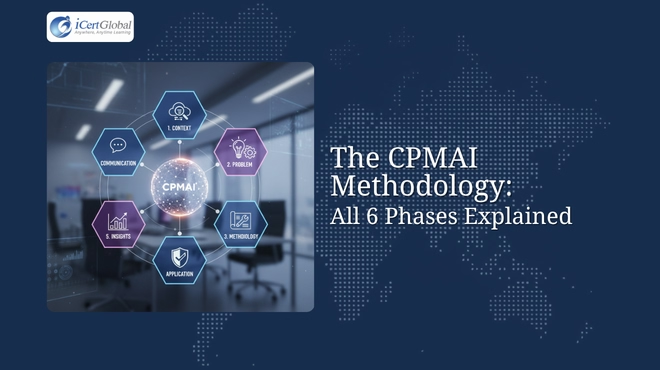
Master the 6 phases of the CPMAI methodology. Learn how to manage AI projects, pass your certification exam,
Advance your career with the PMI-CPMAI certification. Discover how to manage ethical AI projects, master the methodology, and

Our experts are ready to help you with any questions about courses, admissions, or career paths. Get personalized guidance from industry professionals.
Request a Call Back

"PMI®", "PMBOK®", "PMP®", "CAPM®" and "PMI-ACP®" are registered marks of the Project Management Institute, Inc. | "CSM", "CST" are Registered Trade Marks of The Scrum Alliance, USA. | COBIT® is a trademark of ISACA® registered in the United States and other countries.
