





Before You Enroll in PMI-CPMAI, Read This First
Before you take the PMI-CPMAI, learn how mastering project management ai can elevate your career, validate your skills,
Stop messing with broken proof-of-concepts. Get the verified, end-to-end credential that validates your ability to build, connect, and manage Azure-integrated IoT solutions from the sensor to the clou
You're a junior developer or a curious engineer who has pieced together components - a disconnected sensor here, a messy cloud function there. You understand the individual elements, but your projects constantly fail at the connectivity, security, or data pipeline stages. In the professional Cedar Falls, IA market, whether in logistics, smart buildings, or manufacturing, these gaps in competence with IoT devices and IoT cloud integration can lead to massive financial losses. Without the ability to deliver secure, reliable, end-to-end IoT solutions, you remain stuck in the low-skill band. This is not a theoretical exercise. Our Certified IoT Architect - Practical Solutions (CIoT) Training Program is designed by Azure-certified IoT specialists and industry veterans who have managed large-scale IoT projects across Cedar Falls, IA enterprises. They understand why connectivity fails, why raw sensor data is often unusable, and how to structure solutions that scale seamlessly from 10 devices to 10,000. This program ensures you build working, production-ready IoT applications, not just prototypes. Through this program, you will stop writing throwaway code and start designing robust, manageable systems. You will master MQTT protocol optimization, securely provision IoT devices like Raspberry Pi to Azure IoT Hub, implement real-time IoT analytics with Stream Analytics, and design effective Remote Monitoring dashboards. The certification is merely proof - the real value is walking into client meetings in Pune or Delhi and confidently presenting a live, fully functional, and scalable IoT solution prototype. Our curriculum is structured for the technical professional who demands tangible, job-ready skills. It features intensive evening and weekend batches, mandatory hardware simulation and IoT cloud integration labs, 24/7 expert support, and a focused methodology to master the integrated Azure IoT ecosystem. Participants will gain experience with real-world IoT devices examples, understand IoT definitions and industry use cases, and explore how leading IoT companies implement high-impact IoT projects.
Mandatory, hands-on labs focused on connecting physical Raspberry Pi/Sense HAT data to the cloud ingestion point.
Learn from certified professionals who implement Azure IoT Hub, Stream Analytics, and Time Series Insights for enterprise clients.
Intensive, scenario-based lab work covering device setup, protocol implementation, cloud configuration, and remote troubleshooting.
Deep dives into MQTT, its security model, and implementation for reliable, low-power device communication.
Access to 1200+ complex, scenario-based integration questions and 10+ full-length mock exams to build practical endurance.
Immediate, authoritative guidance on your toughest device setup, connectivity, and Azure service integration challenges.
As a Certified IoT Architect, you will be responsible for designing and implementing IoT systems that integrate various devices, sensors, and networks to collect and analyze data. Your primary focus will be on ensuring the scalability, security, and reliability of these systems, while also meeting the business requirements of your organization. This role requires expertise in IoT protocols, data analytics, and cloud computing.
The primary objective of IoT systems is to process vast amounts of data in real-time, using techniques such as event-driven architecture and microservices. You must be familiar with data ingestion, processing, and visualization tools, such as Kafka, Spark, and Tableau. Additionally, you will need to design robust IoT device management systems, incorporating mechanisms for secure firmware updates and device authentication.
In Cedar Falls, IA, where industrial automation is a significant sector, IoT Architects must have a strong understanding of factory automation protocols, such as OPC-UA and PROFINET, to integrate machines and sensors seamlessly. This is essential for creating smart factories that optimize production efficiency and reduce downtime.

Get a custom quote for your organization's training needs.
Industry applicability of IoT Architect skills is vast, spanning across manufacturing, healthcare, transportation, and energy sectors. You will need to evaluate the feasibility of IoT solutions in various industries, taking into account the specific business needs and technical constraints. For instance, in healthcare, IoT systems can improve patient outcomes by remotely monitoring vital signs and medication adherence.
In industries where machinery and equipment are critical, IoT systems can reduce downtime and improve maintenance efficiency through real-time monitoring and predictive analytics. For example, in the manufacturing sector, IoT sensors can track equipment performance, detecting anomalies that may lead to equipment failure, allowing for proactive maintenance. In the context of IoT, analytics and data visualization play a critical role in decision-making.
As a Certified IoT Architect, you will work on collecting, processing, and analyzing data from various sources, including IoT devices, legacy systems, and social media. You must be proficient in data science tools, such as Python, R, and TensorFlow, and libraries like pandas, NumPy, and Matplotlib.
Learn to physically set up and program a Raspberry Pi with sensors (Sense HAT) and securely connect it to the Azure cloud using device twins.
Master the use, configuration, and security best practices of MQTT - the mandatory IoT communication standard - for reliable, bandwidth-efficient messaging.
Achieve functional mastery of IoT Hub for device provisioning, identity management, messaging, and bidirectional communication (Device-to-Cloud, Cloud-to-Device).
Learn to use Azure Stream Analytics to ingest, process, and analyze high-velocity sensor data in real-time, generating immediate business alerts.
Design and implement a complete Azure Remote Monitoring solution, including data visualization (Power BI/Azure Dashboards) and effective threshold alerting.
Master the process of generating and managing device authentication keys/certificates and securely registering thousands of devices without manual intervention.
If your current role requires you to bridge the gap between physical hardware and the Azure cloud to deliver functional, scalable prototypes or solutions in the Cedar Falls, IA enterprise market, this program provides the mandatory integrated skills.
In Cedar Falls, IA's vibrant tech community, professionals in software development and data science play a crucial role in driving innovation. IoT Architects are essential in creating the backbone of IoT systems, which integrate various devices and sensors. This expertise is highly sought after in large enterprises, startups, and government institutions.
While some companies already possess in-house IoT expertise, many organizations face challenges in finding skilled professionals who can design, develop, and deploy complex IoT systems. As a Certified IoT Architect, you can bridge this skill gap by offering your expertise in areas such as cloud computing, data analytics, and device management. In areas with limited IoT expertise, like Cedar Falls, IA, the demand for skilled IoT Architects is particularly high.
Companies are eager to adopt IoT solutions to stay competitive, but they lack the talent to implement these systems effectively. By completing this training program, you can fill this gap and help drive the growth of IoT adoption in your region.
Stop getting filtered out for roles demanding Azure IoT Hub, Stream Analytics, and MQTT proficiency.
Unlock mid-level salary bands by proving you can deliver a secure, working, end-to-end solution from the physical device to the cloud application.
Validate integrated, practical skills across hardware, protocol, and cloud, eliminating the need for separate, disconnected component training.
This program is focused on providing practical, integrated skills, making the requirements more skill-based than experience-based.
Technical Familiarity: A working knowledge of a programming language (Python/C#), basic networking concepts, and familiarity with the Azure cloud concept is required.
Hardware Access (Recommended): While labs can be simulated, ownership of a Raspberry Pi and Sense HAT is strongly encouraged to maximize the practical value.
The reality: If you cannot write a simple Python script or manage a cloud resource group, the initial integration steps will prove highly frustrating. This program assumes foundational technical competence.
The Certified IoT Architect Training Program focuses on developing a comprehensive set of skills necessary for designing, implementing, and managing IoT systems. You will learn how to integrate various devices, sensors, and networks using IoT protocols and data analytics tools. This training covers cloud computing, device management, and data science, empowering you to tackle complex IoT projects.
Upon completing the training, you will be equipped to handle tasks such as device integration, data ingestion, and analytics, using tools like AWS IoT Core, Azure IoT Hub, and Google Cloud IoT Core. Additionally, you will learn about IoT security, device identity management, and secure firmware updates. As a Certified IoT Architect, you will be able to apply your skills in a variety of industries and roles, including IoT system design, implementation, and management.
This expertise is highly valued by employers, ensuring you a competitive edge in the job market.
Deep dive into MQTT (Publish/Subscribe, Quality of Service (QoS), Retained Messages) and a conceptual overview of AMQP/HTTP for IoT workloads.
Mastering the creation and secure configuration of Azure IoT Hub. Learning the process for generating device identities and securely provisioning the Raspberry Pi device.
Hands-on session on connecting the Raspberry Pi client to IoT Hub via the MQTT protocol and successfully sending sensor telemetry data to the cloud.
Mastering Device Twins and Direct Methods for sending commands from the Azure cloud back to the Raspberry Pi for remote control and configuration updates.
Learning to use Azure Stream Analytics to ingest the sensor data, define queries, and implement real-time threshold alerting based on business logic.
Designing the architecture for long-term data persistence (Azure Data Explorer/SQL) and creating functional remote monitoring dashboards using Azure/Power BI.
Mastering Shared Access Signature (SAS) tokens and X.509 Certificate-based authentication for secure device identity and provisioning.
Learning to use Azure IoT Hub Diagnostics and monitoring tools to troubleshoot common issues: device disconnection, message throttling, and data latency.
Conceptual understanding of security at the edge (secure boot) and implementing over-the-air (OTA) device configuration and software updates via the cloud.
Understanding partitioning in IoT Hub for massive ingestion scale. Designing for high availability in the cloud and device resiliency during network outages.
Conceptual overview of Azure IoT Edge and when to move processing and logic from the cloud to the Raspberry Pi device for reduced latency and bandwidth.
Consolidating knowledge, final project review, and guidance on pursuing advanced, specialization certifications (e.g., Azure IoT Developer, Industrial IoT).
The Certified IoT Architect Training Program is designed to address the skill gap that exists in the industry. Many professionals lack the necessary expertise in IoT protocols, data analytics, and cloud computing to design and implement robust IoT systems.
While some training programs focus on specific aspects of IoT, such as device management or analytics, this program offers a comprehensive learning experience, covering the entire spectrum of IoT architecture. You will gain hands-on experience with various tools and technologies, preparing you to tackle real-world IoT projects.
As a result, you will be able to design, implement, and manage IoT systems more efficiently, reducing the time and cost associated with these projects. This expertise will not only enhance your career prospects but also contribute to the growth of IoT adoption in various industries, including Cedar Falls, IA's vibrant tech community.
Great class, very informative.

Great PMP<sup>®</sup> Bootcamp. I had a great time taking this course. I took the course to prepare to sit for the CAPM<sup>®</sup> but may be able to sit for the PMP<sup>®</sup>. I learnt a lot was challenging. Great course. We need one more day. Content was very detailed.

it was a great class. Lots of energy. And I enjoyed.

Fantastic course to prepare for PMP<sup>®</sup> exam.

As a participant it was smooth sailing for me.

Trainer was excellent. Shared good resources and good experiences.

Good content and training.
I wanted to let you know that I took and passed the PMP exam. Thanks to iCert Global and especially my Cincinnati course instructor, who was an excellent teacher and helped me immensely.

Trainer was good. Trainer was very engaged and interacting. Very much satisfied with the training.

I was pleasantly surprised at the quality of this training. Yomi was awesome as a trainer and working to make sure that we understood the concepts. Controlling Cost and Controlling Risk are the most complicated, but Yomi spent time after class working through questions to help others understand. This class also helped to change my perception of the PMP being this MONSTER to something that I can I can successfully do.

Great class with a lot of information and tips to prepare for the exam

It was a great course, covered all the things that i ended up hitting road bumps on. I was the only one in the class, but the trainer was just as involved as if it had been a full class.

I was nervous about taking it online versus classroom; but I am actually glad I took it online. Instructor was very great and gave a good learning experience with his relevant project management experience.
The training was very intense but covered with course material. It was more than I expected.

I thought the class was very informative. The instructor did an excellent job breaking down each chapter to where it was easy to understand. I was also very impressed with his commitment to help us pass ever after the class is over.

Excellent training. Instructor was very knowledgeable and explained information in an understandable way
Quality Materials presented, Instructor very knowledgeable. Exceeded my expectations.
The training is a great introduction into the PMI mindset. Very informative and helpful

Stay updated with the latest insights and trends in your field
Before you take the PMI-CPMAI, learn how mastering project management ai can elevate your career, validate your skills,
Master the critical data scientist skills that separate beginners from top-tier professionals and accelerate your career growth.
Map your data scientist career path for 2026. Learn the high-demand skills, certifications, and real salary expectations you
Prepare for your data science career with the real insights nobody shares. Learn the practical skills and exam-ready
Discover the core skills you need to build a successful data scientist career. Master the essential expertise that

Compare CISA vs CRISC to find your ideal ISACA path. Analyze exam difficulty, career outlook, and skills to
Master the 5 domains of the CISA Certification Syllabus. Get the complete 2026 exam guide to pass on
Discover the CCNA salary in India from fresher to senior roles. Learn how to leverage this certification to
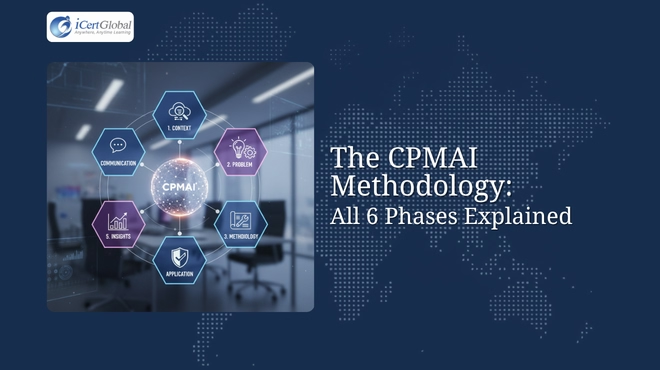
Master the 6 phases of the CPMAI methodology. Learn how to manage AI projects, pass your certification exam,
Advance your career with the PMI-CPMAI certification. Discover how to manage ethical AI projects, master the methodology, and

Our experts are ready to help you with any questions about courses, admissions, or career paths. Get personalized guidance from industry professionals.
Request a Call Back

"PMI®", "PMBOK®", "PMP®", "CAPM®" and "PMI-ACP®" are registered marks of the Project Management Institute, Inc. | "CSM", "CST" are Registered Trade Marks of The Scrum Alliance, USA. | COBIT® is a trademark of ISACA® registered in the United States and other countries.
