






Before You Enroll in PMI-CPMAI, Read This First
Before you take the PMI-CPMAI, learn how mastering project management ai can elevate your career, validate your skills,
Stop patching systems reactively. Become the non-negotiable security expert who finds vulnerabilities before the actual threat actors do, securing your career and commanding top-tier salaries.
If your current security role involves constant fire drills - reacting to breaches, chasing false positives, and managing compliance paperwork - you know the basics of network defense but lack structured offensive knowledge. Ethical Hacking Certification holders, however, run penetration tests, define organizational security posture, and earn ethical hacking salaries 30-50% higher. Without this credential, your resume often gets dismissed. That ends now. This is not a theoretical ethical hacking course. Our Ethical Hacking Training is designed by seasoned security experts who have defended critical infrastructure, banking systems, and IT services in high-stakes Marion, IAenterprises. You'll learn real-world tools, techniques, and procedures (TTPs) used by cybercriminals - exploiting vulnerabilities, escalating privileges, and evading defenses. Unlike typical certification mills, we focus on building offensive security capability. You'll master Kali Linux, execute buffer overflows, conduct SQL injections, and pivot through compromised networks. The ethical hacking exam is just proof - the true value is being able to deliver actionable, non-negotiable security audits in major organizations across Marion, IA. This program is built for working IT and security professionals. You'll get live, instructor-led sessions, hands-on labs, 24/7 practice environments, and expert support. Completing this ethical hacking course online equips you with skills to cut through defensive noise and perform security assessments that save companies millions.
Learn the precise, five-phase methodology (Reconnaissance to Maintaining Access) used by top penetration testers globally.
Unlock your offensive potential with instructors who are certified, active security practitioners experienced in real-world red team operations.
Master every technique in a dedicated, isolated virtual range, ensuring you practice complex hacks without risking live systems.
Master critical exploits fast with 40+ hours of intense, practical training and individualized feedback on your lab reports.
Dominate the exam with 2500+ realistic questions and mock tests designed to build both technical knowledge and testing endurance.
Be worry-free as certified ethical hackers are available 24/7 to troubleshoot lab issues, clear conceptual roadblocks, and guide you at every step.
In Ethical Hacking Certification Training Program, demonstrating professional credibility is essential for securing a job in this field. To achieve certification, candidates must complete training programs, such as the one offered here in Marion, IA, which cover penetration testing, vulnerability assessment, and threat analysis. Their knowledge of security protocols, including HTTPS and DNS tunneling, will help them identify weaknesses in an organization's defenses.
They will also study various hacking techniques, including phishing and SQL injection attacks, to understand the thought process behind these malicious activities. This training will allow them to demonstrate their expertise in security testing, incident response, and risk management. As a result, certified professionals will be better equipped to identify vulnerabilities and provide recommendations for remediation, thereby enhancing an organization's overall security posture.
Effective risk management is crucial in today's technology landscape, and this training program equips professionals with the necessary skills to mitigate threats.

Get a custom quote for your organization's training needs.
As an Ethical Hacker, professionals are responsible for simulating cyber attacks against an organization's networks, systems, and applications. This involves conducting risk assessments, identifying vulnerabilities, and developing mitigation strategies. The Ethical Hacking Certification Training Program provides valuable hands-on experience in this field, allowing students to work with industry-standard hacking tools and frameworks.
During the training, students will learn about social engineering techniques, such as pretexting and baiting, as well as exploit development and binary analysis. This comprehensive training program also covers security policies, procedures, and compliance regulations, ensuring that graduates are equipped to meet the demands of a rapidly evolving threat landscape. Upon completion, professionals will be qualified to perform penetration testing and vulnerability assessments.
Upon graduation, professionals will be well-prepared to fill key roles in organizations, including penetration testers, security consultants, and incident responders. They will be able to analyze complex security threats, develop effective countermeasures, and provide recommendations for improving an organization's overall security posture.
Move beyond Google with ethical hacking techniques like DNS enumeration, OS fingerprinting, and OSINT. Map target networks completely before launching attacks, preparing you for real-world scenarios assessed in the ethical hacking exam.
Stop relying solely on automated tools. Understand the underlying concepts of buffer overflows and exploit payloads so you can customize attacks and bypass standard defense mechanisms.
Master staying undetected by bypassing IDS, WAF, and next-gen antivirus systems using advanced payload encoding and tunneling - a core skill in any ethical hacking course.
Focus intensely on the most critical threats: SQL Injection, Cross-Site Scripting (XSS), and Broken Authentication. Learn to exploit these flaws and demonstrate their business impact.
Go beyond WPA cracking. Learn to compromise wireless infrastructure (access points, controllers) and gain unauthorized access to data within Android and iOS platforms.
Document every finding professionally. Produce actionable penetration test reports with clear risk assessment and remediation steps - a critical skill recognized by employers hiring ethical hacking course graduates.
If your current job involves defending systems, managing security infrastructure, or auditing application security, this program provides the offensive knowledge required to proactively close critical security gaps and advance into senior roles.
The Ethical Hacking Certification Training Program focuses on developing critical skills in security testing, incident response, and risk management. This comprehensive training program covers various hacking techniques, including network scanning, enumeration, and exploitation. Students will also learn about intrusion detection systems, security information and event management, and threat intelligence.
During the training, students will develop practical skills in using industry-standard tools, such as Nmap, Nessus, and Metasploit. They will also learn about cloud security, including AWS and Azure, and develop skills in web application security, including OWASP and security testing frameworks. This training will enable professionals to analyze complex security threats and develop effective countermeasures.
By completing this training program, professionals will be qualified to work as security consultants, penetration testers, and incident responders. They will be able to analyze complex security threats, develop effective countermeasures, and provide recommendations for improving an organization's overall security posture.


Get noticed for high-paying roles in banking, defense, and major IT services that mandate this credential.
Access specialized compensation and bonus structures reserved for professionals who can deliver complete offensive security assessments.
Transition into proactive security leadership and earn a seat at the table where strategic security decisions are made.
This certification is a serious commitment and reflects a high level of technical competency. It is not for beginners - candidates must already have a foundation in networking and systems administration. Below is the high-level breakdown of what you need to qualify.
Mandatory Formal Training: Completion of an accredited, hands-on training program (such as our immersive, lab-heavy course) is often mandatory or highly recommended to obtain the required practical hours and verifiable lab experience.
Recommended Professional Experience: Candidates should typically possess a minimum of 2 years of professional experience in Information Security, IT networking, or Systems Administration roles. Strong consideration is given to real-world incident response, SOC, or vulnerability assessment experience.
Prerequisite Knowledge: A solid, non-negotiable understanding of TCP/IP, routing & switching fundamentals, Windows and Linux internals, firewall and IDS/IPS concepts, and basic virtualization/containerization is required before attempting this certification.
Note: Specific certifying bodies may impose additional eligibility rules (documented lab hours, proctored exams, or documented work experience). Our program is designed to meet or exceed common accreditation requirements and to prepare you for any additional paperwork or verification steps.
The Ethical Hacking Certification Training Program provides a solid foundation for a successful career in the field of cybersecurity. Upon completion, professionals will have gained extensive knowledge and skills in security testing, incident response, and risk management. They will be qualified to work in various industries, including finance, healthcare, and government.
As professionals in this field continue to grow and develop their skills, they will be well-prepared for leadership roles and advanced certifications. They will be able to analyze complex security threats, develop effective countermeasures, and provide recommendations for improving an organization's overall security posture. By completing this training program, professionals will be able to stay up-to-date with the latest threats and technologies, ensuring they remain competitive in the job market.
They will be able to demonstrate their expertise in security testing, incident response, and risk management.
Learn to execute buffer overflows, brute-force attacks, and crack password hashes. Master privilege escalation techniques to gain administrative control over compromised systems.
Understand the function of various malware types (Trojans, Ransomware, Rootkits). Learn to analyze malware behavior and deploy your own undetectable payloads for remote access.
Master network traffic interception using tools like Wireshark. Execute MiTM (Man-in-the-Middle) attacks and exploit weak session management to hijack active user sessions and gain unauthorized access.
Learn the psychology of human manipulation in ethical hacking training. Master phishing, pretexting, and physical security bypass methods to gain initial network access, addressing the most common weaknesses targeted in the ethical hacking exam.
Identify and exploit vulnerabilities in web servers, including misconfigurations and directory traversal. Focus on OWASP Top 10 threats such as XSS and CSRF, essential skills in any ethical hacking course online or hands-on training.
Go beyond basic injection. Learn to bypass WAFs, extract entire database schemas, and utilize advanced techniques like blind SQL injection to compromise back-end data stores.
Learn real attack vectors and testing methods for volume-based, protocol, and application-layer DoS/DDoS. Assess network resilience and mitigation strategies used in professional ethical hacking training and penetration tests.
Explore Android and iOS security flaws - insecure storage, weak crypto, and vulnerable APIs. Practice reverse engineering mobile apps and exploiting mobile backends as part of an ethical hacking course online or in-person lab training.
Master advanced evasion: fragmented packets, custom protocols, tunneling, and other techniques to bypass IDS/IPS, firewalls, and honeypots without detection - core skills for Ethical Hacking Certification and real-world red-team engagements.
Analyze the unique security risks of IaaS and SaaS environments (e.g., AWS, Azure). Learn to exploit misconfigured storage buckets, identity and access management (IAM) roles, and serverless functions.
Understand the flaws in common cryptographic algorithms (e.g., MD5, SHA-1). Learn to execute password attacks and crack weak encryption to gain access to sensitive data.
Master the standard for professional penetration test reporting. Consolidate your knowledge and execute full-length simulations to achieve peak exam readiness and certification success.
The Ethical Hacking Certification Training Program has a wide range of industry applications, including finance, healthcare, government, and e-commerce. Professionals with this certification will be qualified to work in various roles, including penetration testers, security consultants, and incident responders.
Upon graduation, professionals will be well-prepared to analyze complex security threats, develop effective countermeasures, and provide recommendations for improving an organization's overall security posture. This training program covers various hacking techniques, including network scanning, enumeration, and exploitation.
To ensure they remain current with industry developments, professionals can pursue advanced certifications, such as CompTIA Security+ or CISSP. This will enable them to demonstrate their expertise in security testing, incident response, and risk management, and remain competitive in the job market.
Great class, very informative.

Great PMP<sup>®</sup> Bootcamp. I had a great time taking this course. I took the course to prepare to sit for the CAPM<sup>®</sup> but may be able to sit for the PMP<sup>®</sup>. I learnt a lot was challenging. Great course. We need one more day. Content was very detailed.

it was a great class. Lots of energy. And I enjoyed.

Fantastic course to prepare for PMP<sup>®</sup> exam.

As a participant it was smooth sailing for me.

Trainer was excellent. Shared good resources and good experiences.

Good content and training.
I wanted to let you know that I took and passed the PMP exam. Thanks to iCert Global and especially my Cincinnati course instructor, who was an excellent teacher and helped me immensely.

Trainer was good. Trainer was very engaged and interacting. Very much satisfied with the training.

I was pleasantly surprised at the quality of this training. Yomi was awesome as a trainer and working to make sure that we understood the concepts. Controlling Cost and Controlling Risk are the most complicated, but Yomi spent time after class working through questions to help others understand. This class also helped to change my perception of the PMP being this MONSTER to something that I can I can successfully do.

Great class with a lot of information and tips to prepare for the exam

It was a great course, covered all the things that i ended up hitting road bumps on. I was the only one in the class, but the trainer was just as involved as if it had been a full class.

I was nervous about taking it online versus classroom; but I am actually glad I took it online. Instructor was very great and gave a good learning experience with his relevant project management experience.
The training was very intense but covered with course material. It was more than I expected.

I thought the class was very informative. The instructor did an excellent job breaking down each chapter to where it was easy to understand. I was also very impressed with his commitment to help us pass ever after the class is over.

Excellent training. Instructor was very knowledgeable and explained information in an understandable way
Quality Materials presented, Instructor very knowledgeable. Exceeded my expectations.
The training is a great introduction into the PMI mindset. Very informative and helpful

Stay updated with the latest insights and trends in your field
Before you take the PMI-CPMAI, learn how mastering project management ai can elevate your career, validate your skills,

Master the critical data scientist skills that separate beginners from top-tier professionals and accelerate your career growth.

Map your data scientist career path for 2026. Learn the high-demand skills, certifications, and real salary expectations you

Prepare for your data science career with the real insights nobody shares. Learn the practical skills and exam-ready

Discover the core skills you need to build a successful data scientist career. Master the essential expertise that

Compare CISA vs CRISC to find your ideal ISACA path. Analyze exam difficulty, career outlook, and skills to
Master the 5 domains of the CISA Certification Syllabus. Get the complete 2026 exam guide to pass on

Discover the CCNA salary in India from fresher to senior roles. Learn how to leverage this certification to
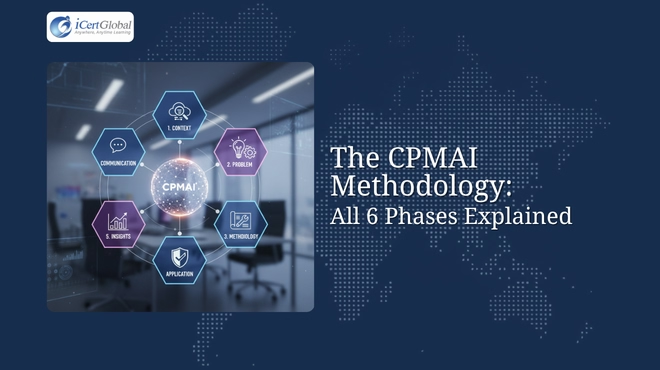
Master the 6 phases of the CPMAI methodology. Learn how to manage AI projects, pass your certification exam,

Advance your career with the PMI-CPMAI certification. Discover how to manage ethical AI projects, master the methodology, and

Our experts are ready to help you with any questions about courses, admissions, or career paths. Get personalized guidance from industry professionals.
Request a Call Back

"PMI®", "PMBOK®", "PMP®", "CAPM®" and "PMI-ACP®" are registered marks of the Project Management Institute, Inc. | "CSM", "CST" are Registered Trade Marks of The Scrum Alliance, USA. | COBIT® is a trademark of ISACA® registered in the United States and other countries.
