





A-CSM Exam 2026: Certification Requirements, Training, and Career
Advance your Scrum Master career. Discover the truth about the A-CSM exam, meet the 2026 certification requirements, and
Stop being just a security technician. Get the globally-recognized credential that validates your strategic leadership and unlocks executive-level pay in the security domain.
You're the most competent security analyst on your team. You can dissect malware, configure firewalls, and run penetration tests that uncover every vulnerability. Yet, the CISO - a CISM-certified professional - is the one making strategic decisions, presenting to the CEO, and determining which risks the business can accept. Your technical skills are essential, but a CISM Certification turns tactical expertise into strategic authority. Without it, your resume might still be filtered out for senior roles that require proven governance skills and a deep understanding of risk management. Our CISM Training Program is designed to bridge this gap. Unlike generic courses that merely reiterate the ISACA syllabus, our program is created by seasoned security leaders who have experienced major breaches and regulatory audits in the Westerville, OH financial, telecom, and service sectors. This training shifts your mindset from patching servers to reducing business risk exposure and maximizing security ROI. It equips you to lead, not just execute. The program doesn't just prepare you for the CISM exam. It teaches you to apply ISACA's framework to the complex realities of managing a security program in cities like Westerville, OH. You'll learn how to develop a cohesive information security strategy that actually secures funding, design incident response plans that survive real crises, and communicate cyber risks effectively to non-technical stakeholders and boards. Designed for working professionals, our training offers flexible evening and weekend batches, fully interactive sessions, and a critical focus on the ISACA exam mindset. Beyond exam preparation, you'll gain actionable templates for governance charters, risk registers, and policy frameworks, along with case studies on Westerville, OHdata compliance such as PDP Bill implications. You also receive 24/7 expert support and complete guidance on navigating the often-complex CISM certification requirements and application process. We provide complete clarity on CISM certification cost and CISM exam cost, so you can plan your career path without surprises. By completing this CISM Certification Training, you're not just preparing for an exam - you're positioning yourself to step into leadership roles where your decisions directly impact business risk, security strategy, and organizational success. Take the leap from technical competence to strategic leadership. Enroll in our CISM Training Program today and transform your expertise into a recognized credential that opens doors to executive-level opportunities. A CISM Certification isn't just a credential; it's the lever that elevates your career.
Trust that your curriculum is rigorously vetted and aligns with the latest CISM job practice areas and the current exam blueprint.
Unlock your potential with expert instructors who are CISM-certified, currently managing large-scale security operations, and bringing current, blunt insights to the class.
Master the ISACA exam's unique focus on managerial judgment, moving past technical answers to select the best security management solution.
Get on top of your weaknesses with over 1500+ tailor-made practice questions and multiple full-length, timed mock tests.
Be worry-free as certified security leaders are available 24x7 to solve your doubts and assist you at every critical step.
Walk away with ready-to-use templates for Security Charters, Risk Assessments, and Incident Playbooks that you can deploy tomorrow.
The CISM Certification Training Program emphasizes practical application of risk management, vendor management, and incident management best practices. This is achieved through a combination of lectures, case studies, and group discussions in a dynamic classroom environment in Westerville, OH. Students learn by doing, applying theoretical concepts to real-world scenarios.
In a CISM certification context, risk management is a key component of the Information Security Program (ISP). The ISP is designed to identify and mitigate potential security threats, using a structured approach that involves risk assessment, risk mitigation, and ongoing monitoring. This requires a detailed understanding of risk analysis techniques, such as the NIST Risk Management Framework.
Through the CISM program, students learn how to apply these techniques in a practical setting, analyzing and mitigating risks in a fictional company, and assessing the effectiveness of their risk reduction strategies. By the end of the program, students are equipped with the skills to implement effective security measures in their own organizations.

Get a custom quote for your organization's training needs.
As a CISM-certified professional, students assume responsibility for managing information security in their organizations. This includes overseeing the development and implementation of security policies, protecting sensitive data, and ensuring regulatory compliance. In Westerville, OH, where the program is delivered, students learn to navigate the complex regulatory landscape.
Effective information security management involves a deep understanding of security policies and procedures, including those related to access control, incident response, and security awareness. Students learn about the importance of security governance, and how to establish a strong security culture within their organizations. They also gain knowledge of security metrics and monitoring, enabling them to evaluate the effectiveness of their security programs.
By completing the CISM program, students develop a comprehensive understanding of their work responsibilities, enabling them to design and implement effective security measures in their own organizations. This knowledge is essential for navigating the complex security landscape, and ensuring that their organizations remain secure and compliant.
Stop reacting to threats. You will learn how to build an organizational risk framework, use quantitative/qualitative analysis, and communicate residual risk to executive leadership for decisive action.
Moving past control lists. You will develop the ability to align the security program and budget directly with business objectives and regulatory mandates like ISO 27001 or Westerville, OH IT Act requirements.
Not just technical triage. You will learn to build, test, and manage a cross-functional incident response team and crisis communication plan that minimizes business disruption and regulatory fallout.
End the gatekeeping from the board. You will learn how to design and present effective security performance metrics (KRIs, KPIs) that prove program value and justify budget requests.
Become an architect, not just a builder. You will learn to establish, document, and manage the full lifecycle of the security program, from initial policy creation to continuous process improvement.
Stop guessing about the law. You will gain a clear understanding of international and Westerville, OH compliance requirements (e.g., SEBI, RBI guidelines) and how to manage the control mapping and auditing process efficiently.
If you lead, manage, or design an organization's information security program and meet ISACA's mandatory experience requirements, this program is engineered to get you certified and ready for the executive security seat.
The CISM Certification Training Program is recognized worldwide as a benchmark of excellence in information security management. Professionals who complete the program demonstrate their expertise and commitment to the field, enhancing their professional credibility. In Westerville, OH, where the program is delivered, students learn to leverage their knowledge to make a meaningful impact in their organizations.
A CISM certification holder possesses a deep understanding of information security governance, including the role of the Chief Information Security Officer (CISO) and the responsibilities of the Information Security Management (ISM) function. They also have knowledge of information security policies, procedures, and standards, including the ISO 27001 standard. This expertise enables them to provide strategic guidance on information security matters, and to lead security initiatives in their organizations.
By completing the CISM program, professionals demonstrate their ability to apply theoretical concepts in a practical setting, enhancing their professional credibility and career prospects.


Stop getting filtered out by HR bots scanning for the "CISM" requirement for all management and CISO-track roles.
Unlock the higher salary bands and bonus structures that are strictly reserved for certified security leaders with proven governance expertise.
Transition from tactical execution to strategic security leadership and gain a non-negotiable seat at the decision-making table with the board.
The CISM certification is the gold standard because ISACA ensures certified professionals have a proven foundation in both formal security knowledge and real-world, high-level experience. Here is the high-level breakdown of what you need to qualify:
Pass the CISM Exam: The first step, which our program is engineered to guarantee.
5 Years of Professional Experience: A mandatory minimum of five years in the field of information security.
3 Years of Management Experience: Within that five-year period, a minimum of three years in the role of an Information Security Manager, covering at least three of the four CISM job practice analysis areas.
Waivers for Other Certifications: Experience waivers of 1-2 years can be granted for certain other certifications (like CISSP) or advanced degrees, but the minimum total of three years of management experience is non-negotiable.
For a comprehensive breakdown of how to document your experience and leverage any waivers, please refer to our detailed FAQ section.
The CISM Certification Training Program is designed to develop essential skills in risk management, vendor management, and incident management. Through a combination of lectures, case studies, and group discussions, students learn to apply theoretical concepts to real-world scenarios. In Westerville, OH, students develop a comprehensive understanding of information security best practices.
Effective risk management involves a structured approach that includes risk assessment, risk mitigation, and ongoing monitoring. Students learn about risk analysis techniques, including the NIST Risk Management Framework, and how to apply these techniques in a practical setting. They also learn about the importance of vendor management, including the selection and management of third-party service providers.
By completing the CISM program, students develop a range of skills that are essential for information security professionals, including risk management, vendor management, and incident management.
Master the process of identifying, analyzing, and evaluating IT and business risks. Apply qualitative and quantitative methods to prioritize critical threats. This knowledge is crucial for CISM Certification Training and passing the CISM exam.
Learn to develop, implement, and manage risk responses (avoid, transfer, mitigate, accept) using cost-benefit analysis. Select and justify controls to address prioritized risks, meeting CISM Certification requirements.
Implement governance-driven monitoring of residual risk, risk appetite, and treatment effectiveness. Understand the full risk lifecycle to strengthen organizational culture. Key for those preparing for the CISM exam and understanding CISM certification cost.
Architect a mature, multi-year security program that systematically reduces risk. Learn to develop the business case, define the roadmap, and secure the budget necessary to build a sustainable, effective security function.
Master the management of the security program's operational aspects, including staffing, budgeting, procurement of security services, and effective interaction with other business functions (HR, Legal, Audit).
Develop and manage a mandatory, ongoing security awareness program that focuses on reducing the human element of risk. Learn to segment training based on role (executive, developer, end-user) for maximum effectiveness.
Build and manage a comprehensive incident response program, including the necessary policies, procedures, resources, and communication channels. Learn to integrate technical response with business continuity and disaster recovery plans.
Master the systematic process of detection, triage, containment, eradication, and recovery. Focus on managerial decisions to minimize business impact and preserve forensic evidence. Essential for meeting CISM Certification requirements.
Lead post-incident reviews to identify root causes, improve your security program, and enforce accountability. Crucial for preparing for the CISM exam and understanding CISM certification cost.
Apply project management principles to large-scale security initiatives (e.g., implementing an SIEM, cloud migration). Focus on managing scope, time, budget, and stakeholder expectations for successful security projects.
Develop advanced test-taking strategies specifically for the CISM exam. Learn to analyze situational questions, identify the managerial best fit answer, and eliminate technically correct but strategically poor options.
Consolidate knowledge across all domains, complete practice assessments, and review the ISACA application process. Walk into the exam with confidence and understanding of CISM certification cost and preparation strategies.
The CISM Certification Training Program is applicable to a wide range of industries, including finance, healthcare, and government. In Westerville, OH, where the program is delivered, students learn to apply information security best practices in a variety of industries. The program focuses on the practical application of risk management, vendor management, and incident management best practices.
In the context of information security, incident response is a critical component of the Information Security Program (ISP). Students learn about incident response planning, including the development of incident response policies, procedures, and standards. They also learn about the importance of security metrics and monitoring, enabling them to evaluate the effectiveness of their security programs.
By completing the CISM program, students are equipped with the skills to implement effective security measures in a variety of industries, enhancing the security posture of their organizations and reducing the risk of security breaches.
Great class, very informative.

Great PMP<sup>®</sup> Bootcamp. I had a great time taking this course. I took the course to prepare to sit for the CAPM<sup>®</sup> but may be able to sit for the PMP<sup>®</sup>. I learnt a lot was challenging. Great course. We need one more day. Content was very detailed.

it was a great class. Lots of energy. And I enjoyed.

Fantastic course to prepare for PMP<sup>®</sup> exam.

As a participant it was smooth sailing for me.

Trainer was excellent. Shared good resources and good experiences.

Good content and training.
I wanted to let you know that I took and passed the PMP exam. Thanks to iCertGlobal and especially my Cincinnati course instructor, who was an excellent teacher and helped me immensely.

Trainer was good. Trainer was very engaged and interacting. Very much satisfied with the training.

I was pleasantly surprised at the quality of this training. Yomi was awesome as a trainer and working to make sure that we understood the concepts. Controlling Cost and Controlling Risk are the most complicated, but Yomi spent time after class working through questions to help others understand. This class also helped to change my perception of the PMP being this MONSTER to something that I can I can successfully do.

Great class with a lot of information and tips to prepare for the exam

It was a great course, covered all the things that i ended up hitting road bumps on. I was the only one in the class, but the trainer was just as involved as if it had been a full class.

I was nervous about taking it online versus classroom; but I am actually glad I took it online. Instructor was very great and gave a good learning experience with his relevant project management experience.
The training was very intense but covered with course material. It was more than I expected.

I thought the class was very informative. The instructor did an excellent job breaking down each chapter to where it was easy to understand. I was also very impressed with his commitment to help us pass ever after the class is over.

Excellent training. Instructor was very knowledgeable and explained information in an understandable way
Quality Materials presented, Instructor very knowledgeable. Exceeded my expectations.
The training is a great introduction into the PMI mindset. Very informative and helpful

Explore CISM Our PMP certification training is available in a city near you
Stay updated with the latest insights and trends in your field
Advance your Scrum Master career. Discover the truth about the A-CSM exam, meet the 2026 certification requirements, and
Master the ISACA domains and advance your cybersecurity career. Test your knowledge with realistic CISM exam questions and
Master the 6 phases of AI project management. Use this CPMAI Study Guide to pass your exam, build
Map your cloud career with the 2026 GCP certification path. Master in-demand skills, prepare for exams, and unlock
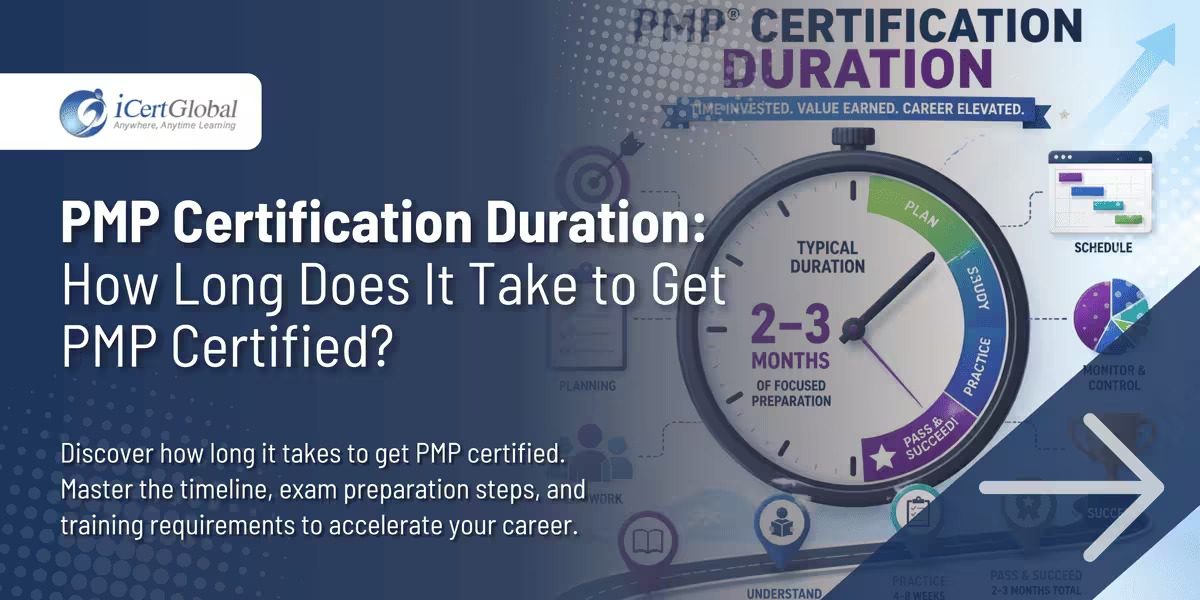
Discover how long it takes to get PMP certified. Master the timeline, exam preparation steps, and training requirements
Master product ownership. Find the complete CSPO certification cost in India, training fees, and career ROI to plan
Master the CEH exam on your first attempt. Use this practical 10-step study plan to build your ethical
Master 10 essential AI prompt engineering techniques to boost your career. Learn how to optimize LLM outputs and
Master risk management and pass your PMI-RMP Exam. Explore proven study strategies, eligibility requirements, and steps to boost
Master the CRISC certification syllabus. Learn the four domains, key exam topics, and proven prep strategies to advance
Our experts are ready to help you with any questions about courses, admissions, or career paths. Get personalized guidance from industry professionals.
Request a Call Back

"PMI®", "PMBOK®", "PMP®", "CAPM®" and "PMI-ACP®" are registered marks of the Project Management Institute, Inc. | "CSM", "CST" are Registered Trade Marks of The Scrum Alliance, USA. | COBIT® is a trademark of ISACA® registered in the United States and other countries.

