






Before You Enroll in PMI-CPMAI, Read This First
Before you take the PMI-CPMAI, learn how mastering project management ai can elevate your career, validate your skills,
Stop processing batch data that's already stale. Get the critical certification that proves you can architect and deploy real-time, low-latency data pipelines.
Your current systems are reactive - processing yesterday's data with hourly ETL jobs, daily batch cycles, and delayed responses to incidents. Meanwhile, enterprises in Hyderabad, Mumbai, and Detroit, MI rely on real-time data streams for instant payment processing, live fraud detection, and immediate user personalization. They need certified experts - Apache Kafka Architects and Engineers - who can design and manage these high-throughput systems. You're currently filtered out by recruiters searching for "Apache Kafka", "Confluent", "ZooKeeper", and Producer/Consumer APIs. Traditional integration skills are becoming legacy, while microservices and event-driven architecture dominate high-paying data engineering roles. This isn't just another Apache Kafka tutorial. Our Apache Kafka course is built by senior Data Streaming and Cloud Engineers who design real-world, high-volume pipelines for Detroit, MI Telecom and Fintech sectors. You'll master the non-negotiable architectural principles: partitioning strategies, replication factors, consumer groups, and throughput/failure trade-offs. Gain hands-on experience across the Apache Kafka ecosystem: Kafka Connect for seamless integration with external systems Kafka Streams for complex, in-flight data processing This Apache Kafka Certification ensures you can confidently design fault-tolerant, multi-AZ streaming pipelines capable of 100,000 messages per second, making you indispensable in real-time data environments. The program also equips you with the knowledge to navigate Apache Kafka documentation, recommended Apache Kafka books, and practical deployment scenarios, giving you the full toolkit to thrive in modern, event-driven architectures.
Master log segments, index files, and critical configuration parameters that separate basic users from high-performance cluster administrators.
Intensive hands-on labs focused on writing robust, optimized Producer and Consumer applications with guaranteed message delivery logic.
Learn to design topics with the correct key and partition structure to eliminate hot spots and guarantee high-volume, ordered message throughput.
Gain deep knowledge of Zookeeper's non-negotiable role in cluster coordination, leader election, and metadata management for stability.
Intensive hands-on time dedicated to setting up, monitoring, load testing, and failure recovery on a multi-broker Kafka cluster.
Get immediate, high-quality answers to complex API, configuration, and replication issues from actively practicing Kafka Streaming Engineers.
In modern distributed systems, Apache Kafka plays a key role in real-time data processing and integration, enabling large-scale event-driven architectures.
Organizations rely on Kafka to handle high-volume data streams, ensuring seamless integration with diverse data sources and processing systems.
This demand for high-performance data processing has driven the development of specialized training programs, such as the Apache Kafka Certification Training Program.

Get a custom quote for your organization's training needs.
Kafka's architecture is built around a distributed, fault-tolerant publish-subscribe model, where producers send messages to topics and consumers subscribe to those topics to receive messages.
This model is particularly effective in handling large volumes of data, such as those generated by IoT devices.
The complexity of Kafka's architecture requires a deep understanding of distributed systems, data processing, and event-driven architecture principles.
Move past simple pub/sub. You will learn to architect the correct Topic, Partition, and Replication factor strategy for high-volume, low-latency use cases like clickstream analytics and IoT ingestion.
Master the critical Producer configurations - batching, compression, and asynchronous sending - to maximize message throughput while guaranteeing message delivery logic.
Learn to design Consumer Groups for parallel processing, manage offsets correctly, and implement effective retry and error handling to guarantee data processing completeness.
Gain mandatory skills in managing Kafka brokers, including configuring logs, understanding critical internal metrics, and performing seamless rolling restarts and capacity upgrades.
Master the use of Kafka Connect to integrate Kafka with external systems (Databases, S3, HDFS), eliminating brittle, custom-coded ETL jobs.
Learn to perform in-flight data transformations, aggregations, and joins using Kafka Streams or KSQL, enabling real-time analytics and decision-making on live data.
If you are currently building microservices, managing high-volume data pipelines, or designing event-driven architecture, this program is the mandatory requirement to validate your expertise and pivot into a senior Streaming Data Engineer role.
For professionals working in data-intensive industries in Detroit, MI, such as automotive and manufacturing, understanding Kafka's capabilities and limitations is crucial for developing scalable data processing solutions. By mastering Kafka, professionals can design and implement robust data pipelines that efficiently process and analyze large datasets in real-time.
The Apache Kafka Certification Training Program is designed to equip professionals with the necessary skills to design, implement, and manage high-performance Kafka-based data processing systems. Through a comprehensive curriculum that covers Kafka architecture, data processing, and event-driven architecture, participants gain a deep understanding of the technological components that underlie modern distributed systems.


Get the senior Data Streaming and Event-Driven Architecture interviews your skills already deserve.
Gain access to bonus structures reserved for certified experts who guarantee the performance and stability of real-time pipelines.
Transition from batch processing to strategic design, becoming a critical part of the modern enterprise backbone.
While Kafka is open-source, the most respected certifications are provided by Confluent (the company founded by Kafka's creators). To sit for the Confluent Certified Developer or Administrator exams, you typically need:
Formal Training/Experience: Completion of 40+ hours of dedicated Kafka training, covering architecture, APIs, Connect, and Streams, is the minimum expectation (satisfied by this course).
Coding Proficiency: For the Developer certification, mandatory, demonstrable ability to code Producers and Consumers in a modern language (Java/Python) is essential.
Practical Deployment: For the Administrator certification, proven hands-on experience in setting up, monitoring, and troubleshooting multi-broker clusters. Our labs provide this rigorous exposure.
Participants learn about Kafka's core components, including producers, consumers, and topics, as well as the importance of data serialization, deserialization, and compression.
This hands-on knowledge enables professionals to design scalable data pipelines that efficiently process and analyze large datasets in real-time.
By mastering these technical skills, professionals can improve the performance and reliability of their organization's data processing systems.
Master the Consumer API (Java/Python). Design Consumer Groups for scalable, parallel reading of partitions. Learn client-side configuration for optimal fetch sizes and time-outs.
Understand where offsets are stored and how to commit them correctly (automatic vs. manual). Implement robust code to achieve "exactly-once" processing using transaction IDs and external stores.
Troubleshoot consumer rebalances and lag issues. Configure session time-outs and heartbeats to maintain stability in dynamic production environments. This module also aligns with insights from advanced apache kafka books and prepares you for practical apache kafka certification exams.
Master the architecture of Kafka Connect (Source and Sink Connectors). Learn to deploy, configure, and monitor Connect workers for reliable database and storage integration.
Understand the purpose of stream processing. Get introduced to the Kafka Streams DSL (KStream, KTable) for simple filtering, transformation, and aggregation.
Master stateful operations, joins, and aggregations using fixed and hopping time windows - the non-negotiable techniques for complex real-time analytics.
Learn mandatory administrator tasks for Apache Kafka clusters: rolling restarts, log size monitoring, broker decommissioning, and essential command-line health checks. This practical module aligns with apache kafka tutorials and prepares you for real-world operations in a apache kafka course or apache kafka certification.
Identify critical metrics (Under-replicated partitions, lag, request latency). Learn to use monitoring tools (Prometheus, JMX) and load testing to validate performance and capacity.
Understand security layers (SSL/TLS for encryption, SASL for authentication). Master critical failure scenarios: partition leader failure, full disk, and recovery procedures.
For professionals working in data-intensive industries in Detroit, MI, such as finance and healthcare, having a deep understanding of Kafka's technical capabilities and limitations is essential for developing innovative data-driven solutions. By mastering Kafka, professionals can improve data processing efficiency, reduce latency, and enhance overall system performance.
The Apache Kafka Certification Training Program addresses a critical skill gap in the industry, where professionals lack the technical expertise to design, implement, and manage high-performance Kafka-based data processing systems. This lack of expertise hinders the development of scalable data pipelines that efficiently process and analyze large datasets in real-time.
Great class, very informative.

Great PMP<sup>®</sup> Bootcamp. I had a great time taking this course. I took the course to prepare to sit for the CAPM<sup>®</sup> but may be able to sit for the PMP<sup>®</sup>. I learnt a lot was challenging. Great course. We need one more day. Content was very detailed.

it was a great class. Lots of energy. And I enjoyed.

Fantastic course to prepare for PMP<sup>®</sup> exam.

As a participant it was smooth sailing for me.

Trainer was excellent. Shared good resources and good experiences.

Good content and training.
I wanted to let you know that I took and passed the PMP exam. Thanks to iCert Global and especially my Cincinnati course instructor, who was an excellent teacher and helped me immensely.

Trainer was good. Trainer was very engaged and interacting. Very much satisfied with the training.

I was pleasantly surprised at the quality of this training. Yomi was awesome as a trainer and working to make sure that we understood the concepts. Controlling Cost and Controlling Risk are the most complicated, but Yomi spent time after class working through questions to help others understand. This class also helped to change my perception of the PMP being this MONSTER to something that I can I can successfully do.

Great class with a lot of information and tips to prepare for the exam

It was a great course, covered all the things that i ended up hitting road bumps on. I was the only one in the class, but the trainer was just as involved as if it had been a full class.

I was nervous about taking it online versus classroom; but I am actually glad I took it online. Instructor was very great and gave a good learning experience with his relevant project management experience.
The training was very intense but covered with course material. It was more than I expected.

I thought the class was very informative. The instructor did an excellent job breaking down each chapter to where it was easy to understand. I was also very impressed with his commitment to help us pass ever after the class is over.

Excellent training. Instructor was very knowledgeable and explained information in an understandable way
Quality Materials presented, Instructor very knowledgeable. Exceeded my expectations.
The training is a great introduction into the PMI mindset. Very informative and helpful

Stay updated with the latest insights and trends in your field
Before you take the PMI-CPMAI, learn how mastering project management ai can elevate your career, validate your skills,
Master the critical data scientist skills that separate beginners from top-tier professionals and accelerate your career growth.

Map your data scientist career path for 2026. Learn the high-demand skills, certifications, and real salary expectations you

Prepare for your data science career with the real insights nobody shares. Learn the practical skills and exam-ready
Discover the core skills you need to build a successful data scientist career. Master the essential expertise that

Compare CISA vs CRISC to find your ideal ISACA path. Analyze exam difficulty, career outlook, and skills to
Master the 5 domains of the CISA Certification Syllabus. Get the complete 2026 exam guide to pass on

Discover the CCNA salary in India from fresher to senior roles. Learn how to leverage this certification to
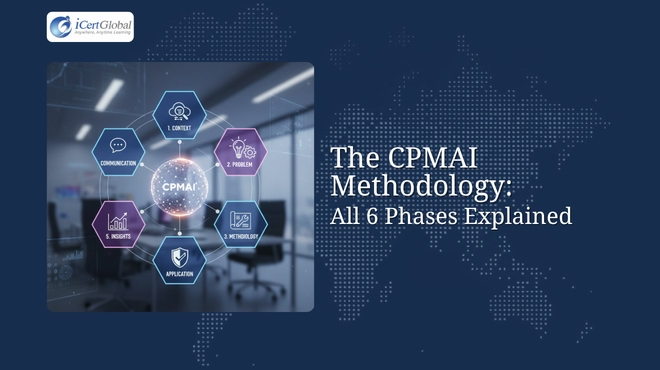
Master the 6 phases of the CPMAI methodology. Learn how to manage AI projects, pass your certification exam,

Advance your career with the PMI-CPMAI certification. Discover how to manage ethical AI projects, master the methodology, and

Our experts are ready to help you with any questions about courses, admissions, or career paths. Get personalized guidance from industry professionals.
Request a Call Back

"PMI®", "PMBOK®", "PMP®", "CAPM®" and "PMI-ACP®" are registered marks of the Project Management Institute, Inc. | "CSM", "CST" are Registered Trade Marks of The Scrum Alliance, USA. | COBIT® is a trademark of ISACA® registered in the United States and other countries.
