






Before You Enroll in PMI-CPMAI, Read This First
Before you take the PMI-CPMAI, learn how mastering project management ai can elevate your career, validate your skills,
Stop bottlenecking your data processing. Get the mandatory credential that proves you can build lightning-fast, highly scalable analytics engines in Spark and command the top salary bracket for Big Data Engineers.
Your current data infrastructure struggles with growing volumes. Batch processes take hours, and management demands real-time insights - a need your legacy ETL or Python setup cannot meet. Modern Apache Spark-driven big data roles in Ogden, UT and other competitive markets require engineers who can design high-performance, fault-tolerant pipelines using Scala. Without skills in Spark, Scala, and DataFrame Optimization, HR filters reject your resume from high-paying Senior Data Engineer and Machine Learning Engineer positions. This program equips you to solve billions of real-time events efficiently. This isn't a basic apache spark tutorial. Our Apache Spark course is designed by experienced Big Data Architects managing multi-terabyte Spark clusters in Ogden, UTFintech and Telecom sectors. You'll master core performance concepts like handling skew, optimizing joins, managing garbage collection, and understanding when to use RDDs versus DataFrames - insights drawn from apache spark documentation and apache spark architecture best practices. Through hands-on labs with Spark Shell and advanced IDEs, you'll tackle real-world apache spark big data projects such as collaborative filtering and large-scale SQL queries. This apache spark certification ensures you're ready for top apache spark interview questions and positions you for sub-second response systems critical in modern enterprises.
Mandatory modules on the Spark execution flow, DAGScheduler, TaskScheduler, and Memory Management to ensure you can optimize any job.
Dedicated hands-on training in Spark Streaming, MLlib (Machine Learning), and GraphX for complete, full-spectrum application development.
Our question bank is engineered to test your ability to debug performance issues, select optimal Spark/Scala syntax, and choose the best data structure for the task.
Achieve the required level of Scala competence to write concise, functional, and enterprise-grade code, maximizing Spark's native efficiency.
Learn the most critical optimization skills: caching strategies, serialization choices (Kryo), and data partitioning to cut down execution time by orders of magnitude.
Get immediate, high-quality help from certified Senior Data Engineers on complex code debugging, performance tuning, and architectural design questions.
Apache Spark and Scala certifications are a crucial part of any organization's big data infrastructure roadmap. Businesses worldwide rely on scalable and fault-tolerant systems to process and analyze vast amounts of data. In Ogden, UT, this is especially true for industries such as finance and healthcare, which heavily utilize data analytics for decision-making. Apache Spark, being an open-source data processing engine, is the primary tool for these tasks due to its performance and scalability features.
Spark's in-memory data processing capabilities and its ability to process structured, semi-structured, and unstructured data types make it an ideal choice for big data analytics. Additionally, the Scala programming language, which is used to write Spark applications, provides a strong type system and concise syntax, enabling developers to write complex data processing pipelines efficiently. Spark and Scala skills are highly sought after by employers looking for professionals to design and implement large-scale data processing systems. In practice, having an Apache Spark and Scala certification can open doors to exciting career opportunities in data engineering and analytics.
Professionals with this certification can work on high-impact projects, contributing to the development of robust big data pipelines that drive business growth.

Get a custom quote for your organization's training needs.
Apache Spark and Scala certifications are highly relevant to the jobs market, with many employers seeking professionals with these skills. In Ogden, UT, companies like Fidelity Investments and Zions Bank heavily utilize Spark-based systems for their financial analytics. As a result, there is a high demand for Spark and Scala developers who can design, implement, and optimize these systems for maximum performance. One of the key aspects of Spark and Scala is their ability to handle complex data processing tasks, such as data aggregation, filtering, and transformation.
This requires developers to have a deep understanding of data modeling, data schema design, and data partitioning strategies, which are all critical skills for big data engineers. Employers look for professionals who can apply these skills to real-world problems, ensuring data quality, scalability, and performance. In terms of career opportunities, Apache Spark and Scala certifications can lead to roles such as Senior Data Engineer, Data Architect, or Lead Developer, positions that require expertise in designing and implementing large-scale data processing systems.
The Apache Spark and Scala ecosystem is constantly evolving, with new features and advancements being released regularly.
This growth is driven by the increasing demand for big data analytics and the need for scalable data processing systems. In Ogden, UT, this growth is reflected in the number of companies adopting Spark-based systems, creating new job opportunities for professionals with Spark and Scala skills.
Learn the foundational Spark architecture, lazy evaluation, and immutability. You will master RDD transformations and actions, understanding when this lower-level API is mandatory for complex tasks.
Achieve proficiency in the Scala language - including case classes, pattern matching, and functional constructs - to write clean, concurrent, and bug-resistant Spark applications.
Master the highly efficient DataFrame/DataSet APIs. You will use Spark SQL for structured data, learning to leverage the Catalyst Optimizer for mandatory, high-speed query execution.
Go live. Implement Spark Streaming and Structured Streaming for continuous data processing, learning techniques for state management and handling event-time windows for accurate, real-time analytics.
Deploy scalable ML models. You will use MLlib to implement algorithms like collaborative filtering and classification across massive datasets, turning raw data into predictive assets.
Tackle complex network analysis. You will utilize GraphX for use cases like social network analysis and supply chain optimization, extending your skills to complex relationship data structures.
If your current job requires processing large datasets (TBs or PBs) and your code is bottlenecking, this rigorous training in Spark & Scala is your only path to high-performance computing, the Senior Engineer title, and the associated high salary.
One of the key drivers of growth in the Spark and Scala ecosystem is the adoption of emerging technologies, such as machine learning and graph processing. This requires developers to have expertise in areas like data science, data visualization, and data modeling. Employers seek professionals who can apply these skills to real-world problems, ensuring data-driven decision-making.
In the field of big data, Apache Spark and Scala certifications are essential for staying up-to-date with the latest developments and advancements. Professionals with these certifications are well-positioned to take on leadership roles or start their own companies, driving innovation and growth in the industry.
Apache Spark and Scala certifications provide hands-on experience with the Spark framework and the Scala programming language.
In Ogden, UT, professionals with these certifications can apply their skills to real-world projects, working with datasets from various industries, such as finance, healthcare, and e-commerce. This practical experience is essential for developers who want to work on high-impact projects that drive business growth.


Get the senior-level, high-performance Data Engineer interviews your experience already deserves.
Reserved for engineers who can guarantee sub-second latency on massive-scale data.
Owning the execution engine that powers all enterprise analytics.
While vendor-neutral certification is less common, the most respected proofs of competence come from organizations like Databricks or Confluent, or simply the demonstrable capability honed by this program.
Success hinges on:
Mandatory Scala Proficiency: Demonstrable ability to write efficient, clean, and functionally correct Scala code is non-negotiable for writing optimized Spark applications.
Spark Architectural Mastery: Proven deep understanding of the Spark execution model (DAG, memory, partitioning) and the trade-offs between RDDs, DataFrames, and DataSets.
Hands-on Component Deployment: Mandatory experience in using Spark SQL for complex queries, Spark Streaming for real-time applications, and MLlib for distributed machine learning.
In practice, Spark and Scala developers use the SparkResilientDistributionDataset class to read data from various sources, such as HDFS, Cassandra, or Kafka. They also use the Scala high-order functions, such as map, flatMap, and reduce, to process and transform data in parallel. Employers look for professionals who can apply these skills to real-world problems, ensuring data quality, scalability, and performance.
Professionals with Apache Spark and Scala certifications can work on a wide range of projects, from data warehousing and ETL (Extract, Transform, Load) to real-time data processing and streaming analytics. These certifications demonstrate expertise in designing and implementing scalable and fault-tolerant systems for big data processing.
Professionals with Apache Spark and Scala certifications typically work on large-scale data processing systems, ensuring data quality, scalability, and performance.
In Ogden, UT, these professionals often work on projects that involve data analytics, data science, and data engineering. Their responsibilities include designing and implementing data pipelines, data warehouses, and ETL processes.
Scope management is the backbone of successful project execution - and a key topic covered in every Project Management Professional course online and in the PMP exam questions. Learn to define project boundaries with precision and prevent costly scope creep.
Time management is one of the most heavily weighted areas in the PMP exam content outline. This lesson trains you to build and control project schedules that meet deadlines without sacrificing quality.
Develop accurate cost estimates using proven methodologies and track real project performance through Earned Value Management. Learn to create meaningful budgets, analyze variances, and communicate financial status to stakeholders in terms they understand and act upon.
Identify what can derail your projects before it happens and build comprehensive response strategies. Master both qualitative and quantitative risk analysis techniques, including Monte Carlo simulations and decision trees that enable data-driven risk decisions.
Build quality into your processes rather than inspecting it later. Learn the difference between quality planning, assurance, and control. Master quality tools like control charts and Pareto analysis to drive continuous improvement and prevent costly rework.
Procurement is a key area of the Project Management Professional exam and essential to professional project delivery. Learn to manage vendor contracts, conduct negotiations, and select the right contract types. This PMP course online module teaches practical approaches to vendor evaluation, risk allocation, and performance monitoring, ensuring your projects stay on schedule and within budget.
Lead project teams through successful delivery while managing resources, resolving issues, and maintaining momentum. Learn to direct project work effectively, acquire and develop team members, and create reporting systems that inform rather than overwhelm stakeholders.
Implement control systems that catch problems early and enable corrective action. Master integrated change control procedures, performance measurement techniques, and variance analysis methods that keep projects on track and stakeholders informed.
Modern project management requires agility. This PMP certification course explores agile, predictive, and hybrid delivery approaches - helping you understand when and how to apply each. Learn Scrum ceremonies, Kanban flow metrics, and hybrid governance techniques that integrate flexibility into traditional structures. These topics are a major part of the current Project Management Professional exam content outline, making this lesson essential for every PMP-certified professional.
Execute proper project closure procedures and understand your ethical obligations as a certified project management professional. Learn to capture lessons learned effectively, manage contract closure, and navigate ethical dilemmas using the PMI Code of Ethics.
Develop test-taking strategies specifically designed for the PMP exam format. Learn question analysis techniques, time management strategies, and how to approach situational questions that test your judgment rather than just knowledge recall.
This capstone lesson brings everything together. You'll review every process group, knowledge area, and agile concept included in the PMP course online curriculum. Our instructors guide you through final assessments, identify weak areas, and ensure full exam readiness.
Understand the limitations of MapReduce and the rise of in-memory computing with Apache Spark. Master the Spark cluster components: Driver, Executor, Cluster Manager, and the critical DAGScheduler. This foundational lesson is essential for any apache spark course or apache spark certification candidate.
Master the functional programming fundamentals of Scala, including immutable variables, functions, closures, and the use of the Scala REPL/IDE for development.
Dive deeper into Scala for Spark with case classes, pattern matching, collections, and higher-order functions. Mastering these concepts ensures you can write concise, high-performance distributed code, aligning with best practices from apache spark documentation and advanced apache spark tutorials.
Master the core Resilient Distributed Dataset (RDD) API. Understand fault tolerance, partitioning, and caching, the foundation for all Spark computations.
Hands-on implementation of the core RDD operations: map, filter, reduceByKey, join, and their critical distinction between narrow and wide dependencies.
Learn mandatory core optimization: choosing the correct Storage Level, using Kryo Serialization for speed, and managing the critical trade-offs between partitioning and memory.
Master Apache Spark SQL by creating and using DataFrames and DataSets. Understand their memory-efficient, strongly-typed nature and how structured data improves performance in apache spark big data projects. This lesson is essential for apache spark course participants preparing for apache spark certification.
Deep dive into the Catalyst Optimizer and Tungsten execution engine. Learn how to interpret query plans, debug performance, and select the optimal join strategies.
Master complex DataFrame manipulations including UDFs (User-Defined Functions) and advanced windowing functions for rolling aggregations and ranking. This expertise is vital for enterprise reporting and real-world apache spark big data applications.
Understand the difference between micro-batching and continuous processing. Implement Structured Streaming for fault-tolerant, end-to-end real-time pipelines.
Master the MLlib API. Implement and evaluate core algorithms like Linear Regression, Logistic Regression, and Collaborative Filtering across large-scale datasets.
Learn the mandatory steps of building a robust ML pipeline: feature selection, scaling, model training, and persistent storage of models for deployment.
Master the GraphX API in Apache Spark for advanced graph analysis. Implement algorithms like PageRank and community detection for applications in social networks, telecom, and other apache spark big data projects. This is a key skill for apache spark certification and apache spark interview questions.
Connect Spark with external systems: Kafka for ingestion, HDFS/S3 for storage, and Hive/Impala for querying. Master deployment on YARN or Kubernetes.
Master production-level skills including cluster sizing, monitoring with Prometheus, memory and garbage collection management, and interpreting Spark UI metrics. These advanced capabilities are essential for real-world apache spark course participants and high-value apache spark certification candidates.
One of the key responsibilities of a Spark and Scala developer is to ensure data quality and integrity. This requires a deep understanding of data modeling, data schema design, and data partitioning strategies.
Employers look for professionals who can apply these skills to real-world problems, ensuring data accuracy, completeness, and consistency. In terms of work responsibilities, Apache Spark and Scala certifications can lead to roles such as Senior Data Engineer, Data Architect, or Lead Developer, positions that require expertise in designing and implementing large-scale data processing systems.
These professionals work closely with cross-functional teams, including data scientists, data analysts, and business stakeholders, to drive data-driven decision-making.
Great class, very informative.

Great PMP<sup>®</sup> Bootcamp. I had a great time taking this course. I took the course to prepare to sit for the CAPM<sup>®</sup> but may be able to sit for the PMP<sup>®</sup>. I learnt a lot was challenging. Great course. We need one more day. Content was very detailed.

it was a great class. Lots of energy. And I enjoyed.

Fantastic course to prepare for PMP<sup>®</sup> exam.

As a participant it was smooth sailing for me.

Trainer was excellent. Shared good resources and good experiences.

Good content and training.
I wanted to let you know that I took and passed the PMP exam. Thanks to iCert Global and especially my Cincinnati course instructor, who was an excellent teacher and helped me immensely.

Trainer was good. Trainer was very engaged and interacting. Very much satisfied with the training.

I was pleasantly surprised at the quality of this training. Yomi was awesome as a trainer and working to make sure that we understood the concepts. Controlling Cost and Controlling Risk are the most complicated, but Yomi spent time after class working through questions to help others understand. This class also helped to change my perception of the PMP being this MONSTER to something that I can I can successfully do.

Great class with a lot of information and tips to prepare for the exam

It was a great course, covered all the things that i ended up hitting road bumps on. I was the only one in the class, but the trainer was just as involved as if it had been a full class.

I was nervous about taking it online versus classroom; but I am actually glad I took it online. Instructor was very great and gave a good learning experience with his relevant project management experience.
The training was very intense but covered with course material. It was more than I expected.

I thought the class was very informative. The instructor did an excellent job breaking down each chapter to where it was easy to understand. I was also very impressed with his commitment to help us pass ever after the class is over.

Excellent training. Instructor was very knowledgeable and explained information in an understandable way
Quality Materials presented, Instructor very knowledgeable. Exceeded my expectations.
The training is a great introduction into the PMI mindset. Very informative and helpful

Stay updated with the latest insights and trends in your field
Before you take the PMI-CPMAI, learn how mastering project management ai can elevate your career, validate your skills,
Master the critical data scientist skills that separate beginners from top-tier professionals and accelerate your career growth.
Map your data scientist career path for 2026. Learn the high-demand skills, certifications, and real salary expectations you

Prepare for your data science career with the real insights nobody shares. Learn the practical skills and exam-ready
Discover the core skills you need to build a successful data scientist career. Master the essential expertise that

Compare CISA vs CRISC to find your ideal ISACA path. Analyze exam difficulty, career outlook, and skills to
Master the 5 domains of the CISA Certification Syllabus. Get the complete 2026 exam guide to pass on
Discover the CCNA salary in India from fresher to senior roles. Learn how to leverage this certification to
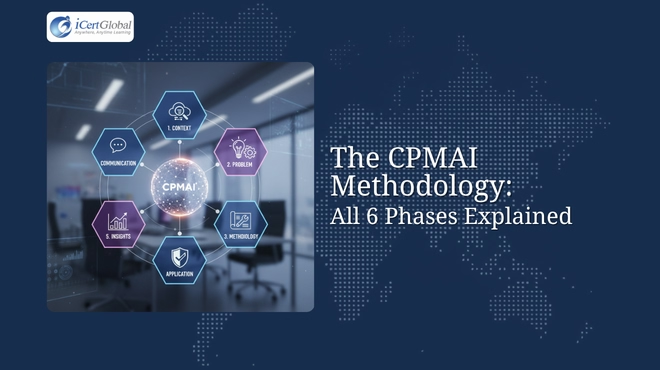
Master the 6 phases of the CPMAI methodology. Learn how to manage AI projects, pass your certification exam,
Advance your career with the PMI-CPMAI certification. Discover how to manage ethical AI projects, master the methodology, and

Our experts are ready to help you with any questions about courses, admissions, or career paths. Get personalized guidance from industry professionals.
Request a Call Back

"PMI®", "PMBOK®", "PMP®", "CAPM®" and "PMI-ACP®" are registered marks of the Project Management Institute, Inc. | "CSM", "CST" are Registered Trade Marks of The Scrum Alliance, USA. | COBIT® is a trademark of ISACA® registered in the United States and other countries.
