



ITIL 4 Foundation vs Practitioner: Certification Path Explained
Compare ITIL 4 Foundation vs Practitioner. Discover which certification aligns with your career goals, boosts your salary, and
Stop managing services and start optimising value. This is the mandatory ITIL Lifecycle CSI module that teaches you to measure, analyse, and enforce efficiency across your entire service landscape.
Your processes are in place. You have a Service Desk, you track Incidents, and you manage Changes. So why is IT still seen as a cost center - Because you lack the governance to consistently improve. The ITIL CSI Certification is for the professional who refuses to accept the status quo. It is the definitive proof that you understand how to audit and enhance service delivery across Service Strategy, Design, Transition, and Operation. This course is not about learning a single process. ITIL Continual Service Improvement is the strategic wrap-around for the entire Service Lifecycle. Many IT organizations, especially those handling high-volume outsourcing, fail to institutionalize improvement, leading to repetitive issues and stagnant performance. This certification provides the precise methodology to implement the ITIL 7-Step Improvement process, ensuring every decision is data-backed. The market doesn't pay a premium for compliance; it pays for performance. By mastering the CSI module, you gain the skills to define, measure, and analyze metrics that actually link IT performance back to business objectives. You'll learn to maintain the ITIL CSI register, turning a list of ideas into a structured, prioritized portfolio of change. Stop relying on anecdotal evidence; start leading with empirical data. We built this for the leaders who want to institutionalise change. Whether you're in Christchurch, England, our training provides the rigorous, metric-focused techniques needed to justify IT's investment and drive continuous maturity.
Earns 3 credits toward your ITIL Expert status, completing your mandatory set of ITIL lifecycle modules.
Deep dive into the Deming Cycle ITIL (Plan-Do-Check-Act) and its application to the ITIL Improvement Process.
Learn how to define CSFs, KPIs, and baselines that align service metrics with actual business goals.
Rigorous training on how ITIL Continual Service Improvement process integrates with and improves every other lifecycle stage.
Learn the mandatory structure and usage of the ITIL CSI register to manage, track, and prioritise improvement initiatives.
Practice with graded mock exams that target the scenario-based, multi-choice format of the Intermediate ITIL Lifecycle CSI exam.
This is the first section. The ITIL Continual Service Improvement (CSI) Certification Training Program enables professionals to develop skills in analyzing and improving service management processes within organizations. This training equips them with knowledge of ITIL best practices and the CSI approach, focusing on data-driven decision-making and the continuous improvement of services through process refinement and innovation. As part of the learning process, professionals can explore the role of metrics and measurement in evaluating service performance.
In the context of CSI, data-driven decision-making is based on the IT Service Management (ITSM) framework, which involves understanding the Service Value System (SVS) and its core components, including the Service Portfolio, Service Catalog, and Service Continuum. CSI also involves the use of Key Performance Indicators (KPIs) and Return on Investment (ROI) analysis to measure the effectiveness of service improvements. This approach helps organizations optimize their service management processes and enhance customer satisfaction. Professionals in Christchurch, England can apply the CSI approach in their work by analyzing service metrics and identifying areas for improvement using the Service Level Agreement (SLA) and Capacity Management processes.
By adopting the CSI approach, organizations in the region can enhance their service management maturity and improve their ability to adapt to changing customer needs and market conditions.

Get a custom quote for your organization's training needs.
This is the second section. Effective service improvement is a continuous process that requires a structured approach to identify and address service gaps. The ITIL CSI Certification Training Program teaches professionals how to use the CSI approach to analyze and improve service management processes, resulting in better service delivery and enhanced customer satisfaction.
By adopting this approach, organizations can establish a culture of continuous improvement and enhance their overall service management maturity. In CSI, the service improvement approach is based on the Plan-Do-Check-Act (PDCA) cycle, which involves identifying areas for improvement, developing and implementing a plan, and then reviewing and adjusting the process to achieve the desired outcomes. The CSI approach also involves the use of change management principles to ensure that service improvements are adopted by all stakeholders within the organization.
This structured approach helps organizations to achieve sustainable service improvements. Professionals in Christchurch, England who complete the ITIL CSI Certification Training Program can apply the CSI approach in their work by developing and implementing service improvement plans, using the PDCA cycle, and applying change management principles to ensure successful service improvements.
Learn how to define measurement requirements and create a robust measurement strategy, linking raw data to business value.
Master the ITIL 7 Step Improvement process (from defining what to measure to implementing improvements) and its alignment with the Deming Cycle ITIL.
Understand the roles and responsibilities required to enforce improvement, including the ownership of the ITIL CSI register.
Develop skills in presenting complex data as clear, actionable information that compels senior management to approve improvement initiatives.
Learn to conduct maturity assessments and gap analysis against current baselines to prioritize where effort should be focused.
Acquire the skills to lead and facilitate Service Review meetings, ensuring accountability for process effectiveness and service quality.
If you are accountable for cost efficiency and value delivery in your IT organisation, this ITIL CSI Certification is your job description.
This is the third section. Achieving certification in the ITIL CSI Certification Training Program demonstrates a professional's expertise in service improvement and their ability to apply the CSI approach in real-world situations. This certification recognizes a professional's knowledge of the CSI approach and their understanding of how to apply it in service management processes.
By achieving this certification, professionals can enhance their credibility and increase their job prospects. In the context of CSI, certification demonstrates a professional's understanding of the service improvement approach and their ability to analyze and improve service management processes. This includes understanding the CSI approach and the Plan-Do-Check-Act (PDCA) cycle, as well as the use of metrics and measurement to evaluate service performance.
By achieving certification, professionals can demonstrate their expertise to employers and clients. Professionals with the ITIL CSI Certification in Christchurch, England can demonstrate their expertise in service improvement and apply the CSI approach in real-world situations, enhancing their credibility and job prospects in the region's IT service management community.
The ITIL CSI Certification proves you possess the strategic governance skills to lead measurement and improvement initiatives.
This certification is a mandatory filter for senior roles focused on cost reduction, maturity, and service quality.
Earn 3 credits towards your ITIL Expert status, completing the essential strategic component of the ITIL lifecycle modules.
This is an Intermediate Lifecycle module. The requirements are strict:
ITIL Foundation Certificate: You must hold the ITIL Foundation Certificate in IT Service Management.
Required Training: Completion of a minimum of 21 contact hours (3 days) of formal, accredited ITIL Lifecycle CSI training is mandatory.
Recommended Experience: It is highly recommended that candidates have at least 2 years of professional experience working in an IT service management environment.
This is the fourth section. Professionals who complete the ITIL CSI Certification Training Program will gain the skills and knowledge required to work in a variety of roles related to service improvement, including service manager, continuous improvement manager, and change manager. This training equips professionals with the skills required to analyze and improve service management processes, resulting in better service delivery and enhanced customer satisfaction.
In the context of CSI, professionals will learn how to use the ITIL CSI Approach to analyze and improve service management processes, including the development and implementation of service improvement plans. This approach involves the use of metrics and measurement to evaluate service performance, as well as the application of change management principles to ensure successful service improvements. By completing this training, professionals can gain the skills required to work in service improvement roles.
Professionals in Christchurch, England who complete the ITIL CSI Certification Training Program can apply for service improvement roles in the region's IT service management community, enhancing their job prospects and career opportunities.
Master the process of identifying the improvement strategy, defining CSFs, KPIs, and baselines that align with business vision and current IT capability.
Learn the mandatory activities for gathering, processing, and analyzing raw data to transform it into meaningful information and knowledge (the DIKW model).
Master the steps for presenting and using information (reporting) and implementing the actual improvement actions to set a new baseline.
Detailed training on how to conduct service and process maturity assessments, benchmarking, and root cause analysis to identify improvement opportunities.
Deep dive into different measurement types (technology, process, service) and how to create effective service reports that compel action.
Understand the human and cultural challenges of implementing CSI and the communication strategies needed to gain buy-in for change.
Define the roles, skills, and organizational structures required to enforce the ITIL Improvement Process, including the CSI Manager and the CSI Coordinator.
Review the tools and technology needed to support the CSI activities, particularly for automated data gathering, analysis, and reporting.
Analyze the common challenges, critical success factors, and risks associated with implementing and maintaining the ITIL Continual Service Improvement process.
Practical guidance on planning and implementing CSI initiatives, integrating them with organizational change management and Service Transition.
Intensive review of mock exams, dissecting the case studies and drilling the 5/3/1/0 scoring system for the ITIL CSI exam questions.
Final strategy session focusing on the interconnectivity of the ITIL lifecycle modules and a final self-assessment for certification readiness.
This is the fifth section. IT service management is a growing sector in Christchurch, England, with a strong demand for professionals with expertise in service improvement. The ITIL CSI Certification Training Program provides professionals with the skills and knowledge required to succeed in this sector, including the ability to analyze and improve service management processes and apply the CSI approach in real-world situations.
By completing this training, professionals can enhance their career prospects and increase their job opportunities. In the context of CSI, service improvement is critical to delivering high-quality services and enhancing customer satisfaction. Professionals who complete the ITIL CSI Certification Training Program will gain the skills and knowledge required to improve service management processes and apply the CSI approach, resulting in better service delivery and enhanced customer satisfaction.
Professionals with the ITIL CSI Certification in Christchurch, England can apply for roles in the region's IT service management community, including service improvement manager, continuous improvement manager, and change manager, enhancing their job prospects and career opportunities.
Great class, very informative.

Great PMP<sup>®</sup> Bootcamp. I had a great time taking this course. I took the course to prepare to sit for the CAPM<sup>®</sup> but may be able to sit for the PMP<sup>®</sup>. I learnt a lot was challenging. Great course. We need one more day. Content was very detailed.

it was a great class. Lots of energy. And I enjoyed.

Fantastic course to prepare for PMP<sup>®</sup> exam.

As a participant it was smooth sailing for me.

Explore our instructor-led ITIL Continual Service Improvement training to learn about the course duration, cost, eligibility, and certification process. You get practical learning, exam-focused preparation, and expert guidance. Ready to get started? Compare ITIL Continual Service Improvement certification training options and choose a classroom or live online format that fits your schedule.
Explore Our ITIL Continual Service Improvement certification training is available in a city near you
Stay updated with the latest insights and trends in your field
Compare ITIL 4 Foundation vs Practitioner. Discover which certification aligns with your career goals, boosts your salary, and
Explore the top 10 IT service management best practices for modern business, from ITIL 5 and AI automation
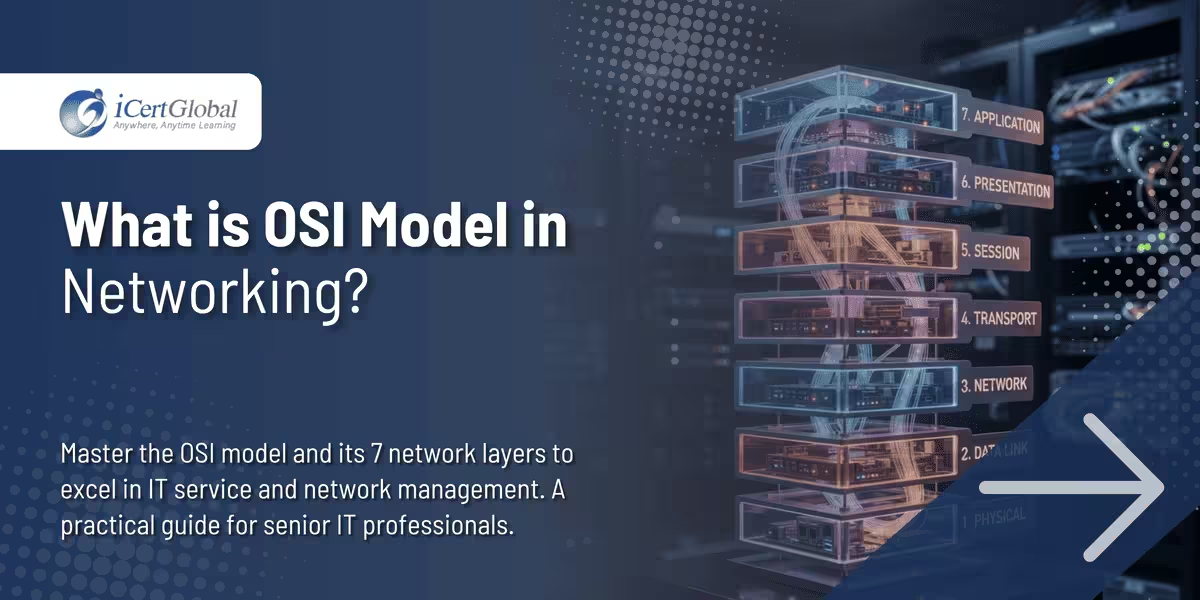
Master the OSI model and its 7 network layers to excel in IT service and network management. A
Learn the top benefits of ITIL certification and how it boosts your IT career and organizational value.
Learn how businesses keep their technology like computers and internet running well with ITSM and ITIL.
Learn what COBIT is and why it matters for managing technology in businesses.
Learn about the key responsibilities, skills, and career path of a Service Desk Manager.

Explore the top high-paying programming languages for 2026 and gain in-demand skills to boost your career, stay competitive,

Master frontend frameworks to accelerate your career. Compare React, Angular, Vue, Svelte, and Next.js to build modern web

Harness the power of Data Science in IT Process Management to streamline operations, improve decision-making, and maximize efficiency
Our experts are ready to help you with any questions about courses, admissions, or career paths. Get personalized guidance from industry professionals.
Request a Call Back

"PMI®", "PMBOK®", "PMP®", "CAPM®" and "PMI-ACP®" are registered marks of the Project Management Institute, Inc. | "CSM", "CST" are Registered Trade Marks of The Scrum Alliance, USA. | COBIT® is a trademark of ISACA® registered in the United States and other countries.

