You are likely stuck in a silo. You know Incident Management, or maybe you are good at Change, but you lack the holistic view. You are fighting fires in Operations while Strategy ignores you. You are trying to transition services that were designed poorly. You are a "Manager" but not a "Master." Meanwhile, ITIL Expert-certified professionals are the ones designing the operating models, defining the service portfolio, and sitting in the boardroom explaining IT value to the CEO. The industry is flooded with Foundation-level certificate holders who think they know ITSM because they memorized what an SLA is. They are commodities. The ITIL Expert is the scarcity. Recruiters and CIOs know that an Expert has survived the gauntlet of Intermediate exams and passed the grueling MALC capstone. They know an Expert understands how Strategy feeds Design, how Design dictates Transition, and how Operation feeds back into Strategy. This isn't a basic boot camp. Our ITIL Expert Training Program is a strategic roadmap designed to get you through the credit system efficiently. Whether you are taking the Lifecycle path (Strategy, Design, Transition, Operation, CSI) or the Capability path, our vetted experts guide you through the complex web of dependencies. We don't just teach you to pass; we teach you to think like a CIO. We built this for serious ITSM professionals who are tired of being ignored. You will learn how to align IT assets with business needs, how to justify million-dollar IT investments, and how to orchestrate complex organizational changes. Whether you are finalizing your v3 journey or preparing to bridge to ITIL 4, this is the apex. The exam is the final gatekeeper - a test of integration, not just memory. We hand you the keys to unlock it.
ITIL Expert Certification Overview in Sarnia, ON
ITIL Expert Training Course Highlights in Sarnia, ON
More Than a Course - It's Your Career Accelerator
Accredited Training Organization (ATO)
Don't risk your credits with unverified providers. We are fully accredited by PeopleCert to deliver the complete ITIL Expert roadmap.
MALC Specialization
The Managing Across the Lifecycle (MALC) exam is where most candidates fail. Our program includes a dedicated MALC intensive module to ensure you clear the final hurdle.
Strategic Credit Planning
Don't waste time on low-value modules. We help you calculate your ITIL v3 credits and choose the fastest, most relevant path to 22 credits.
Real-World Architecture
Learn from instructors who have designed ITSM ecosystems for the largest banking and telecom giants.
Legacy to Modern Bridge
Understand how your Expert knowledge translates to the modern ITIL 4 Managing Professional designation.
24/7 Expert Mentorship
Access to ITSM Experts who can help you untangle the complex scenarios found in the intermediate and capstone exams.
Industry Applicability
The ITIL Expert Certification Training Program is specifically designed for IT Service Management professionals who aim to improve the quality of IT services. This training program is based on the widely-adopted ITIL framework, which is used by over 90% of the Fortune 500 companies.
The ITIL Expert certification is considered the highest level of ITIL certification, demonstrating a high level of knowledge in IT Service Management. In Sarnia, ON, IT professionals can leverage this certification to take on more complex roles and responsibilities within their organizations.
The ITIL Expert certification is highly valued by organizations due to its ability to provide a structured approach to IT service management, which enables IT teams to align their services with business objectives. By participating in the ITIL Expert Certification Training Program, IT professionals can develop a thorough understanding of ITIL processes and roles, as well as the skills to apply them in real-world scenarios.
Corporate Training
Tailored programs for teams with enterprise support

Ready to transform your team?
Get a custom quote for your organization's training needs.
Work Responsibilities
Service Desk processes and Incident Management are two critical components of the ITIL service lifecycle. Service Desk teams are responsible for handling IT incidents, requests, and problems, which can significantly impact the quality of IT services. Effective incident management involves identifying, categorizing, and resolving incidents in a timely manner to minimize their impact on business operations.
In Sarnia, ON, IT professionals can develop the skills to create efficient incident management processes, reducing the mean time to resolve (MTTR) and improving overall IT service quality. Incident management requires a structured approach, including incident classification, prioritization, and assignment of tasks to relevant personnel. IT professionals can leverage the ITIL Expert Certification Training Program to develop a comprehensive understanding of incident management processes, including the roles of the Service Desk, IT teams, and stakeholders.
By mastering incident management, IT professionals can improve the overall quality of IT services and enhance their reputation within their organizations. Effective incident management also involves continuous improvement, with a focus on measuring and analyzing incident metrics, such as the number of incidents, mean time to detect (MTTD), and mean time to resolve. IT professionals can develop the skills to collect and analyze incident data, identify trends, and implement improvements to enhance IT service quality.
Upcoming Schedule
Skills You Will Gain In Our ITIL Expert Training Program
Service Strategy (SS): Stop taking orders.
You will learn to define services as strategic assets, analyze market spaces, and manage demand and financials like a business owner.
Service Design (SD): Build it right the first time.
You will master availability, capacity, and continuity planning to ensure services are fit for purpose and use.
Service Transition (ST): Manage the chaos of change.
You will learn to control assets, manage configurations, and deploy releases without crashing the production environment.
Service Operation (SO): Keep the lights on efficiently.
You will refine incident, problem, and access management processes to stabilize delivery and reduce downtime.
Continual Service Improvement (CSI): Evolve or die.
You will internalize the 7-step improvement process to constantly align IT services with changing business needs.
Managing Across the Lifecycle (MALC): Connect the dots.
You will learn to integrate all lifecycle stages, managing the conflict between stability and responsiveness.
Who This Program Is For
This certification training is ideal for:
ITSM Architects
Service Delivery Managers
Process Owners (Incident, Change, Problem)
IT Consultants & Auditors
CIOs / CTOs
Senior IT Project Managers
If you have your Foundation and are serious about moving into senior management or high-level consulting, the ITIL Expert path is your mandatory roadmap.
Skill Development
The ITIL Expert Certification Training Program focuses on developing the skills required to implement ITIL processes and frameworks within an organization. Service Transition and Release and Deployment Management are two critical components of the ITIL service lifecycle, which involve planning, building, testing, and deploying IT services and releases. In Sarnia, ON, IT professionals can develop a comprehensive understanding of these processes, improving the quality and efficiency of IT service delivery.
Service Transition involves the transition of new or changed IT services into production, which requires careful planning and coordination between IT teams and stakeholders. IT professionals can leverage the ITIL Expert Certification Training Program to develop the skills to create efficient service transition processes, reducing the risk of IT service disruptions and improving overall IT service quality. Effective service transition also involves managing changes to existing IT services, including assessing the impact of changes on business operations and IT infrastructure.
IT professionals can develop the skills to collect and analyze data on change management, incident management, and problem management, enabling them to identify trends and areas for improvement.
ITIL Expert Certification Training Program Roadmap in Sarnia, ON
Why get ITIL Expert-certified?
The Credential That Ends the Gatekeeping
Command the "Expert" Salary
Data shows ITIL Experts earn 40-50% more than their Foundation-level counterparts.
Silence the Imposters
Walk into any meeting knowing you understand the full lifecycle better than anyone else in the room.
Future-Proof Your Career
Being an ITIL Expert automatically qualifies you for the "ITIL 4 Managing Professional Transition" module, skipping 4 exams.
Eligibility and prerequisites
You cannot just "take" the Expert exam. It is a journey. You must earn it through the credit system.
Foundation Certificate: You must hold a valid ITIL Foundation certificate (2 Credits).
15 Intermediate Credits: You must earn a minimum of 15 credits from the Intermediate streams (Lifecycle or Capability).
17 Credits Total: You must have at least 17 credits banked before you are even eligible to book the MALC exam.
MALC Completion: You must complete an accredited MALC training course and pass the exam.
Professional Credibility
The ITIL Expert Certification Training Program provides a structured approach to IT service management, which enables IT teams to align their services with business objectives. Portfolio, Programme, and Project Management are three components of the ITIL service lifecycle, which involve strategic planning, budgeting, and resource allocation for IT projects and services. In Sarnia, ON, IT professionals can develop the skills to create efficient portfolio management processes, improving the alignment of IT services with business objectives.
Portfolio management involves creating a portfolio of IT projects and services, which requires a thorough understanding of business objectives, IT capabilities, and resource allocation. IT professionals can leverage the ITIL Expert Certification Training Program to develop the skills to create a balanced portfolio of IT projects and services, improving the overall quality and efficiency of IT service delivery. Effective portfolio management also involves managing the costs associated with IT projects and services, including the costs of development, maintenance, and support.
IT professionals can develop the skills to collect and analyze data on IT costs, enabling them to identify areas for cost reduction and improve overall IT service quality.
Course Modules & Curriculum
Service Strategy (SS) - 3 Credits
Lesson 1: Strategy Management
Learn to define the market, develop the offering, and develop strategic assets. Understand how to position your IT organization as a value-center, not a cost-center.
Lesson 2: Financial Management
Master the art of budgeting, accounting, and charging. Learn to quantify the value of IT services in financial terms that the CFO understands.
Lesson 3: Demand & Portfolio Management
Stop guessing capacity. Learn to analyze Patterns of Business Activity (PBA) and manage the Service Portfolio to balance supply and demand.
Service Design (SD) - 3 Credits
Lesson 1: Design Coordination
Learn to coordinate all design activities, ensuring that new services are consistent and integrated.
Lesson 2: Availability & Capacity Management
Master the technical metrics. Learn to design services that meet strict SLA requirements for uptime and performance.
Lesson 3: Security & Continuity
Design for resilience. Learn to integrate Information Security and IT Service Continuity into the very fabric of the service.
Service Transition (ST) - 3 Credits
Lesson 1: Change Management
The heart of control. Learn to manage the lifecycle of all changes, enabling beneficial changes to be made with minimum disruption to IT services.
Lesson 2: Release & Deployment
Master the rollout. Learn to plan, schedule, and control the build, test, and deployment of releases.
Lesson 3: Knowledge Management
Stop reinventing the wheel. Learn to gather, analyze, store, and share knowledge and information within an organization.
Service Operation (SO) - 3 Credits
Lesson 1: Incident & Problem Management
Restore service fast, then fix the root cause. Master the interplay between restoring operations and removing permanent errors.
Lesson 2: Request Fulfillment & Access
Streamline the routine. Learn to handle service requests and manage access rights efficiently.
Lesson 3: Service Desk Functions
Optimize the single point of contact. Learn to structure and manage a Service Desk that adds value, not just answers phones.
Continual Service Improvement (CSI) - 3 Credits
Lesson 1: The 7-Step Improvement Process
Master the loop: Identify, Define, Gather, Process, Analyze, Present, Implement.
Lesson 2: Measurement & Reporting
Learn to create reports that drive action. Understand the difference between data, information, knowledge, and wisdom.
Lesson 3: CSI Registers
Manage the pipeline of improvements just like a project portfolio.
Managing Across the Lifecycle (MALC) - 5 Credits
Lesson 1: Integration of Lifecycle Stages
This is the capstone. Learn how Strategy, Design, Transition, Operation, and CSI interact. Understand the inputs and outputs of every stage.
Lesson 2: Governance & Organization
Master the structures required to govern IT services. Learn about organizational development and sourcing strategies.
Lesson 3: Strategic Case Studies
Apply everything you have learned to complex, multi-stage scenarios. This is the direct preparation for the dreaded MALC exam questions.
Course & Support
Everything you need to know about our training options and support
Skill Gap
The ITIL Expert Certification Training Program is highly valued by organizations due to its ability to provide a structured approach to IT service management. Service Desk and IT Service Continuity Management are two critical components of the ITIL service lifecycle, which involve providing IT services and ensuring business continuity in the event of IT disruptions. In Sarnia, ON, IT professionals can develop the skills to create efficient service desk processes and IT service continuity plans, improving the overall quality and availability of IT services.
IT Service Continuity Management involves identifying, assessing, and mitigating the risks associated with IT disruptions, which can significantly impact business operations. IT professionals can leverage the ITIL Expert Certification Training Program to develop the skills to create efficient IT service continuity plans, reducing the impact of IT disruptions on business operations. Effective IT service continuity also involves creating a business continuity plan, which requires a thorough understanding of business objectives, IT capabilities, and resource allocation.
IT professionals can develop the skills to collect and analyze data on IT service continuity, enabling them to identify areas for improvement and improve overall IT service quality.
Customer Testimonials
Hear from our successful graduates
"Exceptional PMP Training Experience with iCertGlobal I recently completed the PMP training by iCertGlobal, and I must say it was an outstanding experience. The instructor demonstrated a deep understanding of project management principles and brought real-world experience to the table. The training material's provided were comprehensive and well-organized, offering valuable insights and practical tips. I would highly recommend iCertGlobal to anyone looking for professional PMP Training.. "

John Anderson
"iCertGlobal provided a great learning experience with clear, well organised courses. The trainers were knowledgeable, and the support team was responsive to all my questions. The study material was comprehensive, which helped me pass my certification exam with ease. Highly recommended for anyone looking to get certified. "
James Walsh
"iCertGlobal is the best Certificate Training Organization. you will get good instructor and they will improve leaning sills and give the real time experience examples due to that you will get pass in first try. "
Andy Moran
"The course content, exam prep questions, interactive Q&A, and real-life examples made attending this PMP Project Management training class worth my time and money. The support from iCertGlobal was exceptional and I would like to thank them for accepting my request of meeting the trainer post the session for clearing my doubts."
Tim Malone
"I had a good learning experience with icertGlobal and it had been an amazing development journey. Actually, I accidentally bumped into iCertGlobal while searching for an online course for preparing my PMP examination. With positive reviews all over the internet and quick responses to my questions, I was flabbergasted enough to sign-up immediately. The instructor-led PMP preparatory course helped me both offline and online preparations. All the high-quality materials written in simple layman language was enough to grasp the gist of various topics. The instructors were very knowledgeable as they imparted not only their wealth of experiences but also real life examples. Thanks a lot iCertGlobal for imbibing this great learning experience. "
Jason Walter
"Thank you for your great course, great support, rapid response and excellent service."
Hoda Alavi
"My trainer made the materials relatable and easy to understand. It was fun being in class everyday. "
Cassandra Corn
"Amazing trainer who was very supportive. "

Shanna Pilgrim
"Trainer was well versed in the subject matter and got the impression the gentleman was professional and educated within standards and procedures for PMI. "
Anthony Zamora
"The Training was good and customer service was perfect. "
Maka Diakhate
"Trainer was knowledgeable and lesson's pace was just right."

Roger Gonzales
"Trainer (Bruce) was very excellent in delivery and presentation. He provided me with all the tools required to be successful in the PMP exams with lots of quiz questions on all topics reviewed. "
Bashiru Ojibara
"The trainer, Emad was top notch and very knowledgeable. He is up to date with all current versions and is great in 1:1 Training. "

Jonathan Obien
"Thank you for your great course, great support, rapid response and excellent service"

Hoda Alavi
"Marc had very good knowledge and he was able to explain the material and provide guidance to get ready for the test. "

Roque Montesino
"Excellent Course. Zahn was a great instructor and the course material definitely will help me pass the PMP Exam "

Jared Nelson
"Great teacher, went out of his way in every possible aspect. "
Radiah Sims
"Customer service provided by Robin was great as he was very responsive and the trainer, John, was very good at relating the content to my industry. "

Jason D Niebauer
"Excellent "

Roger Muyani
"The instructor (Houssin) was great. There was a lot of good course material provided. There were few exam questions outside the covered subject matter. However, I would say that the overall experience was positive and that I learned a lot. "

Mike
"Customer service provided by Robin was great as he was very responsive and the trainer, John, was very good at relating the content to my industry. "

Anthony Nguyen
"The actual class was outstanding and the on-line course was thorough and effective. I am more confident now to pass the exam. "
 Hefner.jpg)
Denise R Hefner
"The trainer was excellent. Very knowledgeable and was able to answer my questions along the way. "

Jason Blezard
"The pace of the course was good. Attending multiple sessions provided me great insights on the course. "
Keith Lowder
"Its the very useful course to complete the PMP. Sure the Provided materials will help us to clear the PMP. "

Sivanesan Viswanathan
Build In-Demand Skills
Explore our instructor-led ITIL Expert training to learn about the course duration, cost, eligibility, and certification process. You get practical learning, exam-focused preparation, and expert guidance. Ready to get started? Compare ITIL Expert certification training options and choose a classroom or live online format that fits your schedule.
ITIL Expert Training in Other Cities
Our ITIL Expert certification training is available in major cities worldwide
Related Blogs
Stay updated with the latest insights and trends in your field
ITIL 4 Foundation vs Practitioner: Certification Path Explained
Compare ITIL 4 Foundation vs Practitioner. Discover which certification aligns with your career goals, boosts your salary, and...
Top 10 IT Service Management Best Practices for
Explore the top 10 IT service management best practices for modern business, from ITIL 5 and AI automation...
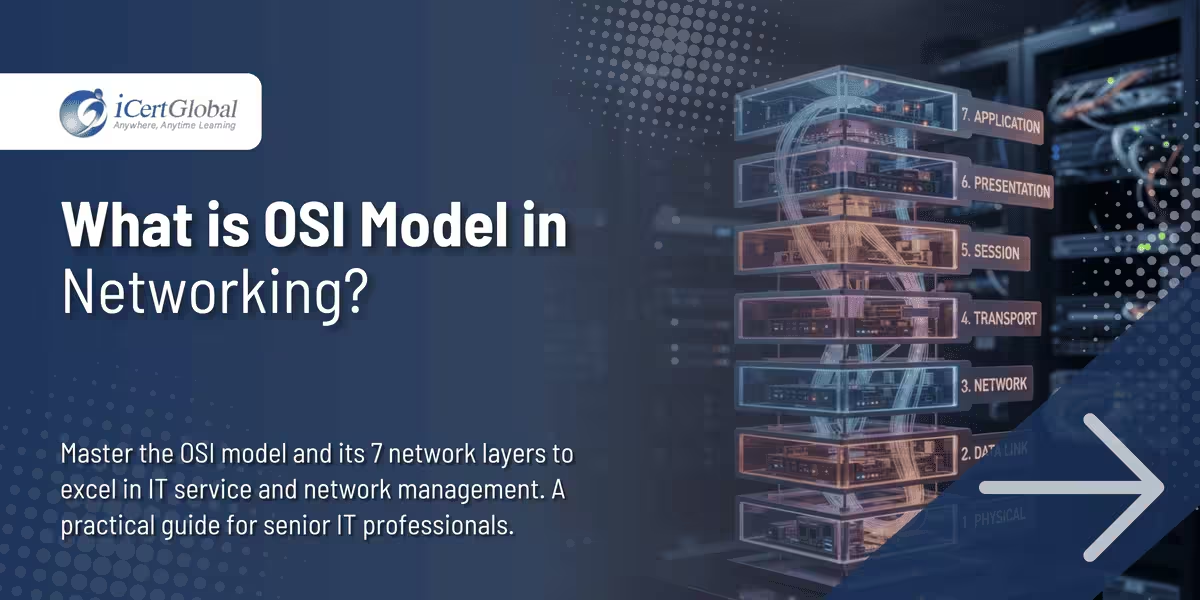
What is OSI Model in Networking
What is OSI model in networking? Learn the 7 layers, protocols, devices, how data flows, and how OSI...
7 Strong Advantages of ITIL Certification
Learn the top benefits of ITIL certification and how it boosts your IT career and organizational value....
Ensuring Tech Support Functions in Businesses
Learn how businesses keep their technology like computers and internet running well with ITSM and ITIL....
The Importance of COBIT in IT Management
Learn what COBIT is and why it matters for managing technology in businesses. ...
Guide to the Service Desk Manager Role
Learn about the key responsibilities, skills, and career path of a Service Desk Manager....
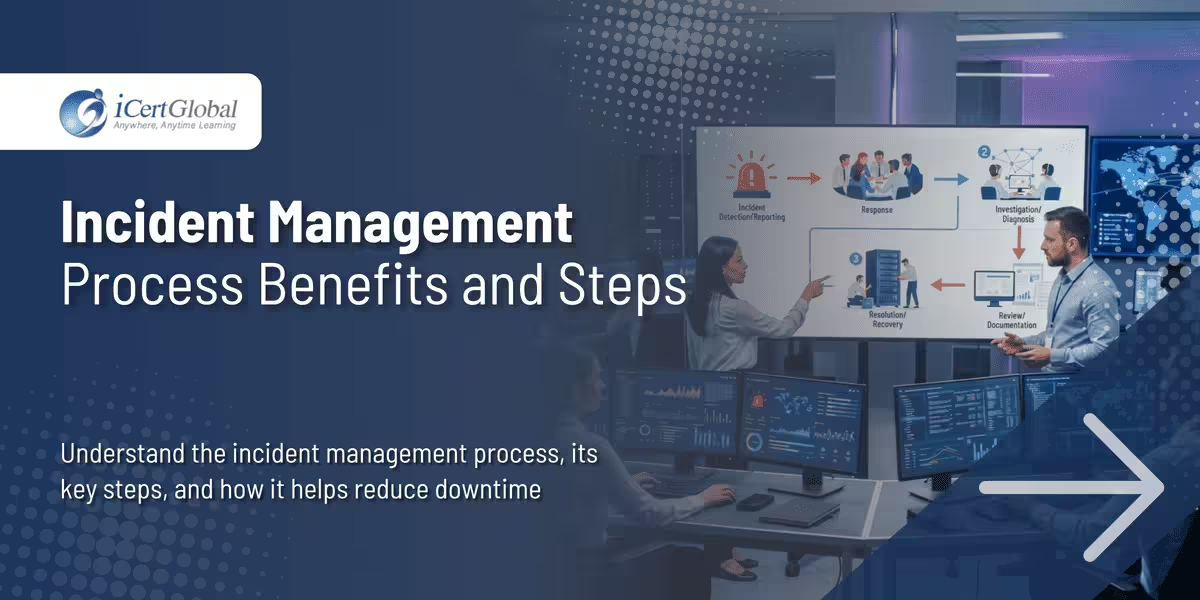
Incident Management Process Benefits and Steps
Master the incident management process to reduce downtime. Learn key steps, roles, and benefits to restore IT services...
Top Highest-Paying Programming Languages to Learn in 2026
Explore the top high-paying programming languages for 2026 and gain in-demand skills to boost your career, stay competitive,...
Top 5 Frontend Frameworks to Watch in 2026
Master frontend frameworks to accelerate your career. Compare React, Angular, Vue, Svelte, and Next.js to build modern web...

