



ITIL 4 Foundation vs Practitioner: Certification Path Explained
Compare ITIL 4 Foundation vs Practitioner. Discover which certification aligns with your career goals, boosts your salary, and
Stop using technology terms and start speaking the global language of IT Service Management. This is the mandatory entry point to all structured IT governance.
You work in IT and use terms like “Incident,” “Change,” and “Service Level,” but without ITIL Foundation Certification, you may lack standardized, industry-agreed definitions for these concepts. This can lead to guesswork. ITIL Foundation Certification provides the essential ITSM foundation needed to operate effectively in structured, enterprise-level environments. It demonstrates that you understand the ITIL basics—the “what” and “why” behind delivering effective IT services. This course is designed to eliminate ambiguity. It teaches you the precise terminology, principles, and processes across the entire Service Lifecycle (Strategy to CSI). Most professionals waste time on self-study, missing key concepts and failing the exam. Our accredited ITIL Foundation 2 days training ensures rapid, targeted knowledge transfer. The value isn't just passing the test; it's gaining the lingua franca of IT Service Management. Without the ITIL v3 Foundation credential, your resume is filtered out by HR bots scanning for the mandatory first step. Stop communicating inefficiently; start speaking the language of control and value. We built this for maximum speed and certainty. Whether you need the V3 certification for the Expert path or simply the standardized ITIL Basics, this course provides the most efficient route to achieving your goal.
This is the non-negotiable prerequisite for all higher-level ITIL Service Management certifications (Intermediate and MALC).
Our intensive ITIL Foundation 2 days training model maximizes retention and prepares you to pass immediately.
Rigorous drilling of the 26 processes and 4 functions, ensuring you master the ITIL Foundation syllabus for the closed-book test.
Practice with simulators engineered to match the exact format of the ITIL v3 Foundation exam for maximum test confidence.
Detailed guidance on the differences between the V3 and ITIL 4 frameworks to help inform your future ITIL Service Management path.
This is the most cost-effective way to secure the 2 credits needed to start your journey toward ITIL Expert status.
Services are often seen as mere cost centers, but ITIL's focus on value is a departure from this mind-set. By emphasizing the delivery of services that meet agreed-upon specifications for quality and efficiency, ITIL encourages organizations to adopt a more service-based approach to management. This shift in focus can significantly enhance the overall customer experience. In practice, ITIL's service-oriented approach requires organizations to implement a service portfolio management process to define, deliver, and maintain a set of services that meet customer needs.
This involves identifying service level agreements (SLAs), operational level agreements (OLAs), and underpinning contracts (UCs) to ensure that services are delivered in accordance with agreed-upon service levels. By doing so, ITIL encourages organizations to adopt a customer-centric approach to service management. In Buffalo, NY, the ITIL Foundation Certification Training Program can help organizations such as M&T Bank and KeyBank adopt a service-oriented approach to customer service. By implementing ITIL's service portfolio management process, these organizations can better meet the needs of their customers and improve their overall customer experience.
ITIL Foundation Certification Training Program teaches professionals to identify and categorize services as they exist in the service catalog. This involves categorizing services into three main types: services, service components, and service offerings. Service components are the building blocks of services and can be categorized as processes, infrastructure, or software applications. Service offerings, on the other hand, are the combinations of service components that provide value to customers.

Get a custom quote for your organization's training needs.
In ITIL, the service catalog plays a critical role in managing services by providing a single source of truth for service information. It is used to manage service levels, track customer requests, and maintain SLAs, OLAs, and UCs. By maintaining a service catalog, ITIL encourages organizations to adopt a service-oriented approach to service management. In Buffalo, NY, the ITIL Foundation Certification Training Program can help organizations such as the University at Buffalo adopt a service-oriented approach to managing their IT services.
By implementing ITIL's service catalog management process, these organizations can improve their service levels and enhance the overall customer experience. Practical application of ITIL concepts involves implementing the ITIL lifecycle stages: service strategy, service design, service transition, service operation, and continuous service improvement. These stages help organizations align their services with business objectives and deliver value to customers. ITIL's process framework provides a structured approach to service management that enables organizations to integrate IT services with business operations.
In ITIL, the IT service continuity management (ITSCM) process is used to identify, assess, and mitigate IT service disruptions. By implementing ITSCM, organizations can ensure that critical IT services remain available during disruptions and minimize the impact of downtime on business operations. ITIL's approach to ITSCM is customer-centric, focusing on delivering IT services that meet or exceed customer expectations.
Understand the purpose and strategic goals of all five stages: Strategy, Design, Transition, Operation, and CSI.
Learn the critical differences between Incidents, Problems, Changes, and Releases, eliminating the primary cause of operational chaos.
Master the concepts of Service, Utility, and Warranty - the language required to define the value of IT services to the business.
Gain the accredited, precise terminology for processes like Service Level Management, Capacity Management, and IT Financial Management.
Understand the purpose of key functions like the Service Desk and Technical Management within the ITSM Foundation.
Grasp the core principles of CSI and the importance of using metrics (KPIs) to drive performance.
If your career touches IT, this ITSM Foundation is the first step you should have already taken.
In Buffalo, NY, the ITIL Foundation Certification Training Program can help organizations such as the Buffalo Niagara Medical Campus implement ITIL's IT service continuity management process. By doing so, these organizations can reduce the risk of IT service disruptions and improve their overall quality of service. ITIL Foundation Certification Training Program emphasizes the importance of service level agreements (SLAs), operational level agreements (OLAs), and underpinning contracts (UCs) in defining service relationships.
SLAs are agreements between organizations and their customers that define the level of service to be provided. OLAs define the relationships between internal teams or external partners, while UCs define the contractual relationships between organizations and their suppliers. ITIL's approach to service level management involves defining clear metrics for measuring service levels and using these metrics to evaluate service performance.
By implementing ITIL's service level management process, organizations can ensure that services are delivered in accordance with agreed-upon service levels. In Buffalo, NY, the ITIL Foundation Certification Training Program can help organizations such as the City of Buffalo implement ITIL's service level management process. By doing so, these organizations can improve their service levels and enhance the overall customer experience.
The ITIL Foundation Certification validates your ability to speak the standardized language of IT Service Management.
This is the non-negotiable prerequisite that opens the door to all 15+ credits required for the ITIL Expert designation.
Our ITIL Foundation 2 days model delivers a globally recognized ITSM Foundation certificate in the fastest possible timeframe.
This is the entry-level course. The only requirement is a commitment to study.
Zero Prior Experience Required: Unlike PMP, you do not need to document any professional experience hours.
No Prior Education Required: The exam tests only your knowledge of the official ITIL Foundation syllabus.
Required Training (Recommended): While self-study is possible, our accredited training is the guaranteed path to success and includes the exam voucher.
The ITIL Foundation Certification Training Program encourages organizations to adopt a service-oriented approach to management by implementing the seven ITIL principles. These principles provide a framework for managing IT services in alignment with business objectives and customer needs. The seven ITIL principles are: know your customers, focus on value, align to business, design for experience, keep it simple, be collaborative, and make decisions for the future. In ITIL, the service desk is a critical component of service management.
It is responsible for providing frontline support to customers and resolving customer requests. By implementing ITIL's service desk management process, organizations can improve their service levels and enhance the overall customer experience. In Buffalo, NY, the ITIL Foundation Certification Training Program can help organizations such as the University at Buffalo implement ITIL's service desk management process. By doing so, these organizations can improve their service levels and enhance the overall customer experience.
ITIL Foundation Certification Training Program provides professionals with the knowledge and skills necessary to adopt a service-oriented approach to management. The program covers ITIL's process framework, which provides a structured approach to service management that enables organizations to integrate IT services with business operations. ITIL's five lifecycle stages help organizations align their services with business objectives and deliver value to customers.
Learn the crucial distinction between Incident Management (restoring service) and Problem Management (finding root cause), a heavily tested topic.
Understand Event Management (monitoring IT components) and Request Fulfillment (standard service requests) and their role in day-to-day stability.
Define the process for managing user access and the mandatory functions of IT Operations (Job Scheduling, Facilities Management).
Master the process of assessing/authorizing changes and the lifecycle of building/testing/deploying new services - critical for ITIL Service Management.
Understand the importance of the Configuration Management Database (CMDB) and the role of knowledge management in the ITIL V model.
Learn the creation of SLAs (Service Level Agreements) and the role of the Service Catalogue in defining service offerings to customers.
Define the core concepts of planning capacity (performance) and designing availability (uptime) to meet business requirements.
Understand the purpose of managing budgets/costs and controlling customer demand - the strategic drivers of the Service Lifecycle.
A practical overview of the differences between the two frameworks to inform your next steps on the ITIL Service Management path.
Targeted, rapid-fire review of the most difficult terminology and process goals (e.g., Supplier Management, Continual Service Improvement).
Specific strategies for selecting the single best answer on the multiple-choice exam under time pressure.
Full-length mock exam execution and an honest self-assessment before sitting the ITIL Foundation Certification exam.
ITIL's process framework is based on five core values: customer focus, leadership, collaboration, communication, and innovation. By implementing ITIL's process framework, organizations can improve their service levels and enhance the overall customer experience.
ITIL's approach to service management is customer-centric, focusing on delivering IT services that meet or exceed customer expectations. In Buffalo, NY, the ITIL Foundation Certification Training Program can help professionals in various industries, such as healthcare and finance, adopt a service-oriented approach to management.
By doing so, these professionals can improve their service levels and enhance the overall customer experience.
Great class, very informative.

Great PMP<sup>®</sup> Bootcamp. I had a great time taking this course. I took the course to prepare to sit for the CAPM<sup>®</sup> but may be able to sit for the PMP<sup>®</sup>. I learnt a lot was challenging. Great course. We need one more day. Content was very detailed.

it was a great class. Lots of energy. And I enjoyed.

Fantastic course to prepare for PMP<sup>®</sup> exam.

As a participant it was smooth sailing for me.

Trainer was excellent. Shared good resources and good experiences.

Good content and training.
I wanted to let you know that I took and passed the PMP exam. Thanks to iCertGlobal and especially my Cincinnati course instructor, who was an excellent teacher and helped me immensely.

Trainer was good. Trainer was very engaged and interacting. Very much satisfied with the training.

I was pleasantly surprised at the quality of this training. Yomi was awesome as a trainer and working to make sure that we understood the concepts. Controlling Cost and Controlling Risk are the most complicated, but Yomi spent time after class working through questions to help others understand. This class also helped to change my perception of the PMP being this MONSTER to something that I can I can successfully do.

Great class with a lot of information and tips to prepare for the exam

It was a great course, covered all the things that i ended up hitting road bumps on. I was the only one in the class, but the trainer was just as involved as if it had been a full class.

I was nervous about taking it online versus classroom; but I am actually glad I took it online. Instructor was very great and gave a good learning experience with his relevant project management experience.
The training was very intense but covered with course material. It was more than I expected.

I thought the class was very informative. The instructor did an excellent job breaking down each chapter to where it was easy to understand. I was also very impressed with his commitment to help us pass ever after the class is over.

Excellent training. Instructor was very knowledgeable and explained information in an understandable way
Quality Materials presented, Instructor very knowledgeable. Exceeded my expectations.
The training is a great introduction into the PMI mindset. Very informative and helpful

Explore our instructor-led ITIL Foundation training to learn about the course duration, cost, eligibility, and certification process. You get practical learning, exam-focused preparation, and expert guidance. Ready to get started? Compare ITIL Foundation certification training options and choose a classroom or live online format that fits your schedule.
Explore Our ITIL Foundation certification training is available in a city near you
Stay updated with the latest insights and trends in your field
Compare ITIL 4 Foundation vs Practitioner. Discover which certification aligns with your career goals, boosts your salary, and
Master the top 10 ITSM best practices for modern businesses. Transform your service desk with proven frameworks to
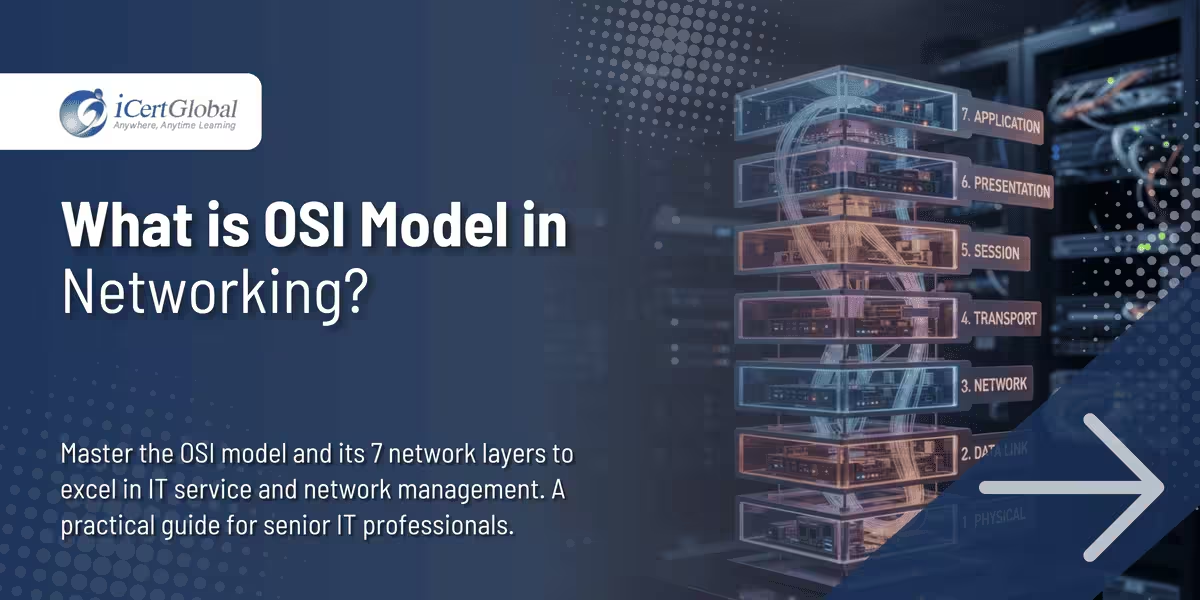
Master the OSI model and its 7 network layers to excel in IT service and network management. A
Learn the top benefits of ITIL certification and how it boosts your IT career and organizational value.
Learn how businesses keep their technology like computers and internet running well with ITSM and ITIL.
Learn what COBIT is and why it matters for managing technology in businesses.
Learn about the key responsibilities, skills, and career path of a Service Desk Manager.

Explore the top high-paying programming languages for 2026 and gain in-demand skills to boost your career, stay competitive,
Master frontend frameworks to accelerate your career. Compare React, Angular, Vue, Svelte, and Next.js to build modern web
Harness the power of Data Science in IT Process Management to streamline operations, improve decision-making, and maximize efficiency
Our experts are ready to help you with any questions about courses, admissions, or career paths. Get personalized guidance from industry professionals.
Request a Call Back

"PMI®", "PMBOK®", "PMP®", "CAPM®" and "PMI-ACP®" are registered marks of the Project Management Institute, Inc. | "CSM", "CST" are Registered Trade Marks of The Scrum Alliance, USA. | COBIT® is a trademark of ISACA® registered in the United States and other countries.

