You are likely living in "Ticket Hell." Your queue is overflowing, your phone is ringing off the hook, and you are fixing the same printer issue for the 50th time this week. You are reacting, not managing. You are the "IT Guy" who reboots servers, not the "Operations Manager" who prevents them from crashing. To the business, you are a cost center. To your boss, you are a commodity. While others are drowning in volume, ITIL OSA Certification holders are analyzing trends. They aren't just closing tickets; they are opening Problem records to kill the root cause so the ticket never comes back. They are configuring Event Management systems to auto-heal servers before users even notice. Recruiters for Major Incident Manager roles in in South Gloucestershire, England's massive NOCs and global support centers don't want "help desk agents"; they want ITIL Operational Support and Analysis experts who can command a bridge call during a P1 outage. This isn't a customer service soft-skills course. Our ITIL OSA training online and in-person is a technical operations bootcamp. We strip away the fluff and focus on the "Restore" and "Repair" workflows. You will learn how to execute a Major Incident Procedure without panicking, how to use Kepner-Tregoe or Ishikawa diagrams for ITIL Problem Management, and how to secure access without blocking productivity. We built this for the Service Desk Leads, Incident Commanders, and L2/L3 Support Engineers who are tired of the churn. Whether you are supporting a bank's trading floor or an e-commerce site's Black Friday sale, this training gives you the structural authority to take control of the chaos. You will learn to optimize the ITIL Service Desk function to deliver value, not just apologies.
ITIL OSA Training Program Overview in South Gloucestershire, England
ITIL OSA Training Course Highlights in South Gloucestershire, England
More Than a Course - It's Your Operations Playbook
PeopleCert Accredited
We are an Authorized Training Organization (ATO).1 Your 4 credits are guaranteed to count toward the ITIL Intermediate OSA qualification.
Real-World "War Room" Labs
We simulate P1/Critical outages. You will practice managing the communication, the technical teams, and the angry stakeholders in real-time.
Root Cause Analysis (RCA) Mastery
Learn the difference between a "workaround" and a "permanent fix." We teach you the specific techniques to find the needle in the haystack.
Exam-Centric Strategy
The OSA exam is scenario-heavy. We provide specific tips on how to distinguish between "Incident" (Speed) and "Problem" (Quality) answers.
Service Desk Optimization
Learn how to structure your desk - Local, Centralized, Virtual, or Follow-the-Sun - for maximum efficiency and minimum cost.
24/7 Expert Support
Stuck on an Event Management correlation rule? Our experts are available around the clock to help you configure the logic.
Career Relevance
Operational Support and Analysis (OSA) plays a pivotal role in ITIL, ensuring that service disruptions are minimized and resolution times are optimized. In ITIL Operational Support and Analysis (OSA) Training Program, participants learn how to analyze and resolve service-related issues efficiently.
This involves applying the ITIL best practice framework, leveraging tools like Incident Management, Problem Management, and Change Management. By adopting the ITIL approach, organizations can align their service desk with the business objectives and improve customer satisfaction.
The program focuses on developing a structured approach to incident management, encompassing incident categorization, prioritization, and assignment. In South Gloucestershire, England, IT professionals and service desk managers can benefit from this training by adopting a more systematic approach to incident management, leading to better customer experience and reduced resolution times.
Corporate Training
Tailored programs for teams with enterprise support

Ready to transform your team?
Get a custom quote for your organization's training needs.
Skill Development
Throughout the ITIL Operational Support and Analysis (OSA) Training Program, participants develop essential skills necessary for effective operational support. This includes understanding key ITIL processes such as Incident Management, Problem Management, and Change Management.
Participants learn to analyze incident data to identify root causes, develop strategies for corrective actions, and communicate with stakeholders effectively. By applying the ITIL approach, professionals can improve their analytical skills, problem-solving abilities, and communication skills.
This enables them to make informed decisions and provide effective support to customers. Upon completion of the program, professionals in South Gloucestershire, England, can demonstrate their expertise in ITIL operational support, helping them secure better job prospects and career advancement.
Upcoming Schedule
Skills You Will Gain In Our ITIL OSA Training Program
Incident Management: Restore speed.
You will learn to manage the lifecycle of all incidents, focusing on rapid restoration of service to minimize business impact. You will master "Incident Models" to automate routine fixes.
Problem Management: Kill the cause.
You will learn to identify the root cause of recurring incidents. You will master reactive and proactive problem management to permanently remove errors from the infrastructure.
Event Management: Automate the eyes.
You will learn to filter and categorize events (Informational, Warning, Exception) to make sense of the noise generated by monitoring tools.
Request Fulfillment: Streamline the asks.
You will learn to handle Service Requests (password resets, new laptops) separately from Incidents, improving user satisfaction and team efficiency.
Access Management: Secure the gate.
You will learn to grant authorized users the right to use a service while preventing access to non-authorized users (Executing the policies of Information Security).
The Service Desk Function: Be the face.
You will learn to manage the Single Point of Contact (SPOC) between the Service Provider and the Users, managing expectations and communications.
Who This Program Is For
This certification training is ideal for:
Incident Managers
Problem Managers
Service Desk Managers / Team Leads
NOC (Network Operations Center) Engineers
Application Support Leads (L2/L3)
IT Operations Managers
If you are responsible for the daily operation, support, and restoration of IT services, this Capability module is your mandatory professional standard.
Practical Application
The ITIL Operational Support and Analysis (OSA) Training Program equips participants with practical knowledge and skills to apply in real-world scenarios. Participants learn to analyze incident reports, identify patterns, and develop strategies for resolution.
By applying the ITIL best practice framework, participants can optimize their incident management processes, reducing mean time to repair (MTTR) and mean time between failures (MTBF). This enables organizations to improve their service quality, increase customer satisfaction, and reduce costs.
In South Gloucestershire, England, IT professionals can apply their learning to real-world scenarios, improving their service management practices and contributing to business success.
ITIL OSA Certification Training Program Roadmap in South Gloucestershire, England
Why get ITIL OSA Certified?
The Credential That Ends the Gatekeeping
Escape Help Desk
Use OSA to prove you have the analytical skills for Problem Management and Operations leadership.
Stop Late Calls
Implement Event Management and proactive Problem Management so systems don't crash while you sleep.
Unlock Specialized Roles
Qualify for high-paying "Major Incident Manager" and "Operations Bridge Lead" positions in top MNCs.
Eligibility and Prerequisites
This is an advanced Capability module. It assumes you know the basics.
Mandatory Prerequisite: You must hold a valid ITIL Foundation certificate (v3, 2011, or ITIL 4 Foundation). You cannot sit for OSA without it.
Training Requirement: You must complete an accredited training course (like ours) to get the "Candidate Number" required for the exam.
Recommended Experience: We strongly advise candidates to have 2+ years of experience in a Service Desk or Operations environment to understand the pressure of the scenarios.
Professional Credibility
The ITIL Operational Support and Analysis (OSA) Training Program enhances the professional credibility of participants, enabling them to demonstrate their expertise in ITIL operational support. This is achieved by applying the ITIL best practice framework, leveraging process knowledge, and adopting a proactive approach to incident management.
Participants learn to analyze and resolve complex incidents, develop strategies for preventive maintenance, and communicate with stakeholders effectively. By completing the program, professionals in South Gloucestershire, England, can demonstrate their commitment to ITIL best practices, enhancing their professional reputation and career prospects.
Upon completion of the program, participants can apply for ITIL certification, further validating their expertise in operational support and analysis.
Course Modules & Curriculum
Event Management
Lesson 1: The Monitoring Loop
Stop ignoring alerts. Learn to generate, detect, filter, and categorize events. Understand the difference between an "Event" and an "Incident."
Lesson 2: Active vs. Passive Monitoring
Learn when to poll devices (Active) and when to wait for traps (Passive). Master the integration of monitoring tools with the Service Desk.
Incident Management
Lesson 1: The Incident Lifecycle
Master the flow: Detect, Log, Categorize, Prioritize, Diagnose, Resolve, Close. Learn the difference between Functional Escalation (Technical) and Hierarchical Escalation (Management).
Lesson 2: Major Incident Procedure
When the house is on fire. Learn the specific procedure for handling high-impact incidents: The Bridge Call, The Communication Plan, and The Post-Implementation Review.
Request Fulfillment
Lesson 1: The Menu
Separate the noise. Learn to build a Request Catalog for standard changes (password resets, software installs).
Lesson 2: Automation & Self-Help
Drive efficiency. Learn how to use Request Fulfillment to reduce the burden on the Service Desk and lower the cost per ticket.
Problem Management
Lesson 1: Root Cause Analysis (RCA)
Stop the recurrence. Learn to investigate the underlying cause of incidents. Master techniques like Kepner-Tregoe, Ishikawa (Fishbone), and Pareto Analysis.
Lesson 2: The Known Error Database (KEDB)
Manage the workarounds. Learn to document temporary fixes and share them with the Service Desk to speed up restoration times.
Access Management
Lesson 1: Rights & Identity
Execute the policy. Learn to verify identity (Authentication) and grant rights (Authorization).
Lesson 2: The Access Lifecycle
Manage the user journey. Learn to handle Access Requests, Change of Status (Promotion/Transfer), and Revocation (Termination).
The Service Desk Function
Lesson 1: Structures & Models
Design the team. Compare Local (Face-to-Face), Centralized (Cost-Effective), Virtual (Follow-the-Sun), and Specialized Service Desk structures.
Lesson 2: Metrics & Staffing
Measure success. Learn to track First Call Resolution (FCR), Average Handling Time (AHT), and Customer Satisfaction (CSAT). Learn how to staff for peak volumes.
Exam Strategy
Review ITIL OSA exam tips. Learn to handle the "Gradient Scoring" questions and manage your time during the 90-minute test.
Review ITIL OSA exam tips. Learn to handle the "Gradient Scoring" questions and manage your time during the 90-minute test.
Course & Support
Everything you need to know about our training options and support
Industry Applicability
The ITIL Operational Support and Analysis (OSA) Training Program has wide industry applicability, enabling participants to apply their learning in various sectors, including financial services, healthcare, and government. By adopting the ITIL approach, organizations can improve their service quality, increase customer satisfaction, and reduce costs.
Participants learn to analyze incident reports, identify patterns, and develop strategies for resolution, enabling them to make informed decisions and provide effective support to customers. In South Gloucestershire, England, IT professionals can apply their learning to real-world scenarios, improving their service management practices and contributing to business success, particularly in sectors where IT service management is critical to business operations.
Customer Testimonials
Hear from our successful graduates
"As a participant it was smooth sailing for me."

Eric S. Tumlinson
"Fantastic course to prepare for PMP<sup>®</sup> exam."

Kevin Hambrice
"it was a great class. Lots of energy. And I enjoyed. "

John Denke
"Great PMP<sup>®</sup> Bootcamp. I had a great time taking this course. I took the course to prepare to sit for the CAPM<sup>®</sup> but may be able to sit for the PMP<sup>®</sup>. I learnt a lot was challenging. Great course. We need one more day. Content was very detailed. "

Karle Scroggins
"Great class, very informative."

James Conklin
Build In-Demand Skills
Explore our instructor-led ITIL Operational Support and Analysis training to learn about the course duration, cost, eligibility, and certification process. You get practical learning, exam-focused preparation, and expert guidance. Ready to get started? Compare ITIL Operational Support and Analysis certification training options and choose a classroom or live online format that fits your schedule.
ITIL Operational Support and Analysis Training in Other Cities
Our ITIL Operational Support and Analysis certification training is available in major cities worldwide
Related Blogs
Stay updated with the latest insights and trends in your field
ITIL 4 Foundation vs Practitioner: Certification Path Explained
Compare ITIL 4 Foundation vs Practitioner. Discover which certification aligns with your career goals, boosts your salary, and...
Top 10 IT Service Management Best Practices for
Explore the top 10 IT service management best practices for modern business, from ITIL 5 and AI automation...
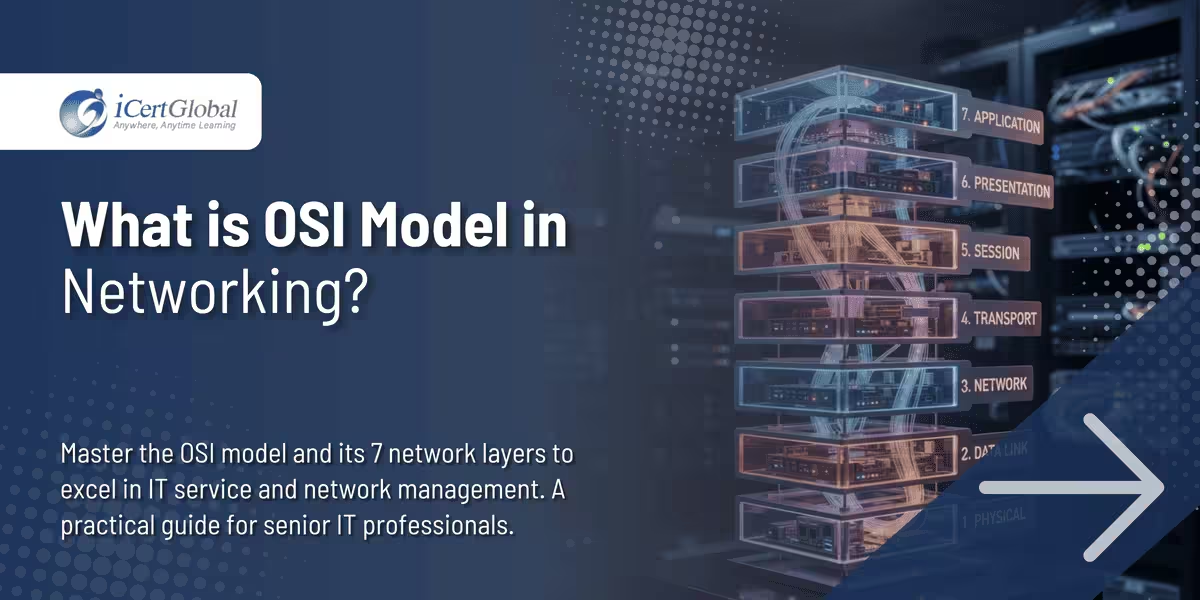
What is OSI Model in Networking
What is OSI model in networking? Learn the 7 layers, protocols, devices, how data flows, and how OSI...
7 Strong Advantages of ITIL Certification
Learn the top benefits of ITIL certification and how it boosts your IT career and organizational value....
Ensuring Tech Support Functions in Businesses
Learn how businesses keep their technology like computers and internet running well with ITSM and ITIL....
The Importance of COBIT in IT Management
Learn what COBIT is and why it matters for managing technology in businesses. ...
Guide to the Service Desk Manager Role
Learn about the key responsibilities, skills, and career path of a Service Desk Manager....

Top Highest-Paying Programming Languages to Learn in 2026
Explore the top high-paying programming languages for 2026 and gain in-demand skills to boost your career, stay competitive,...

Top 5 Frontend Frameworks to Watch in 2026
Master frontend frameworks to accelerate your career. Compare React, Angular, Vue, Svelte, and Next.js to build modern web...
Data Science for IT Process Management and Optimization
Harness the power of Data Science in IT Process Management to streamline operations, improve decision-making, and maximize efficiency...

