



ITIL 4 Foundation vs Practitioner: Certification Path Explained
Compare ITIL 4 Foundation vs Practitioner. Discover which certification aligns with your career goals, boosts your salary, and
Stop making handshake deals. Get the credential that proves you can define, sell, and legally guarantee IT services that generate revenue.
You are likely stuck in a cycle of over-promising and under-delivering. Sales sells a premium product, but your budget only builds a cheaper one. You are the one arguing with angry business heads who claim "the system is slow," but you have no data to prove otherwise because your SLAs are vague. You are managing vendors who bleed your budget dry because your contracts lack teeth. You are an operational victim. SOA-certified professionals are commercial architects. While others are just "taking orders" from the business, ITIL SOA professionals are defining the Service Portfolio, calculating the ROI of every ticket, and managing suppliers with the ruthlessness of a procurement officer. Recruiters for Service Delivery, fin-techs and BRM roles in National City, CA, don't want "nice" managers; they want Service Level Management experts who can translate technical metrics into business dollars. This isn't a class on being polite to customers. Our ITIL Service Offerings and Agreements training is a commercial bootcamp. We strip away the "customer is always right" fluff and focus on the mechanics of value. You will learn how to build a Service Catalog that restricts users to what they pay for, how to forecast Demand so you aren't blindsided by traffic spikes, and how to enforce Financial Management so every server has a billing code.2 We built this for the Service Level Managers, Business Relationship Managers, and Catalog Owners who are tired of the chaos. Whether you are dealing with internal stakeholders or external clients, this training gives you the structural authority to say, "That's out of scope," and point to the contract. You will learn to optimize ITIL Portfolio Management to ensure you are investing in profitable services and killing the dead weight.
We are an Authorized Training Organization (ATO). Your 4 credits are guaranteed to count toward the ITIL Capability Stream total.
Unlike technical modules, SOA focuses on the “Business of IT” – Money, Contracts, and Agreements.
We don't just read definitions. We audit real (anonymized) broken SLAs to show you exactly where the loopholes are.
The SOA exam is scenario-heavy.4 We provide a specific ITIL SOA study guide to help you dissect complex business scenarios and find the winning answer.
Learn the two most neglected areas of ITIL — Supplier Management and Financial Management which are the keys to senior management roles.5
Stuck on a complex financial model or penalty clause? Our experts are available around the clock to clarify the details.
Understanding the importance of effective service offerings and agreements is crucial in delivering high-quality services to customers. Organizations like those in the IT sector need to align these offers with the needs of the market. By doing so, they can ensure that their services meet the desired outcomes and are delivered on time.
To achieve this, service level agreements (SLAs) and underpinning contracts (UCs) are created to define the services to be provided, the parameters of service delivery, and the level of quality expected. These agreements also define the roles and responsibilities of both the service provider and the customer. By developing and implementing these agreements, organizations can maintain a customer-centric approach and ensure the delivery of services that meet agreed-upon standards.
Professionals in National City, CA, working in this field must stay focused on crafting and implementing clear agreements that drive value for both the organization and its customers. This requires staying current with industry developments and adapting to changing customer needs.

Get a custom quote for your organization's training needs.
When taking the ITIL SOA training program, professionals in National City, CA, develop a comprehensive understanding of service offerings and agreements. They learn how to design and deliver service solutions that meet customer requirements and exceed expectations.
This involves understanding the principles of service portfolio management, which encompasses service level management, capacity management, and service continuity management. By grasping these concepts, professionals can develop the skills necessary to create and manage effective service portfolios that cater to the diverse needs of customers.
The training program also equips professionals with the skills necessary to develop service management policies, procedures, and standards. This enables them to ensure that services are delivered with consistency, quality, and alignment with organizational goals.
You will learn to negotiate, agree, and document SLAs that are realistic, measurable, and defensible. You will master the art of the Service Review Meeting.
You will learn to build a Service Catalog that clearly defines what is available, who can get it, and how much it costs, stopping "under-the-table" requests.
You will learn to manage the entire lifecycle of services (Pipeline, Catalog, Retired) to ensure you aren't spending budget on zombie applications.
You will learn to analyze Patterns of Business Activity (PBA) to ensure you have capacity when it's needed and aren't wasting money when it's not.
You will learn to manage the full lifecycle of supplier contracts, ensuring you get value for money and have clear exit strategies.
You will learn to account for, budget, and charge for IT services. You will stop being a "Cost Center" and start being a "Service Provider."
You will learn to move from being an "Order Taker" to a "Strategic Partner" by understanding the customer's business outcomes.
If you are responsible for the "Business" side of IT - contracts, costs, catalogs, and customers - this Capability module is your mandatory professional standard.
Upon completing the training program, professionals can apply their knowledge and skills to real-world scenarios in National City, CA. They can use their understanding of service offerings and agreements to design and develop service management systems that meet customer requirements and drive business growth.
Professionals will learn how to create service management processes and procedures that align with industry best practices. They can apply their knowledge to analyze customer needs and develop tailored solutions that meet those needs.
This enables organizations to differentiate themselves in the market and build strong relationships with customers. By applying their knowledge in practical ways, professionals can demonstrate their value to their employers and contribute to the success of the organization.
Prove you are more than a techie. Show leadership that you understand P&L, contracts, and business strategy.
Stop bleeding money. Use SOA skills to identify waste in supplier contracts and unbilled service usage.
Unlock senior roles. Qualify for high-paying "Head of Service Delivery" and "Vendor Management Lead" positions that require certified expertise.
This is an advanced Capability module. It assumes you understand the basics of the service lifecycle.
Mandatory Prerequisite: You must hold a valid ITIL Foundation certificate (v3, 2011, or ITIL 4 Foundation).15 You cannot sit for SOA without it.
Training Requirement: You must complete an accredited training course (like ours) to get the "Candidate Number" required for the exam.16
Recommended Experience: We strongly advise candidates to have 2+ years of experience in Service Delivery or Account Management to understand the complex scenarios.
In their roles, professionals with ITIL SOA certification are responsible for developing and maintaining service agreements that meet customer needs. They work closely with customers to understand their requirements and develop solutions that meet those needs.
Professionals are also responsible for managing the service level agreements (SLAs) and underpinning contracts (UCs) that define the services to be provided and the level of quality expected. They work closely with the customer to ensure that services are delivered on time and within the agreed-upon standards.
In addition to managing these agreements, professionals are also responsible for analyzing customer feedback and making recommendations for service improvements.
Master the documents. Learn the difference between a Service Level Agreement (Customer), Operational Level Agreement (Internal Team), and Underpinning Contract (Vendor).
The art of the deal. Learn to negotiate realistic targets (SLAM charts) and set up monitoring to catch breaches before the customer does.
Fix it. Learn the formal process for initiating a SIP when a service consistently fails to meet its targets.
Analyze the load. Learn to identify Patterns of Business Activity (PBA) and User Profiles.17 Use "Differential Charging" to influence behavior (e.g., cheaper processing at night).
Speak the language of money. Learn the concepts of Budgeting, Accounting, and Charging.
Prove the worth. Learn to calculate the Return on Investment (ROI) and Total Cost of Ownership (TCO) for IT services.18
Control the supply chain. Learn to categorize suppliers (Strategic, Tactical, Commodity, Operational) and manage their performance against the contract.19
The bridge. Learn to identify customer needs, ensure high levels of satisfaction, and handle complaints strategically.
Review ITIL SOA exam questions. Learn to handle the "Gradient Scoring" questions and manage your time during the 90-minute test.20
The ITIL SOA training program has practical applications in various industries in the IT sector, particularly in National City, CA. ITIL SOA offers a framework for managing service offerings and agreements that is widely applicable in industries such as IT service management, cloud computing, and software as a service (SaaS).
The concepts learned in this training program can be applied to any industry where services are delivered to customers. Professionals can use this knowledge to design and deliver service management systems that meet customer requirements and drive business growth.
By understanding the principles of service portfolio management, service level management, and demand management, professionals can develop services that meet customer needs and exceed expectations. This makes ITIL SOA certification a valuable asset for professionals in various industries in the IT sector.
Great class, very informative.

Great PMP<sup>®</sup> Bootcamp. I had a great time taking this course. I took the course to prepare to sit for the CAPM<sup>®</sup> but may be able to sit for the PMP<sup>®</sup>. I learnt a lot was challenging. Great course. We need one more day. Content was very detailed.

it was a great class. Lots of energy. And I enjoyed.

Fantastic course to prepare for PMP<sup>®</sup> exam.

As a participant it was smooth sailing for me.

Trainer was excellent. Shared good resources and good experiences.

Good content and training.
I wanted to let you know that I took and passed the PMP exam. Thanks to iCertGlobal and especially my Cincinnati course instructor, who was an excellent teacher and helped me immensely.

Trainer was good. Trainer was very engaged and interacting. Very much satisfied with the training.

I was pleasantly surprised at the quality of this training. Yomi was awesome as a trainer and working to make sure that we understood the concepts. Controlling Cost and Controlling Risk are the most complicated, but Yomi spent time after class working through questions to help others understand. This class also helped to change my perception of the PMP being this MONSTER to something that I can I can successfully do.

Great class with a lot of information and tips to prepare for the exam

It was a great course, covered all the things that i ended up hitting road bumps on. I was the only one in the class, but the trainer was just as involved as if it had been a full class.

I was nervous about taking it online versus classroom; but I am actually glad I took it online. Instructor was very great and gave a good learning experience with his relevant project management experience.
The training was very intense but covered with course material. It was more than I expected.

I thought the class was very informative. The instructor did an excellent job breaking down each chapter to where it was easy to understand. I was also very impressed with his commitment to help us pass ever after the class is over.

Excellent training. Instructor was very knowledgeable and explained information in an understandable way
Quality Materials presented, Instructor very knowledgeable. Exceeded my expectations.
The training is a great introduction into the PMI mindset. Very informative and helpful

Explore our instructor-led ITIL Service Offerings and Agreements training to learn about the course duration, cost, eligibility, and certification process. You get practical learning, exam-focused preparation, and expert guidance. Ready to get started? Compare ITIL Service Offerings and Agreements certification training options and choose a classroom or live online format that fits your schedule.
Explore Our ITIL Service Offerings and Agreements certification training is available in a city near you
Stay updated with the latest insights and trends in your field
Compare ITIL 4 Foundation vs Practitioner. Discover which certification aligns with your career goals, boosts your salary, and
Master the top 10 ITSM best practices for modern businesses. Transform your service desk with proven frameworks to
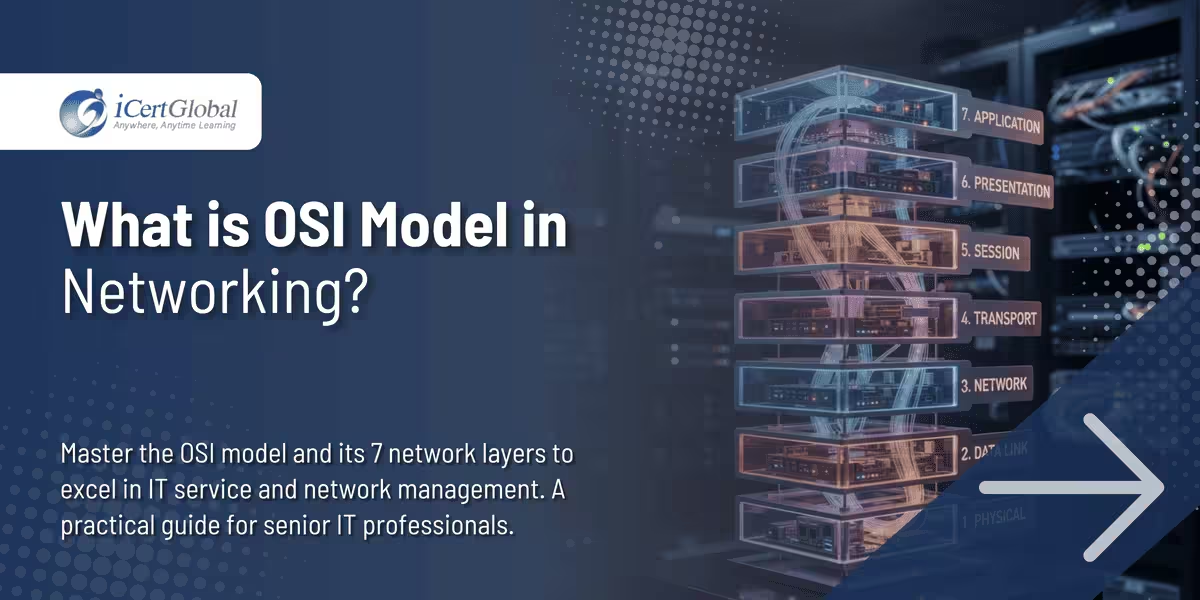
Master the OSI model and its 7 network layers to excel in IT service and network management. A
Learn the top benefits of ITIL certification and how it boosts your IT career and organizational value.
Learn how businesses keep their technology like computers and internet running well with ITSM and ITIL.
Learn what COBIT is and why it matters for managing technology in businesses.
Learn about the key responsibilities, skills, and career path of a Service Desk Manager.

Explore the top high-paying programming languages for 2026 and gain in-demand skills to boost your career, stay competitive,
Master frontend frameworks to accelerate your career. Compare React, Angular, Vue, Svelte, and Next.js to build modern web
Harness the power of Data Science in IT Process Management to streamline operations, improve decision-making, and maximize efficiency
Our experts are ready to help you with any questions about courses, admissions, or career paths. Get personalized guidance from industry professionals.
Request a Call Back

"PMI®", "PMBOK®", "PMP®", "CAPM®" and "PMI-ACP®" are registered marks of the Project Management Institute, Inc. | "CSM", "CST" are Registered Trade Marks of The Scrum Alliance, USA. | COBIT® is a trademark of ISACA® registered in the United States and other countries.

