





Before You Enroll in PMI-CPMAI, Read This First
Before you take the PMI-CPMAI, learn how mastering project management ai can elevate your career, validate your skills,
Stop managing projects with outdated spreadsheets. Get the Microsoft Project Specialist certification that proves you can build, optimize, and track enterprise-level project schedules with professional rigor.
You're a Project Manager, but your schedules are a liability. Relying on Excel or outdated tools prevents you from efficiently managing complex task dependencies, allocating resources, and tracking progress. Every update is manual, the critical path is unclear, and delays hit without data to justify change requests. This inefficiency is unprofessional and guarantees late project delivery. Meanwhile, certified professionals who master Microsoft Project turn schedules into predictive, living models, command higher authority, and are entrusted with high-stakes projects across IT, infrastructure, and manufacturing sectors in Port St Lucie, FL . This is not just a Microsoft Project Management Software tutorial. Our Microsoft Project Professional training is designed by PMP and Microsoft Certified Project Management professionals who have implemented massive projects in Port St Lucie, FL . You will learn the methodology behind the software - how to structure a Work Breakdown Structure (WBS), allocate resources without overloading teams, and use the Baseline feature to enforce accountability and track commitments. A generic PM resume gets filtered out, but a resume highlighting Microsoft Project Mastery lands at the top. This Microsoft Project Certification Course proves you can manage time, cost, and scope simultaneously using the industry's default scheduling tool, making you a credible and highly employable Project Manager. We cut the fluff. This high-impact Microsoft Project Management Professional Certificate program focuses on hands-on application. You'll build and troubleshoot project files, track actual work against baselines, and generate objective performance reports that resolve stakeholder conflicts. Pass the certification exam and walk into your next project meeting with confidence, managing the schedule instead of being controlled by it.
Go beyond simple task lists. Master the proper creation of a Work Breakdown Structure (WBS), summary tasks, and iterative scheduling for both Waterfall and Agile hybrids.
Learn to identify, monitor, and shorten the Critical Path, ensuring you know exactly which tasks control your project end date - the core skill for on-time delivery.
Master resource allocation, resolve over-allocation issues using Resource Leveling, and accurately track resource costs and work consumption.
Master creating and saving multiple Baselines and utilizing Earned Value Management (EVM) metrics (CPI, SPI) to report on project health objectively.
Learn to customize views, tables, and reports to show precisely the data required by project sponsors (e.g., Variance reports, Cost Overrun reports).
An intensive, project-based program that builds the practical fluency needed to manage schedules for large-scale projects common in Port St Lucie, FL enterprises.
In this course, students will develop their skills in planning and managing projects using Microsoft Project. They will learn to create project schedules, set milestones, and track progress.
As they navigate the interface, they will discover how to use Gantt charts, critical path analysis, and resource allocation to ensure projects are completed on time and within budget. By the end of the course, students will be able to create and manage projects that are scalable, flexible, and meeting the needs of their teams in Port St Lucie, FL.

Get a custom quote for your organization's training needs.
As students progress through the course, they will identify the gaps in their existing skills and knowledge. They will realize the importance of integrating Microsoft Project with other Microsoft tools, such as Excel and Power BI, to create a comprehensive project management system.
This integration will allow them to visualize project data, track performance metrics, and make data-driven decisions. Through hands-on practice and real-world examples, students will develop the skills they need to bridge this skill gap and become proficient in Microsoft Project.
Learn how to correctly structure a project using the Work Breakdown Structure (WBS) to ensure all work is captured and accurately linked to project objectives.
Master identifying and analyzing the Critical Path to determine the minimum project duration and accurately calculate schedule variance from the baseline.
Learn to effectively assign resources, identify over-allocation, and use Resource Leveling techniques to smooth workloads and prevent team burnout and project delays.
Gain the skills to calculate and interpret Schedule Performance Index (SPI) and Cost Performance Index (CPI), providing an objective, defensible metric of project health.
Master the use of predecessor and successor relationships (FS, SS, FF, SF) and lag/lead time to build realistic, predictable schedule logic that reflects real-world constraints.
Learn to filter, group, and customize Views, Tables, and Visual Reports to extract the exact data needed for executive briefings and stakeholder status updates.
If your job requires you to manage project timelines and resources and you are tired of manual tracking, this program is engineered to make you the certified Microsoft Project expert who controls the schedule.
Microsoft Project is a highly relevant skill in today's business landscape. In fact, many companies in the area, including those in Fort Pierce, use Microsoft Project to manage large-scale projects and initiatives.
By acquiring this skill, students will open themselves up to a wide range of career opportunities in project management, including roles in construction, IT, and manufacturing. They will be able to work on complex projects that require strong organizational and communication skills.


Stop getting filtered out for high-value scheduling roles that require proven proficiency in Microsoft Project for planning and tracking.
Prove your ability to accurately manage and report Earned Value, Critical Path, and performance metrics across enterprise-scale projects.
Transition from manual updates to predictive data modeling that forecasts delays, justifies resource allocation, and strengthens accountability.
The Microsoft Project certification is a high-value, skills-based exam. While no formal prerequisites exist, practical experience is non-negotiable. Here is the high-level breakdown of what you need to qualify.
Experience: Candidates should have 1-2 years of experience working on complex projects. Success requires a practical understanding of project management concepts (WBS, dependencies, cost management).
Prior Training: Completion of a rigorous, hands-on program like ours is mandatory to gain the practical fluency required for the performance-based exam format.
Technical Focus: The exam is purely performance-based, requiring you to perform tasks (e.g., "Set a Baseline," "Run Resource Leveling") directly in the Microsoft Project application. Rote memorization will fail; task-based speed and accuracy are mandatory.
In terms of industry applicability, Microsoft Project is widely used across various sectors, including finance, healthcare, and education. Students will learn how to create project plans, track progress, and manage resources using Microsoft Project.
They will also explore how to integrate Microsoft Project with other Office tools, such as SharePoint and OneDrive, to streamline project management processes. By mastering Microsoft Project, students will be able to tackle complex projects with confidence in Port St Lucie, FL.
Use Microsoft Project Professional to create Work, Material, and Cost Resources, and assign them to tasks. This ensures accurate tracking of effort and costs, a key skill for Microsoft Project certification.
Identify over-allocated resources and use Manual or Automatic Resource Leveling in Microsoft Project to balance workloads efficiently.
Learn to accurately track and report project costs. Master fixed costs, cost rates, and using cost tables to establish the definitive Cost Baseline for tracking.
Create and save the Initial Project Baseline to lock in scope and schedule commitments. Update progress using percentage complete and actual work, ensuring accurate tracking - a core skill for Microsoft Project certification.
Use the Tracking Gantt View in Microsoft Project to monitor schedule variance, identify delays, and take corrective actions to keep the project on track.
Master calculating and interpreting EVM metrics: PV, EV, AC, CPI, and SPI. Learn to use these objective metrics to report project health to executive leadership confidently.
Handle external dependencies and cross-project links. Master techniques to troubleshoot illogical schedules and fix circular dependencies, a crucial skill in Microsoft Project management.
Create custom tables, views, and filters to display exactly the project information required, e.g., filtering for only late tasks or tasks over budget.
Learn to create custom fields with formulas to calculate specialized metrics and use the Visual Reports feature for high-level summaries. These skills are vital for Microsoft Project certification and professional certificate preparation.
Create a Master Project to consolidate multiple sub-projects. Learn to set up and manage a Resource Pool to share resources across multiple active schedules.
Save your projects in various formats like PDF, Excel, or XML. Master best practices for updating and sharing schedules with team members who don't use Microsoft Project, improving collaboration for project success.
Consolidate all skills learned and complete full-length practice assessments under timed conditions. This ensures readiness for the Microsoft Project certification and aligns with professional certificate standards.
Through this course, students will experience significant growth in their knowledge and skills.
They will develop a deeper understanding of project management principles and practices, as well as the tools and techniques used to implement them.
By the end of the course, students will be able to create and manage projects that meet the needs of their teams and stakeholders, and they will be equipped with the skills and knowledge needed to take on more complex projects in a variety of industries.
Great class, very informative.

Great PMP<sup>®</sup> Bootcamp. I had a great time taking this course. I took the course to prepare to sit for the CAPM<sup>®</sup> but may be able to sit for the PMP<sup>®</sup>. I learnt a lot was challenging. Great course. We need one more day. Content was very detailed.

it was a great class. Lots of energy. And I enjoyed.

Fantastic course to prepare for PMP<sup>®</sup> exam.

As a participant it was smooth sailing for me.

Trainer was excellent. Shared good resources and good experiences.

Good content and training.
I wanted to let you know that I took and passed the PMP exam. Thanks to iCert Global and especially my Cincinnati course instructor, who was an excellent teacher and helped me immensely.

Trainer was good. Trainer was very engaged and interacting. Very much satisfied with the training.

I was pleasantly surprised at the quality of this training. Yomi was awesome as a trainer and working to make sure that we understood the concepts. Controlling Cost and Controlling Risk are the most complicated, but Yomi spent time after class working through questions to help others understand. This class also helped to change my perception of the PMP being this MONSTER to something that I can I can successfully do.

Great class with a lot of information and tips to prepare for the exam

It was a great course, covered all the things that i ended up hitting road bumps on. I was the only one in the class, but the trainer was just as involved as if it had been a full class.

I was nervous about taking it online versus classroom; but I am actually glad I took it online. Instructor was very great and gave a good learning experience with his relevant project management experience.
The training was very intense but covered with course material. It was more than I expected.

I thought the class was very informative. The instructor did an excellent job breaking down each chapter to where it was easy to understand. I was also very impressed with his commitment to help us pass ever after the class is over.

Excellent training. Instructor was very knowledgeable and explained information in an understandable way
Quality Materials presented, Instructor very knowledgeable. Exceeded my expectations.
The training is a great introduction into the PMI mindset. Very informative and helpful

Stay updated with the latest insights and trends in your field
Before you take the PMI-CPMAI, learn how mastering project management ai can elevate your career, validate your skills,
Master the critical data scientist skills that separate beginners from top-tier professionals and accelerate your career growth.
Map your data scientist career path for 2026. Learn the high-demand skills, certifications, and real salary expectations you

Prepare for your data science career with the real insights nobody shares. Learn the practical skills and exam-ready

Discover the core skills you need to build a successful data scientist career. Master the essential expertise that

Compare CISA vs CRISC to find your ideal ISACA path. Analyze exam difficulty, career outlook, and skills to
Master the 5 domains of the CISA Certification Syllabus. Get the complete 2026 exam guide to pass on
Discover the CCNA salary in India from fresher to senior roles. Learn how to leverage this certification to
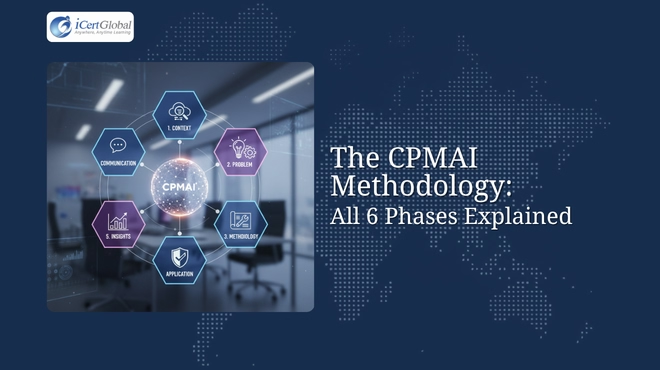
Master the 6 phases of the CPMAI methodology. Learn how to manage AI projects, pass your certification exam,
Advance your career with the PMI-CPMAI certification. Discover how to manage ethical AI projects, master the methodology, and

Our experts are ready to help you with any questions about courses, admissions, or career paths. Get personalized guidance from industry professionals.
Request a Call Back

"PMI®", "PMBOK®", "PMP®", "CAPM®" and "PMI-ACP®" are registered marks of the Project Management Institute, Inc. | "CSM", "CST" are Registered Trade Marks of The Scrum Alliance, USA. | COBIT® is a trademark of ISACA® registered in the United States and other countries.
