






Before You Enroll in PMI-CPMAI, Read This First
Before you take the PMI-CPMAI, learn how mastering project management ai can elevate your career, validate your skills,
Stop building on shaky ground. Get the verifiable skills in Ethereum and Hyperledger Fabric that enterprises actually pay for.
You've read the whitepapers and built simple DApps, but your resume still lands in the generic pile. The market now demands proven skills as a Blockchain Developer, not just enthusiasm for the technology. Companies across Kenosha, WI are seeking professionals with blockchain developer certification who can architect and deploy multi-million dollar ledger systems for major banks and IT service giants. Your bottleneck is navigating the fractured landscape of public, private, and consortium blockchains without formal credentials. Certified professionals are already confidently discussing Chaincode lifecycle, consensus mechanisms, and secure contract deployment - skills you'll master in this Blockchain Developer course. This isn't a course on decentralization theory. Our Certified Blockchain Developer Training Program is engineered by enterprise blockchain consultants who have deployed production-grade networks under regulatory scrutiny in Kenosha, WI . We focus on the two platforms that matter most: Ethereum for public/tokenized solutions and Hyperledger Fabric for permissioned corporate ledgers. Unlike programs teaching only abstract concepts, our blockchain developer course ensures you are immediately deployable. You'll learn to: Secure a network using VPC and IAM roles on AWS Deploy proxy nodes for enhanced security Write auditable, gas-efficient smart contracts The blockchain developer certification proves you know the code. The real value - Walking into client meetings and confidently proposing scalable, immutable solutions that solve real business problems - not just proof-of-concepts. This program is designed for developers, architects, and product managers ready to pivot into this high-demand vertical. Benefits include: Flexible schedules with live, interactive Q&A sessions Production-ready code templates for Ethereum and Hyperledger Fabric Access to private network setups on AWS for hands-on practice 24/7 expert support from active industry Blockchain Developers
Master the two dominant enterprise standards - Ethereum (Solidity) for public/DeFi use cases and Hyperledger Fabric (Golang Chaincode) for corporate consortiums. Don't be a one-trick pony.
Get hands-on experience deploying and securing full networks using AWS Blockchain Templates, teaching you the critical cloud ops skills that distinguish engineers from mere coders.
Learn to identify and mitigate critical vulnerabilities like re-entrancy, underflow/overflow, and state inconsistencies - skills essential for building reliable, production-ready code.
Get 180-day access to a dedicated Certified Blockchain Developer Exam Prep Engine with 2000+ targeted practice questions, ensuring you waste no time studying irrelevant material.
Be worry-free as active blockchain architects are available 24x7 to solve your complex technical doubts and assist with your project deployments.
Receive fully-functional code bases and deployment scripts for common use cases (e.g., ERC-20 token, asset tracking chaincode) that you can fork and use in your projects today.
Blockchain-based systems require decentralized, immutable data storage that ensures the integrity and security of transactions. This is precisely the goal of the Certified Blockchain Developer Training Program, which equips software developers with the skills and knowledge needed to build secure, scalable blockchain applications. In Kenosha, WI, where manufacturers and logistics companies rely on efficient supply chain management, blockchain technology can streamline processes and reduce costs.
Through this course, students learn how to implement smart contract programming languages like Solidity and Vyper, as well as blockchain protocols such as Ethereum and Hyperledger Fabric. They also gain hands-on experience with popular development tools, including Truffle and Ganache, which enable the efficient testing and deployment of blockchain-based applications. By mastering these technical skills, developers in Kenosha, WI, can contribute to the development of innovative blockchain solutions that enhance supply chain visibility, automate inventory management, and improve shipment tracking.

Get a custom quote for your organization's training needs.
The Certified Blockchain Developer Training Program fills a significant skill gap in the industry by providing comprehensive training on blockchain development principles and best practices. Many aspiring developers lack practical experience with blockchain-based systems, which can hinder their ability to design and implement secure, efficient blockchain applications.
This course addresses this gap by offering students a deep understanding of blockchain fundamentals, including consensus algorithms, data storage, and network architecture. By mastering these concepts, students can develop a range of blockchain-based solutions, from cryptocurrency wallets to supply chain management platforms.
In Kenosha, WI, where industries such as manufacturing and logistics rely on efficient data exchange, the Certified Blockchain Developer Training Program equips developers with the skills needed to improve data security and reduce transaction costs through the use of blockchain technology.
Write secure, upgradeable, and gas-efficient Solidity contracts. Understand the Ethereum Virtual Machine (EVM) to debug transactions and optimize performance, moving past basic token deployment.
Develop, test, and deploy Golang-based Chaincode for the Hyperledger Fabric platform. Master the Chaincode lifecycle, including installation, instantiation, and upgrade policies essential for corporate governance.
Understand and implement solutions for self-sovereign identity using blockchain, a critical skill for compliance and digital transformation projects in Kenosha, WI regulatory environment.
Critically evaluate and select the appropriate consensus for a given business problem (e.g., Proof-of-Work vs. Raft/Kafka). Know the trade-offs in finality, throughput, and security.
Secure blockchain nodes on cloud platforms (AWS/Azure) using VPC, security groups, and encryption (KMS). Prevent unauthorized access and ensure network integrity from day one.
Master the Truffle Framework and Web3.js/Ethers.js for front-end integration, building a complete, production-ready decentralized application stack.
If you write code, design systems, or make technology decisions and recognize that ledger technology is the future of verifiable data, this program is engineered to make you the expert.
The Certified Blockchain Developer Training Program bestows professional credibility on graduates, who can demonstrate their expertise in blockchain development to potential employers. With the increasing adoption of blockchain technology across various industries, having a certification in blockchain development can be a significant differentiator in the job market.
The course covers a range of technical topics, including blockchain security measures, decentralized application (dApp) development, and blockchain testing and validation. By mastering these concepts, students can develop a range of blockchain-based solutions that meet the needs of various industries and organizations.
In Kenosha, WI, where the manufacturing and logistics industries are expanding their use of blockchain technology, having a Certified Blockchain Developer certification can increase job prospects and career advancement opportunities.


Get the recognized Certified Blockchain Developer credential that validates your expertise across both public and private enterprise platforms.
Gain access to specialized project opportunities reserved for developers who can architect, deploy, and secure production-grade DLT solutions.
Gain a seat at the architecture decision-making table where real money is spent.
The Certified Blockchain Developer credential is a technical validation for experienced professionals. While iCertGlobal does not impose strict requirements, here is the industry standard for those who succeed in this program and the exam.
Prerequisite Knowledge: Solid understanding of at least one high-level programming language (JavaScript, Java, Go, Python). Familiarity with basic cryptography concepts such as hashing and public-key infrastructure.
Cloud Skills: Working knowledge of basic cloud infrastructure concepts (VPC, VMs, IAM) is a significant advantage, as all real-world deployment is cloud-centric.
Formal Training: Completion of a comprehensive training program like ours is essential to systematically cover the vast scope of public and enterprise DLT platforms.
Recommended Experience: 2+ years of professional software development experience or 1+ year in cloud/DevOps roles. This is a specialization, not a foundation course.
The Certified Blockchain Developer Training Program is highly relevant to the career aspirations of software developers, system administrators, and other IT professionals. As blockchain technology continues to gain traction across various industries, the demand for skilled blockchain developers is increasing rapidly.
The course covers a range of topics, including blockchain architecture, data storage, and consensus algorithms, as well as programming languages such as Solidity and Vyper. By mastering these technical skills, students can develop a range of blockchain-based solutions that meet the needs of various industries and organizations.
In Kenosha, WI, where industries such as manufacturing and logistics rely on efficient data exchange, the Certified Blockchain Developer Training Program equips professionals with the skills needed to improve data security and reduce transaction costs through the use of blockchain technology.
Implement complex Solidity patterns such as the Factory Pattern, Upgradeable Contracts (Proxies), and Access Control (Ownable). Learn to write auditable, gas-efficient code that avoids common pitfalls - an essential skill for blockchain developer jobs.
Master the Truffle Framework (or Hardhat) for development, testing, and deployment. Connect a front-end to a contract using Web3.js/Ethers.js to build a complete DApp stack.
Hands-on lab for deploying a private Ethereum network using AWS Blockchain Templates. Learn to configure VPCs, security groups, Bastion Hosts, and Metamask clients for enterprise-grade access. These skills demonstrate your readiness for blockchain developer certification and practical enterprise jobs.
Critically compare permissioned (Fabric) vs. permissionless (Ethereum) architecture. Understand the Fabric components: Peers, Orderers, Certificate Authorities (CA), and the concept of Channels.
Learn to write, package, and deploy Golang Chaincode (smart contracts) for Hyperledger Fabric. Master transaction flow, state management, and the difference between endorsing and committing peers. This hands-on skill is essential for Certified Blockchain Developer candidates and for securing high-value blockchain developer jobs.
Hands-on lab for deploying a Hyperledger Fabric network using AWS Blockchain Templates. Configure the network, create channels, join peers, and manage the Chaincode lifecycle using the CLI. Completing this lab demonstrates practical expertise and strengthens your profile for enterprise blockchain developer roles.
Evaluate various consensus mechanisms (PoW, PoS, Raft, BFT). Understand Fabric's pluggable ordering service and the challenges of network scalability and data privacy (Private Data Collections).
Explore the concepts and implementation of Decentralized Identity (DID). Understand the challenges and solutions for cross-chain and cross-platform interoperability in an enterprise context.
Analyze real-world enterprise use cases (e.g., Supply Chain, Trade Finance) and map them to the correct DLT platform, learning when not to use a blockchain.
Final review of common contract vulnerabilities (Solidity) and best practices for securing Fabric networks (ACLs, Chaincode access).
Develop test-taking strategies for situational and scenario-based questions. Learn time management and platform-specific techniques to tackle technical queries on your Certified Blockchain Developer exam.
Take a full-length mock exam simulating the real Certified Blockchain Developer test environment, followed by a detailed technical debrief. Consolidate your knowledge and ensure full exam readiness, giving you a competitive edge in blockchain developer roles.
Work responsibilities for Certified Blockchain Developers include designing and implementing secure, efficient blockchain-based applications, as well as ensuring the integrity and security of transactions. They typically work with cross-functional teams to develop blockchain-based solutions that meet business requirements and improve operational efficiency.
Certified Blockchain Developers also contribute to the development of blockchain-based standards and best practices, which enable organizations to adopt blockchain technology more effectively. By mastering these technical skills, developers can enhance data exchange, improve transaction security, and reduce costs through the use of blockchain technology.
In Kenosha, WI, where industries rely on efficient supply chain management, Certified Blockchain Developers can play a key role in improving data exchange, reducing costs, and enhancing supply chain visibility through the use of blockchain technology.
Great class, very informative.

Great PMP<sup>®</sup> Bootcamp. I had a great time taking this course. I took the course to prepare to sit for the CAPM<sup>®</sup> but may be able to sit for the PMP<sup>®</sup>. I learnt a lot was challenging. Great course. We need one more day. Content was very detailed.

it was a great class. Lots of energy. And I enjoyed.

Fantastic course to prepare for PMP<sup>®</sup> exam.

As a participant it was smooth sailing for me.

Trainer was excellent. Shared good resources and good experiences.

Good content and training.
I wanted to let you know that I took and passed the PMP exam. Thanks to iCert Global and especially my Cincinnati course instructor, who was an excellent teacher and helped me immensely.

Trainer was good. Trainer was very engaged and interacting. Very much satisfied with the training.

I was pleasantly surprised at the quality of this training. Yomi was awesome as a trainer and working to make sure that we understood the concepts. Controlling Cost and Controlling Risk are the most complicated, but Yomi spent time after class working through questions to help others understand. This class also helped to change my perception of the PMP being this MONSTER to something that I can I can successfully do.

Great class with a lot of information and tips to prepare for the exam

It was a great course, covered all the things that i ended up hitting road bumps on. I was the only one in the class, but the trainer was just as involved as if it had been a full class.

I was nervous about taking it online versus classroom; but I am actually glad I took it online. Instructor was very great and gave a good learning experience with his relevant project management experience.
The training was very intense but covered with course material. It was more than I expected.

I thought the class was very informative. The instructor did an excellent job breaking down each chapter to where it was easy to understand. I was also very impressed with his commitment to help us pass ever after the class is over.

Excellent training. Instructor was very knowledgeable and explained information in an understandable way
Quality Materials presented, Instructor very knowledgeable. Exceeded my expectations.
The training is a great introduction into the PMI mindset. Very informative and helpful

Stay updated with the latest insights and trends in your field
Before you take the PMI-CPMAI, learn how mastering project management ai can elevate your career, validate your skills,

Master the critical data scientist skills that separate beginners from top-tier professionals and accelerate your career growth.

Map your data scientist career path for 2026. Learn the high-demand skills, certifications, and real salary expectations you

Prepare for your data science career with the real insights nobody shares. Learn the practical skills and exam-ready

Discover the core skills you need to build a successful data scientist career. Master the essential expertise that

Compare CISA vs CRISC to find your ideal ISACA path. Analyze exam difficulty, career outlook, and skills to
Master the 5 domains of the CISA Certification Syllabus. Get the complete 2026 exam guide to pass on

Discover the CCNA salary in India from fresher to senior roles. Learn how to leverage this certification to
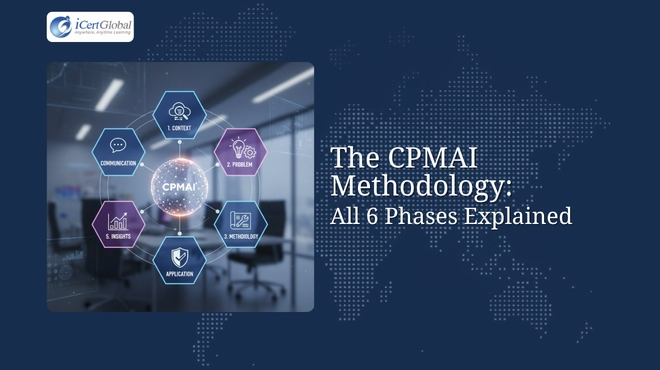
Master the 6 phases of the CPMAI methodology. Learn how to manage AI projects, pass your certification exam,

Advance your career with the PMI-CPMAI certification. Discover how to manage ethical AI projects, master the methodology, and

Our experts are ready to help you with any questions about courses, admissions, or career paths. Get personalized guidance from industry professionals.
Request a Call Back

"PMI®", "PMBOK®", "PMP®", "CAPM®" and "PMI-ACP®" are registered marks of the Project Management Institute, Inc. | "CSM", "CST" are Registered Trade Marks of The Scrum Alliance, USA. | COBIT® is a trademark of ISACA® registered in the United States and other countries.
