





CISA vs CRISC: Which ISACA Certification Is Right
Compare CISA vs CRISC to find your ideal ISACA path. Analyze exam difficulty, career outlook, and skills to
Stop being just a data analyst. Get the practical, in-demand certification that makes you a predictive modeler and unlocks the highest salary brackets in AI and Data Science.
You've read the books, run Jupyter notebooks, and built some models - but struggle in interviews that demand explaining the math behind XGBoost, optimizing production pipelines, or handling multi-terabyte datasets common in Lancaster, PAe-commerce, banking, and telecom. Your skills are academic; the industry requires actionable, deployable machine learning models. Our Machine Learning Training Program is designed by working Machine Learning Engineers who solve real-world problems like model drift, GPU limitations, and accuracy vs. F1-score trade-offs. Learn the machine learning algorithms, mathematical intuition, robust data preprocessing pipelines, and model selection rigor that turns raw data into predictive revenue. Unlike basic tutorials, this machine learning course builds full-stack ML capability. You'll learn to construct production-grade feature stores, conduct A/B testing, tune hyperparameters, and deliver measurable business impact - skills that matter for machine learning engineer jobs and higher machine learning engineer salary roles. This program is tailored for working professionals in Lancaster, PA. Expect interactive weekday evening and weekend batches, live coding with Q&A, recorded sessions, access to large-scale Lancaster, PA datasets (banking fraud, telecom churn), 24/7 expert support, and a portfolio of high-impact machine learning projects. Enroll in Machine Learning Certification - Master machine learning and deep learning, understand machine learning definition, gain expertise in machine learning AI, and confidently handle machine learning interview questions to land top machine learning jobs.
Gain proficiency in production-ready tools like Scikit-learn, TensorFlow, PyTorch, and cloud platforms essential for real-world ML engineering.
Unlock your potential with expert instructors who are actively building and deploying models in high-velocity tech companies across Lancaster, PA.
Aim for certification and choose a training schedule that fits your demanding coding time with weekday-evening, weekend, or accelerated tracks.
Master the concepts fast with 100+ hours of hands-on coding labs, individualized project feedback, and rigorous deployment challenges.
Get on top of your weaknesses with 1800+ tailor-made technical questions covering math, concepts, and deployment best practices.
Be worry-free as certified ML practitioners are available 24x7 to solve your complex coding doubts and project bottlenecks.
Applying machine learning models to real-world problems requires careful consideration of data quality and feature engineering. This entails extracting relevant insights from datasets, transforming variables, and selecting appropriate algorithms. Effective model deployment involves integrating these models into existing business processes and ensuring they are interpretable and explainable.
Feature engineering plays a critical role in machine learning. By transforming and selecting the right variables, data scientists can improve model performance and generalizability. Techniques such as dimensionality reduction, feature scaling, and normalization are essential for creating robust models.
In Lancaster, PA's industry, practical application involves using machine learning models to drive business decisions. By leveraging techniques such as linear regression and decision trees, organizations can gain insights into customer behavior and improve operational efficiency.

Get a custom quote for your organization's training needs.
Developing machine learning skills requires a combination of knowledge and practical experience. Data scientists need to understand machine learning concepts, algorithms, and tools, as well as apply these skills to real-world problems. This involves developing expertise in programming languages, software frameworks, and data visualization tools.
Data scientists should develop skills in supervised and unsupervised learning, including classification and clustering algorithms. This involves understanding concepts such as overfitting, regularization, and feature selection. Familiarity with deep learning techniques, including convolutional neural networks and recurrent neural networks, is also essential.
Professionals in Lancaster, PA's industry can develop these skills through interactive learning and hands-on experience. This involves working on real-world projects, collaborating with peers, and receiving feedback from instructors.
Learn to handle the 80% of data science that is cleaning. You will master techniques for imputation, feature engineering, and dealing with massive, non-uniform datasets common in Lancaster, PA industry.
Stop guessing. You will learn the mathematical foundations and practical trade-offs of Linear, Ridge, Lasso, and Time Series models, enabling accurate predictive forecasting.
Master the deployment of high-impact models like Support Vector Machines (SVMs), Random Forests, and the crucial Gradient Boosting algorithms (XGBoost, LightGBM).
Learn to find hidden insights in customer data or anomaly detection. You will develop practical skills in K-Means, Hierarchical Clustering, and Principal Component Analysis (PCA).
Learn to cut through the noise of generic settings. You will master Grid Search, Random Search, and Bayesian Optimization to squeeze maximum performance out of your production models.
Gain a practical introduction to building and training Neural Networks, understanding activation functions, backpropagation, and basic architectures for image/text data.
If you are comfortable with programming and want to transition from retrospective analysis to predictive capability - and meet the high technical bar of the industry - this program is engineered to get you certified and hired in top-tier ML roles.
Machine learning has numerous applications in various industries, including finance, healthcare, and retail. By leveraging machine learning models, organizations can improve predictive accuracy, automate decision-making, and enhance customer experiences. For example, in finance, machine learning can be used for risk assessment and portfolio optimization.
In healthcare, machine learning can be applied to medical imaging analysis and diagnosis. Techniques such as computer vision and natural language processing are essential for analyzing large datasets and identifying patterns. In retail, machine learning can be used for personalized marketing and recommendation systems.
In Lancaster, PA's industry, machine learning models can be applied to supply chain management and inventory optimization. This involves using data analytics and machine learning algorithms to predict demand and streamline logistics.


Stop getting filtered out by HR bots and hiring managers looking for demonstrable, production-ready ML skills beyond basic Python knowledge.
Unlock the higher salary bands and bonus structures reserved for professionals who can build, tune, and deploy predictive intelligence at scale.
Transition from a tactical coder to a strategic model architect who delivers measurable ROI and gains a seat at the product strategy table.
Because this is a capability-focused certification, there are fewer bureaucratic prerequisites and more practical skill requirements. The industry demands competence, not paper. Here is the blunt breakdown of what you need to succeed in the program:
Strong Foundational Mathematics: A working knowledge of Linear Algebra, Calculus (derivatives/gradients), and Probability/Statistics is non-negotiable. We offer a refresher, but the foundation must exist.
Programming Proficiency: Mandatory comfort with Python (or similar) and its core data libraries (NumPy, Pandas). This is a coding-heavy program.
Discipline for Depth: This is not a high-level overview. You must commit to understanding the mathematical intuition behind algorithms, as this is what separates a model deployer from a model user.
Experience is Preferred, not Mandatory: While no formal experience is strictly required to begin, you will need to complete several challenging, industry-grade projects to master the material and pass the final assessment.
The machine learning skill gap refers to the disparity between the skills required for machine learning and the skills possessed by professionals. This gap arises due to the rapidly evolving nature of machine learning and the need for ongoing knowledge and skill updates.
Data scientists require expertise in emerging technologies, including natural language processing and computer vision. The skill gap also arises due to the lack of standardized training programs and certification.
This makes it challenging for professionals to develop the necessary skills and demonstrate their expertise. In Lancaster, PA's industry, the skill gap is particularly pronounced in the areas of deep learning and data visualization.
Deep dive into the mathematics and practical use of Linear Regression, Polynomial Regression, and Regularization techniques (Lasso, Ridge) to prevent overfitting in machine learning models. Essential knowledge for any Machine Learning Engineer aiming to excel in machine learning engineer jobs and understand machine learning algorithms.
Master the intuition and application of Logistic Regression, K-Nearest Neighbors (KNN), and Naive Bayes for practical classification problems like churn prediction and risk scoring. Learn to evaluate models using metrics beyond simple accuracy.
Explore advanced ensemble techniques such as Bagging (Random Forest) and Boosting (AdaBoost, XGBoost). Understand the difference between these machine learning algorithms and how to select the right method for machine learning projects and production-ready machine learning models.
Master the metrics that matter: Precision, Recall, F1-Score, ROC-AUC, and Confusion Matrices. Learn how to execute robust cross-validation, and perform A/B testing on competing models in a production environment.
Gain practical skills in Unsupervised Learning by mastering K-Means, DBSCAN, and Hierarchical Clustering. Learn how to interpret the results to gain actionable insights into customer segmentation and fraud detection.
Understand the unique challenges of sequential data. Gain exposure to foundational Time Series models (ARIMA, Prophet) used for forecasting key business metrics like sales or inventory in Lancaster, PA businesses.
Learn to save and deploy trained machine learning models using Pickle or Joblib, and expose them as live APIs with Flask or Django. This practical skill is crucial for Machine Learning Engineers aiming to stand out in machine learning engineer jobs and maximize machine learning engineer salary potential.
Understand how to monitor model performance in production to detect model drift and concept drift - the silent killers of real-world ML ROI. Learn strategies for retraining and version control.
Gain hands-on insight into the MLOps lifecycle. Understand automation, CI/CD pipelines for machine learning algorithms, and architectural considerations for deploying scalable machine learning models on cloud platforms like AWS, Azure, or GCP.
Master the foundational components of Deep Learning: layers, activation functions, optimizers, and the backpropagation algorithm. Build and train your first basic Neural Network using TensorFlow/Keras.
Gain exposure to simple Convolutional Neural Networks (CNNs) for image data and Recurrent Neural Networks (RNNs) for sequential/text data. Focus on their practical application and when to use them over traditional ML.
Consolidate your knowledge across all coding, mathematical, and deployment domains. Complete final comprehensive practice assessments and polish your mandatory portfolio projects, ensuring maximum impact for recruiters.
Machine learning professionals are responsible for developing and deploying machine learning models in various industries. Their work involves data collection, data preprocessing, and model training and testing.
Effective communication and collaboration are essential for working with stakeholders and integrating machine learning models into existing business processes. Machine learning professionals must also ensure model interpretability and explainability.
This involves using techniques such as feature importance and partial dependence plots to provide insights into model behavior. By doing so, they can build trust with stakeholders and ensure model adoption.
Great class, very informative.

Great PMP<sup>®</sup> Bootcamp. I had a great time taking this course. I took the course to prepare to sit for the CAPM<sup>®</sup> but may be able to sit for the PMP<sup>®</sup>. I learnt a lot was challenging. Great course. We need one more day. Content was very detailed.

it was a great class. Lots of energy. And I enjoyed.

Fantastic course to prepare for PMP<sup>®</sup> exam.

As a participant it was smooth sailing for me.

Trainer was excellent. Shared good resources and good experiences.

Good content and training.
I wanted to let you know that I took and passed the PMP exam. Thanks to iCert Global and especially my Cincinnati course instructor, who was an excellent teacher and helped me immensely.

Trainer was good. Trainer was very engaged and interacting. Very much satisfied with the training.

I was pleasantly surprised at the quality of this training. Yomi was awesome as a trainer and working to make sure that we understood the concepts. Controlling Cost and Controlling Risk are the most complicated, but Yomi spent time after class working through questions to help others understand. This class also helped to change my perception of the PMP being this MONSTER to something that I can I can successfully do.

Great class with a lot of information and tips to prepare for the exam

It was a great course, covered all the things that i ended up hitting road bumps on. I was the only one in the class, but the trainer was just as involved as if it had been a full class.

I was nervous about taking it online versus classroom; but I am actually glad I took it online. Instructor was very great and gave a good learning experience with his relevant project management experience.
The training was very intense but covered with course material. It was more than I expected.

I thought the class was very informative. The instructor did an excellent job breaking down each chapter to where it was easy to understand. I was also very impressed with his commitment to help us pass ever after the class is over.

Excellent training. Instructor was very knowledgeable and explained information in an understandable way
Quality Materials presented, Instructor very knowledgeable. Exceeded my expectations.
The training is a great introduction into the PMI mindset. Very informative and helpful

Stay updated with the latest insights and trends in your field
Compare CISA vs CRISC to find your ideal ISACA path. Analyze exam difficulty, career outlook, and skills to
Master the 5 domains of the CISA Certification Syllabus. Get the complete 2026 exam guide to pass on
Discover the CCNA salary in India from fresher to senior roles. Learn how to leverage this certification to
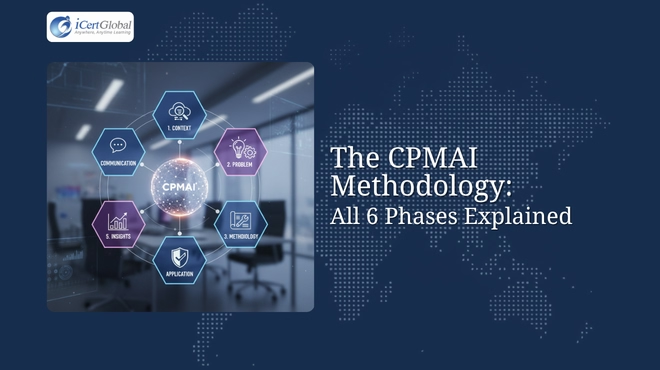
Master the 6 phases of the CPMAI methodology. Learn how to manage AI projects, pass your certification exam,
Advance your career with the PMI-CPMAI certification. Discover how to manage ethical AI projects, master the methodology, and
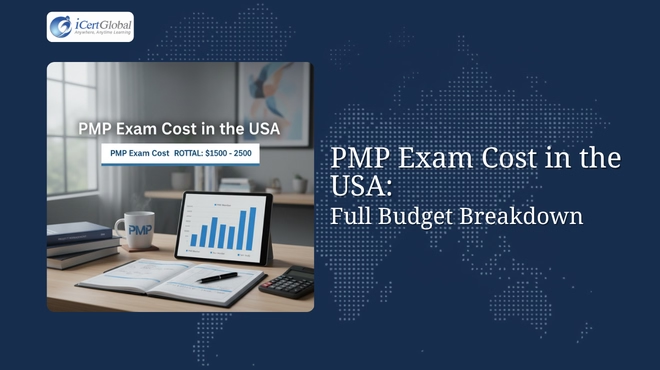
Plan your PMP exam cost budget. Learn about USA certification fees, PMI membership savings, prep course rates, and
Master the new PMP exam 2026. Learn about the July 9 updates, PMBOK 8th Edition changes, and how

Advance your IT audit career. Learn to master data privacy compliance, protect sensitive assets, and pass your CISA

Learn how an information systems audit protects critical business data, mitigates security risks, and advances your IT audit

Explore CISA salary expectations by experience level and job role. Learn how this certification boosts your earning potential.

Our experts are ready to help you with any questions about courses, admissions, or career paths. Get personalized guidance from industry professionals.
Request a Call Back

"PMI®", "PMBOK®", "PMP®", "CAPM®" and "PMI-ACP®" are registered marks of the Project Management Institute, Inc. | "CSM", "CST" are Registered Trade Marks of The Scrum Alliance, USA. | COBIT® is a trademark of ISACA® registered in the United States and other countries.
