





Decision Making in Management: Process, Types & Importance
Master the process of decision making in management. Learn key types and frameworks to boost your leadership skills
Stop guessing with data. Get the software mastery to find statistically-valid answers and present them with authority.
You've learned Six Sigma theory. You know when to run a capability analysis, perform a Gage R&R, or conduct a t-test. But when you open Minitab, hesitation creeps in. Hours are lost scrolling through confusing menus, struggling with messy data imports, and wondering which graph best communicates your findings. Meanwhile, your colleagues who've completed professional Minitab training courses produce precise insights in minutes, gaining the reputation of being "data-driven" experts. Your analysis might be correct in theory - but without fluency in the software, your credibility takes the hit. That's exactly why our Minitab certification course online exists. This isn't a generic, button-clicking software tutorial that parrots the help menu. Our Minitab training certification is designed and delivered by practicing Master Black Belts - professionals who've used Minitab to achieve multi-crore savings across Vineland, NJ manufacturing plants, service industries, and corporate operations. You don't just learn what button to click - you learn why to click it, how to interpret every line of the session window output, and how to turn raw data into visual stories that decision-makers understand instantly. Our Minitab course online builds fluency, not just familiarity. You'll learn to handle the kind of messy, real-world data that never fits the clean textbook examples. You'll master advanced functions like Design of Experiments, regression modelling, and control chart interpretation. The course also teaches you to create professional-quality reports and automate repetitive analysis tasks - skills that make you indispensable in a data-driven organization. Completing the Minitab certification course isn't just about earning another credential - it's about transforming how you work. After this Minitab training, you won't just "use" the software; you'll command it with confidence. You'll become the go-to expert in your team - the person who can translate complex data into decisive business action with clarity, speed, and precision.
Learn by doing with practical, real-world exercises that build muscle memory and true proficiency, not just theoretical knowledge.
Learn from elite practitioners who use Minitab to solve complex business problems daily, not academics who only know the software's features.
Work with messy, imperfect datasets from Vineland, NJ manufacturing, IT, and service sectors, preparing you for the challenges you'll actually face on the job.
Master the critical skill of translating complex statistical output from the session window into clear, actionable business recommendations.
Choose from weekend-only batches, weekday evening sessions, or intensive bootcamps designed around your professional commitments - no career breaks required.
Get your Minitab questions answered around the clock by certified experts, ensuring you never get stuck on a technical issue or statistical concept.
The application of statistical process control methods to ensure quality in manufacturing processes is a crucial aspect of the Minitab Training Program. Statistical process control (SPC) is a methodology that helps companies optimize production processes by monitoring and controlling variables that affect quality. By using Minitab, professionals in Vineland, NJ, can apply SPC methods to identify and correct defects in real-time.
In the context of quality control, statistical process control relies heavily on the use of control charts to monitor process behavior. Control charts, such as the X-bar chart and R chart, allow professionals to track process mean and variability, identifying when a process is in control or out of control. Minitab provides a suite of control chart tools that enable users to create and customize control charts tailored to their specific needs.
Practical application of SPC methods in manufacturing processes requires a deep understanding of process variability and the ability to analyze data using statistical techniques. By analyzing control chart data, professionals in Vineland, NJ, can identify sources of variability, diagnose defects, and implement corrective actions to optimize production processes. _

Get a custom quote for your organization's training needs.
The Minitab Training Program emphasizes statistical thinking and data-driven decision-making skills. Statistical thinking is a critical skill that enables professionals to interpret data and draw meaningful conclusions about production processes. By applying statistical thinking, professionals can make data-driven decisions that drive business outcomes.
In the context of data analysis, statistical thinking involves understanding the underlying assumptions of inferential statistical methods, such as regression and hypothesis testing. Minitab provides a range of statistical tools, including linear regression, analysis of variance (ANOVA), and hypothesis testing, that enable users to analyze data and draw conclusions about production processes. Professionals in Vineland, NJ, can apply statistical thinking to real-world problems, such as analyzing the relationship between process variables and quality outcomes.
By analyzing data using statistical methods, professionals can identify trends, patterns, and correlations that inform business decisions. _
Stop struggling with messy data. Learn to import, stack, unstack, sort, and clean real-world datasets so your analysis is built on a solid foundation.
Go beyond just creating control charts. Master the art of interpreting patterns, identifying special causes, and using SPC to maintain process stability.
Execute Gage R&R studies correctly to validate your data collection systems. Confidently determine if your measurement error is obscuring your process variation.
End the guesswork. Learn to select and execute the right statistical test (t-tests, ANOVA, Chi-Square) to make data-driven decisions with statistical confidence.
Master the most powerful tool in Minitab. Learn to set up, analyze, and interpret factorial and response surface experiments to optimize your processes systematically.
Create clear, compelling graphs - from box plots to contour plots - that tell a story. Learn to customize and export them for impactful presentations to leadership.
If you are expected to analyze data to solve problems, this program is engineered to make you proficient with the tool the entire industry uses.
The Minitab Training Program covers various aspects of quality and process improvement, including the Design of Experiments (DOE). DOE is a systematic approach to optimizing production processes by identifying and optimizing the effects of controllable variables. In the context of DOE, professionals use designed experiments to identify the relationships between controllable variables and quality outcomes.
Minitab provides a range of DOE tools, including factorial designs and response surface methods, that enable users to create and analyze experiments. By applying DOE methods, professionals in Vineland, NJ, can identify and optimize process settings that minimize defects and optimize production efficiency. This enables companies to achieve significant productivity gains and improved quality outcomes.


Gain the speed and fluency in Minitab that marks you as a true professional.
Gain the confidence to not only run analyses but to defend your interpretations to skeptical stakeholders.
Earn the credibility to influence key process decisions.
This certification is designed to build a practical skill. Unlike methodology certifications, the requirements are focused on your willingness to learn and practice, not on years of prior experience.
No Formal Experience Required: While a background in quality or data analysis is helpful, it is not a prerequisite. The program is designed to build your skills from a foundational level.
Access to Minitab Software: You will need a working version of Minitab Statistical Software on your computer to participate in the hands-on labs. We provide guidance on obtaining the free trial version.
Completion of Training Program: You must complete our full training curriculum to be eligible to sit for the certification exam.
The Minitab Training Program covers various statistical and quality control tools, including capability analysis. Capability analysis is a method used to evaluate the ability of a process to produce parts that meet specified quality requirements. In the context of capability analysis, professionals use statistical methods to evaluate process performance, including the calculation of process capability indices (Cp and Cpk).
Minitab provides a range of capability analysis tools that enable users to create and customize capability plots and charts. Professionals in Vineland, NJ, can apply capability analysis to evaluate process performance and identify opportunities for improvement. By evaluating process performance, professionals can identify areas for improvement and implement corrective actions to optimize production processes.
Identify what can derail your projects before it happens and build comprehensive response strategies. Master both qualitative and quantitative risk analysis techniques, including Monte Carlo simulations and decision trees that enable data-driven risk decisions.
Build quality into your processes rather than inspecting it later. Learn the difference between quality planning, assurance, and control. Master quality tools like control charts and Pareto analysis to drive continuous improvement and prevent costly rework.
Procurement is a key area of the Project Management Professional exam and essential to professional project delivery. Learn to manage vendor contracts, conduct negotiations, and select the right contract types. This PMP course online module teaches practical approaches to vendor evaluation, risk allocation, and performance monitoring, ensuring your projects stay on schedule and within budget.
Lead project teams through successful delivery while managing resources, resolving issues, and maintaining momentum. Learn to direct project work effectively, acquire and develop team members, and create reporting systems that inform rather than overwhelm stakeholders.
Implement control systems that catch problems early and enable corrective action. Master integrated change control procedures, performance measurement techniques, and variance analysis methods that keep projects on track and stakeholders informed.
Modern project management requires agility. This PMP certification course explores agile, predictive, and hybrid delivery approaches - helping you understand when and how to apply each. Learn Scrum ceremonies, Kanban flow metrics, and hybrid governance techniques that integrate flexibility into traditional structures. These topics are a major part of the current Project Management Professional exam content outline, making this lesson essential for every PMP-certified professional.
Execute proper project closure procedures and understand your ethical obligations as a certified project management professional. Learn to capture lessons learned effectively, manage contract closure, and navigate ethical dilemmas using the PMI Code of Ethics.
Develop test-taking strategies specifically designed for the PMP exam format. Learn question analysis techniques, time management strategies, and how to approach situational questions that test your judgment rather than just knowledge recall.
This capstone lesson brings everything together. You'll review every process group, knowledge area, and agile concept included in the PMP course online curriculum. Our instructors guide you through final assessments, identify weak areas, and ensure full exam readiness.
Start your journey by mastering the Minitab interface - Session Window, Worksheet, Project Manager, and Graph Window. You'll learn to configure settings, manage projects, and use Minitab's powerful Assistant feature to guide your statistical analysis. This part of the Minitab training courses helps you become comfortable with the workspace so you can focus on analysis instead of navigation.
Learn to import data from Excel, text files, and databases without errors. Master essential data handling skills like stacking/unstacking columns, sorting, ranking, and using the calculator for transformations.
Understand the critical difference between numeric, text, and date/time data types. Learn to format columns correctly, use formulas to clean messy data, and prepare your worksheet for analysis.
Move beyond averages. Generate comprehensive statistical summaries and create insightful graphical summaries that provide a complete picture of your data's distribution, central tendency, and spread.
Master the essential graphical tools for problem-solving. Build effective Pareto charts to focus on the vital few, and create detailed Cause-and-Effect diagrams directly within Minitab.
Visualize your data like a pro. Create histograms, box plots, and scatter plots to understand distributions, identify outliers, and explore relationships between variables.
Learn to select, create, and interpret the correct control charts (Xbar-R, I-MR) for continuous data. Master the rules for identifying special causes and out-of-control conditions.
Monitor defect and defective rates effectively using P, NP, C, and U charts. Understand the assumptions behind each chart and how to apply them to your quality data.
Execute and interpret a Gage R&R study (Crossed and Nested) to validate your measurement system. Confidently determine your data's trustworthiness before making critical business decisions.
Determine if your process is capable of meeting customer specifications. Calculate and interpret Cp, Cpk, Pp, and Ppk for both normal and non-normal data using Minitab's powerful capability tools.
Here's where data-driven decision-making comes alive. You'll master how to perform 1-Sample, 2-Sample, and Paired t-tests, along with ANOVA, to statistically compare means and validate hypotheses. With guidance from expert instructors in our Minitab training courses, you'll learn to interpret p-values correctly, separate signal from noise, and draw confident conclusions that stand up to executive or client scrutiny.
Quantify the relationship between variables. Perform correlation analysis to understand the strength and direction of relationships and build regression models to make predictions based on your data.
Build predictive models with multiple input variables. Learn to interpret coefficients, R-squared, and residual plots to create a statistically valid and practically useful regression model.
Master the most powerful process improvement tool. Design, analyze, and interpret full and fractional factorial experiments in Minitab to identify critical factors and interactions that impact your process output.
Learn how to use RSM to find the optimal settings for your process variables. Create contour plots and optimization plots to identify the sweet spot for peak performance.
The Minitab Training Program emphasizes the importance of continuous improvement and data-driven decision-making. Continuous improvement is a business philosophy that emphasizes ongoing effort to improve production processes and quality outcomes.
In the context of continuous improvement, professionals use data analysis and statistical methods to identify opportunities for improvement. Minitab provides a range of tools, including data mining and predictive analytics, that enable users to analyze data and identify trends and patterns.
By applying continuous improvement principles, professionals in Vineland, NJ, can drive business outcomes and improve quality outcomes. This enables companies to stay competitive and achieve long-term success.
Great class, very informative.

Great PMP<sup>®</sup> Bootcamp. I had a great time taking this course. I took the course to prepare to sit for the CAPM<sup>®</sup> but may be able to sit for the PMP<sup>®</sup>. I learnt a lot was challenging. Great course. We need one more day. Content was very detailed.

it was a great class. Lots of energy. And I enjoyed.

Fantastic course to prepare for PMP<sup>®</sup> exam.

As a participant it was smooth sailing for me.

Trainer was excellent. Shared good resources and good experiences.

Good content and training.
I wanted to let you know that I took and passed the PMP exam. Thanks to iCert Global and especially my Cincinnati course instructor, who was an excellent teacher and helped me immensely.

Trainer was good. Trainer was very engaged and interacting. Very much satisfied with the training.

I was pleasantly surprised at the quality of this training. Yomi was awesome as a trainer and working to make sure that we understood the concepts. Controlling Cost and Controlling Risk are the most complicated, but Yomi spent time after class working through questions to help others understand. This class also helped to change my perception of the PMP being this MONSTER to something that I can I can successfully do.

Great class with a lot of information and tips to prepare for the exam

It was a great course, covered all the things that i ended up hitting road bumps on. I was the only one in the class, but the trainer was just as involved as if it had been a full class.

I was nervous about taking it online versus classroom; but I am actually glad I took it online. Instructor was very great and gave a good learning experience with his relevant project management experience.
The training was very intense but covered with course material. It was more than I expected.

I thought the class was very informative. The instructor did an excellent job breaking down each chapter to where it was easy to understand. I was also very impressed with his commitment to help us pass ever after the class is over.

Excellent training. Instructor was very knowledgeable and explained information in an understandable way
Quality Materials presented, Instructor very knowledgeable. Exceeded my expectations.
The training is a great introduction into the PMI mindset. Very informative and helpful

Stay updated with the latest insights and trends in your field
Master the process of decision making in management. Learn key types and frameworks to boost your leadership skills
Meet the 2026 PgMP certification requirements. Learn the exact experience, eligibility criteria, and application steps to advance your
Master your next cloud interview. Practice these 50 essential Azure questions and answers to validate your skills and
Learn the core product meaning, types, and real-world examples. Master these business fundamentals to accelerate your career in
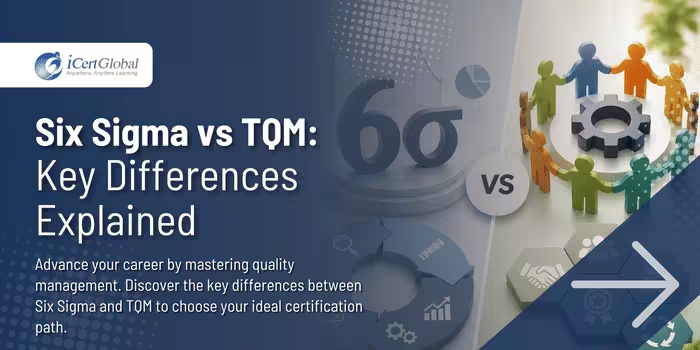
Advance your career by mastering quality management. Discover the key differences between Six Sigma and TQM to choose

Master all 49 PMP project management processes. Pass your exam on the first try and advance your career
Before you take the PMI-CPMAI, learn how mastering project management ai can elevate your career, validate your skills,
Master the critical data scientist skills that separate beginners from top-tier professionals and accelerate your career growth.

Map your data scientist career path for 2026. Learn the high-demand skills, certifications, and real salary expectations you

Prepare for your data science career with the real insights nobody shares. Learn the practical skills and exam-ready

Our experts are ready to help you with any questions about courses, admissions, or career paths. Get personalized guidance from industry professionals.
Request a Call Back

"PMI®", "PMBOK®", "PMP®", "CAPM®" and "PMI-ACP®" are registered marks of the Project Management Institute, Inc. | "CSM", "CST" are Registered Trade Marks of The Scrum Alliance, USA. | COBIT® is a trademark of ISACA® registered in the United States and other countries.
