





Before You Enroll in PMI-CPMAI, Read This First
Before you take the PMI-CPMAI, learn how mastering project management ai can elevate your career, validate your skills,
Stop leading small projects. Get the elite credential to solve multi-crore problems with advanced statistical mastery.
As a Green Belt, you might be executing projects, but designing enterprise improvement strategy requires a Six Sigma Black Belt certification. While Green Belts focus on basic data analysis, Six Sigma Black Belt certified professionals are performing regression analysis, running design of experiments, and presenting transformation roadmaps to senior leadership. They lead Six Sigma Black Belt jobs that command 40-60% higher salaries due to advanced statistical methods and change management expertise. Without Black Belt certification, your career is capped at project execution - strategic roles list Six Sigma Black Belt certification as mandatory. This isn't just a statistics course disguised as Six Sigma training. Our Six Sigma Black Belt training is designed by Master Black Belts and Lead Assessors who have certified hundreds of practitioners across manufacturing, services, and transactional environments. They know the difference between passing an exam and leading transformations that generate measurable millions in savings. Our program develops strategic improvement leaders who can design experiments, perform multivariate analysis, and lead organizational change initiatives that sustain beyond project closure. Unlike other courses that overload you with formulas without context, our Six Sigma Black Belt course builds transformation leaders who can execute. You'll learn to design robust experiments optimizing multiple factors simultaneously, perform hypothesis testing that proves causation - not just correlation, build statistical process control systems that prevent defects rather than detect them, and lead cross-functional teams through resistance using proven change management frameworks. The Six Sigma Black Belt certification online validates your skills, but the real value is confidently walking into the C-suite with a transformation strategy and projected ROI that gets immediate funding. This program is built for experienced Green Belts and quality professionals ready for strategic leadership. It's an intensive 8-week program with weekend and evening batches, fully interactive with advanced Minitab training and real industrial case studies. Every session is recorded. Beyond training, you get Black Belt project templates, design of experiments workbooks, hypothesis testing decision trees, 24/7 Master Black Belt support, and comprehensive mentoring for your mandatory Black Belt project - the complex, multi-month transformation that most programs require but provide inadequate guidance on, leaving candidates struggling alone. Investing in Six Sigma Black Belt certification cost today is investing in your strategic career growth, unlocking Six Sigma Black Belt salary potential, and preparing you for impactful leadership roles across industries.
Our Six Sigma Black Belt training ensures you master the complete Black Belt Body of Knowledge, aligned with real certification standards and workplace complexity. This isn't just exam prep - it's preparation for leadership.
Unlock your potential with instructors who are Certified Master Black Belts, each with a proven track record of leading multi-million dollar transformation projects across industries.
Balance certification goals with your senior-level commitments through flexible options - weekday-evening sessions, weekend batches, or an intensive 10-day bootcamp format.
Gain hands-on expertise in advanced statistical methods including DOE, multivariate analysis, reliability engineering, and hypothesis testing - going far beyond Green Belt fundamentals.
Achieve proficiency in industry-standard tools like Minitab, JMP, and advanced Excel, along with project financial modeling templates and executive presentation frameworks.
Get round-the-clock assistance from certified Master Black Belts to tackle complex statistical challenges confidently and accelerate your career growth in Six Sigma leadership.
The Six Sigma Black Belt (SSBB) Certification Training Program is a widely recognized standard for process improvement in various industries. Largo, FL's manufacturing sector, for example, relies heavily on this framework to optimize production efficiency and reduce defects. By adopting a Six Sigma methodology, companies can effectively mitigate risk and improve overall productivity.
The SSBB certification is an advanced level of expertise that enables professionals to lead complex improvement projects, analyze complex data sets, and implement process changes that yield measurable results. This expertise is particularly valuable in industries like pharmaceuticals, where strict quality control measures are paramount. SSBB certification holders can apply this knowledge to drive process innovation and improve product quality, thereby enhancing customer satisfaction.
In the context of SSBB, industry applicability is demonstrated through the practical application of statistical process control (SPC) and design of experiments (DOE) techniques. These tools enable professionals to identify and mitigate process variability, reducing the likelihood of defective products and improving overall quality.

Get a custom quote for your organization's training needs.
The Six Sigma Black Belt (SSBB) Certification Training Program provides professionals with the hands-on skills and knowledge necessary to drive process improvement initiatives. A primary focus of the program is developing practical skills in data analysis and statistical process control (SPC). By mastering these skills, professionals can effectively analyze complex data sets, identify process flaws, and develop targeted improvement strategies.
In addition to data analysis, the SSBB program emphasizes the importance of stakeholder management and communication. This includes developing effective project management plans, leading cross-functional teams, and communicating complex technical information to non-technical stakeholders. These skills are critical for successful project execution and ensuring that stakeholders are aligned with project objectives.
In Largo, FL's healthcare sector, for instance, SSBB certification holders can apply their skills to improve patient outcomes and reduce healthcare costs. By analyzing patient flow data and identifying bottlenecks, professionals can develop targeted improvement strategies to streamline care delivery and enhance patient satisfaction.
Stop inefficient trial-and-error. Our Six Sigma Black Belt training teaches you to design experiments that systematically optimize multiple process variables at once - skills required to excel in Six Sigma Black Belt jobs.
Move beyond isolated variable analysis. Master techniques like multiple regression to build predictive models and uncover the true drivers of performance - a core component of Six Sigma Black Belt certification requirements.
End arguments based on opinion. Learn to select and execute the correct statistical test to validate your conclusions with hard data.
Stop just reacting to failures. Learn to analyze life data to predict product reliability and prevent costly breakdowns before they happen.
Ensure your improvements last. Implement advanced control charts that sustain gains and detect subtle issues early - a competency emphasized in our Six Sigma Black Belt course.
A perfect solution is useless if it's ignored. Learn to quantify savings in financial terms and manage stakeholders to get your projects approved.
If you're responsible for leading strategic transformation initiatives, developing organizational process improvement capability, or driving enterprise-level change, this program is engineered to give you the advanced credential and leadership skills executives demand.
The Six Sigma Black Belt (SSBB) Certification Training Program is designed to develop advanced skills in process analysis, improvement, and problem-solving. A key emphasis of the program is developing expertise in statistical analysis and data visualization tools, such as MINITAB and EXCEL. By mastering these tools, professionals can create informative dashboards and reports that help identify process flaws and track progress.
In addition to statistical analysis, the SSBB program covers advanced topics in quality management, including design of experiments (DOE) and statistical process control (SPC). By mastering these concepts, professionals can drive process innovation and improve product quality, thereby enhancing customer satisfaction. This expertise is particularly valuable in industries like aerospace, where strict quality control measures are paramount.
In Largo, FL's transportation industry, SSBB certification holders can apply their skills to improve supply chain efficiency and reduce transportation costs. By analyzing data on shipment volumes and routes, professionals can develop targeted improvement strategies to optimize logistics and enhance customer satisfaction.


Get past executive filters and land quality leadership positions your expertise and project track record already deserve.
Demonstrate quantified business impact through documented seven-figure savings that translate directly to executive salary bands and performance bonuses.
Move beyond fixing individual processes and start building organizational capability, mentoring Green Belts, and shaping strategic improvement portfolios.
The Six Sigma Black Belt certification is an advanced credential designed for experienced professionals with proven project leadership and analytical expertise. It's not an entry-level certification - it validates mastery of both statistical methodology and organizational transformation. Here's what you need to qualify:
Green Belt Foundation: While not always mandatory, most certification bodies require or strongly recommend completing Green Belt certification first. You need the statistical foundation and DMAIC project experience to succeed - skipping this step often leads to failure.
Statistical Competence: You must be comfortable with intermediate statistics, including hypothesis testing, regression analysis, and probability distributions. If basic concepts like p-values and confidence intervals are unclear, you'll struggle with advanced DOE and multivariate analysis.
Project Leadership Experience: Certification bodies typically require completion of 1-2 Black Belt-level projects showing measurable financial impact, advanced data analysis, and organizational change leadership. ASQ requires one completed project, while IASSC requires two. Our program provides full project execution support.
Organizational Support: Successful Black Belt projects require cross-functional collaboration, data access, and executive sponsorship. Attempting this certification without organizational backing reduces your chances of success.
Certification Body Requirements: For detailed eligibility criteria and documentation requirements across ASQ, IASSC, and other certifying bodies, refer to our FAQ section where we break down exam formats, prerequisites, and project standards.
The Six Sigma Black Belt (SSBB) Certification Training Program prepares professionals to assume leadership roles in process improvement initiatives. A primary responsibility of SSBB certification holders is to develop and implement process improvement plans, which involves analyzing data, identifying process flaws, and developing targeted improvement strategies. In addition to process analysis, SSBB certification holders are responsible for leading cross-functional teams and communicating complex technical information to stakeholders.
This involves developing effective project management plans, ensuring stakeholder alignment, and tracking progress against project objectives. These responsibilities require strong leadership and communication skills, as well as expertise in statistical analysis and data visualization. In the context of SSBB, work responsibilities include ensuring that improvement projects are aligned with organizational goals and objectives.
This involves conducting regular project status updates, identifying resource needs, and advocating for project resources.
Transform ambiguous customer requirements into measurable process specifications with advanced VOC techniques, including conjoint analysis, Kano modeling, and Quality Function Deployment (QFD). Learn to prioritize competing customer requirements, translate qualitative feedback into quantitative targets, and establish CTQ specifications that align process capability with market demands.
Master sophisticated MSA techniques beyond basic Gage R&R including attribute agreement analysis, destructive testing analysis, and measurement system discrimination studies. Learn to assess measurement system capability for automated inspection equipment, understand measurement uncertainty propagation, and determine economically optimal measurement strategies balancing precision against cost.
Develop advanced capability analysis skills including non-normal data transformation techniques, capability indices for complex tolerance structures, and multi-vari studies for identifying dominant sources of variation. Master how to conduct short-term versus long-term capability studies, calculate appropriate sample sizes, and communicate capability gaps in business impact terms executives understand.
Move beyond basic t-tests to master the complete statistical testing arsenal including multiple comparison procedures, equivalence testing, and advanced ANOVA techniques for unbalanced designs and nested factors. Learn to calculate statistical power, determine economically optimal sample sizes, and understand the practical versus statistical significance distinction that confuses most practitioners.
Develop sophisticated analytical capability through multiple regression including model building strategies, variable selection techniques, multicollinearity diagnosis, and residual analysis. Master logistic regression for categorical outcomes, principal component analysis for data reduction, and discriminant analysis for classification problems. Learn when each technique is appropriate and how to validate model assumptions.
Apply sophisticated analytical tools including multi-vari studies that isolate positional, cyclical, and temporal variation sources, advanced failure mode analysis techniques, and fault tree analysis for complex systems. Master how to structure complex problem investigations, prioritize root cause hypotheses using statistical evidence, and avoid the common trap of confusing correlation with causation.
Master the DOE techniques that separate Black Belts from Green Belts including two-level full factorial designs, fractional factorial designs with confounding strategies, and resolution concepts. Learn to design experiments that optimize multiple factors simultaneously, interpret complex interaction plots, and select appropriate fractional designs that balance information gain against experimental cost.
Develop advanced optimization capability through response surface designs including central composite and Box-Behnken designs that map curved response surfaces. Learn to conduct steepest ascent/descent experiments, fit second-order models, and identify optimal operating conditions. Master how to optimize multiple responses simultaneously using desirability functions and overlay plots.
The Six Sigma Black Belt (SSBB) Certification Training Program enhances the professional credibility of certification holders by demonstrating their expertise in process improvement and statistical analysis. A key indicator of credibility is the ability to apply advanced statistical techniques, such as regression analysis and time-series analysis, to drive process innovation.
By mastering these techniques, SSBB certification holders can develop targeted improvement strategies that yield measurable results. In industries like finance, where data-driven decision-making is paramount, SSBB certification holders can apply their expertise to optimize financial processes and enhance business performance.
In Largo, FL's education sector, SSBB certification holders can apply their skills to improve student outcomes and reduce costs. By analyzing data on student performance and instructional delivery, professionals can develop targeted improvement strategies to enhance educational quality and efficiency.
Great class, very informative.

Great PMP<sup>®</sup> Bootcamp. I had a great time taking this course. I took the course to prepare to sit for the CAPM<sup>®</sup> but may be able to sit for the PMP<sup>®</sup>. I learnt a lot was challenging. Great course. We need one more day. Content was very detailed.

it was a great class. Lots of energy. And I enjoyed.

Fantastic course to prepare for PMP<sup>®</sup> exam.

As a participant it was smooth sailing for me.

Trainer was excellent. Shared good resources and good experiences.

Good content and training.
I wanted to let you know that I took and passed the PMP exam. Thanks to iCert Global and especially my Cincinnati course instructor, who was an excellent teacher and helped me immensely.

Trainer was good. Trainer was very engaged and interacting. Very much satisfied with the training.

I was pleasantly surprised at the quality of this training. Yomi was awesome as a trainer and working to make sure that we understood the concepts. Controlling Cost and Controlling Risk are the most complicated, but Yomi spent time after class working through questions to help others understand. This class also helped to change my perception of the PMP being this MONSTER to something that I can I can successfully do.

Great class with a lot of information and tips to prepare for the exam

It was a great course, covered all the things that i ended up hitting road bumps on. I was the only one in the class, but the trainer was just as involved as if it had been a full class.

I was nervous about taking it online versus classroom; but I am actually glad I took it online. Instructor was very great and gave a good learning experience with his relevant project management experience.
The training was very intense but covered with course material. It was more than I expected.

I thought the class was very informative. The instructor did an excellent job breaking down each chapter to where it was easy to understand. I was also very impressed with his commitment to help us pass ever after the class is over.

Excellent training. Instructor was very knowledgeable and explained information in an understandable way
Quality Materials presented, Instructor very knowledgeable. Exceeded my expectations.
The training is a great introduction into the PMI mindset. Very informative and helpful

Stay updated with the latest insights and trends in your field
Before you take the PMI-CPMAI, learn how mastering project management ai can elevate your career, validate your skills,

Master the critical data scientist skills that separate beginners from top-tier professionals and accelerate your career growth.

Map your data scientist career path for 2026. Learn the high-demand skills, certifications, and real salary expectations you

Prepare for your data science career with the real insights nobody shares. Learn the practical skills and exam-ready

Discover the core skills you need to build a successful data scientist career. Master the essential expertise that

Compare CISA vs CRISC to find your ideal ISACA path. Analyze exam difficulty, career outlook, and skills to
Master the 5 domains of the CISA Certification Syllabus. Get the complete 2026 exam guide to pass on
Discover the CCNA salary in India from fresher to senior roles. Learn how to leverage this certification to
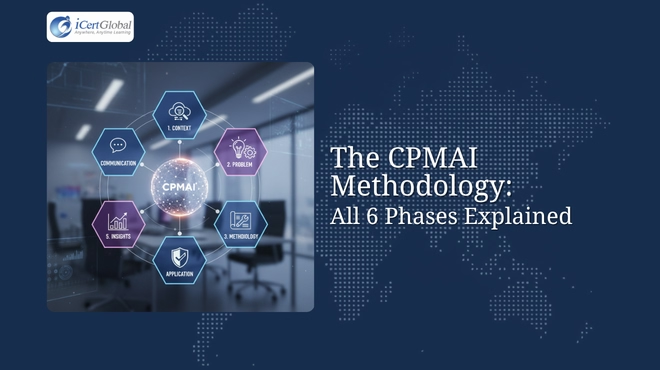
Master the 6 phases of the CPMAI methodology. Learn how to manage AI projects, pass your certification exam,
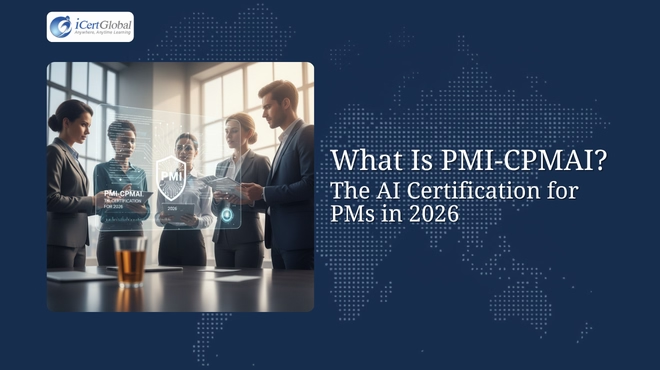
Advance your career with the PMI-CPMAI certification. Discover how to manage ethical AI projects, master the methodology, and

Our experts are ready to help you with any questions about courses, admissions, or career paths. Get personalized guidance from industry professionals.
Request a Call Back

"PMI®", "PMBOK®", "PMP®", "CAPM®" and "PMI-ACP®" are registered marks of the Project Management Institute, Inc. | "CSM", "CST" are Registered Trade Marks of The Scrum Alliance, USA. | COBIT® is a trademark of ISACA® registered in the United States and other countries.
