






Before You Enroll in PMI-CPMAI, Read This First
Before you take the PMI-CPMAI, learn how mastering project management ai can elevate your career, validate your skills,
Stop building proof-of-concepts. Build enterprise-grade frontends. Get the specialized skill to command the complex, single-page application (SPA) roles that fuel modern banking, e-commerce, and IT services.
You've toyed with basic frameworks. You've followed tutorials that result in toy applications that crash under real-world load. Meanwhile, professionals who command Angular's component lifecycle, performance tuning, and complex routing are solving high-stakes problems in New Brunswick, NJ financial services and major IT firms in Pune and Chennai, earning 40% more. Your current, superficial knowledge makes you a risk; this certification makes you a strategic asset. This is not another course that teaches you to memorize directives and syntax. Our program is engineered by senior full-stack architects who understand the brutal reality of New Brunswick, NJ enterprise development: legacy backend systems, impossible performance benchmarks, and aggressive deadlines. They built this program to teach you the hard parts of Angular: Dependency Injection, the real-world utility of RxJS Observables, and how to structure a large application that doesn't collapse into component sprawl. Certification mills focus on passing the exam by rote. We focus on building architectural competence. You'll learn how to implement effective NgRx/state management to prevent impossible-to-debug data flow issues, master lazy loading to hit crucial Lighthouse performance scores, and write rigorous unit and end-to-end tests that stop regression defects before they cost your project days of rework. The exam is the necessary validation; the real value is delivering frontends that scale to millions of users. This is built for working developers in New Brunswick, NJ who are tired of being pigeonholed as backend or legacy coders. Our weekday evening and weekend batches are highly focused. You get a fully architected reference application, reusable code scaffolding for common patterns, 24/7 expert support, and project assessments designed to prove you can solve real-world production bugs.
Learn from seasoned Angular consultants and full-stack architects with a minimum of 7 years of high-volume application development experience.
Conquer the most challenging part of Angular - reactive programming - through dedicated modules and practical problem-solving labs.
Heavy emphasis on Change Detection, AOT Compilation, and Lazy Loading to ensure your code is fast, not just functional.
Drill your knowledge with 2000+ targeted coding challenges and realistic, timed certification exam simulators.
Mandatory training in writing maintainable Jasmine/Karma unit tests and Protractor/Cypress E2E tests - a non-negotiable industry requirement.
Eliminate debilitating coding roadblocks instantly with dedicated support channels staffed by certified Angular architects.
Angular is primarily responsible for front-end development, focusing on building reusable UI components and interfaces. Angular applications rely heavily on dependency injection, which allows components to be loosely coupled and easily testable. This approach enables developers to write more modular, scalable code that can be easily maintained in the long term.
In New Brunswick, NJ, companies are constantly seeking skilled developers who can craft high-quality, complex front-end experiences that meet the needs of their users. By mastering Angular, developers can create robust, data-driven UI components that provide a seamless experience for users. In large-scale Angular applications, developers often employ a technique called modularization, where the application is broken down into smaller, independent modules.
This approach makes it easier to manage dependencies between modules, reduce code duplication, and improve overall code organization.

Get a custom quote for your organization's training needs.
Angular development requires a strong foundation in object-oriented programming principles, including encapsulation, inheritance, and polymorphism. Developers must also have a solid grasp of JavaScript syntax and semantics to write efficient, effective code. In order to harness the full potential of Angular, developers should also familiarize themselves with key concepts such as two-way data binding, templates, and services.
A comprehensive understanding of Angular's change detection mechanism, which uses the zone.js library to detect changes in the application, is crucial for building high-performance applications. This knowledge enables developers to write code that is optimized for speed and efficiency. By leveraging TypeScript, developers can also take advantage of features such as static type checking and code completion.
Effective Angular development also requires a deep understanding of the component lifecycle, including how components are created, initialized, and destroyed. This knowledge enables developers to write code that is predictable, reliable, and easy to maintain.
Learn to structure your application using Smart/Dumb components and module federation to enforce clean separation of concerns, which is critical for large-scale application maintenance.
Stop using Promises for everything. Master Observables, Subjects, and advanced RxJS operators to handle complex asynchronous data streams, manage state, and prevent debilitating memory leaks.
Understand the eight component lifecycle hooks. Know exactly when to fetch data (ngOnInit), optimize performance (ngDoCheck), and safely tear down resources (ngOnDestroy) to write clean, stable code.
Move beyond basic providers. Master the hierarchical injector system, tokens, and use factory providers to manage complex service dependencies and create highly testable components.
Build robust navigation with complex nested routes. Master Route Guards (CanActivate, CanDeactivate) to enforce crucial authentication and authorization logic on the client-side.
Learn to implement OnPush Change Detection, lazy loading of modules, and Ahead-of-Time (AOT) compilation to drastically cut application load times and improve perceived performance.
If your role requires you to build or maintain complex, high-performance web applications, this program is the non-negotiable path to achieving architectural credibility.
In real-world Angular applications, developers often encounter complex scenarios involving data binding and manipulation. For instance, they may need to handle large datasets, implement pagination, or perform data filtering. By mastering Angular's data binding mechanisms, including the use of pipes and directives, developers can create intuitive, user-friendly interfaces that meet the needs of their users.
Developers in New Brunswick, NJ can apply their Angular skills to build complex, data-driven applications that meet the needs of local businesses and organizations. By leveraging Angular's powerful dependency injection system, they can create scalable, maintainable code that is optimized for performance. When implementing Angular components, developers must also consider factors such as accessibility, responsive design, and SEO optimization.
By following best practices and industry standards, developers can create high-quality, user-centric applications that deliver a seamless experience for users.


Stop getting filtered out by firms demanding "proven experience with enterprise framework architecture" for senior developer roles.
Unlock the specialized salary bands and retention bonuses reserved for developers who can deliver high-volume, performance-critical front-ends.
Transition from a tactical coder to an architectural contributor, gaining the authority to influence technology choices and design strategy.
The Certified Angular Developer credential is not for those who simply can code; it is for those who can architect and optimize. While there are no formal, mandatory prerequisites like years of experience for enrollment, the exam validates deep practical competence.
Formal Training: Completion of a comprehensive, 60+ hour training program that covers TypeScript, Angular architecture, RxJS, and application testing. (Fully satisfied by this iCertGlobal course).
Project Proficiency: Demonstrated ability to complete an end-to-end Single Page Application (SPA) that includes component hierarchy, routing, service integration, and forms validation.
Exam Readiness: Achieve a passing score on the final certification examination, validating a candidate's architectural and performance optimization knowledge.
Do not attempt this certification if you cannot confidently explain the difference between a Promise and an Observable.
Angular is widely used in various industries, including finance, healthcare, and e-commerce. In the finance industry, for example, Angular is used to build complex trading platforms and financial analytics tools. In the healthcare sector, Angular is used to develop patient engagement platforms and electronic health records systems.
In New Brunswick, NJ, companies in the pharmaceutical and biotechnology industries are increasingly adopting Angular to build complex web applications that meet the needs of their users. By leveraging Angular's powerful features, developers can create high-performance, scalable applications that are optimized for performance and security. In order to be effective in the industry, developers must have a deep understanding of the business requirements and user needs.
They must also be able to work collaboratively with cross-functional teams to deliver high-quality solutions that meet the needs of the business.
Master the Dependency Injection system - the architectural backbone. Learn to create stateless, reusable services and inject them efficiently into components via the hierarchical injector.
Go beyond NgIf and NgFor. Master Attribute and Structural Directives. Learn how to create custom directives to encapsulate and reuse DOM manipulation logic.
Master built-in pipes for date and currency formatting. Learn to create custom, pure, and impure pipes to handle data transformation within templates efficiently, avoiding unnecessary component logic.
Master both Template-Driven and Reactive Forms. Focus heavily on Reactive Forms for complex validation scenarios, custom validators, and creating dynamic form arrays/groups.
Master defining complex routes, nested routes, and route parameters. Implement Route Guards (CanActivate, CanDeactivate) to protect application access and manage navigation flow professionally.
Understand the fundamental shift from Promises to Observables. Learn to use the HttpClientModule to communicate with RESTful APIs, handling request, response, and error paths.
Deep dive into core RxJS: map, filter, switchMap, and mergeMap. Learn to manage multiple API calls sequentially and concurrently, preventing data race conditions and messy subscription chains.
Understand the pitfalls of component-based state. Learn the basics of a Redux/NgRx pattern to establish a single source of truth, making your application state predictable and debuggable.
This is non-negotiable for large applications. Master Ahead-of-Time (AOT) compilation and Lazy Loading of modules to ensure your application bundle size is minimal and its load time is fast.
Understand Angular's built-in security features. Learn to prevent Cross-Site Scripting (XSS) and properly handle user tokens and credentials, a common failing point in junior developer code.
Master the Angular CLI build process for production. Learn the basics of deploying to common cloud services and using environment files to manage production vs. development configurations.
Conquer the test environment. Master Jasmine and Karma for unit testing components, services, and pipes. Learn the principles of End-to-End (E2E) testing to ensure overall application flow integrity.
With the increasing demand for front-end developers, Angular is an in-demand skill in the industry. In New Brunswick, NJ, companies are constantly seeking skilled developers who can build high-quality, complex front-end experiences that meet the needs of their users.
Developers who master Angular can pursue a wide range of career opportunities, from front-end development to full-stack development. They can also explore career paths in DevOps, technical leadership, or consulting.
By acquiring skills in Angular, developers can enhance their career prospects and stay competitive in the industry. They can also take advantage of the numerous job opportunities available in the tech industry, from startups to established corporations.
Great class, very informative.

Great PMP<sup>®</sup> Bootcamp. I had a great time taking this course. I took the course to prepare to sit for the CAPM<sup>®</sup> but may be able to sit for the PMP<sup>®</sup>. I learnt a lot was challenging. Great course. We need one more day. Content was very detailed.

it was a great class. Lots of energy. And I enjoyed.

Fantastic course to prepare for PMP<sup>®</sup> exam.

As a participant it was smooth sailing for me.

Trainer was excellent. Shared good resources and good experiences.

Good content and training.
I wanted to let you know that I took and passed the PMP exam. Thanks to iCert Global and especially my Cincinnati course instructor, who was an excellent teacher and helped me immensely.

Trainer was good. Trainer was very engaged and interacting. Very much satisfied with the training.

I was pleasantly surprised at the quality of this training. Yomi was awesome as a trainer and working to make sure that we understood the concepts. Controlling Cost and Controlling Risk are the most complicated, but Yomi spent time after class working through questions to help others understand. This class also helped to change my perception of the PMP being this MONSTER to something that I can I can successfully do.

Great class with a lot of information and tips to prepare for the exam

It was a great course, covered all the things that i ended up hitting road bumps on. I was the only one in the class, but the trainer was just as involved as if it had been a full class.

I was nervous about taking it online versus classroom; but I am actually glad I took it online. Instructor was very great and gave a good learning experience with his relevant project management experience.
The training was very intense but covered with course material. It was more than I expected.

I thought the class was very informative. The instructor did an excellent job breaking down each chapter to where it was easy to understand. I was also very impressed with his commitment to help us pass ever after the class is over.

Excellent training. Instructor was very knowledgeable and explained information in an understandable way
Quality Materials presented, Instructor very knowledgeable. Exceeded my expectations.
The training is a great introduction into the PMI mindset. Very informative and helpful

Stay updated with the latest insights and trends in your field
Before you take the PMI-CPMAI, learn how mastering project management ai can elevate your career, validate your skills,

Master the critical data scientist skills that separate beginners from top-tier professionals and accelerate your career growth.

Map your data scientist career path for 2026. Learn the high-demand skills, certifications, and real salary expectations you

Prepare for your data science career with the real insights nobody shares. Learn the practical skills and exam-ready

Discover the core skills you need to build a successful data scientist career. Master the essential expertise that

Compare CISA vs CRISC to find your ideal ISACA path. Analyze exam difficulty, career outlook, and skills to
Master the 5 domains of the CISA Certification Syllabus. Get the complete 2026 exam guide to pass on
Discover the CCNA salary in India from fresher to senior roles. Learn how to leverage this certification to
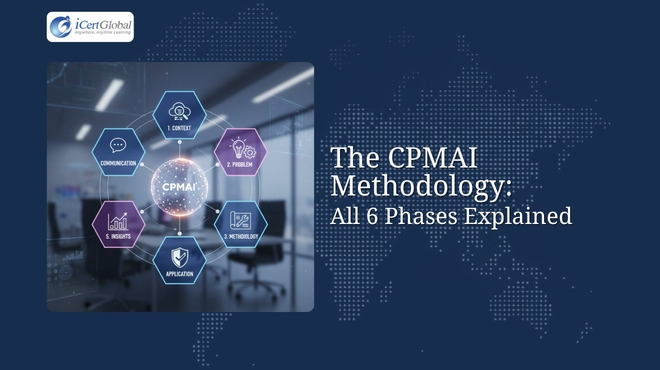
Master the 6 phases of the CPMAI methodology. Learn how to manage AI projects, pass your certification exam,

Advance your career with the PMI-CPMAI certification. Discover how to manage ethical AI projects, master the methodology, and

Our experts are ready to help you with any questions about courses, admissions, or career paths. Get personalized guidance from industry professionals.
Request a Call Back

"PMI®", "PMBOK®", "PMP®", "CAPM®" and "PMI-ACP®" are registered marks of the Project Management Institute, Inc. | "CSM", "CST" are Registered Trade Marks of The Scrum Alliance, USA. | COBIT® is a trademark of ISACA® registered in the United States and other countries.
