





Before You Enroll in PMI-CPMAI, Read This First
Before you take the PMI-CPMAI, learn how mastering project management ai can elevate your career, validate your skills,
Stop writing fragmented, single-tier code. Master the enterprise architecture that powers 90% of all Johns Creek, GA banking and IT systems.
You've mastered core Java, but your contributions often stop at single-file programs. You're stuck in a junior role because you lack the expertise to build scalable, multi-tier enterprise applications - the systems that handle billions of transactions daily in Johns Creek, GA banking and telecom. Recruiters in Chennai and Pune searching for a Java full stack developer will filter out resumes that don't demonstrate mastery of Java frameworks like Spring and Hibernate. This isn't just another Java tutorial or syntax refresher. Our Certified Java EE Developer training is crafted by Principal Architects who have scaled mission-critical, high-traffic applications for major Johns Creek, GA service companies and product firms. The program delivers a practical curriculum on Java Enterprise Edition, focusing on architecture that is stable, secure, and drives global business. Unlike generic bootcamps, you'll confront real enterprise problems. Learn to manage database transactions with Spring JDBC, build efficient ORM layers with Hibernate Queries, and decouple components using Spring AOP. The certificate validates your knowledge, but the real value is confidently refactoring legacy Servlet/JSP applications into modern Spring MVC patterns, proving your worth as a strategic contributor. This program is designed for mid-level developers aiming to pivot into senior, high-impact roles. Flexible evening and weekend schedules include live coding, Q&A sessions, and access to Java online compiler environments. Beyond the training, you'll receive production-ready Java code templates, dedicated server access for deployment practice, and 24/7 expert support. By the end, you'll be fully equipped with skills relevant for Java developer roles, ready to ace Java interview questions, understand Java documentation, master Java data types, and earn recognized Java certifications.
Master the critical layers: Presentation (Servlets/JSP/Spring MVC), Business Logic (Spring Core/AOP), and Persistence (JDBC/Hibernate/Spring Data).
Complete projects focusing on integrating a full three-tier application, including Web Service deployment and secure transaction management.
Gain deep, practical knowledge of the dominant enterprise framework, focusing on Dependency Injection (DI) and Aspect-Oriented Programming (AOP) for maintainable code.
Move past raw SQL by mastering Hibernate for efficient, object-oriented database access, including complex queries and relationship mapping.
Learn the practical steps to build and consume Web Services (SOA), preparing you for the inevitable shift to microservices architecture.
Get real-time help on complex stack errors and configuration issues from instructors who are actively writing enterprise Java code.
The Certified Java Developer Training Program is designed to equip professionals with a comprehensive understanding of Java programming principles, including object-oriented design and development, exception handling, and multithreading. This course covers the Java SE 8 and Java EE 7 specifications, focusing on features such as lambda expressions, functional programming, and concurrency. By mastering Java fundamentals, developers can build scalable and efficient applications.
Java's modular design, encapsulation, and inheritance enable developers to create maintainable code. The Certified Java Developer Training Program emphasizes best practices for coding, testing, and debugging, including the effective use of interfaces, abstract classes, and annotations. By grasping the nuances of Java's type system and memory management, developers can write high-quality code that performs well and is easy to modify.
In Johns Creek, GA, professionals in the technology industry can leverage their Java skills to contribute to the growth of software development companies, fintech startups, and innovation hubs. By mastering Java, developers can take on complex projects, work collaboratively with cross-functional teams, and help drive business outcomes through data-driven insights.

Get a custom quote for your organization's training needs.
The Certified Java Developer Training Program prepares professionals for a variety of responsibilities, including designing and developing software applications, collaborating with stakeholders, and ensuring code quality. This involves implementing software development methodologies, such as Agile and Scrum, to manage and prioritize tasks effectively. By developing strong problem-solving skills and analytical thinking, Java developers can troubleshoot complex issues and implement efficient solutions.
Developers who complete the Certified Java Developer Training Program should be familiar with Java's ecosystem, including the Java Virtual Machine (JVM), Java Runtime Environment (JRE), and popular libraries such as Spring and Hibernate. They should also understand Java's security features, including secure coding practices and threat modeling. By grasping these concepts, developers can build secure and reliable software systems.
In Johns Creek, GA, Java developers can assume leadership roles or work as part of a DevOps team to ensure smooth software deployment, monitoring, and maintenance. By developing a strong understanding of Java and its ecosystem, professionals can drive technological innovation and contribute to the growth of the local tech community.
Master the foundational technologies for building web applications. Learn how to manage session state, handle requests, and structure the presentation layer securely and efficiently.
Design and implement a robust Object-Relational Mapping (ORM) layer. Learn to use Hibernate Queries (HQL) and advanced relationship mappings (One-to-Many, Many-to-Many) to ensure data integrity and performance.
Master the inversion of control (IoC) container and Dependency Injection (DI) for highly decoupled, testable code. Utilize Spring AOP to manage transactions and logging centrally, cleaning up your business logic.
Implement the Model-View-Controller (MVC) pattern using the Spring MVC framework. Learn to configure controllers, use form binding, and manage request flow for scalable web apps.
Confidently manage transactional boundaries across multiple operations using Spring JDBC and declarative transaction management, preventing data corruption in concurrent systems.
Develop and consume SOAP and RESTful Web Services to integrate decoupled applications and microservices, a necessary skill for working in large, distributed IT environments.
If you write code, aspire to architect systems that run at scale, or are currently supporting a large Java application, this program is your mandatory pivot into the high-value Java Enterprise ecosystem.
The Certified Java Developer Training Program helps professionals apply their knowledge in real-world scenarios, including building web applications, mobile apps, and enterprise software systems. This involves using Java frameworks such as Spring Boot and Java Server Faces (JSF), as well as databases like MySQL and PostgreSQL. By mastering Java's persistence mechanisms, developers can design and implement efficient data storage and retrieval systems.
Developers who complete the Certified Java Developer Training Program should be able to write high-quality, maintainable code that adheres to industry standards and best practices. They should be familiar with Java's testing frameworks, including JUnit and TestNG, and understand how to write unit tests, integration tests, and system tests. By grasping these concepts, developers can ensure the reliability and stability of software systems.
In Johns Creek, GA, professionals can apply their Java skills to build innovative solutions for industries such as healthcare, finance, and education. By working on real-world projects, developers can develop a deeper understanding of Java's strengths and limitations and contribute to the growth of the local tech ecosystem.


Get the verifiable Java EE credential that proves your ability to build and deploy complex, multi-tier systems.
Access specialized project opportunities reserved for senior developers who master enterprise frameworks like Spring and Hibernate.
Gain authority over application architecture and design decisions on critical projects.
The Certified Java EE Developer certification is a technical validation for developers ready to build enterprise-grade applications. It is not for beginners - experience is the only thing that matters. Here is the high-level breakdown of what you need to qualify.
Prerequisite Knowledge: Strong proficiency in Core Java (OOP concepts, Collections, Multithreading, Exceptions) is non-negotiable. Without this foundation, passing the certification will be extremely difficult.
Hands-on Practice: Success requires relentless practice with configuration files and server deployment. Our comprehensive training program provides the mandatory structure and environment access.
Recommended Experience: At least 2+ years of professional software development experience is highly recommended to understand the architectural trade-offs discussed in the course.
The Reality: This is a specialization for developers ready to build the backend of major applications. Beginners should gain core Java experience before attempting this certification.
The Certified Java Developer Training Program is highly relevant to the current software development landscape, with Java continuing to be a widely used and in-demand programming language. This course covers the latest Java features and technologies, including Java 11 and Java 17, as well as popular frameworks and libraries like JavaFX and Java EE. By mastering Java, developers can stay up-to-date with industry trends and drive technological innovation.
Developers who complete the Certified Java Developer Training Program should be familiar with Java's integration with various operating systems, including Windows, macOS, and Linux. They should also understand Java's support for multi-platform development, including Android and iOS apps. By grasping these concepts, developers can build cross-platform software systems that meet the needs of diverse user bases.
In Johns Creek, GA, professionals can leverage their Java skills to work in a variety of industries, including software development, fintech, and healthcare. By staying current with the latest Java technologies and trends, developers can remain competitive in the job market and contribute to the growth of the local tech community.
Master the presentation layer in Java using JSP. Learn to cleanly separate presentation logic from business logic, leverage JSTL (JSP Standard Tag Library), and understand the JSP compilation lifecycle. This knowledge is critical for real-world enterprise projects.
Master Object-Relational Mapping (ORM). Configure Hibernate, map Java objects to relational tables, and perform basic CRUD operations, moving beyond raw JDBC.
Write efficient database queries with Hibernate Query Language (HQL). Understand and implement complex relationship mappings, including One-to-Many and Many-to-Many, for enterprise-scale data models.
Master the fundamental concept of Inversion of Control (IoC). Configure the Spring container and implement Dependency Injection (DI) for highly decoupled, testable code.
Utilize Spring AOP to manage cross-cutting concerns (logging, security, transaction management). Learn to define advice, join points, and aspects to cleanly decouple services.
Master Spring's integration with the database. Use Spring JDBC Template for clean SQL access and understand how to seamlessly integrate Hibernate ORM with the Spring context for centralized transaction management.
Implement the Model-View-Controller (MVC) design pattern using Spring MVC. Master the request flow from Dispatcher Servlet to Controller and View Resolver, laying the foundation for scalable enterprise Java applications.
Write effective controllers using annotations. Master data binding, form validation, and handling different request types (GET, POST, PUT, DELETE) for RESTful services.
Integrate all three tiers: Spring MVC (Presentation), Spring Core (Business Logic), and Spring Hibernate (Persistence) into a single, cohesive, deployable enterprise application.
Develop and consume both SOAP and RESTful Web Services. Understand the principles of Service-Oriented Architecture (SOA) and its role in integrating large, distributed systems.
Master unit testing with JUnit and integration testing within the Spring context. Learn advanced debugging techniques for multi-tier Java applications, eliminating configuration issues.
Consolidate knowledge across all sections. Complete final practice assessments and review core configuration files (XML/Annotations) to ensure full readiness for the certification exam.
The Certified Java Developer Training Program is designed to establish experts in Java programming who can demonstrate a high level of technical knowledge and skills. This course requires passing a rigorous examination that assesses a candidate's understanding of Java fundamentals, including data structures, algorithms, and software design patterns. By earning this certification, developers can demonstrate their professionalism and expertise to employers, colleagues, and clients.
Developers who complete the Certified Java Developer Training Program should be able to write high-quality code that meets industry standards and best practices. They should be familiar with Java's coding conventions, including naming conventions, coding standards, and commenting guidelines. By grasping these concepts, developers can ensure the maintainability and readability of software systems.
In Johns Creek, GA, professionals who earn the Certified Java Developer certification can command higher salaries and advance their careers in the technology industry. By demonstrating their expertise in Java and commitment to professional development, developers can establish themselves as trusted advisors and thought leaders in their field.
Great class, very informative.

Great PMP<sup>®</sup> Bootcamp. I had a great time taking this course. I took the course to prepare to sit for the CAPM<sup>®</sup> but may be able to sit for the PMP<sup>®</sup>. I learnt a lot was challenging. Great course. We need one more day. Content was very detailed.

it was a great class. Lots of energy. And I enjoyed.

Fantastic course to prepare for PMP<sup>®</sup> exam.

As a participant it was smooth sailing for me.

Trainer was excellent. Shared good resources and good experiences.

Good content and training.
I wanted to let you know that I took and passed the PMP exam. Thanks to iCert Global and especially my Cincinnati course instructor, who was an excellent teacher and helped me immensely.

Trainer was good. Trainer was very engaged and interacting. Very much satisfied with the training.

I was pleasantly surprised at the quality of this training. Yomi was awesome as a trainer and working to make sure that we understood the concepts. Controlling Cost and Controlling Risk are the most complicated, but Yomi spent time after class working through questions to help others understand. This class also helped to change my perception of the PMP being this MONSTER to something that I can I can successfully do.

Great class with a lot of information and tips to prepare for the exam

It was a great course, covered all the things that i ended up hitting road bumps on. I was the only one in the class, but the trainer was just as involved as if it had been a full class.

I was nervous about taking it online versus classroom; but I am actually glad I took it online. Instructor was very great and gave a good learning experience with his relevant project management experience.
The training was very intense but covered with course material. It was more than I expected.

I thought the class was very informative. The instructor did an excellent job breaking down each chapter to where it was easy to understand. I was also very impressed with his commitment to help us pass ever after the class is over.

Excellent training. Instructor was very knowledgeable and explained information in an understandable way
Quality Materials presented, Instructor very knowledgeable. Exceeded my expectations.
The training is a great introduction into the PMI mindset. Very informative and helpful

Stay updated with the latest insights and trends in your field
Before you take the PMI-CPMAI, learn how mastering project management ai can elevate your career, validate your skills,

Master the critical data scientist skills that separate beginners from top-tier professionals and accelerate your career growth.

Map your data scientist career path for 2026. Learn the high-demand skills, certifications, and real salary expectations you

Prepare for your data science career with the real insights nobody shares. Learn the practical skills and exam-ready
Discover the core skills you need to build a successful data scientist career. Master the essential expertise that

Compare CISA vs CRISC to find your ideal ISACA path. Analyze exam difficulty, career outlook, and skills to
Master the 5 domains of the CISA Certification Syllabus. Get the complete 2026 exam guide to pass on
Discover the CCNA salary in India from fresher to senior roles. Learn how to leverage this certification to
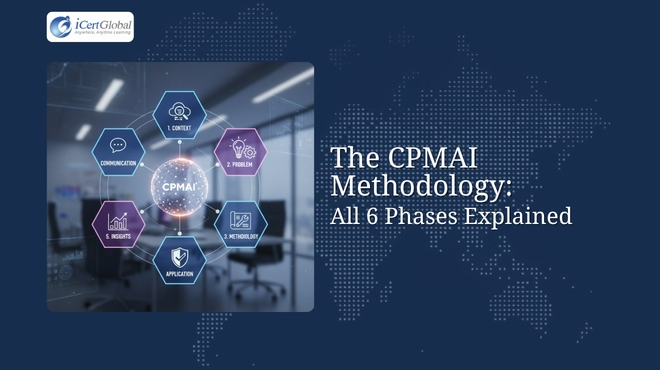
Master the 6 phases of the CPMAI methodology. Learn how to manage AI projects, pass your certification exam,

Advance your career with the PMI-CPMAI certification. Discover how to manage ethical AI projects, master the methodology, and

Our experts are ready to help you with any questions about courses, admissions, or career paths. Get personalized guidance from industry professionals.
Request a Call Back

"PMI®", "PMBOK®", "PMP®", "CAPM®" and "PMI-ACP®" are registered marks of the Project Management Institute, Inc. | "CSM", "CST" are Registered Trade Marks of The Scrum Alliance, USA. | COBIT® is a trademark of ISACA® registered in the United States and other countries.
