





Before You Enroll in PMI-CPMAI, Read This First
Before you take the PMI-CPMAI, learn how mastering project management ai can elevate your career, validate your skills,
Stop relying on rigid tables. Get the globally recognized NoSQL credential that makes you a specialist in handling modern, high-volume, unstructured data and unlocks architecture roles.
You're probably using MongoDB because it's easy - no schema, quick setup. That's fine for small projects, but in the demanding world of FinTech, E-commerce, and high-frequency data logging in Mount Pleasant, SC , "easy" quickly becomes "unmanageable". Without deep knowledge of the MongoDB Aggregation Pipeline, performance tuning, and proper data modeling, your MongoDB database will hit a scaling wall and crash under load. You'll be left fixing application errors caused by faulty database architecture. This isn't another generic MongoDB certification course that just teaches you basic CRUD operations. This program is engineered by senior Data Architects and DevOps specialists who've been in the trenches - scaling MongoDB clusters from zero to millions of daily requests in the competitive tech hubs of Hyderabad, Mumbai, and Bangalore. They built this program to teach you how to design a MongoDB cloud architecture that is fault-tolerant, horizontally scalable, and optimized for the specific data access patterns of your applications. Unlike basic MongoDB documentation or tutorials, our curriculum focuses on actionable, real-world usefulness. You'll learn how to correctly model complex relationships to avoid performance-killing lookups, master the Aggregation Framework to replace cumbersome application-side joins, and implement Sharding to distribute your data seamlessly across multiple commodity servers. The final exam is just the proof - the real value is walking into a scaling review meeting and confidently advising your team on the precise shard key and indexing strategy required to sustain 10,000+ requests per second. We built this course for working professionals and developers aiming to accelerate their MongoDB careers or lead the NoSQL transition in their organizations. Our batches are fully interactive, focusing on lab exercises, real-world failure simulations, and AI-powered query analysis tools that help you understand performance patterns faster. Beyond the training, you get reusable MongoDB query templates, diagnostic checklists for performance bottlenecks, 24/7 expert support, and project-based assignments that simulate scaling a real, data-intensive application. If you're ready to move beyond reading MongoDB interview questions and actually start solving real-world database challenges - this is your launchpad to becoming a MongoDB expert.
Learn directly from senior database administrators and NoSQL architects with extensive experience deploying MongoDB in production environments across Mount Pleasant, SC.
Get hands-on experience setting up, configuring, and maintaining geo-distributed, zone-aware Sharded Clusters - the ultimate scaling solution for large datasets.
Gain deep skills in using the Explain Plan, diagnostic tools, and advanced indexing strategies to reduce query latency from seconds to milliseconds.
Test your mastery with 2000+ scenario-based questions and advanced simulations focused on cluster administration and query optimization.
Conquer the multi-stage Aggregation Framework to execute complex reporting and analytics natively within MongoDB, minimizing application-level processing.
Access certified MongoDB professionals around the clock through dedicated support channels to eliminate production bottlenecks and technical roadblocks instantly.
As a Certified MongoDB Professional, participants in this training program will be empowered to design, develop, and deploy scalable, high-performance data storage solutions. This involves a deep understanding of MongoDB's distributed architecture and replication mechanisms.
MongoDB's architecture is based on a sharded cluster model, where data is split across multiple nodes, and each node serves a specific function, such as data retrieval or storage. Participants will learn to configure MongoDB's query routing layer to optimize data retrieval and minimize latency.
In Mount Pleasant, SC, businesses and organizations rely on data-driven decision-making to stay competitive, and MongoDB's flexibility and scalability make it an ideal choice for complex data storage needs.

Get a custom quote for your organization's training needs.
During the course, participants will work on hands-on projects that simulate real-world scenarios, applying MongoDB's NoSQL data modeling and querying techniques to achieve optimal data retrieval and storage efficiency. MongoDB's aggregation framework allows users to process large datasets by aggregating and transforming data in real-time, which is particularly useful for big data analytics.
Participants will learn to use MongoDB's aggregation pipeline to create efficient data processing workflows. In practical terms, understanding MongoDB's data modeling and querying techniques can significantly improve data analysis and reporting capabilities, enabling organizations to make more informed business decisions and stay ahead of the competition.
Stop losing data when a primary server fails. You will learn to configure Replica Sets for redundancy and automatic failover, ensuring 99.99% uptime for your production environment.
Move beyond basic embedding. You will learn precise Denormalization, Referencing, and Modeling techniques to optimize for specific query patterns and avoid inefficient $lookup operations that kill performance.
Learn to read and interpret the Explain Plan. You will master Compound, Partial, and Geospatial Indexes to reduce query execution time from hundreds of milliseconds to under 10ms.
Conquer the hardest part of scaling. You will learn how to select the optimal Shard Key, set up a sharded cluster, and manage data distribution for horizontal scalability across commodity hardware.
Stop pulling massive datasets into your application layer. You will learn the multi-stage Aggregation Pipeline to perform complex grouping, filtering, and reporting efficiently within the database engine.
Stop leaving your data exposed. You will learn Role-Based Access Control (RBAC), internal authentication mechanisms, and best practices for securing data in transit (TLS/SSL) and at rest (Encryption).
If your career requires you to build or maintain high-availability, high-performance, distributed data systems, this program is the non-negotiable path to architectural credibility.
Upon completion of the Certified MongoDB Professional Training Program, participants will gain a comprehensive understanding of MongoDB's features and capabilities, including data normalization, data validation, and data retrieval mechanisms. MongoDB's query optimization and indexing techniques enable participants to optimize their database performance and improve data retrieval efficiency, which is critical for business-critical applications.
Participants will learn to implement query optimization strategies to minimize latency and maximize data retrieval speed. In Mount Pleasant, SC, data analysts and scientists rely on MongoDB's scalability and performance to handle large volumes of data and make data-driven decisions, and the Certified MongoDB Professional Training Program prepares them for these demanding requirements.


Prove your deep expertise in MongoDB clustering, replication, and performance tuning to qualify for senior DBA and Architect roles.
Access architecture-level compensation and bonuses reserved for experts who ensure data integrity and horizontal scalability.
Gain the authority to influence infrastructure design and lead enterprise-scale data migration projects.
The Certified MongoDB Professional (CMP) credential is globally respected because it validates the ability to deploy, scale, and optimize MongoDB in real-world production environments. It is not for beginners - the certification benchmarks operational mastery of distributed data systems.
Formal Training: Completion of a comprehensive, 40+ hour training program covering advanced replication, sharding, and performance diagnostics. (Fully satisfied by this iCertGlobal course.)
Practical Proficiency: Demonstrated ability to configure and troubleshoot a distributed MongoDB cluster, select optimal shard keys, and optimize complex aggregation pipelines.
Experience (Recommended, not mandatory): At least 1 year of hands-on experience working with MongoDB in a development or operations role involving real production workloads.
Important Note: Do not attempt this certification if your experience is limited to single-node setups and basic CRUD operations - this exam demands deep architectural understanding.
The Certified MongoDB Professional Training Program addresses the skill gap in MongoDB development by providing participants with a deep understanding of MongoDB's architecture, data modeling, and querying techniques. This enables them to design, develop, and deploy scalable, high-performance data storage solutions.
MongoDB's JSON data format and MongoDB's schema-less data modeling allow for flexible data storage and retrieval, which is particularly useful for handling complex data structures. Participants will learn to leverage MongoDB's flexible data model to achieve optimal data storage and retrieval efficiency.
By addressing the skill gap in MongoDB development, participants will be equipped to handle complex data storage and retrieval requirements, which is critical for business-critical applications and big data analytics.
Master the roles of Primary, Secondary, and Arbiter members in a Replica Set. Learn to configure, initialize, and maintain a fault-tolerant environment spanning multiple nodes to ensure continuous availability and automatic failover.
Understand MongoDB's election mechanics and how to trigger controlled failovers. Learn to balance durability and latency using Write Concerns and Read Concerns - ensuring both performance and data consistency in mission-critical deployments.
Gain expertise in Replica Set maintenance tasks such as member reconfiguration, rolling upgrades, and synchronization management. Learn hot and cold backup methodologies vital for high-availability and disaster recovery scenarios in production environments.
Understand the foundation of MongoDB's horizontal scaling - Shards, Config Servers, and Query Routers (mongos). Learn how these interact to deliver linear scalability, aligning directly with MongoDB certification standards and enterprise best practices.
Discover the critical principles behind Shard Key selection. Learn the difference between Hashed and Ranged Shard Keys, and how proper selection ensures even data distribution, prevents hot spots, and maintains optimal query performance.
Develop hands-on skills to manage and troubleshoot live sharded clusters. Learn chunk pre-splitting, zone-based sharding for geographic awareness, and effective handling of unbalanced chunks and migration failures.
Learn to design Compound, Partial, and Text Indexes that maximize query efficiency. Understand index order, size, and memory fit, and how these directly influence MongoDB's internal query planner - essential for performance optimization and certification success.
Master performance tuning with the Explain Plan tool. Identify inefficient queries, detect missing or misused indexes, and apply corrective optimizations. This skill is frequently tested in MongoDB certification exams and essential for database performance engineering.
Conquer MongoDB's aggregation pipeline with operators like $match, $group, $project, $lookup, and $unwind. Learn to execute complex data transformations and analytics natively within MongoDB, reducing external computation load.
Secure your MongoDB environment by implementing robust authentication and authorization. Create users, assign roles, and enforce the principle of least privilege to achieve enterprise-grade data security and meet MongoDB certification standards.
Monitor MongoDB performance using Compass, Atlas monitoring tools, and third-party dashboards. Track replication lag, slow queries, and I/O bottlenecks to proactively manage health and prevent downtime in production-grade MongoDB clusters.
Explore MongoDB's extensive ecosystem - GridFS for handling large files, official language drivers, and connection pooling strategies. Learn client-side best practices for error handling, retries, and efficient connection management in real-world application integrations.
The Certified MongoDB Professional Training Program has a wide range of industry applications, from web development and mobile app development to data analytics and big data processing. Participants will learn to apply MongoDB's NoSQL data modeling and querying techniques to real-world scenarios.
MongoDB's flexible data model and MongoDB's schema-less data storage enable participants to handle complex data structures and unstructured data, which is particularly useful for handling big data and IoT data. Participants will learn to apply MongoDB's data modeling and querying techniques to handle complex data structures and achieve optimal data storage and retrieval efficiency.
In Mount Pleasant, SC, MongoDB's flexibility and scalability make it an ideal choice for complex data storage needs, and the Certified MongoDB Professional Training Program prepares participants for these demanding requirements.
Great class, very informative.

Great PMP<sup>®</sup> Bootcamp. I had a great time taking this course. I took the course to prepare to sit for the CAPM<sup>®</sup> but may be able to sit for the PMP<sup>®</sup>. I learnt a lot was challenging. Great course. We need one more day. Content was very detailed.

it was a great class. Lots of energy. And I enjoyed.

Fantastic course to prepare for PMP<sup>®</sup> exam.

As a participant it was smooth sailing for me.

Trainer was excellent. Shared good resources and good experiences.

Good content and training.
I wanted to let you know that I took and passed the PMP exam. Thanks to iCert Global and especially my Cincinnati course instructor, who was an excellent teacher and helped me immensely.

Trainer was good. Trainer was very engaged and interacting. Very much satisfied with the training.

I was pleasantly surprised at the quality of this training. Yomi was awesome as a trainer and working to make sure that we understood the concepts. Controlling Cost and Controlling Risk are the most complicated, but Yomi spent time after class working through questions to help others understand. This class also helped to change my perception of the PMP being this MONSTER to something that I can I can successfully do.

Great class with a lot of information and tips to prepare for the exam

It was a great course, covered all the things that i ended up hitting road bumps on. I was the only one in the class, but the trainer was just as involved as if it had been a full class.

I was nervous about taking it online versus classroom; but I am actually glad I took it online. Instructor was very great and gave a good learning experience with his relevant project management experience.
The training was very intense but covered with course material. It was more than I expected.

I thought the class was very informative. The instructor did an excellent job breaking down each chapter to where it was easy to understand. I was also very impressed with his commitment to help us pass ever after the class is over.

Excellent training. Instructor was very knowledgeable and explained information in an understandable way
Quality Materials presented, Instructor very knowledgeable. Exceeded my expectations.
The training is a great introduction into the PMI mindset. Very informative and helpful

Stay updated with the latest insights and trends in your field
Before you take the PMI-CPMAI, learn how mastering project management ai can elevate your career, validate your skills,
Master the critical data scientist skills that separate beginners from top-tier professionals and accelerate your career growth.
Map your data scientist career path for 2026. Learn the high-demand skills, certifications, and real salary expectations you
Prepare for your data science career with the real insights nobody shares. Learn the practical skills and exam-ready
Discover the core skills you need to build a successful data scientist career. Master the essential expertise that

Compare CISA vs CRISC to find your ideal ISACA path. Analyze exam difficulty, career outlook, and skills to
Master the 5 domains of the CISA Certification Syllabus. Get the complete 2026 exam guide to pass on
Discover the CCNA salary in India from fresher to senior roles. Learn how to leverage this certification to
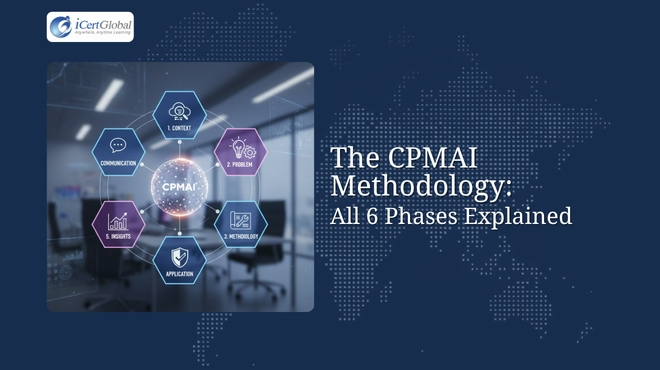
Master the 6 phases of the CPMAI methodology. Learn how to manage AI projects, pass your certification exam,
Advance your career with the PMI-CPMAI certification. Discover how to manage ethical AI projects, master the methodology, and

Our experts are ready to help you with any questions about courses, admissions, or career paths. Get personalized guidance from industry professionals.
Request a Call Back

"PMI®", "PMBOK®", "PMP®", "CAPM®" and "PMI-ACP®" are registered marks of the Project Management Institute, Inc. | "CSM", "CST" are Registered Trade Marks of The Scrum Alliance, USA. | COBIT® is a trademark of ISACA® registered in the United States and other countries.
