





Before You Enroll in PMI-CPMAI, Read This First
Before you take the PMI-CPMAI, learn how mastering project management ai can elevate your career, validate your skills,
Stop writing scripts. Build systems. Get the core programming credential that ends your reliance on specific software and unlocks roles in AI/ML, Data Science, and DevOps.
You've likely been using Python programming for basic scripting, a quick data pull, or automating small tasks. That's a coordinator's job, not a developer's. Meanwhile, professionals who deeply understand the Python ecosystem - those who can build a secure REST API with Flask, deploy a machine learning model, or optimize massive Python data structures - are commanding senior roles and salaries 30-50% higher. Your current Python skills keep you in a support function; this Python certification proves you're ready to build and lead. This isn't just about learning syntax. Our Python course is engineered by senior developers and data architects who've solved high-stakes problems in Huntsville, AL tech, finance, and e-commerce. They've distilled years of experience into a curriculum that teaches you to write clean, optimized, and production-ready Python code. The market doesn't pay for theory; it pays for Python programming that works, scales, and is maintainable. We move beyond basic tutorials. You will learn Object-Oriented Programming (OOP) principles, advanced Python data types and data structures to optimize performance, and best practices for writing unit tests that prevent failures in production. The Python certification is just proof; the real value is walking into your next interview and confidently discussing asynchronous programming, multi-threading, and memory management. This program is designed for working professionals. Our weekday evening and weekend batches are fully interactive, providing real-time feedback. Beyond the live sessions, you get access to reusable Python code repositories, practical templates for tasks like API creation and web scraping, 24/7 expert support, and project-based assignments that mirror real-world tickets from Huntsville, AL tech firms. Whether your goal is Python coding interview questions, full-stack development, or data-intensive applications, this Python course equips you with the practical Python programming expertise needed to advance your career.
Learn directly from senior Python developers and data scientists with a minimum of 10,000 hours of production coding experience.
Complete 5 major hands-on projects, applying libraries like NumPy, SciPy, Matplotlib, and Django to real-world scenarios.
The curriculum emphasizes automation, data manipulation, and web backend development - the areas with the highest salary growth.
Drill your knowledge with over 2,000 challenge-based practice questions and advanced coding assessments.
Receive personalized, critical feedback on your project code from experts to ensure maintainable, idiomatic Python.
Eliminate coding roadblocks instantly with dedicated support channels staffed by certified Python developers.
The growth of a programming language like Python necessitates a focus on scalability. This means adapting to changing requirements, integrating diverse tools, and maintaining performance despite increasing data volumes. Certified Python programmers must be able to handle the demands of a rapidly evolving technological landscape.
Automating workflows and streamlining processes are critical for businesses to stay competitive. The ability to harness the power of Python for data analysis, machine learning, and web development makes it an ideal choice. As the need for efficient and scalable solutions continues to grow, the value of a certified Python programmer will become increasingly apparent, not just in major metropolitan areas but also in smaller cities like Huntsville, AL.
In a field where technological innovation is a constant, a proficient programmer's ability to adapt and innovate is crucial. Certified Python programmers will find themselves at the forefront of this effort, driving the development of new tools and methodologies that can be applied across various industries.

Get a custom quote for your organization's training needs.
Practical Application of the Certified Python Programmer Training Program
The Certified Python Programmer Training Program goes beyond providing a theoretical foundation in Python programming. It equips students with hands-on experience in developing robust and maintainable code. This is achieved through a combination of lectures, labs, and project work, ensuring that students can apply their knowledge in real-world scenarios.
By mastering Python's built-in data structures, such as lists and dictionaries, and its extensive libraries, like NumPy and pandas, students can tackle complex tasks with ease. As they progress through the program, students will learn how to integrate Python with other languages and tools, such as Java and Django, to create comprehensive solutions. This versatility will enable them to tackle a wide range of projects, from data science and machine learning to web development and automation.
Upon completion of the program, students will possess the skills necessary to tackle complex programming tasks with confidence.
Stop writing monolithic, spaghetti code. Master classes, inheritance, and encapsulation to build robust, scalable, and easily maintainable applications used in finance and enterprise systems.
Go beyond Jupyter notebooks. Learn to use Pandas, NumPy, and Scikit-learn to build and deploy repeatable, automated data extraction, cleaning, and model training pipelines.
Transition from a scripting role to a full-stack contributor. Master Flask/Django to build high-performance, secure backend services and RESTful APIs, which is a non-negotiable skill for senior developers.
Stop manual work. You will learn to use Python for infrastructure automation, system monitoring, and CI/CD pipelines (e.g., Ansible, Docker integration), making you invaluable to DevOps teams.
Learn to handle multiple tasks simultaneously using threading, multiprocessing, and asyncio to optimize performance bottlenecks in I/O-bound and CPU-bound applications - a key differentiator.
Stop shipping broken code. Master unit testing (unittest, pytest) and logging best practices to systematically prevent and eliminate bugs before they hit production, saving your team massive cleanup work.
If your current role involves data, systems, or application logic, and you're tired of being limited by legacy tools, this program is the direct path to high-level system mastery.
Work Responsibilities of a Certified Python Programmer
As a certified Python programmer, one's primary responsibility will be to design, develop, and maintain software applications that meet the needs of various industries. This involves working closely with cross-functional teams to identify requirements and develop effective solutions.
In addition, certified Python programmers will be tasked with troubleshooting and debugging code, ensuring that applications are stable and efficient. To achieve these objectives, certified Python programmers must possess a deep understanding of object-oriented programming, inheritance, and polymorphism.
This knowledge will enable them to design and implement complex software systems, taking into account factors such as scalability, security, and maintainability. By leveraging Python's extensive libraries and frameworks, such as Flask and Pyramid, certified Python programmers can deliver high-quality software solutions.


Stop getting filtered out for senior developer, data scientist, and machine learning engineer roles that mandate high-level programming certification.
Unlock the higher salary bands and specialized bonus structures reserved for proven experts in core development and data manipulation.
Gain the credibility to lead technical design and project-level decisions.
The Certified Python Programmer credential is a proof of practical capability, not mere attendance. This certification ensures that every candidate demonstrates real-world proficiency in Python, from fundamentals to advanced application development. Here is the high-level breakdown of what you need to qualify.
Formal Training: Completion of a comprehensive, 60+ hour training program that covers Python's core language features, advanced libraries, and development best practices. (Fully satisfied by this iCertGlobal course).
Practical Proficiency: Successful completion of multiple project-based assessments that require building and debugging real-world Python applications.
Exam Readiness: Achieve a passing score on the final certification examination, which validates your ability to apply Python to solve complex problems in areas like data analysis and web development.
For a comprehensive breakdown of the specific objectives and recommended preparation, please refer to our detailed FAQ section.
Industry Applicability of the Certified Python Programmer Training Program
The Certified Python Programmer Training Program has far-reaching implications for various industries. In the field of data science, Python's extensive libraries and frameworks make it an ideal choice for data analysis, machine learning, and visualization.
By mastering Python, data scientists can develop sophisticated models and algorithms that drive business decision-making. In the field of web development, Python's frameworks, such as Django and Flask, enable developers to create scalable and maintainable web applications.
This is particularly relevant in industries such as e-commerce, finance, and healthcare, where web applications are critical to business operations. As a result, certified Python programmers will find themselves in high demand across various industries, including Huntsville, AL.
Dive deep into dictionaries, sets, and dynamic arrays. Understand the performance implications of different data structures and techniques for efficient memory management in data-intensive applications.
Handle file I/O in Python including reading and writing CSV, JSON, and text files. Gain practical experience interacting with the operating system using the os and sys modules, essential for automation and real-world Python projects.
Master exception handling using try-except-finally and implement structured logging with Python's logging module. Create actionable logs to efficiently debug production systems.
Learn efficient array manipulation, vectorization, and broadcasting techniques to drastically reduce execution time for numerical tasks, forming the foundation of high-performance data science in Python.
Master Python data structures such as DataFrames, perform data cleaning, aggregation, merging, and time-series analysis to efficiently handle massive datasets, crucial for data science and analytics roles.
Visualize data with Matplotlib and Seaborn, and get hands-on with Scikit-learn for basic machine learning tasks like linear regression and classification. Enhance your portfolio and prepare for Python interviews and certification exams.
Build your first production-ready RESTful API. Master the micro-framework Flask for rapid back-end development, routing, and request handling.
Connect Python applications to databases like PostgreSQL and MySQL using an ORM such as SQLAlchemy. Master CRUD operations and strengthen knowledge of Python data types and structures for real-world projects.
Learn to deploy Python web applications using Gunicorn, Nginx, and basic cloud services. Implement essential security practices to protect APIs from vulnerabilities, making your Python skills production-ready.
Master threading, multiprocessing, and the asyncio library. Understand when to use each for I/O-bound vs. CPU-bound tasks, elevating you from intermediate to senior developer level.
Implement unit and integration testing using pytest, utilize proper IDE debuggers, and follow Python Enhancement Proposals (PEPs) like PEP 8 to ensure professional-quality code.
Consolidate knowledge with a final review and targeted practice. Complete the major final project and tackle full-length simulators to master the structure and mental pressure of the certification exam.
Skill Gap in the Certified Python Programmer Training Program
A key skill gap in the Certified Python Programmer Training Program lies in the area of concurrent programming. As the need to process large volumes of data in real-time continues to grow, the ability to write efficient and scalable concurrent code becomes increasingly important.
Certified Python programmers must be able to master the art of concurrent programming using libraries such as threading, multiprocessing, and asyncio. To effectively bridge this skill gap, the training program must provide students with hands-on experience in developing concurrent applications using Python.
This can be achieved through a combination of lectures, labs, and project work, ensuring that students can apply their knowledge in real-world scenarios. By mastering the intricacies of concurrent programming, certified Python programmers will be able to tackle complex tasks with ease.
Great class, very informative.

Great PMP<sup>®</sup> Bootcamp. I had a great time taking this course. I took the course to prepare to sit for the CAPM<sup>®</sup> but may be able to sit for the PMP<sup>®</sup>. I learnt a lot was challenging. Great course. We need one more day. Content was very detailed.

it was a great class. Lots of energy. And I enjoyed.

Fantastic course to prepare for PMP<sup>®</sup> exam.

As a participant it was smooth sailing for me.

Trainer was excellent. Shared good resources and good experiences.

Good content and training.
I wanted to let you know that I took and passed the PMP exam. Thanks to iCert Global and especially my Cincinnati course instructor, who was an excellent teacher and helped me immensely.

Trainer was good. Trainer was very engaged and interacting. Very much satisfied with the training.

I was pleasantly surprised at the quality of this training. Yomi was awesome as a trainer and working to make sure that we understood the concepts. Controlling Cost and Controlling Risk are the most complicated, but Yomi spent time after class working through questions to help others understand. This class also helped to change my perception of the PMP being this MONSTER to something that I can I can successfully do.

Great class with a lot of information and tips to prepare for the exam

It was a great course, covered all the things that i ended up hitting road bumps on. I was the only one in the class, but the trainer was just as involved as if it had been a full class.

I was nervous about taking it online versus classroom; but I am actually glad I took it online. Instructor was very great and gave a good learning experience with his relevant project management experience.
The training was very intense but covered with course material. It was more than I expected.

I thought the class was very informative. The instructor did an excellent job breaking down each chapter to where it was easy to understand. I was also very impressed with his commitment to help us pass ever after the class is over.

Excellent training. Instructor was very knowledgeable and explained information in an understandable way
Quality Materials presented, Instructor very knowledgeable. Exceeded my expectations.
The training is a great introduction into the PMI mindset. Very informative and helpful

Stay updated with the latest insights and trends in your field
Before you take the PMI-CPMAI, learn how mastering project management ai can elevate your career, validate your skills,
Master the critical data scientist skills that separate beginners from top-tier professionals and accelerate your career growth.
Map your data scientist career path for 2026. Learn the high-demand skills, certifications, and real salary expectations you
Prepare for your data science career with the real insights nobody shares. Learn the practical skills and exam-ready
Discover the core skills you need to build a successful data scientist career. Master the essential expertise that

Compare CISA vs CRISC to find your ideal ISACA path. Analyze exam difficulty, career outlook, and skills to
Master the 5 domains of the CISA Certification Syllabus. Get the complete 2026 exam guide to pass on
Discover the CCNA salary in India from fresher to senior roles. Learn how to leverage this certification to
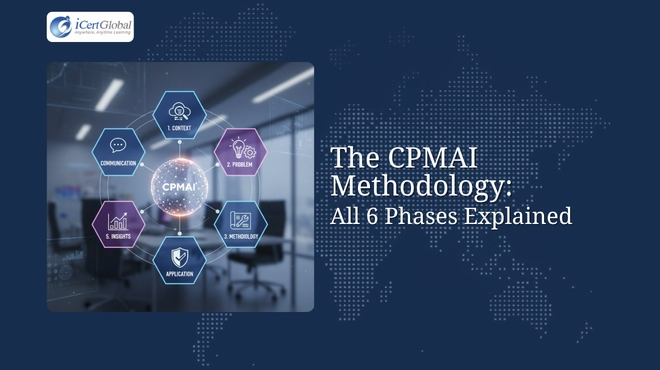
Master the 6 phases of the CPMAI methodology. Learn how to manage AI projects, pass your certification exam,
Advance your career with the PMI-CPMAI certification. Discover how to manage ethical AI projects, master the methodology, and

Our experts are ready to help you with any questions about courses, admissions, or career paths. Get personalized guidance from industry professionals.
Request a Call Back

"PMI®", "PMBOK®", "PMP®", "CAPM®" and "PMI-ACP®" are registered marks of the Project Management Institute, Inc. | "CSM", "CST" are Registered Trade Marks of The Scrum Alliance, USA. | COBIT® is a trademark of ISACA® registered in the United States and other countries.
