You are likely trapped in the "implementation trap." You are the one correcting the code, stabilizing the servers, and resolving crises caused by short-term decisions made years ago. You comprehend the systems better than anyone, yet you are still reporting to leaders who cannot distinguish a microservice from a monolith. Meanwhile, Enterprise Architecture professionals holding the TOGAF 9 Certification are the ones setting the course, defining the roadmap, and demanding billing rates 30-50% higher than yours. They do not resolve defects; they design the future of the organization. Your resume is currently being excluded by HR systems at major your region's IT consultancies and MNCs because you lack the standard vocabulary of high-level strategy. You may have the required experience, but without the credential, you are invisible for the Principal Architect and Chief Architect roles. That ends now. This is not a theoretical review of The Open Group's history. Our TOGAF 9 training course is developed by active Enterprise Architects who have reorganized complex IT environments in the local area's technology parks and financial districts. They have navigated legacy spaghetti code, resistant stakeholders, and financial restrictions. They built this program to instruct you on the Architecture Development Method (ADM) not as a dull academic exercise, but as a crucial tool to bypass corporate bureaucracy and impose technical standards. Unlike minimal "dump-and-run" training sessions that provide you with a PDF and minimal assistance, we build architectural thinking. You will learn how to bridge the divide between business strategy and IT execution. The examination is merely a hurdle?the true value is confidently walking into a boardroom and justifying why a multi-million dollar migration is necessary, utilizing the specific governance frameworks that executives respect. We have designed this for employed IT professionals who cannot afford to waste time. We offer weekday evening and weekend cohorts, fully interactive with live Q&A. Beyond the training, you receive case studies relevant to the your region's market, 24/7 expert support, and a direct path to passing the TOGAF 9 Combined exam?saving you the time and expense of taking Level 1 and Level 2 separately.
TOGAF 9 Certification Overview
Your TOGAF 9 Isn't a Certificate. It's Your Non-Negotiable Pass to Senior Roles
Why get TOGAF 9-certified?
The Credential That Ends the Gatekeeping
Stop getting filtered out.
Major Indian consultancies and Global Capability Centers (GCCs) require Enterprise Architecture Certification for senior-level roles.
Command authority.
Transition from being merely a "technical resource" to a strategic advisor who speaks the language of business transformation.
Future-proof your career.
As AI and cloud complexity increases, the demand for structured Enterprise Architecture is rapidly expanding, not diminishing.
TOGAF 9 Training Course Highlights
More Than a Course - It's Your Career Accelerator
Accredited Training Course
Do not risk your time or investment with unaccredited providers. Our material is fully aligned with The Open Group standards for the TOGAF 9 Certification.
Taught by Practicing Architects
Learn from industry veterans who are TOGAF 9 Certified and actively consult for Fortune 500 organizations.
Flexible Schedule
Aim for the certification without having to leave your current role. Choose from weekday-evening, weekend-only, or intensive corporate bootcamps.
Combined Level 1 & 2 Prep
We ensure efficiency. Our curriculum comprehensively covers both the Foundation and Certified levels simultaneously to get you fully qualified more quickly.
Exhaustive Practice Materials
Eliminate uncertainty. Gain access to hundreds of exam-style questions for both the multiple-choice Level 1 and the complex scenario-based Level 2.
24x7 Expert Guidance & Support
Industry experts are available around the clock to clarify complex ADM concepts and assist you at every stage.
Skills You Will Gain In Our TOGAF 9 Training Program
From Knowledge to Actionable Intelligence
Who This Program Is For
Ideal Candidates for TOGAF 9 Certification
This certification training is ideal for:
If you are involved in the design, planning, or oversight of IT infrastructure and strategy, this program is specifically engineered to validate your expertise.
TOGAF 9 Certification Training Program Roadmap
The Step-by-Step System for First-Attempt Success
Eligibility and Pre-requisites
For TOGAF 9 Certification
Unlike other restrictive certifications, The Open Group focuses on knowledge, not gatekeeping based on years of service. However, do not mistake "open eligibility" for "easy."
Course Modules
Comprehensive curriculum covering all exam domains
Introduction & Core Concepts
Lesson 1: The TOGAF 9 Framework Overview
Understand the structure of the TOGAF standard. Learn the key terminology that the exam will test you on, including the Core, Mandated, and Recommended concepts. Differentiate clearly between Level 1 and Level 2 requirements.
Lesson 2: Core Concepts of Enterprise Architecture
Master the definitions that form the bedrock of the exam. Understand the purpose of Enterprise Architecture, the role of the Architect, and the relationship between business strategy and IT execution.
Lesson 3: The Architecture Development Method (ADM) Introduction
Get the high-level view of the ADM cycle. Understand how the crop circle diagram works, the iterative nature of the process, and how the phases relate to each other. This is the "map" you will memorize for the exam.
The ADM Cycle (Strategy & Design)
Lesson 1: Preliminary Phase & Architecture Vision (Phase A)
Learn how to set up the architecture capability. Master the inputs and outputs of the Preliminary phase and how to define the scope, stakeholders, and business goals in Phase A. This is where the TOGAF 9 Certification tests your ability to start correctly.
Lesson 2: Business Architecture (Phase B)
Dive into the business layer. Learn how to describe the baseline and target business architecture, analyze gaps, and define the roadmap from a business perspective.
Lesson 3: Information Systems Architectures (Phase C)
Split into Data and Application architectures. Learn the intricacies of designing the data entity and application component blueprints that support the business vision.
The ADM Cycle (Transition & Governance)
Lesson 1: Technology Architecture (Phase D)
Map the software to the hardware. Learn to define the technology portfolio and technical standards required to support the applications and data.
Lesson 2: Opportunities, Solutions & Migration (Phase E & F)
Shift from design to planning. Learn how to identify major implementation projects, group them into work packages, and build a realistic Migration Plan that delivers business value.
Lesson 3: Implementation Governance & Change Management (Phase G & H)
Master the art of oversight. Learn how to govern the implementation projects through architecture contracts and how to manage changes to the architecture once it is live.
Guidelines & Techniques
Lesson 1: ADM Guidelines and Techniques
Master the tools of the trade. Learn the specifics of Gap Analysis, Stakeholder Management, and Risk Management. Understand when to iterate the ADM and how to apply it at different levels of the enterprise.
Lesson 2: Architecture Content Framework
Understand the deliverables. Learn the metamodel that describes the artifacts (catalogs, matrices, diagrams) you must produce during the ADM cycle.
Lesson 3: The Enterprise Continuum & Tools
Learn how to classify architecture assets. Master the Architecture Repository and the concept of the continuum, moving from Foundation Architectures to Organization-Specific Architectures.
Reference Models & Certification Prep
Lesson 1: TOGAF Reference Models
Study the TRM (Technical Reference Model) and the III-RM (Integrated Information Infrastructure Reference Model). These are legacy concepts but are critical high-index topics for the TOGAF 9 exam.
Lesson 2: Architecture Capability Framework
Learn how to establish an architecture practice within a company. Covers the Architecture Board, compliance reviews, and the skills framework for architects.
Lesson 3: Final Review & Exam Strategy
A brutal review of Level 1 facts and Level 2 scenario logic. We dissect how The Open Group words their questions to trick you and how to select the "best" answer in the gradient scoring system of Part 2.
Corporate Training
Tailored programs for teams with enterprise support

Ready to transform your team?
Get a custom quote for your organization's training needs.
Upcoming Schedule
Join the next batch that fits your timezone
Course & Support
Everything you need to know about our training options and support
Customer Testimonials
Hear from our successful graduates
"Exceptional PMP Training Experience with iCertGlobal I recently completed the PMP training by iCertGlobal, and I must say it was an outstanding experience. The instructor demonstrated a deep understanding of project management principles and brought real-world experience to the table. The training material's provided were comprehensive and well-organized, offering valuable insights and practical tips. I would highly recommend iCertGlobal to anyone looking for professional PMP Training.. "

John Anderson
"iCertGlobal provided a great learning experience with clear, well organised courses. The trainers were knowledgeable, and the support team was responsive to all my questions. The study material was comprehensive, which helped me pass my certification exam with ease. Highly recommended for anyone looking to get certified. "
James Walsh
"iCertGlobal is the best Certificate Training Organization. you will get good instructor and they will improve leaning sills and give the real time experience examples due to that you will get pass in first try. "
Andy Moran
"The course content, exam prep questions, interactive Q&A, and real-life examples made attending this PMP Project Management training class worth my time and money. The support from iCertGlobal was exceptional and I would like to thank them for accepting my request of meeting the trainer post the session for clearing my doubts."
Tim Malone
"I had a good learning experience with icertGlobal and it had been an amazing development journey. Actually, I accidentally bumped into iCertGlobal while searching for an online course for preparing my PMP examination. With positive reviews all over the internet and quick responses to my questions, I was flabbergasted enough to sign-up immediately. The instructor-led PMP preparatory course helped me both offline and online preparations. All the high-quality materials written in simple layman language was enough to grasp the gist of various topics. The instructors were very knowledgeable as they imparted not only their wealth of experiences but also real life examples. Thanks a lot iCertGlobal for imbibing this great learning experience. "
Jason Walter
"Thank you for your great course, great support, rapid response and excellent service."
Hoda Alavi
"My trainer made the materials relatable and easy to understand. It was fun being in class everyday. "
Cassandra Corn
"Amazing trainer who was very supportive. "

Shanna Pilgrim
"Trainer was well versed in the subject matter and got the impression the gentleman was professional and educated within standards and procedures for PMI. "
Anthony Zamora
"The Training was good and customer service was perfect. "
Maka Diakhate
"Trainer was knowledgeable and lesson's pace was just right."

Roger Gonzales
"Trainer (Bruce) was very excellent in delivery and presentation. He provided me with all the tools required to be successful in the PMP exams with lots of quiz questions on all topics reviewed. "
Bashiru Ojibara
"The trainer, Emad was top notch and very knowledgeable. He is up to date with all current versions and is great in 1:1 Training. "

Jonathan Obien
"Thank you for your great course, great support, rapid response and excellent service"

Hoda Alavi
"Marc had very good knowledge and he was able to explain the material and provide guidance to get ready for the test. "

Roque Montesino
"Excellent Course. Zahn was a great instructor and the course material definitely will help me pass the PMP Exam "

Jared Nelson
"Great teacher, went out of his way in every possible aspect. "
Radiah Sims
"Customer service provided by Robin was great as he was very responsive and the trainer, John, was very good at relating the content to my industry. "

Jason D Niebauer
TOGAF 9 Training in Other Cities
Our TOGAF 9 certification training is available in major cities worldwide
Related Blogs
Stay updated with the latest insights and trends in project management
ITIL 4 Foundation vs Practitioner: Certification Path Explained
Compare ITIL 4 Foundation vs Practitioner. Discover which certification aligns with your career goals, boosts your salary, and...
Top 10 IT Service Management Best Practices for
Master the top 10 ITSM best practices for modern businesses. Transform your service desk with proven frameworks to...
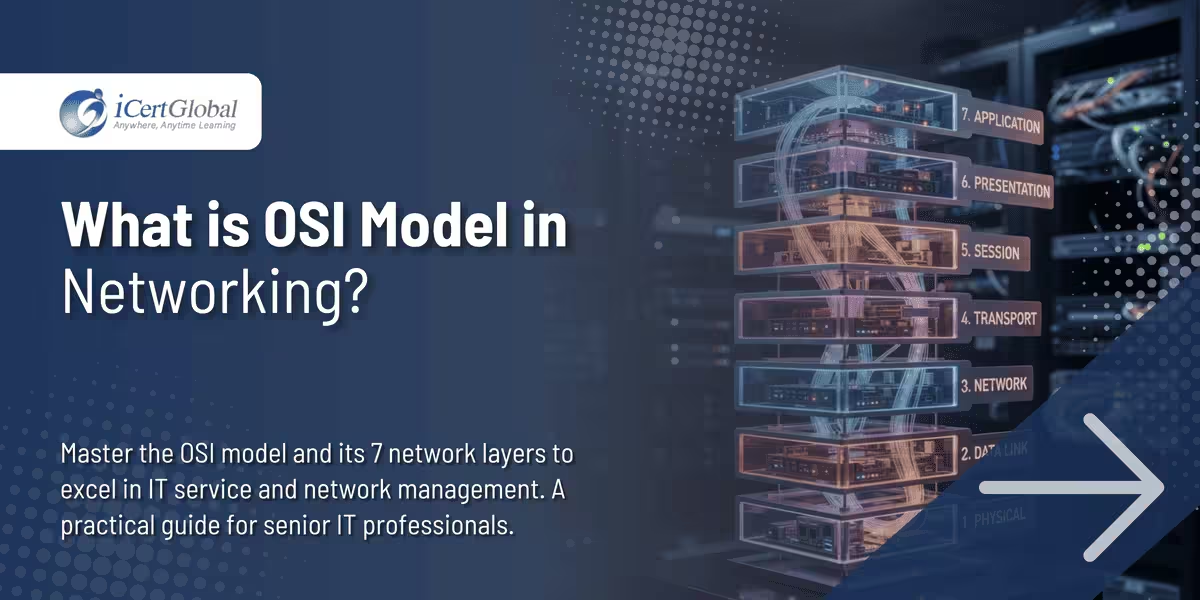
What is OSI Model in Networking
Master the OSI model and its 7 network layers to excel in IT service and network management. A...
7 Strong Advantages of ITIL Certification
Learn the top benefits of ITIL certification and how it boosts your IT career and organizational value....
Ensuring Tech Support Functions in Businesses
Learn how businesses keep their technology like computers and internet running well with ITSM and ITIL....
The Importance of COBIT in IT Management
Learn what COBIT is and why it matters for managing technology in businesses. ...



