Your operational background deserves greater recognition than simply managing the same recurring issues every month. While you are busy with reactive measures, quality teams are securing funding, staffing, and executive attention by spearheading methodical improvement projects. The key distinction is that they hold a Six Sigma Yellow Belt certification that demonstrates their capability to use data to pinpoint underlying causes, rather than just discussing surface-level issues. This is your chance to change that today. Our Six Sigma Yellow Belt course is not an excessively theoretical program overwhelming you with complex statistical methods. It is a hands-on learning opportunity developed by certified Black Belt practitioners who have successfully managed projects in manufacturing, IT services, and healthcare operations. You will master the DMAIC framework and learn how to implement it in actual work settings?where documentation is lacking, data is incomplete, and resistance to change is significant. Unlike standard programs that focus only on preparing you for the Six Sigma Yellow Belt exam, this course builds practical problem-solving capabilities. You'll gain skills to: Develop process maps that reveal operational bottlenecks. Apply Pareto analysis to prioritize the most impactful problems. Your Six Sigma Yellow Belt certification will confirm your understanding of the methodology, but its true value is in its practical application. You will return to your workplace ready to identify inefficiencies, quantify improvements, and present a compelling business case for change that leadership will take seriously. This Six Sigma Yellow Belt training is designed for working professionals in operations, production, and quality roles seeking to enhance their skills without disrupting their careers. You can select from weekday evening or weekend groups?all sessions are fully interactive and recorded for maximum flexibility.
Six Sigma Yellow Belt Certification Overview
Your SSYB isn’t just a belt—it’s a way to get noticed by management.
Why get Six Sigma Yellow Belt-certified?
The Credential That Ends the Gatekeeping
Bypass HR Filters
Avoid being rejected by HR systems that mandate "Six Sigma certification" for quality and continuous improvement positions you are fully qualified to handle.
Prove Foundational Competence
Demonstrate your core skills to hiring managers in manufacturing, healthcare, IT, and service sectors who seek qualified analysts for cost-critical projects.
Transition to Strategic Roles
Move from performing operational tasks into strategic process improvement positions where you reduce defects, identify waste, and drive measurable cost savings.
Six Sigma Yellow Belt Certification Highlights
More Than a Course-It's Your Career Accelerator.
Accredited Training Partner
Study confidently knowing your educational program meets the globally recognized IASSC, ASQ, and CSSC standards for the Six Sigma Yellow Belt certification.
Taught by Certified Black Belt Practitioners
Learn the methodology from subject matter experts who possess Six Sigma Black Belt credentials and are actively directing process improvement initiatives in the field.
Flexible Schedule
Enter the field of process improvement without interference to your current job, with choices including weekday-evening, weekend-only, or an intensive 3-day bootcamp option.
Performance-Focused Training
Quickly master the DMAIC fundamentals through 21 hours of hands-on practice and personalized feedback provided via assessments specific to each phase.
Exhaustive Practice Materials
Identify and resolve gaps in your knowledge with over 1000 specifically designed practice questions, full-length mock examinations, and real-world manufacturing and service scenarios.
24x7 Expert Guidance & Support
Get immediate help from Six Sigma Black Belt experts available around the clock to clarify DMAIC concepts and statistical tools at any stage of your learning.
Skills You Will Gain in Our Six Sigma Yellow Belt Certification Training
From knowledge to actionable intelligence
Who This Program Is For
Ideal candidates for Six Sigma Yellow Belt (SSYB) certification
This certification training is ideal for:
If you are beginning your career in process improvement or moving from operational or support roles, this program is specifically engineered to equip you with the credential and make you ready for project participation.
Six Sigma Yellow Belt Certification Roadmap
The step-by-step system for first-attempt success

Eligibility and Pre-requisites
For Six Sigma Yellow Belt Certification
The Six Sigma Yellow Belt credential is specifically designed as an entry-level certification with minimal requirements for entry. Certifying organizations created this credential to validate foundational knowledge for individuals who are starting their careers in process improvement or moving from existing operational roles. Here is what you need to meet the qualification criteria:
Course Modules
Comprehensive curriculum covering all exam domains
Six Sigma Fundamentals & Define Phase
Lesson 1: Introduction to Six Sigma & Lean Thinking
Understand what Six Sigma actually is versus what consultants claim it to be. Learn the history, philosophy, and statistical foundation of 3.4 defects per million opportunities. Master the distinction between Lean and Six Sigma and understand how they complement each other in waste elimination and variation reduction.
Lesson 2: Six Sigma Roles & Organizational Structure
Understand the roles of Yellow Belts, Green Belts, Black Belts, Master Black Belts, and Champions within process improvement organizations. As a Six Sigma Yellow Belt, learn how to support larger projects and lead small-scale improvements within your department skills that can enhance your Six Sigma Yellow Belt salary.
Lesson 3: Define Phase Tools & Project Selection
Master the critical first phase of DMAIC. Learn to create project charters, develop problem statements, identify stakeholders using SIPOC diagrams, and define project scope that's achievable within organizational constraints. Understand Voice of the Customer (VOC) and how to translate it into Critical to Quality (CTQ) characteristics.
Measure Phase Fundamentals
Lesson 1: Process Mapping & Documentation
Stop accepting ambiguous processes. You will learn to create value stream maps, detailed flowcharts, and swim lane diagrams that expose hidden waste, redundant steps, and handoff delays in any process?manufacturing or transactional.
Lesson 2: Data Collection & Sampling Techniques
Understand that opinions don't drive improvement?data does. Learn to design data collection plans, select appropriate sampling methods, and distinguish between continuous and discrete data. Master operational definitions that ensure data consistency across multiple collectors.
Lesson 3: Measurement System Analysis (MSA) Basics
Learn to validate your measurement system before trusting the data. Understand Gage R&R studies, accuracy, precision, and stability. Recognize when measurement error is masking true process variation and how to fix it before proceeding to analysis.
Analyze Phase & Root Cause Identification
Lesson 1: Descriptive Statistics & Data Visualization
Move beyond Excel averages. You will learn to calculate mean, median, mode, range, variance, and standard deviation. Master histograms, box plots, scatter diagrams, and run charts that reveal patterns invisible in spreadsheet tables.
Lesson 2: Process Capability Analysis
Understand whether your process can actually meet customer specifications. Learn to calculate Cp, Cpk, Pp, and Ppk indices. Interpret sigma levels and understand what "six sigma quality" actually means in real-world terms.
Lesson 3: Root Cause Analysis Tools
Master the core techniques: Fishbone (Ishikawa) diagrams, 5 Whys analysis, and Pareto charts. Learn when each technique is appropriate and how to facilitate root cause sessions without wasting everyone's time chasing symptoms instead of causes.
Improve Phase & Solution Implementation
Lesson 1: The 8 Wastes of Lean
Identify and eliminate waste systematically. Learn to recognize Defects, Overproduction, Waiting, Non-Utilized Talent, Transportation, Inventory, Motion, and Extra-Processing (DOWNTIME) in manufacturing, service, and transactional processes.
Lesson 2: Kaizen & Rapid Improvement Events
Understand that not every improvement requires a six-month Black Belt project. Learn to facilitate rapid kaizen events that deliver measurable results in days, not months. Master 5S workplace organization and visual management techniques.
Lesson 3: Brainstorming & Solution Selection
Generate improvement solutions that are actually implementable. Learn structured brainstorming techniques, affinity diagrams, and multi-criteria decision matrices to evaluate solutions against cost, impact, and feasibility constraints.
Control Phase & Exam Preparation
Lesson 1: Control Plans & Mistake-Proofing
Understand that implementation isn't the finish line. Learn to create control plans that sustain improvements after project closure. Master poka-yoke (error-proofing) techniques that prevent defects from occurring in the first place.
Lesson 2: Statistical Process Control (SPC) Basics
Learn to monitor process stability using control charts. Understand common cause versus special cause variation. Interpret X-bar and R charts, p-charts, and c-charts to detect when processes drift out of control.
Lesson 3: Final Review & Certification Readiness
Consolidate your knowledge across all five DMAIC phases and address any remaining weak spots through targeted review. Complete final practice assessments aligned with IASSC, ASQ, or CSSC formats and prepare for your certification journey with confidence.
Corporate Training
Tailored programs for teams with enterprise support

Ready to transform your team?
Get a custom quote for your organization's training needs.
Upcoming Schedule
Join the next batch that fits your timezone


Course & Support
Everything you need to know about our training options and support
Customer Testimonials
Hear from our successful graduates
"Exceptional PMP Training Experience with iCertGlobal I recently completed the PMP training by iCertGlobal, and I must say it was an outstanding experience. The instructor demonstrated a deep understanding of project management principles and brought real-world experience to the table. The training material's provided were comprehensive and well-organized, offering valuable insights and practical tips. I would highly recommend iCertGlobal to anyone looking for professional PMP Training.. "

John Anderson
"iCertGlobal provided a great learning experience with clear, well organised courses. The trainers were knowledgeable, and the support team was responsive to all my questions. The study material was comprehensive, which helped me pass my certification exam with ease. Highly recommended for anyone looking to get certified. "
James Walsh
"iCertGlobal is the best Certificate Training Organization. you will get good instructor and they will improve leaning sills and give the real time experience examples due to that you will get pass in first try. "
Andy Moran
"The course content, exam prep questions, interactive Q&A, and real-life examples made attending this PMP Project Management training class worth my time and money. The support from iCertGlobal was exceptional and I would like to thank them for accepting my request of meeting the trainer post the session for clearing my doubts."
Tim Malone
"I had a good learning experience with icertGlobal and it had been an amazing development journey. Actually, I accidentally bumped into iCertGlobal while searching for an online course for preparing my PMP examination. With positive reviews all over the internet and quick responses to my questions, I was flabbergasted enough to sign-up immediately. The instructor-led PMP preparatory course helped me both offline and online preparations. All the high-quality materials written in simple layman language was enough to grasp the gist of various topics. The instructors were very knowledgeable as they imparted not only their wealth of experiences but also real life examples. Thanks a lot iCertGlobal for imbibing this great learning experience. "
Jason Walter
"Thank you for your great course, great support, rapid response and excellent service."
Hoda Alavi
"My trainer made the materials relatable and easy to understand. It was fun being in class everyday. "
Cassandra Corn
"Amazing trainer who was very supportive. "

Shanna Pilgrim
"Trainer was well versed in the subject matter and got the impression the gentleman was professional and educated within standards and procedures for PMI. "
Anthony Zamora
"The Training was good and customer service was perfect. "
Maka Diakhate
"Trainer was knowledgeable and lesson's pace was just right."

Roger Gonzales
"Trainer (Bruce) was very excellent in delivery and presentation. He provided me with all the tools required to be successful in the PMP exams with lots of quiz questions on all topics reviewed. "
Bashiru Ojibara
"The trainer, Emad was top notch and very knowledgeable. He is up to date with all current versions and is great in 1:1 Training. "

Jonathan Obien
"Thank you for your great course, great support, rapid response and excellent service"

Hoda Alavi
"Marc had very good knowledge and he was able to explain the material and provide guidance to get ready for the test. "

Roque Montesino
"Excellent Course. Zahn was a great instructor and the course material definitely will help me pass the PMP Exam "

Jared Nelson
"Great teacher, went out of his way in every possible aspect. "
Radiah Sims
"Customer service provided by Robin was great as he was very responsive and the trainer, John, was very good at relating the content to my industry. "

Jason D Niebauer
Six Sigma Yellow Belt Training in Other Cities
Our Six Sigma Yellow Belt certification training is available in major cities worldwide
Related Blogs
Stay updated with the latest insights and trends in project management
Lean Six Sigma Green Belt and Black Belt
Discover the true Lean Six Sigma certification cost for Green and Black Belts. Compare exam fees, career ROI,...
DMAIC Explained Through a Realistic Process Improvement Example
Master the DMAIC process with a practical, step-by-step example. Learn how to solve process issues, pass your exam,...
How to Select a Lean Six Sigma Project
Learn how to identify and execute high-impact projects. Master Lean Six Sigma project selection to drive business results...
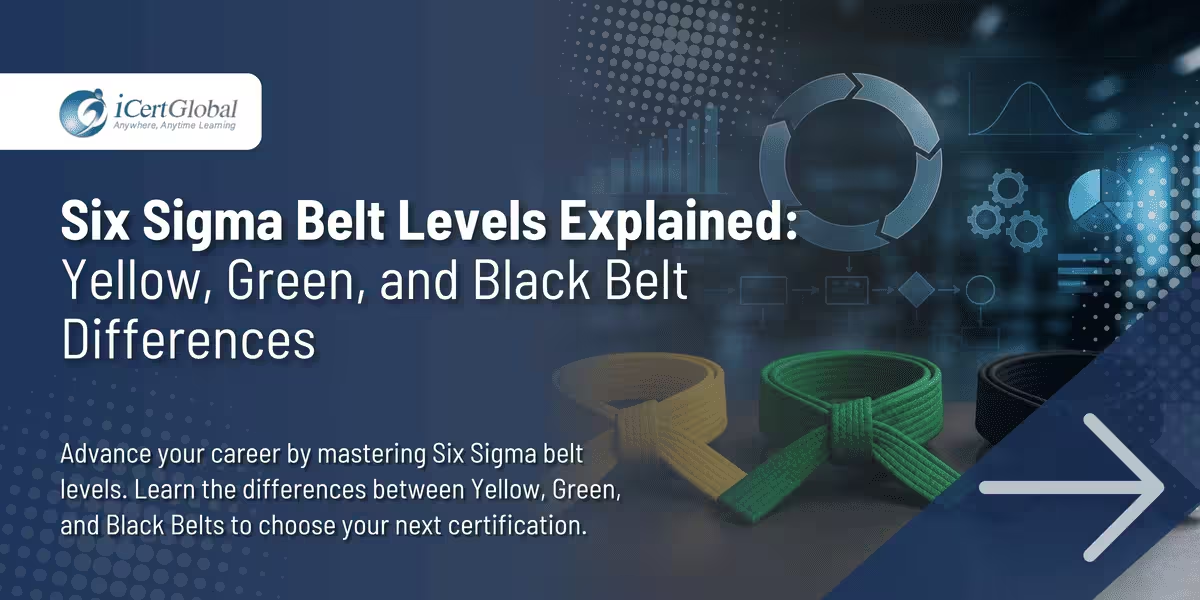
Six Sigma Belt Levels Explained: Yellow, Green, and
Advance your career by mastering Six Sigma belt levels. Learn the differences between Yellow, Green, and Black Belts...
How to Prepare for the Six Sigma Green
Master the DMAIC methodology and pass your Six Sigma Green Belt Certification Exam. Learn proven study strategies to...
10 Industries Where Lean Six Sigma Green Belt
Advance your career with Lean Six Sigma Green Belt skills. Explore the top 10 industries actively hiring certified...

