You are likely stuck in "Reactive Mode." Your queue is overflowing, your phone is constantly active, and you are troubleshooting the same basic issue repeatedly. You are reacting, not leading. You are the "IT Specialist" who reboots systems, not the "Operations Manager" who prevents them from crashing. To the business, you are a cost center. To your management, you are easily replaced. While others are overwhelmed by volume, ITIL Operational Support and Analysis Certification holders are analyzing trends. They aren't just resolving incidents; they are initiating Problem records to destroy the root cause so the ticket never recurs. They are configuring Event Management systems to automatically remediate services before users even notice. Recruiters for Major Incident Manager roles in your region's massive Network Operations Centers and global support centers don't want "help desk agents"; they want ITIL Operational Support and Analysis experts who can command a bridge call during a P1 outage. This isn't a customer service soft-skills course. Our ITIL OSA training virtual and in-person is a technical operations bootcamp. We strip away the non-essential content and focus on the "Restore" and "Repair" workflows. You will learn how to execute a Major Incident Procedure without panicking, how to use Kepner-Tregoe or Ishikawa diagrams for ITIL Problem Management, and how to secure access without impeding productivity. We built this for the Service Desk Leads, Incident Commanders, and L2/L3 Support Engineers who are tired of the churn. Whether you are supporting a bank?s trading floor or an e-commerce site?s peak season sale, this training gives you the structural authority to take control of the chaos. You will learn to optimize the ITIL Service Desk function to deliver value, not just apologies.
ITIL OSA Training Program Overview
Your ITIL OSA Certification Isn't Just a Badge. It's Your License to Eliminate Problems.
Why get ITIL OSA Certified?
The Credential That Ends the Gatekeeping
Break away from the Help Desk
Use OSA to prove you have the analytical skills required for Problem Management and Operations leadership.
Stop the late-night calls
Implement Event Management and proactive Problem Management so systems remain stable while you sleep.
Unlock specialized roles
Qualify for high-paying "Major Incident Manager" and "Operations Bridge Lead" positions in top MNCs.
ITIL OSA Training Course Highlights
More Than a Course - It's Your Operations Playbook
PeopleCert Accredited: We are an Authorized Training Organization (ATO).
Your 4 credits are guaranteed to count toward the ITIL Intermediate OSA qualification.
Real-World "War Room" Labs: We simulate P1/Critical outages.
You will practice managing the communication, the technical teams, and the angry stakeholders in real-time.
Root Cause Analysis (RCA) Mastery: Learn the difference between a "workaround" and a "permanent fix."
We teach you the specific techniques to find the needle in the haystack.
Exam-Centric Strategy: The OSA exam is scenario-heavy.
We provide specific tips on how to distinguish between "Incident" (Speed) and "Problem" (Quality) answers.
Service Desk Optimization: Learn how to structure your desk?Local, Centralized, Virtual, or Follow-the-Sun?
for maximum efficiency and minimum cost.
24/7 Expert Support: Stuck on an Event Management correlation rule?
Our experts are available around the clock to help you configure the logic.
Skills You Will Gain In Our ITIL OSA Training Program
From Knowledge to Actionable Intelligence
Who This Program Is For
Ideal Candidates for ITIL OSA Certification
This certification training is ideal for:
If you are responsible for the daily operation, support, and restoration of IT services, this Capability module is your mandatory professional standard.
ITIL OSA Certification Training Program Roadmap
The Step-by-Step System for First-Attempt Success
Eligibility and Pre-requisites
ITIL OSA Prerequisites
This is an advanced Capability module. It assumes you know the basics.
Course Modules
Comprehensive curriculum covering all exam domains
Event Management
Lesson 1: The Monitoring Loop
Stop ignoring alerts. Learn to generate, detect, filter, and categorize events. Understand the difference between an "Event" and an "Incident."
Lesson 2: Active vs. Passive Monitoring
Learn when to poll devices (Active) and when to wait for traps (Passive). Master the integration of monitoring tools with the Service Desk.
Incident Management
Lesson 1: The Incident Lifecycle
Master the flow: Detect, Log, Categorize, Prioritize, Diagnose, Resolve, Close. Learn the difference between Functional Escalation (Technical) and Hierarchical Escalation (Management).
Lesson 2: Major Incident Procedure
When the house is on fire. Learn the specific procedure for handling high-impact incidents: The Bridge Call, The Communication Plan, and The Post-Implementation Review.
Request Fulfillment
Lesson 1: The Menu
Separate the noise. Learn to build a Request Catalog for standard changes (password resets, software installs).
Lesson 2: Automation & Self-Help
Drive efficiency. Learn how to use Request Fulfillment to reduce the burden on the Service Desk and lower the cost per ticket.
Problem Management
Lesson 1: Root Cause Analysis (RCA)
Stop the recurrence. Learn to investigate the underlying cause of incidents. Master techniques like Kepner-Tregoe, Ishikawa (Fishbone), and Pareto Analysis.
Lesson 2: The Known Error Database (KEDB)
Manage the workarounds. Learn to document temporary fixes and share them with the Service Desk to speed up restoration times.
Access Management
Lesson 1: Rights & Identity
Execute the policy. Learn to verify identity (Authentication) and grant rights (Authorization).
Lesson 2: The Access Lifecycle
Manage the user journey. Learn to handle Access Requests, Change of Status (Promotion/Transfer), and Revocation (Termination).
The Service Desk Function
Lesson 1: Structures & Models
Design the team. Compare Local (Face-to-Face), Centralized (Cost-Effective), Virtual (Follow-the-Sun), and Specialized Service Desk structures.
Lesson 2: Metrics & Staffing
Measure success. Learn to track First Call Resolution (FCR), Average Handling Time (AHT), and Customer Satisfaction (CSAT). Learn how to staff for peak volumes.
Exam Strategy
Review ITIL OSA exam tips. Learn to handle the "Gradient Scoring" questions and manage your time during the 90-minute test.
Corporate Training
Tailored programs for teams with enterprise support

Ready to transform your team?
Get a custom quote for your organization's training needs.
Upcoming Schedule
Join the next batch that fits your timezone
Course & Support
Everything you need to know about our training options and support
Customer Testimonials
Hear from our successful graduates
"Exceptional PMP Training Experience with iCertGlobal I recently completed the PMP training by iCertGlobal, and I must say it was an outstanding experience. The instructor demonstrated a deep understanding of project management principles and brought real-world experience to the table. The training material's provided were comprehensive and well-organized, offering valuable insights and practical tips. I would highly recommend iCertGlobal to anyone looking for professional PMP Training.. "

John Anderson
"iCertGlobal provided a great learning experience with clear, well organised courses. The trainers were knowledgeable, and the support team was responsive to all my questions. The study material was comprehensive, which helped me pass my certification exam with ease. Highly recommended for anyone looking to get certified. "
James Walsh
"iCertGlobal is the best Certificate Training Organization. you will get good instructor and they will improve leaning sills and give the real time experience examples due to that you will get pass in first try. "
Andy Moran
"The course content, exam prep questions, interactive Q&A, and real-life examples made attending this PMP Project Management training class worth my time and money. The support from iCertGlobal was exceptional and I would like to thank them for accepting my request of meeting the trainer post the session for clearing my doubts."
Tim Malone
"I had a good learning experience with icertGlobal and it had been an amazing development journey. Actually, I accidentally bumped into iCertGlobal while searching for an online course for preparing my PMP examination. With positive reviews all over the internet and quick responses to my questions, I was flabbergasted enough to sign-up immediately. The instructor-led PMP preparatory course helped me both offline and online preparations. All the high-quality materials written in simple layman language was enough to grasp the gist of various topics. The instructors were very knowledgeable as they imparted not only their wealth of experiences but also real life examples. Thanks a lot iCertGlobal for imbibing this great learning experience. "
Jason Walter
"Thank you for your great course, great support, rapid response and excellent service."
Hoda Alavi
"My trainer made the materials relatable and easy to understand. It was fun being in class everyday. "
Cassandra Corn
"Amazing trainer who was very supportive. "

Shanna Pilgrim
"Trainer was well versed in the subject matter and got the impression the gentleman was professional and educated within standards and procedures for PMI. "
Anthony Zamora
"The Training was good and customer service was perfect. "
Maka Diakhate
"Trainer was knowledgeable and lesson's pace was just right."

Roger Gonzales
"Trainer (Bruce) was very excellent in delivery and presentation. He provided me with all the tools required to be successful in the PMP exams with lots of quiz questions on all topics reviewed. "
Bashiru Ojibara
"The trainer, Emad was top notch and very knowledgeable. He is up to date with all current versions and is great in 1:1 Training. "

Jonathan Obien
"Thank you for your great course, great support, rapid response and excellent service"

Hoda Alavi
"Marc had very good knowledge and he was able to explain the material and provide guidance to get ready for the test. "

Roque Montesino
"Excellent Course. Zahn was a great instructor and the course material definitely will help me pass the PMP Exam "

Jared Nelson
"Great teacher, went out of his way in every possible aspect. "
Radiah Sims
"Customer service provided by Robin was great as he was very responsive and the trainer, John, was very good at relating the content to my industry. "

Jason D Niebauer
ITIL Operational Support and Analysis Training in Other Cities
Our ITIL Operational Support and Analysis certification training is available in major cities worldwide
Related Blogs
Stay updated with the latest insights and trends in project management
Top 10 IT Service Management Best Practices for
Master the top 10 ITSM best practices for modern businesses. Transform your service desk with proven frameworks to...
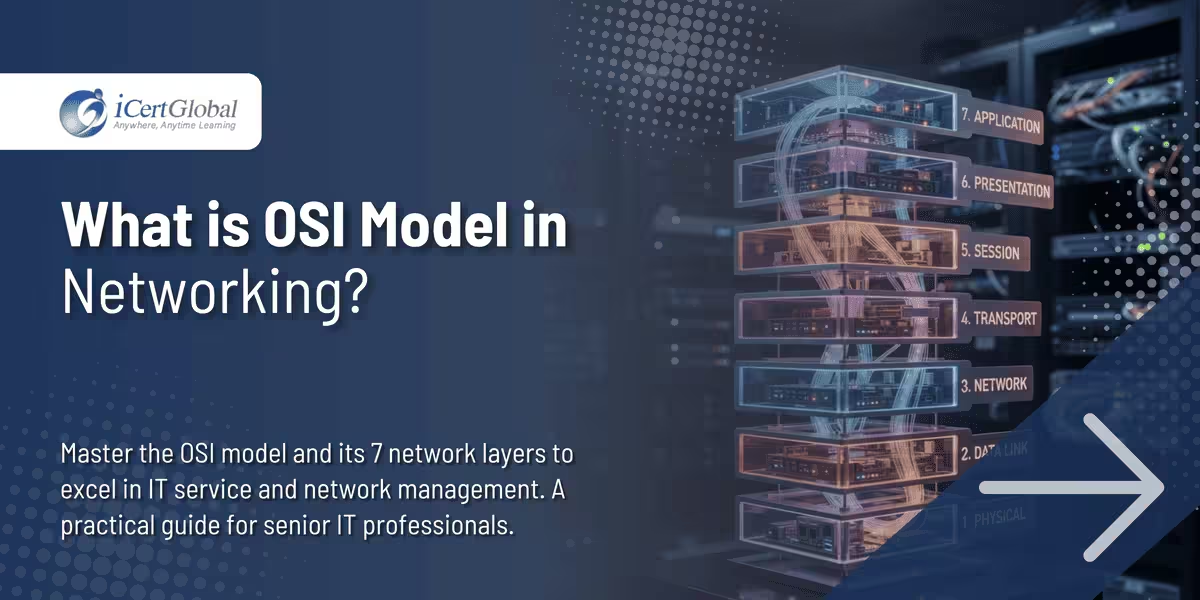
What is OSI Model in Networking
Master the OSI model and its 7 network layers to excel in IT service and network management. A...
7 Strong Advantages of ITIL Certification
Learn the top benefits of ITIL certification and how it boosts your IT career and organizational value....
Ensuring Tech Support Functions in Businesses
Learn how businesses keep their technology like computers and internet running well with ITSM and ITIL....
The Importance of COBIT in IT Management
Learn what COBIT is and why it matters for managing technology in businesses. ...
Guide to the Service Desk Manager Role
Learn about the key responsibilities, skills, and career path of a Service Desk Manager....



