






8 Best Practices for Successful Business Analysts
Learn 8 proven best practices for Business Analysts to master requirements, manage stakeholders, and drive project value. Expert
Stop waiting for a chance. Get the foundational credential that opens the door to your first business analyst role.
You're already performing the work of a business analyst - gathering requirements, documenting processes, and bridging the gap between business and IT. Yet, without the ECBA credential, you risk staying stuck in "analyst" or "coordinator" roles, while formally certified business analysts command 40-60% higher salaries for the same work.
HR systems filter out candidates who lack certification before hiring managers even see your resume, and internal job postings often list ECBA as required, not just preferred. That ends now.
This isn't another course that teaches you to memorize BABOK definitions. Our ECBA Training Program, designed by IIBA-certified practitioners, shows how to apply business strategy and business process management in real-world environments - stakeholders who contradict each other, projects without clear business cases, and technical teams that speak a different language than executives.
Unlike certification mills that focus solely on exam tricks, we build real capability. You'll learn to:
Facilitate requirements workshops that drive results, not complaints.
Write user stories that developers can implement effectively.
Create process models that stakeholders understand without lengthy explanations.
Apply structured process improvement techniques that make you indispensable in your role.
The exam is just validation - the real value is walking into your current job and immediately applying proven business analyst techniques. We've structured this program for working professionals: weekday evening and weekend batches, fully interactive with live Q&A, and every session recorded for future reference.
Beyond the classroom, you'll gain:
Ready-to-use requirements templates for immediate application.
Case studies from
Learn with confidence knowing your training program aligns with the official IIBA BABOK Guide standards and certification requirements.
Master business analysis from experts who hold CBAP or CCBA credentials and actively work as professional business analysts.
Break into business analysis without disrupting your career - choose from weekday-evening, weekend-only, or intensive 3-day bootcamp options.
Accelerate your learning with 21 hours of hands-on training and personalized feedback through 8+ knowledge area assessments.
Identify and eliminate knowledge gaps with 1000+ custom practice questions, mock exams, and real-world scenario exercises.
Stay confident throughout your learning journey with IIBA-certified mentors available around the clock to clarify BABOK concepts and provide guidance.
In the Entry Certificate in Business Analysis (ECBA) Certification Training Program, students learn to analyze business needs through the lens of requirements, stakeholder analysis, and documentation. This skillset is essential for professionals who want to excel in business analysis roles, where they will be responsible for identifying and articulating business needs. In the Waukegan, IL area, companies rely on business analysts to drive process improvements and implement strategic changes.
The ECBA certification emphasizes the importance of requirements gathering, stakeholder management, and documentation in delivering successful projects. Students learn about various techniques for eliciting requirements, such as interviewing, workshops, and surveys, as well as the best practices for documenting and managing requirements. By mastering these skills, professionals can ensure that they are delivering solutions that meet stakeholder needs and expectations.
In the Waukegan, IL business community, business analysts play a critical role in facilitating collaboration between stakeholders and project team members. By leveraging their skills in requirements analysis and documentation, professionals can effectively communicate business needs and drive project outcomes that meet stakeholder objectives.

Get a custom quote for your organization's training needs.
The Entry Certificate in Business Analysis (ECBA) Certification Training Program places a strong emphasis on developing the skills required to analyze stakeholder needs, gather and document requirements, and create effective plans. Students learn to identify stakeholder groups, assess their interest and influence, and develop strategies for managing stakeholder expectations. By applying these skills in business analysis roles, professionals can mitigate risks, resolve conflicts, and deliver successful projects.
In the ECBA certification, students study various documentation techniques, including use cases, wireframes, and business process models. They learn to create clear and concise documents that articulate business needs, identify key stakeholders, and outline the benefits and risks associated with proposed solutions. By mastering these skills, professionals can ensure that their documentation is aligned with business objectives and supports informed decision-making.
In the Waukegan, IL business environment, effective stakeholder analysis and documentation are critical for driving business growth and innovation. By applying the skills learned in the ECBA certification, professionals can identify opportunities for process improvements, develop strategies for stakeholder engagement, and deliver solutions that meet stakeholder needs and expectations.
Stop guessing what stakeholders need. Learn proven interview and workshop techniques to extract actual requirements instead of assumptions.
Master it or watch your initiatives fail. You will develop frameworks to identify who matters, what they need, and how to manage competing interests before they sabotage your work.
Visualize how work truly flows. Create process maps using Business Process Management (BPM) techniques and flowcharts that reveal inefficiencies and support intelligent automation and process improvement decisions.
Cut through vague requirements. You get templates and structures for writing user stories that developers can actually implement without endless clarification meetings.
Build traceability or lose control. You will understand how to document functional and non-functional requirements in a format that passes through approval cycles without constant rework.
Realize that delivery isn't a success. You will learn how to assess whether solutions actually solve the business problem and create measurement frameworks that prove ROI.
If you're starting your business analysis career or transitioning from technical or support roles, this program is engineered to get you credentialed and job-ready.
The Entry Certificate in Business Analysis (ECBA) Certification Training Program equips professionals with the skills and knowledge required to participate in and lead business analysis initiatives. Students learn to analyze business needs, identify opportunities for improvement, and develop solutions that meet stakeholder objectives. By applying these skills in business analysis roles, professionals can drive business growth, improve operational efficiency, and increase customer satisfaction.
In the ECBA certification, students study the principles of requirements engineering, including requirement elicitation, analysis, specification, and validation. They learn to create requirements specifications, identify potential risks and constraints, and develop strategies for mitigating these risks. By mastering these skills, professionals can ensure that they are delivering solutions that meet stakeholder needs and expectations.
In the Waukegan, IL business community, business analysts play a critical role in facilitating business transformation and growth. By applying the skills learned in the ECBA certification, professionals can drive business initiatives, identify opportunities for innovation, and deliver solutions that meet stakeholder objectives and drive business outcomes.


Get noticed by recruiters and secure the Business Analyst interviews your potential deserves - even if you're just starting out or lack extensive experience on paper.
Show decision-makers that you have the core analytical, documentation, and problem-solving skills they can rely on, making you a lower-risk and higher-value hire for key projects.
Move beyond technical support or manual testing roles into impactful business analysis positions where you define solutions, influence processes, and drive organizational change.
The Entry Certificate in Business Analysis (ECBA) is specifically crafted for newcomers to the business analysis profession. IIBA designed this certification to validate your foundational understanding of core BA principles and techniques - even if you have zero prior business analysis experience. Here's what you need to qualify.
No Formal BA Experience Required: Unlike CCBA or CBAP, the ECBA has no mandatory work experience prerequisites. You can register and attempt the exam immediately after completing your training.
21 Hours of Professional Development: This is a compulsory requirement that can be fully met by completing our IIBA-endorsed ECBA training program. It covers critical BA concepts including stakeholder interviews, process improvement, business process management, and documentation techniques.
IIBA Membership: You must hold an active IIBA membership to apply for and maintain your ECBA credential. The annual membership fee is $115 USD and grants you access to official resources and member benefits.
Comprehensive Eligibility Guidance: For a detailed breakdown of the ECBA application process, exam structure, and eligibility nuances, refer to the FAQ section below.
The Entry Certificate in Business Analysis (ECBA) Certification Training Program prepares professionals to participate in business analysis roles, where they will be responsible for analyzing business needs, identifying opportunities for improvement, and developing solutions that meet stakeholder objectives. Students learn to create project plans, identify key stakeholders, and develop strategies for stakeholder engagement. By applying these skills in business analysis roles, professionals can drive business growth, improve operational efficiency, and increase customer satisfaction.
In the ECBA certification, students study the principles of business process modeling, including identifying business processes, analyzing business rules, and documenting business processes. They learn to create business process diagrams, identify potential improvements, and develop strategies for implementing these improvements. By mastering these skills, professionals can ensure that they are delivering solutions that meet stakeholder needs and expectations.
In the Waukegan, IL business environment, business analysts play a critical role in driving business growth and innovation. By applying the skills learned in the ECBA certification, professionals can identify opportunities for process improvements, develop strategies for stakeholder engagement, and deliver solutions that meet stakeholder needs and expectations.
Stop improvising stakeholder meetings. Learn how to plan and prepare elicitation sessions effectively - from selecting the right techniques to developing elicitation materials and securing stakeholder participation well in advance.
Master essential elicitation techniques such as interviews, workshops, observation, document analysis, and surveys. Understand when to use each method and how to execute them effectively to capture accurate and actionable requirements.
Bridge the gap between what stakeholders say and what they mean. Learn to compare elicitation outputs with other data sources, resolve conflicts, and communicate findings clearly to ensure alignment across all project participants.
Learn to create and manage traceability matrices that serve a real purpose. Understand how to trace requirements backward to business objectives and forward to solution components, ensuring every deliverable ties back to organizational goals.
Handle change without creating chaos. You'll learn techniques to maintain requirements attributes, manage evolving needs, and apply version control effectively to ensure consistency throughout the project lifecycle.
Use proven prioritization frameworks like MoSCoW, Kano analysis, and weighted ranking to objectively rank requirements. Learn to assess change requests based on business value, implementation cost, and impact to ongoing initiatives.
Before proposing improvements, understand how things currently work. Learn to document as-is process models, identify inefficiencies, and establish measurable baselines that justify future-state recommendations.
Design practical and impactful future states that solve real problems. You will conduct gap analyses, perform capability assessments, and define solution scopes that align with business strategy and organizational readiness.
Transform stakeholder needs into precise, implementable specifications. Learn techniques such as functional decomposition, data modeling, user interface design, and packaging requirements in formats developers can easily execute.
Realize that implementation isn't success by default. Learn to define measurable success metrics, collect relevant performance data, and assess whether your solutions deliver the intended business value.
Identify solution gaps and improvement opportunities based on evidence, not assumptions. Master root cause analysis and business case development to recommend enhancements that create measurable value.
Consolidate knowledge across all six BABOK knowledge areas. Address weak spots through targeted review sessions and full-length practice assessments designed to ensure you walk into your ECBA exam fully prepared and confident.
The Entry Certificate in Business Analysis (ECBA) Certification Training Program is designed to equip professionals with the skills and knowledge required to participate in business analysis roles. Students learn to analyze business needs, identify opportunities for improvement, and develop solutions that meet stakeholder objectives. By applying these skills, professionals can drive business growth, improve operational efficiency, and increase customer satisfaction.
In the ECBA certification, students study the principles of business requirements analysis, including requirement elicitation, analysis, specification, and validation. They learn to create requirements specifications, identify potential risks and constraints, and develop strategies for mitigating these risks. By mastering these skills, professionals can ensure that they are delivering solutions that meet stakeholder needs and expectations.
In the Waukegan, IL business community, business analysts play a critical role in facilitating business transformation and growth. By applying the skills learned in the ECBA certification, professionals can drive business initiatives, identify opportunities for innovation, and deliver solutions that meet stakeholder objectives and drive business outcomes.
Great class, very informative.

Great PMP<sup>®</sup> Bootcamp. I had a great time taking this course. I took the course to prepare to sit for the CAPM<sup>®</sup> but may be able to sit for the PMP<sup>®</sup>. I learnt a lot was challenging. Great course. We need one more day. Content was very detailed.

it was a great class. Lots of energy. And I enjoyed.

Fantastic course to prepare for PMP<sup>®</sup> exam.

As a participant it was smooth sailing for me.

Trainer was excellent. Shared good resources and good experiences.

Good content and training.
I wanted to let you know that I took and passed the PMP exam. Thanks to iCertGlobal and especially my Cincinnati course instructor, who was an excellent teacher and helped me immensely.

Trainer was good. Trainer was very engaged and interacting. Very much satisfied with the training.

I was pleasantly surprised at the quality of this training. Yomi was awesome as a trainer and working to make sure that we understood the concepts. Controlling Cost and Controlling Risk are the most complicated, but Yomi spent time after class working through questions to help others understand. This class also helped to change my perception of the PMP being this MONSTER to something that I can I can successfully do.

Great class with a lot of information and tips to prepare for the exam

It was a great course, covered all the things that i ended up hitting road bumps on. I was the only one in the class, but the trainer was just as involved as if it had been a full class.

I was nervous about taking it online versus classroom; but I am actually glad I took it online. Instructor was very great and gave a good learning experience with his relevant project management experience.
The training was very intense but covered with course material. It was more than I expected.

I thought the class was very informative. The instructor did an excellent job breaking down each chapter to where it was easy to understand. I was also very impressed with his commitment to help us pass ever after the class is over.

Excellent training. Instructor was very knowledgeable and explained information in an understandable way
Quality Materials presented, Instructor very knowledgeable. Exceeded my expectations.
The training is a great introduction into the PMI mindset. Very informative and helpful

Explore our instructor-led ECBA training to learn about the course duration, cost, eligibility, and certification process. You get practical learning, exam-focused preparation, and expert guidance. Ready to get started? Compare ECBA certification training options and choose a classroom or live online format that fits your schedule.
Explore Our ECBA certification training is available in a city near you
Stay updated with the latest insights and trends in your field
Learn 8 proven best practices for Business Analysts to master requirements, manage stakeholders, and drive project value. Expert

Explore why the ECBA Certification is a must-have for new BAs. Learn about ECBA career benefits, salary hikes,

Kickstart your business analysis career. Master your ECBA Exam preparation with a structured study plan, mock benchmarks, and
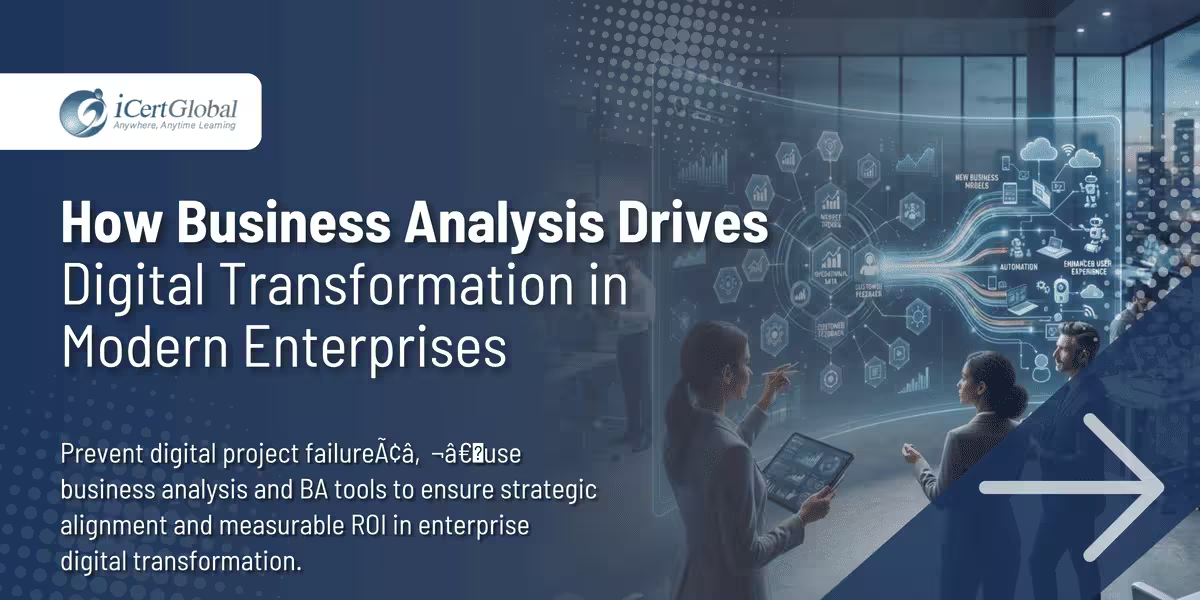
Prevent digital project failure—use business analysis and BA tools to ensure strategic alignment and measurable ROI in enterprise

Explore 7 key reasons a Business Analytics career boosts ROI and growth for senior professionals (10+ yrs). Gain
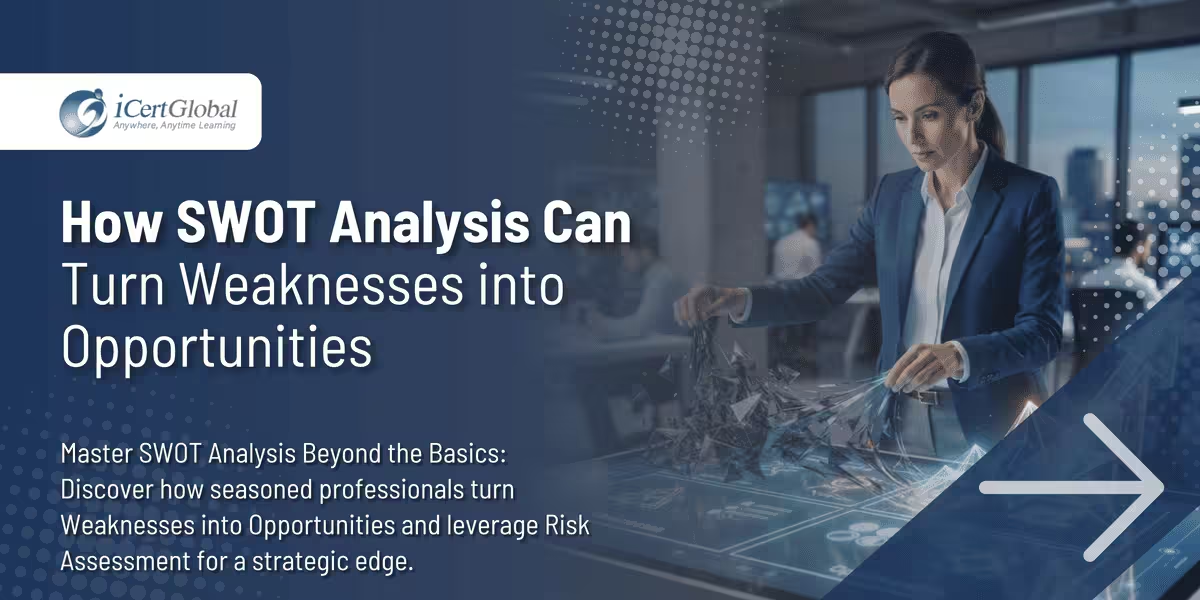
Learn how to perform a SWOT analysis. Master this essential strategic tool to advance your career and make

Master scalable and secure Business Analytics with cloud-native architecture. Learn how microservices, Kubernetes, and BI tools like Power

Learn how advanced ML algorithms, from deep learning to MLOps, are transforming Business Analytics. Gain expert insights to

Learn how quantum computing is revolutionizing business analytics and operation solving. Discover key use cases and prepare for

Explore how AR/VR is transforming business analytics. Master immersive data visualization to drive better decision making. A guide
Our experts are ready to help you with any questions about courses, admissions, or career paths. Get personalized guidance from industry professionals.
Request a Call Back

"PMI®", "PMBOK®", "PMP®", "CAPM®" and "PMI-ACP®" are registered marks of the Project Management Institute, Inc. | "CSM", "CST" are Registered Trade Marks of The Scrum Alliance, USA. | COBIT® is a trademark of ISACA® registered in the United States and other countries.

