





How Corporate Certification Training Boosts Team Performance
Learn how corporate certification training builds your skills, validates your expertise, and drives measurable team performance.
Stop being just a security analyst. Get the globally mandated credential that proves you are a certified Information Security Leader, unlocking C-level access and the highest pay scales.
You're already fighting daily cybersecurity battles - patching vulnerabilities, managing access, and containing phishing threats. You handle the technical how, but you're often left out of the strategic why: enterprise security architecture, governance, and budget allocation. While you remain tactical, CISSP-certified professionals operate at the executive level, defining policy, shaping risk appetite, and commanding salaries up to 60% higher. Recruiters scan for "CISSP Certification REQUIRED" for nearly every senior security role - without it, your resume never makes the shortlist. That stops now. This isn't another course full of jargon or endless slides. Our CISSP Certification Training is designed by active CISSP-certified CSOs and Principal Security Architects who secure Draper, UT largest banking, telecom, and government systems. They've built a CISSP training experience that helps you master the (ISC) framework while applying Governance, Risk, and Compliance (GRC) principles to real-world Draper, UT enterprise challenges. Unlike generic study courses, our CISSP course builds true leadership capability. You'll learn to establish enterprise-wide Security and Risk Management programs, design resilient Security Architecture and Engineering systems, and enforce Software Development Security from the first line of code. The CISSP exam is simply the validation - the real value is being able to walk into a boardroom and deliver a risk-balanced defense strategy that earns executive confidence. Built for busy professionals, this CISSP certification training offers flexible weekday and weekend options, live sessions with interactive Q&A, and round-the-clock support. You'll also get a curated exam preparation library, access to a CAT-simulated question engine, and practical insights to minimize CISSP certification cost and maximize success.
Learn with confidence knowing your training program is structured precisely around the latest 8 domains of the CISSP Common Body of Knowledge (CBK).
Unlock your potential with expert instructors who are CISSP-certified practitioners currently working in senior risk and security leadership roles.
Master the Adaptive Testing methodology with 10+ full-length, computer-adaptive mock exams that replicate the real CISSP testing environment.
Accelerate your mastery with 40+ hours of strategic, scenario-based learning and in-depth domain reviews designed to build lasting competence.
Strengthen your weak areas with 2000+ technically accurate, tailor-made practice questions focused on management, architecture, and governance.
Get round-the-clock access to certified security leaders who can help you resolve complex domain, architecture, and governance challenges.
To secure network infrastructure, CISSP professionals apply secure configuration protocols to mitigate threats against sensitive data in transit and at rest. Focusing on confidentiality, integrity, and availability, these protocols ensure only authorized individuals access and share information. This enables organizations to protect their intellectual property and maintain a strong competitive position in the market.
As a result, CISSP professionals must prioritize access control mechanisms that prevent unauthorized access to sensitive information. This includes implementing role-based access control and multifactor authentication techniques to minimize the risk of a security breach. Moreover, they apply incident response guidelines to contain and remediate security incidents.
CISSP professionals, based in Draper, UT, regularly assess and improve their organization's security posture to meet the evolving threat landscape. By doing so, they help maintain the trust of their stakeholders and protect their organization's reputation. Effective incident response capabilities are critical to containing breaches, minimizing downtime, and restoring operations.

Get a custom quote for your organization's training needs.
Secure communication protocols such as Transport Layer Security (TLS) and Secure Shell (SSH) protect data in transit. CISSP professionals understand the importance of encrypting data both at rest and during transmission to safeguard it from unauthorized access. This is particularly relevant when handling sensitive customer data, which typically requires adherence to regulatory requirements such as PCI-DSS.
To ensure data accuracy and integrity, CISSP professionals apply digital signatures and message authentication codes to prevent tampering. They also utilize secure communication protocols, such as SFTP, to encrypt data in transit. In doing so, they minimize the risk of data breaches and maintain data confidentiality.
In practice, CISSP professionals in Draper, UT, apply their knowledge of secure communication protocols to protect their organization's data. This includes configuring firewalls and intrusion detection systems to prevent unauthorized access. By doing so, they maintain a secure environment for sensitive data and protect it from cyber threats.
Learn to establish governance frameworks, define risk appetite, and manage compliance with Draper, UT and international regulations such as the IT Act and GDPR.
Master the design and implementation of secure principles in system and component architecture, including cryptography, secure kernel access, and secure hardware design.
Advance your CISSP training with network-level defense. Learn to design segmented, zero-trust networks, configure secure communication protocols like TLS and IPsec, and implement intrusion prevention systems aligned with CISSP certification standards.
Design and implement enterprise-wide IAM solutions covering federation (SAML), single sign-on (SSO), multi-factor authentication (MFA), and access control models.
Operate like a seasoned security leader. Learn to manage a modern Security Operations Center (SOC), plan disaster recovery strategies, and enforce physical and environmental security controls - all core areas in CISSP certification training.
Integrate security across the software development lifecycle (DevSecOps). Learn to define application security requirements, apply secure coding standards, and manage vulnerabilities effectively.
If you have 5 or more years of cumulative, paid, full-time work experience in at least two of the eight CISSP domains and your career trajectory demands executive influence and strategic decision-making, this certification is non-negotiable.
A CISSP certification demonstrates a professional's expertise in risk management and mitigation. This expertise enables organizations to reduce their security risks and vulnerability to cyber threats. CISSP professionals possess the knowledge to design and implement effective security measures to protect sensitive information.
CISSP professionals are equipped to develop security policies and procedures that align with the organization's business objectives. They understand the importance of maintaining a proactive security posture and can implement incident response plans to mitigate potential security breaches. By doing so, they help protect the organization's assets and reduce the risk of reputational damage.
In the IT industry, a CISSP certification is highly valued in Draper, UT, as it demonstrates a professional's ability to apply theoretical knowledge in real-world scenarios. This certification can lead to increased job prospects and career advancement opportunities. CISSP professionals are sought after by organizations seeking to strengthen their security posture and reduce cyber risks.


Earn the CISO/Director-level credential that gets you past automated filters and into top-tier interviews.
Position yourself for the elite compensation packages reserved for certified, strategic security leaders.
Build credibility with auditors, boards, and international peers as a recognized cybersecurity leader.
The CISSP certification is globally recognized as the gold standard for information security leadership. It is not an entry-level credential - it validates both deep technical expertise and proven professional experience. Below is the clear breakdown of what you need to qualify.
Mandatory Experience: A minimum of 5 years of cumulative, paid, full-time work experience in at least two of the eight CISSP domains of the CBK.
Education Waiver: A 4-year college degree or regional equivalent can substitute for 1 year of the required experience.
Endorsement Requirement: After passing the exam, candidates must be formally endorsed by an active CISSP holder to obtain the full certification.
Reality Check: There are no shortcuts. This training prepares you for the exam, but you must verify your experience with (ISC) to receive the official credential.
CISSP professionals possess a deep understanding of risk management methodologies, including the NIST Risk Management Framework. They can identify vulnerabilities in the organization's security posture and develop strategies to mitigate them. This includes conducting risk assessments to identify potential threats and vulnerabilities.
CISSP professionals also understand the importance of threat intelligence in informing their security strategies. They can gather and analyze intelligence on emerging threats and develop incident response plans to contain and remediate security incidents. By doing so, they minimize the risk of data breaches and maintain a strong security posture.
In Draper, UT, CISSP professionals continue to develop their skills in threat intelligence and risk management. They stay up-to-date with emerging threats and vulnerabilities, ensuring their organization maintains a proactive security posture. By doing so, they protect the organization's assets and reduce the risk of reputational damage.
Design and implement robust security controls within system architectures. Learn key security models, secure design principles, and fundamental cryptographic concepts that underpin secure systems development.
Develop and apply comprehensive physical and environmental security controls while mastering the security architectures of SaaS, PaaS, and IaaS cloud environments, including virtualization and containerization security.
Dive deep into the world of cryptographic services and PKI (Public Key Infrastructure). Learn key management, encryption algorithms, and digital signature techniques that ensure integrity, confidentiality, and non-repudiation.
Master network design principles and secure network component configurations. Explore OSI and TCP/IP models, secure segmentation techniques (VLANs, DMZs), and controls for securing wireless access.
Gain command of firewalls, intrusion detection/prevention systems (IDPS), and VPNs. Learn to implement secure communications using protocols like TLS and IPsec for enterprise-grade protection.
Embed security throughout the software development lifecycle (SDLC) using DevSecOps principles. Learn secure coding, security testing, code review practices, and the management of both internal and third-party software risks.
Design and implement IAM systems that balance security and usability. Learn about identity lifecycle management, access control models (RBAC, DAC, MAC), and robust authorization mechanisms.
Explore authentication methods including Single Sign-On (SSO), Federation (SAML, OAuth), and Multi-Factor Authentication (MFA). Learn to mitigate common identity-related attacks and enforce secure authentication practices.
Master vulnerability assessment, penetration testing, and control validation strategies to measure and strengthen the effectiveness of enterprise security programs.
Understand the critical functions of a Security Operations Center (SOC). Learn incident management processes, forensic evidence collection, and configuration management for operational resilience.
Design, document, and test effective Business Continuity (BCP) and Disaster Recovery (DRP) plans to ensure business resilience and rapid recovery from critical disruptions.
Address the human factor in cybersecurity through personnel screening, ongoing security awareness programs, and enforcement of policies such as acceptable use and mandatory vacations.
CISSP professionals can apply their knowledge of security protocols and procedures to various industries, including healthcare and finance. In these industries, they can develop and implement security measures to protect sensitive customer data and maintain compliance with regulatory requirements. In the healthcare industry, CISSP professionals can develop security protocols to protect patient data and maintain HIPAA compliance.
In the finance industry, they can implement security measures to protect sensitive financial information and maintain PCI-DSS compliance. By doing so, they maintain the trust of their stakeholders and protect their organization's reputation. In Draper, UT, CISSP professionals are in high demand, particularly in industries handling sensitive customer data.
They can apply their knowledge of security protocols and procedures to develop and implement effective security measures, protecting the organization's assets and reducing the risk of reputational damage.
Great class, very informative.

Great PMP<sup>®</sup> Bootcamp. I had a great time taking this course. I took the course to prepare to sit for the CAPM<sup>®</sup> but may be able to sit for the PMP<sup>®</sup>. I learnt a lot was challenging. Great course. We need one more day. Content was very detailed.

it was a great class. Lots of energy. And I enjoyed.

Fantastic course to prepare for PMP<sup>®</sup> exam.

As a participant it was smooth sailing for me.

Trainer was excellent. Shared good resources and good experiences.

Good content and training.
I wanted to let you know that I took and passed the PMP exam. Thanks to iCertGlobal and especially my Cincinnati course instructor, who was an excellent teacher and helped me immensely.

Trainer was good. Trainer was very engaged and interacting. Very much satisfied with the training.

I was pleasantly surprised at the quality of this training. Yomi was awesome as a trainer and working to make sure that we understood the concepts. Controlling Cost and Controlling Risk are the most complicated, but Yomi spent time after class working through questions to help others understand. This class also helped to change my perception of the PMP being this MONSTER to something that I can I can successfully do.

Great class with a lot of information and tips to prepare for the exam

It was a great course, covered all the things that i ended up hitting road bumps on. I was the only one in the class, but the trainer was just as involved as if it had been a full class.

I was nervous about taking it online versus classroom; but I am actually glad I took it online. Instructor was very great and gave a good learning experience with his relevant project management experience.
The training was very intense but covered with course material. It was more than I expected.

I thought the class was very informative. The instructor did an excellent job breaking down each chapter to where it was easy to understand. I was also very impressed with his commitment to help us pass ever after the class is over.

Excellent training. Instructor was very knowledgeable and explained information in an understandable way
Quality Materials presented, Instructor very knowledgeable. Exceeded my expectations.
The training is a great introduction into the PMI mindset. Very informative and helpful

Explore CISSP Our PMP certification training is available in a city near you
Stay updated with the latest insights and trends in your field
Learn how corporate certification training builds your skills, validates your expertise, and drives measurable team performance.

Deciding between self paced vs live online training? Discover which learning format accelerates your career growth and fits
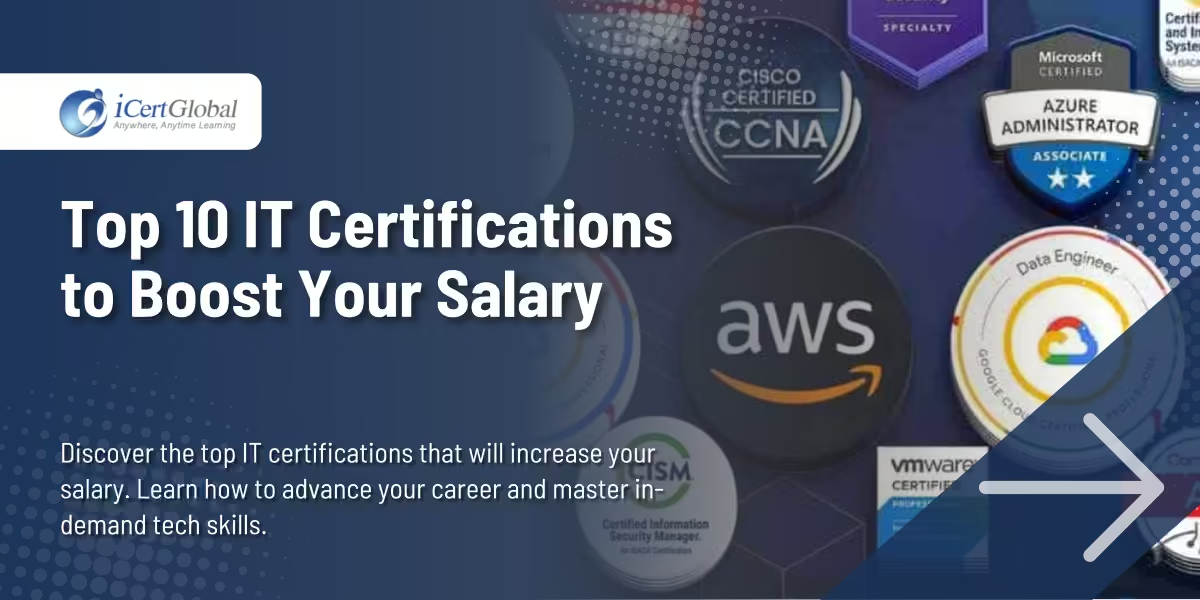
Discover the top IT certifications that will increase your salary in 2026. Learn how to advance your career
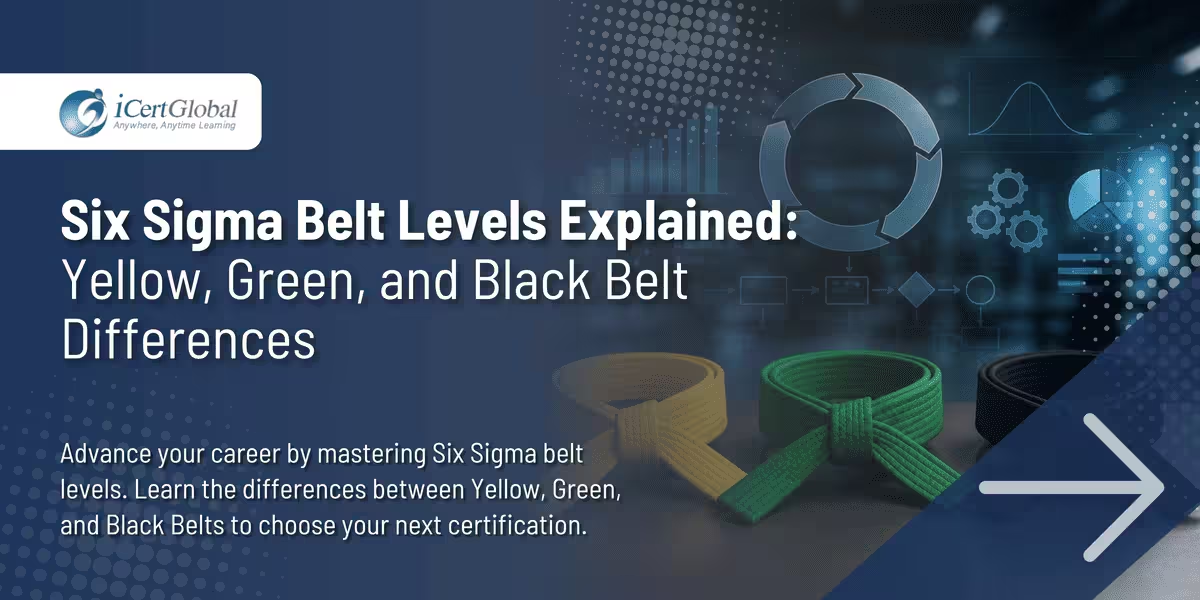
Advance your career by mastering Six Sigma belt levels. Learn the differences between Yellow, Green, and Black Belts

Learn how to calculate CAGR in Excel step-by-step. Master the RRI function, avoid common errors, and build high-value

Master the practical applications of ai in business and education. Learn how these in-demand skills can accelerate your
Understand the data encryption standard meaning, explore DES vs AES, and build the core cryptography skills you need
Master the essential applications of cloud computing. Learn 15 real-world use cases to advance your career, pass your

Discover the best PMP books and study resources to pass your 2026 exam. Master key project management skills
Master the top CISSP interview questions and expert answers. Prove your cybersecurity expertise, ace your technical round, and
Our experts are ready to help you with any questions about courses, admissions, or career paths. Get personalized guidance from industry professionals.
Request a Call Back

"PMI®", "PMBOK®", "PMP®", "CAPM®" and "PMI-ACP®" are registered marks of the Project Management Institute, Inc. | "CSM", "CST" are Registered Trade Marks of The Scrum Alliance, USA. | COBIT® is a trademark of ISACA® registered in the United States and other countries.

