





ITIL 4 Foundation vs Practitioner: Certification Path Explained
Compare ITIL 4 Foundation vs Practitioner. Discover which certification aligns with your career goals, boosts your salary, and
Stop firefighting tickets. Master the framework to deliver predictable, high-quality IT services that the business values.
Your IT department delivers service, but you can't prove it. When your company bids on major enterprise or government contracts, competitors with ISO/IEC 20000 certification gain the advantage. While you're firefighting internally, your organization is losing revenue because your IT service management lacks a globally recognized, auditable seal of quality. That stops now. This isn't an academic course that simply reviews the clauses of ISO/IEC 20000-1. Our ITSM Training Program is designed by certified Lead Auditors and Implementers who have guided IT service providers and corporate IT departments through full certification journeys. They know exactly what auditors look for, where companies may fail their Stage 1 audit, and how to build a Service Management System (SMS) that is compliant, efficient, and practical. Unlike theory-only programs, we focus on implementation and audit-readiness. You'll learn to: 1. Define the scope and applicability of your SMS across managed IT services, cloud migration services, and software development services. 2. Create policies, procedures, and monitoring systems to prove continual improvement and compliance. 3. Apply practical skills in data backup management, IT service workflows, and team coordination. Certification proves you understand the standard - but the real value is returning to your organization as the expert who leads your team to compliance, operational excellence, and the ability to win critical contracts. This program is built for IT Managers, Quality Assurance professionals, and consultants tasked with organizational excellence. Choose from weekday evening or weekend batches, all fully interactive with recorded sessions. Beyond the classroom, you'll receive audit preparation checklists, sample SMS documentation, and real-world case studies. Learn how to integrate IT processes with practical programming languages and tools to improve service delivery and competitive positioning.
Build a strong foundation and advance your expertise with practical implementation strategies tailored for managed IT services, cloud migration projects, and software development environments.
Learn directly from experienced professionals who have successfully implemented ISO 20000 across diverse industries and guided organizations through real certification audits.
Choose from weekday-evening sessions, weekend-only batches, or intensive 5-day bootcamps in Evansville, IN - each designed to suit the schedules of busy IT professionals.
Go beyond theoretical learning with over 40 hours of practical exercises covering service design, transition, operation, and continual improvement processes essential to ISO 20000 implementation.
Gain audit confidence through mock assessments, gap analysis tools, and detailed preparation materials based on real-world ISO 20000 certification experiences.
Access round-the-clock support from certified industry experts ready to clarify concepts, resolve challenges, and guide you in applying IT service management best practices.
In the context of delivering high-quality IT services, the Service Desk is a critical component, as it is the primary point of contact for users. This is also where the first level of incident management takes place, where users report issues and where the service provider's staff diagnose and resolve problems. The role of the Service Desk is crucial to ensure that incidents are identified and resolved quickly, minimizing downtime and maintaining user satisfaction. Effective Service Desk management involves a thorough understanding of ITIL processes, particularly incident management and problem management.
Service Desk staff must be trained to identify and classify incidents, prioritize tasks, and manage the resolution of incidents and problems. This requires a deep understanding of the service lifecycle, from service design to service retirement. In a typical IT service management framework, the Service Desk is the entry point for all user interactions. In Evansville, IN, where IT service providers are increasingly expected to deliver high-quality services, investing in effective Service Desk management is crucial.
This includes staffing the Service Desk with trained professionals who can respond to user queries, identify and resolve incidents, and provide timely updates on the status of incidents. By investing in effective Service Desk management, service providers can enhance user satisfaction, reduce downtime, and improve overall service quality.

Get a custom quote for your organization's training needs.
Service asset and configuration management (SACM) is a critical component of the IT Service Management (ITSM) framework, enabling organizations to maintain an accurate and up-to-date inventory of their IT assets and configurations. This involves identifying, recording, and reporting on all hardware, software, and documentation that make up the IT service, as well as maintaining a change management process to ensure that any changes to the service are properly documented and approved. By implementing SACM, organizations can ensure that their IT assets are properly managed and that changes to the service are properly controlled.
SACM involves the use of various ITIL processes, including change management, incident management, and problem management, to ensure that IT assets are properly managed and maintained. This requires a thorough understanding of the service lifecycle, from service design to service retirement, and the ability to identify and manage changes to the service. In a typical ITSM framework, SACM is a critical component of the service management process, enabling organizations to maintain accurate records and ensure that their IT assets are properly managed.
In the IT service management industry in Evansville, IN, effective SACM is crucial for service providers who must deliver high-quality services to their customers. By implementing an effective SACM process, service providers can ensure that their IT assets are properly managed, that changes to the service are properly controlled, and that users have access to accurate and up-to-date information about the service.
Note: The training location may be subject to change depending on the number of participants registered for the session and participant convenience. Confirmed venue details will be shared by email after enrollment.
Stop reactive firefighting and start strategic service planning. Learn to align IT services with business objectives, develop service portfolios, and create value propositions that executives understand and fund.
Master the art of designing sustainable ITSM processes that actually work in real-world environments. Create efficient workflows that reduce operational overhead while improving service quality, data backup reliability, and user satisfaction across all managed IT services.
Navigate complex vendor relationships and multi-sourced service delivery models. Develop frameworks to manage external suppliers, ensure service level compliance, and maintain accountability across the entire service value chain.
Identify service risks before they impact business operations. Learn systematic approaches to risk assessment, mitigation planning, and compliance management that satisfy both internal stakeholders and external auditors.
Go beyond vanity metrics. Build dashboards and reports that measure true IT performance and communicate the value of managed IT services to business leaders. Leverage analytics and programming languages to automate and visualize performance insights.
Build systematic improvement capabilities that evolve with business needs. Learn methodologies for identifying improvement opportunities, implementing changes, and measuring their impact on overall service effectiveness.
If you're responsible for IT service delivery and want to transform your role from tactical execution to strategic leadership, this program is designed to accelerate that transition.
ISO 20000 IT Service Management Certification is about ensuring that an organization's services are consistently delivered in accordance with the standards and best practices of the IT Service Management (ITSM) framework. This involves implementing a comprehensive IT service management system (ITSMS) that includes processes for service design, transition, operation, and continuous improvement. By achieving certification, organizations can demonstrate their commitment to delivering high-quality services and enhancing user satisfaction.
ITSM involves the use of various ITIL processes, including service level management, service desk management, and incident management, to ensure that services are delivered in accordance with agreed-upon service levels. This requires a thorough understanding of the service lifecycle, from service design to service retirement, and the ability to manage changes to the service. In a typical ITSM framework, ITSM processes are designed to ensure that services are delivered efficiently and effectively, with minimum disruption to users.
In Evansville, IN, achieving ISO 20000 certification is a strategic move for service providers who want to differentiate themselves from competitors and demonstrate their commitment to delivering high-quality services. By achieving certification, service providers can enhance their reputation, improve user satisfaction, and increase business opportunities.


Get the strategic leadership recognition your experience deserves and gain access to executive-level discussions.
Access compensation packages reserved for certified professionals who can drive organizational transformation.
Earn your place in business leadership conversations.
The ISO 20000 certification is globally respected because it validates both theoretical knowledge and practical implementation capability. The certification structure ensures every professional can demonstrate real-world service management expertise. Here's what you need to qualify.
Foundation Level: No prerequisites required - this establishes your fundamental understanding of ISO 20000 principles, Service Level Agreements (SLAs), and basic IT service management concepts.
Practitioner Level: Foundation certification plus practical experience in ITSM implementation is recommended for maximum program value.
Consultant Level: Practitioner certification plus documented experience in ISO 20000 implementation projects across multiple organizational contexts, covering Managed IT Services, Incident Management, and IT Asset Management strategies.
Need Guidance? For detailed advice on which certification level aligns with your career objectives and current experience, refer to our comprehensive FAQ section below.
The ISO 20000 IT Service Management Certification Training Program is designed to equip service management professionals with the knowledge and skills needed to design, implement, and maintain a comprehensive IT service management system (ITSMS). This involves understanding the ITIL processes and best practices that underpin the ITSM framework, as well as the principles of service management and the management of IT services. By completing this training program, professionals can demonstrate their expertise in IT service management and enhance their career prospects.
Effective ITSM involves the use of various ITIL processes, including service level management, service desk management, and incident management, to ensure that services are delivered in accordance with agreed-upon service levels. This requires a thorough understanding of the service lifecycle, from service design to service retirement, and the ability to manage changes to the service. In a typical ITSM framework, ITSM processes are designed to ensure that services are delivered efficiently and effectively, with minimum disruption to users.
In Evansville, IN, service management professionals who complete the ISO 20000 IT Service Management Certification Training Program can enhance their career prospects and contribute to the delivery of high-quality services to users. By equipping themselves with the knowledge and skills needed to design, implement, and maintain an ITSMS, professionals can demonstrate their expertise in IT service management and improve their employability.
Engineer robust service designs that scale with business growth and technological evolution. Master service modeling techniques, capacity planning methodologies, and architectural principles that ensure services meet current demands while remaining adaptable to future requirements.
Implement disciplined change management processes that balance agility with risk management. Learn to design change approval workflows, release planning procedures, and deployment strategies that minimize business disruption while enabling rapid value delivery.
Build comprehensive Configuration Management databases (CMDB) and IT Asset Management systems that provide accurate service dependency mapping. Learn to maintain configuration accuracy, automate discovery processes, and leverage configuration data for strategic decision-making. Strengthen operational reliability with Incident Management insights and Knowledge Management practices to support continuous improvement.
Design incident response systems that minimize business impact and customer frustration. Master escalation procedures, problem identification techniques, and root cause analysis methodologies that prevent recurring issues and demonstrate continuous improvement to business stakeholders.
Create meaningful Service Level Agreements (SLAs) that balance business expectations with operational reality. Learn to design SLAs, establish measurement frameworks, and create reporting systems that demonstrate value delivery rather than just operational metrics. Leverage Automation tools to streamline monitoring and reporting for greater efficiency.
Implement proactive capacity planning and availability management processes that prevent service degradation. Master forecasting techniques, resource optimization strategies, and availability design principles that ensure services scale efficiently with business growth.
Navigate complex multi-vendor environments and establish accountability across the entire service value chain. Learn supplier selection criteria, contract negotiation strategies, and performance management techniques that ensure external providers contribute to overall service excellence.
Master the integration of multiple IT Solutions providers into cohesive service delivery models. Develop skills in SIAM governance, conflict resolution, and performance coordination that ensure seamless service delivery, while using Automation and Configuration Management practices to streamline processes and reduce errors.
Implement comprehensive risk management frameworks for supplier relationships. Learn to assess supplier risks, develop mitigation strategies, and maintain compliance oversight that protects organizational interests while enabling productive partnerships.
Build systematic improvement capabilities that evolve services in alignment with changing business needs. Master improvement identification techniques, change impact assessment, and benefit realization processes that demonstrate ongoing value creation.
Prepare comprehensively for ISO 20000 certification audits through systematic documentation and evidence management. Learn auditor expectations, common audit pitfalls, and evidence preparation techniques. Ensure Service Level Agreements (SLAs), Configuration Management, and IT Asset Management processes are audit-ready for smooth certification outcomes.
Assess and advance organizational service management maturity through structured capability development. Master maturity assessment techniques, capability gap analysis, and transformation roadmap development that guides long-term ITSM evolution.
The ITIL processes and best practices that underpin the IT Service Management (ITSM) framework are widely recognized and adopted in the industry. These processes include service level management, service desk management, and incident management, which are designed to ensure that services are delivered in accordance with agreed-upon service levels. By adopting these processes, organizations can achieve improved service quality, increased efficiency, and better user satisfaction.
Effective ITSM involves a thorough understanding of the service lifecycle, from service design to service retirement, and the ability to manage changes to the service. This requires a comprehensive IT service management system (ITSMS) that includes processes for service design, transition, operation, and continuous improvement. In a typical ITSM framework, ITSM processes are designed to ensure that services are delivered efficiently and effectively, with minimum disruption to users.
In Evansville, IN, adopting the ITIL processes and best practices outlined in the ISO 20000 IT Service Management Certification Training Program can enhance the quality of services delivered by service providers. By equipping themselves with the knowledge and skills needed to design, implement, and maintain an ITSMS, service providers can demonstrate their commitment to delivering high-quality services and enhancing user satisfaction.
Great class, very informative.

Great PMP<sup>®</sup> Bootcamp. I had a great time taking this course. I took the course to prepare to sit for the CAPM<sup>®</sup> but may be able to sit for the PMP<sup>®</sup>. I learnt a lot was challenging. Great course. We need one more day. Content was very detailed.

it was a great class. Lots of energy. And I enjoyed.

Fantastic course to prepare for PMP<sup>®</sup> exam.

As a participant it was smooth sailing for me.

Trainer was excellent. Shared good resources and good experiences.

Good content and training.
I wanted to let you know that I took and passed the PMP exam. Thanks to iCertGlobal and especially my Cincinnati course instructor, who was an excellent teacher and helped me immensely.

Trainer was good. Trainer was very engaged and interacting. Very much satisfied with the training.

I was pleasantly surprised at the quality of this training. Yomi was awesome as a trainer and working to make sure that we understood the concepts. Controlling Cost and Controlling Risk are the most complicated, but Yomi spent time after class working through questions to help others understand. This class also helped to change my perception of the PMP being this MONSTER to something that I can I can successfully do.

Great class with a lot of information and tips to prepare for the exam

It was a great course, covered all the things that i ended up hitting road bumps on. I was the only one in the class, but the trainer was just as involved as if it had been a full class.

I was nervous about taking it online versus classroom; but I am actually glad I took it online. Instructor was very great and gave a good learning experience with his relevant project management experience.
The training was very intense but covered with course material. It was more than I expected.

I thought the class was very informative. The instructor did an excellent job breaking down each chapter to where it was easy to understand. I was also very impressed with his commitment to help us pass ever after the class is over.

Excellent training. Instructor was very knowledgeable and explained information in an understandable way
Quality Materials presented, Instructor very knowledgeable. Exceeded my expectations.
The training is a great introduction into the PMI mindset. Very informative and helpful

Explore our instructor-led ISO 20000 training to learn about the course duration, cost, eligibility, and certification process. You get practical learning, exam-focused preparation, and expert guidance. Ready to get started? Compare ISO 20000 certification training options and choose a classroom or live online format that fits your schedule.
Explore Our ISO 20000 certification training is available in a city near you
Stay updated with the latest insights and trends in your field
Compare ITIL 4 Foundation vs Practitioner. Discover which certification aligns with your career goals, boosts your salary, and
Explore the top 10 IT service management best practices for modern business, from ITIL 5 and AI automation
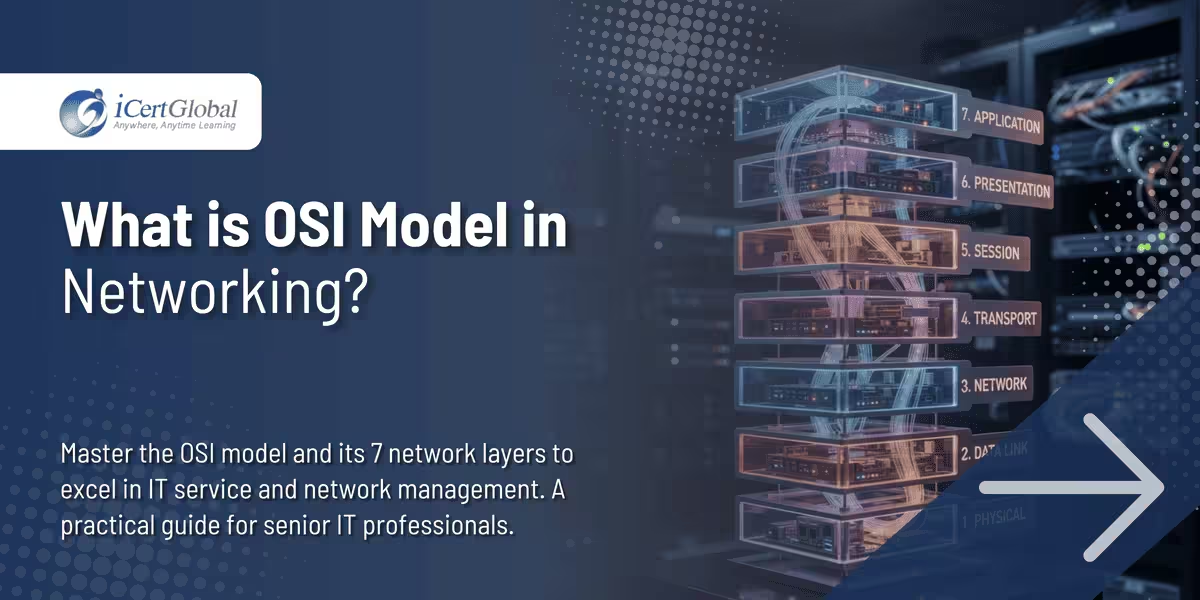
Master the OSI model and its 7 network layers to excel in IT service and network management. A
Learn the top benefits of ITIL certification and how it boosts your IT career and organizational value.
Learn how businesses keep their technology like computers and internet running well with ITSM and ITIL.
Learn what COBIT is and why it matters for managing technology in businesses.
Learn about the key responsibilities, skills, and career path of a Service Desk Manager.
Explore the top high-paying programming languages for 2026 and gain in-demand skills to boost your career, stay competitive,
Master frontend frameworks to accelerate your career. Compare React, Angular, Vue, Svelte, and Next.js to build modern web
Harness the power of Data Science in IT Process Management to streamline operations, improve decision-making, and maximize efficiency
Our experts are ready to help you with any questions about courses, admissions, or career paths. Get personalized guidance from industry professionals.

Live online and classroom training in PMP, ITIL, Agile, Six Sigma and more, with exam support included.
Subscribe to our newsletter for the latest updates on certifications and training opportunities.
Search iCertGlobal for certifications, courses and articles.

"PMI®", "PMBOK®", "PMP®", "CAPM®" and "PMI-ACP®" are registered marks of the Project Management Institute, Inc. | "CSM", "CST" are Registered Trade Marks of The Scrum Alliance, USA. | COBIT® is a trademark of ISACA® registered in the United States and other countries.