
ITIL 4 Foundation vs Practitioner: Certification Path Explained
Compare ITIL 4 Foundation vs Practitioner. Discover which certification aligns with your career goals, boosts your salary, and
Classroom Training and Live Online Courses in Plymouth, England
Stop being a process expert. Become the strategic integrator who delivers holistic value across the entire IT Service Lifecycle. This is the ITIL Capstone Exam - the final test of your ability to lead.
You've mastered the silos—Strategy, Design, Transition, Operation, and Continual Service Improvement. But in the real world, these silos leak, processes clash, and value disappears in the handoff. You're an expert in one area, but you lack the connective tissue to lead the whole system. The ITIL MALC Certification is the definitive proof that you understand how these five stages must interact, align, and be governed from a strategic perspective. This course is designed to eliminate the fatal flaw of the Intermediate track: deep knowledge in isolation. Managing Across the Lifecycle forces you to think like an ITIL Expert Exam candidate, evaluating scenarios where a decision in Service Design has a critical, cascading impact on Service Operation - and vice versa. This is not rote memorization; it's the ultimate test of your strategic judgment. The ITIL Expert status, earned by passing the MALC, is the non-negotiable credential for senior IT Service Management (ITSM) roles in Plymouth, England and globally. Without it, you are filtered out as a tactical manager. With it, you gain the vocabulary and governance framework to lead large, multi-disciplinary teams and drive transformational change that delivers tangible business ROI. This is the ITIL Strategic Integration required to sit at the decision table. We built this for professionals who refuse to settle for intermediate status. The training is a high-intensity synthesis of your previous learning, focusing solely on the interfaces, communications, and measurements that bind the Service Lifecycle together. Be prepared for rigorous case study analysis - this is where your ITIL knowledge finally translates into actionable business intelligence.
More Than a Course - It's Your Career Accelerator
Passing the ITIL MALC Certification is the final mandatory step before receiving the ITIL Expert Exam designation.
Training is focused exclusively on the case study format, which tests strategic judgment across all lifecycle stages.
Learn to maximize your score on the unique 5/3/1/0 point system used in the MALC and Intermediate exams.
Deep dive into how Governance, Measurement, and Implementation bind the five lifecycle stages into a value-driven system.
Earns 5 mandatory credits towards your ITIL Expert Exam status, completing your required 17-credit total.
We provide rigorous support to ensure your ITIL MALC prerequisites are met and documented correctly before you enroll.
The ITIL MALC Certification requires professionals to grasp the lifecycle approach to IT service management. This involves understanding the integration of stages from initiation through to continual improvement. The training program helps professionals to appreciate the importance of service management in achieving business objectives.
This program empowers individuals to develop a comprehensive understanding of ITIL processes and their application across the lifecycle. By adopting an integrated approach, professionals can better manage IT services and improve overall service quality. ITIL lifecycle stages include service strategy, service design, service transition, service operation, and continual service improvement.
Professionals based in Plymouth, England, will benefit from the ITIL MALC training program by acquiring in-depth knowledge of IT service management. This will enable them to develop, implement, and maintain effective ITIL processes, improving service management efficiency.
Tailored programs for teams with enterprise support
Get a custom quote for your organization's training needs.
Service value and service relationships are critical components of IT service management in the ITIL framework. The ITIL MALC training program focuses on developing essential skills for professionals to create, deliver, and maintain value from services. This includes an understanding of service portfolio management and requirements management.
Professionals will learn about the importance of service level agreements (SLAs) and operational level agreements (OLAs) in ensuring service delivery meets business requirements. Additionally, they will develop knowledge of the ITIL service lifecycle, including the design and transition of services. This enables them to effectively manage IT services and mitigate risks.
Upon completing the ITIL MALC training program in Plymouth, England, professionals will have developed a wide range of skills, including service portfolio management, service transition planning, and service level management.
Learn how to apply governance structures to the entire Service Lifecycle, ensuring compliance and aligning service strategy with business goals.
Master the interfaces between all five stages, resolving conflicts and ensuring seamless process flow (e.g., Change Management bridging Transition and Operation).
Develop strategies for effective communication across silos and managing the competing interests of diverse stakeholders (Business vs. IT).
Understand how to define, measure, and report metrics that span the entire lifecycle, providing genuine insight into end-to-end service value.
Acquire the methods for driving and sustaining organizational change required to successfully implement and improve ITSM processes.
Learn how to integrate the CSI approach across all lifecycle stages, making improvement a non-stop management mandate.
This certification training is ideal for:
If you meet the ITIL MALC prerequisites and aim for the highest strategic roles in ITSM, this is the final, essential hurdle.
ITIL processes and activities, such as service desk, incident management, and problem management, are essential for delivering high-quality IT services. The ITIL MALC training program provides in-depth knowledge of these processes and how to apply them effectively throughout the lifecycle. Professionals will learn about the key performance indicators (KPIs) and service metrics used to measure the performance of IT services.
This includes service availability, service response time, and service quality metrics. By applying their knowledge of ITIL processes and metrics, professionals can improve IT service delivery and efficiency. In Plymouth, England, professionals will be able to apply the practical skills and knowledge gained from the ITIL MALC training program to enhance IT service management and improve business outcomes.
The Credential That Ends the Gatekeeping
The ITIL MALC Certification immediately elevates you to the status of an ITIL Expert, proving holistic strategic competence.
Gain the credibility to discuss and influence strategic IT decisions across the entire organization, not just within a single process silo.
Earn the final, required credits for the ITIL Expert Exam title, a non-negotiable requirement for senior ITSM leadership roles globally.
The ITIL MALC Certification is the final component of the ITIL Intermediate stream and is strictly regulated. You must meet all the following ITIL MALC prerequisites to be eligible for the exam:
ITIL Foundation: You must hold the ITIL Foundation Certificate.
Intermediate Credits: You must have successfully completed and passed ITIL Intermediate modules, accumulating a minimum of 15 credits from the Lifecycle and/or Capability streams.
Required Training: Completion of an accredited Managing Across the Lifecycle training course is mandatory before sitting the exam.
The ITIL MALC Certification training program is a globally recognized credential that demonstrates a professional's ability to manage IT services across the lifecycle. This certification is highly valued by organizations and can significantly enhance a professional's career prospects. In Plymouth, England, professionals with this certification can demonstrate their expertise in IT service management to potential employers.
Professionals will learn about the key roles and responsibilities of ITIL roles, including service manager, IT service manager, and IT service desk manager. They will also gain knowledge of the processes and activities required to deliver high-quality IT services. This will enable them to take on leadership roles and contribute to strategic business decisions.
By completing the ITIL MALC training program, professionals will have the knowledge and skills required to excel in IT service management roles, including strategic IT service management, IT service transition planning, and IT service level management.
Synthesize the purpose, objectives, and value of all five lifecycle stages and the role of governance (COBIT, ISO 20000) in Managing Across the Lifecycle.
Examine how governance, decision rights, and organizational design must be aligned to support end-to-end service management and strategic objectives.
Master the techniques for communicating value and managing conflicts of interest across different lifecycle stages and various stakeholders (internal/external).
Deep dive into the interfaces of critical processes (e.g., Change, Release, Service Level Management) and how their conflicts are resolved via ITIL Strategic Integration.
Analyze service portfolio management, service catalog management, and the overall management of the service pipeline across all five stages.
Define how value is achieved and measured throughout the lifecycle, focusing on linking Service Strategy goals to Service Operation metrics.
Master the role of CSI in integrating and driving improvement activities across all lifecycle stages, utilizing the 7-step process.
Understand the human and cultural challenges of implementing ITSM change, and how to use communication and motivation to achieve buy-in.
Review risk identification, analysis, and management across the lifecycle, particularly focusing on how risks transition between stages.
Analyze the key CSFs for each lifecycle stage and the common risks and pitfalls encountered during the transition and operation phases in a large organization.
Examine how the service lifecycle applies differently to internal, external, and shared service organizations, a common subject of the ITIL MALC case study.
Synthesis of the common implementation challenges (vendor management, resource constraints) and strategies to overcome them.
Intensive review of the provided case study, identifying strategic gaps, pain points, and critical areas for improvement that will feature in the exam.
Specific, focused training on identifying the 'best' answer (5 points) and eliminating the 'distractor' (0 points) on the ITIL Capstone Exam.
Final mock exam execution, time management drills, and self-assessment against the ITIL MALC exam difficulty benchmarks to ensure readiness.
Everything you need to know about our training options and support
Organizations in various industries, including finance, healthcare, and government, rely heavily on IT services to deliver business capabilities. The ITIL MALC training program provides professionals with the knowledge and skills required to manage IT services in these industries effectively.
This includes developing service management strategies, designing and transitioning services, and ensuring service continuity. Professionals will learn about the application of ITIL processes and activities in different industry contexts, including managing service relationships, managing service level agreements, and managing service availability.
They will also gain knowledge of the key metrics and KPIs used to measure the performance of IT services in these industries. In Plymouth, England, professionals will be able to apply the ITIL MALC training program to enhance IT service management in a variety of industries, including finance, healthcare, and government.
Great class, very informative.

Great PMP<sup>®</sup> Bootcamp. I had a great time taking this course. I took the course to prepare to sit for the CAPM<sup>®</sup> but may be able to sit for the PMP<sup>®</sup>. I learnt a lot was challenging. Great course. We need one more day. Content was very detailed.

it was a great class. Lots of energy. And I enjoyed.

Fantastic course to prepare for PMP<sup>®</sup> exam.

As a participant it was smooth sailing for me.

Explore our instructor-led ITIL MALC training to learn about the course duration, cost, eligibility, and certification process. You get practical learning, exam-focused preparation, and expert guidance. Ready to get started? Compare ITIL MALC certification training options and choose a classroom or live online format that fits your schedule.
Explore Our ITIL MALC certification training is available in a city near you
Stay updated with the latest insights and trends in your field
Compare ITIL 4 Foundation vs Practitioner. Discover which certification aligns with your career goals, boosts your salary, and
Explore the top 10 IT service management best practices for modern business, from ITIL 5 and AI automation
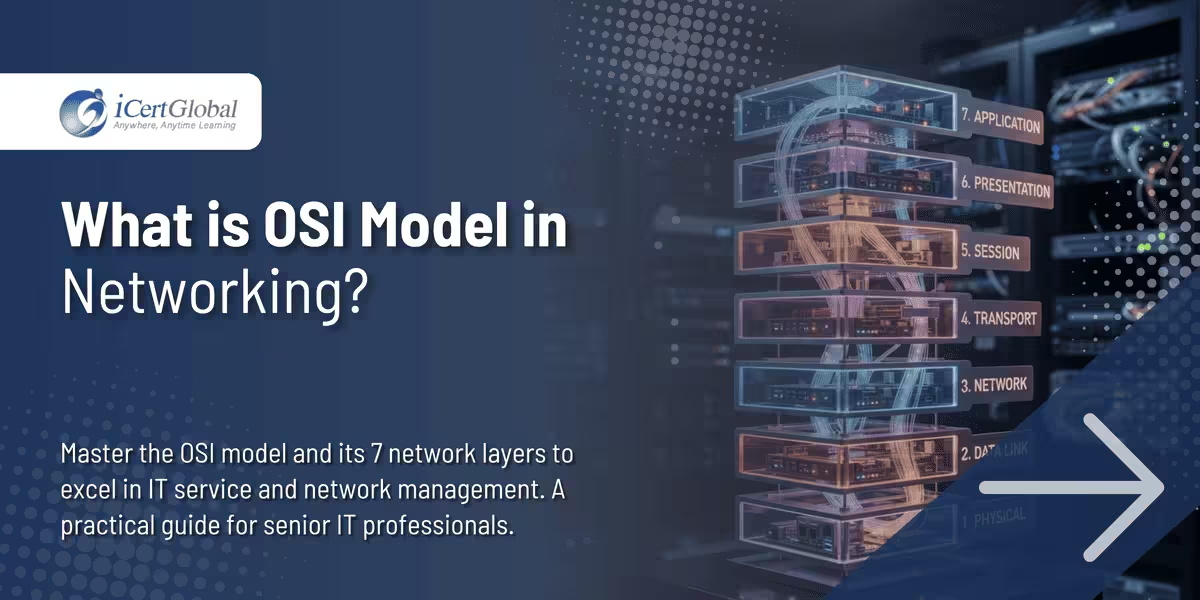
Master the OSI model and its 7 network layers to excel in IT service and network management. A
Learn the top benefits of ITIL certification and how it boosts your IT career and organizational value.
Learn how businesses keep their technology like computers and internet running well with ITSM and ITIL.
Learn what COBIT is and why it matters for managing technology in businesses.
Learn about the key responsibilities, skills, and career path of a Service Desk Manager.

Explore the top high-paying programming languages for 2026 and gain in-demand skills to boost your career, stay competitive,

Master frontend frameworks to accelerate your career. Compare React, Angular, Vue, Svelte, and Next.js to build modern web
Harness the power of Data Science in IT Process Management to streamline operations, improve decision-making, and maximize efficiency
Our experts are ready to help you with any questions about courses, admissions, or career paths. Get personalized guidance from industry professionals.

Live online and classroom training in PMP, ITIL, Agile, Six Sigma and more, with exam support included.
Subscribe to our newsletter for the latest updates on certifications and training opportunities.
Search iCertGlobal for certifications, courses and articles.

"PMI®", "PMBOK®", "PMP®", "CAPM®" and "PMI-ACP®" are registered marks of the Project Management Institute, Inc. | "CSM", "CST" are Registered Trade Marks of The Scrum Alliance, USA. | COBIT® is a trademark of ISACA® registered in the United States and other countries.