Your services are beautifully designed, but they die when deployed. The business judges IT on delivery, and if every release is a high-stakes fire drill, your entire ITIL investment is worthless. The ITIL Service Transition Certification proves you are the professional who can enforce control, reduce risk, and guarantee that what was designed is exactly what gets delivered and supported. This course is designed to eliminate the fatal flaw of IT organizations in high-volume environments like Lansing, MI: poor handoffs. It teaches you the precise principles and processes required to manage complex changes, releases, and deployments without disrupting the live service. You'll learn how Change Management is linked to Knowledge Management ITIL, ensuring every transition builds the organizational experience base. The market demands that senior IT roles - Release Managers, Change Managers, Transition Managers - possess the ITIL ST credential. Without it, you lack the accredited, standardized knowledge to run effective, low-risk deployments. Stop letting poor service transitions sabotage your Service Operation; start using the framework to enforce predictability. We built this for professionals who understand that risk mitigation is paramount. The training provides scenario-based application of the seven core processes, ensuring your knowledge translates directly into optimized, low-risk deployment packages.
ITIL Service Transition Certification Overview in Lansing, MI
ITIL Service Transition Training Course Highlights in Lansing, MI
More Than a Course - It's Your Career Accelerator
Core Lifecycle Module
Earns 3 credits toward your ITIL Expert status, completing a mandatory component of the ITIL Lifecycle ST path.
Master the Seven Processes
Deep dive into Change Management, Release and Deployment Management, Service Asset and Configuration Management (SACM), and Knowledge Management ITIL.
ITIL V Model Expertise
Rigorous training on how the ITIL V model is used to plan, build, test, and verify releases before production deployment.
Risk and Quality Control
Master the techniques for minimizing risk, maintaining the integrity of the CMS/CMDB, and ensuring successful handover to Operation.
ITIL ST Exam Precision
Practice with graded mock exams that target the scenario-based, multi-choice format required to pass the Intermediate exam.
Strategic Integration
Understand the critical dependencies between Design (SD) and Transition (ST), specifically through the ITIL Service Transition plan.
Practical Application
ITIL Service Transition Certification Training Program is hands-on, focusing on real-world processes that professionals can apply immediately in their work. The certification emphasizes the importance of managing changes, releases, and service assets to deliver high-quality services. This practical orientation is critical for IT professionals seeking to improve service management in organizations.
This emphasis on practicality stems from the Service Transition phase's critical role in aligning IT services with business needs. By adopting this approach, organizations can reduce service disruptions, minimize errors, and streamline service delivery. Key processes such as migration planning and service asset management are essential in achieving these objectives.
In Lansing, MI, companies can benefit from the real-world applications of Service Transition principles. By adopting a more structured approach to service management, organizations can improve their competitiveness in the market and enhance customer satisfaction.
Corporate Training
Tailored programs for teams with enterprise support

Ready to transform your team?
Get a custom quote for your organization's training needs.
Growth
Participating in the ITIL Service Transition Certification Training Program can lead to significant growth in a professional's understanding of IT service management. The certification program covers key areas such as release and deployment management, and transition planning and support, which are essential for successful service transition. By mastering these concepts, IT professionals can expand their skill set and contribute more effectively to their organizations.
Service Transition is a critical phase in the ITIL service lifecycle, and professionals who grasp its nuances can significantly enhance service quality and delivery. This phase integrates business needs, service strategy, and IT capabilities to deliver high-quality services that meet changing customer requirements. As a result, organizations can reap the benefits of improved efficiency, reduced costs, and enhanced customer satisfaction.
By investing in the ITIL Service Transition Certification Training Program, professionals in Lansing, MI can expand their knowledge and skill base, positioning themselves for career advancement and increased earning potential. This growth can lead to greater job security and opportunities for those seeking to specialize in IT service management. -
Upcoming Schedule
Where your classroom training takes place
Note: The training location may be subject to change depending on the number of participants registered for the session and participant convenience. Confirmed venue details will be shared by email after enrollment.
Skills You Will Gain In Our ITIL ST Program
Change Management Mastery
Learn the goals and principles of Change Management, including categorization, prioritization, risk assessment, and the use of the Change Advisory Board (CAB).
Release & Deployment Control
Master the four stages of release and deployment and the various deployment approaches (Big Bang, Phased, Push/Pull).
Configuration Integrity (SACM)
Understand the goals of Service Asset and Configuration Management, ensuring the CMDB accurately reflects the configuration of the live environment.
Knowledge Management ITIL
Master the importance of the Service Knowledge Management System (SKMS) and how to manage the transition of knowledge from design to operation.
Transition Planning
Learn how to create a complete ITIL Service Transition plan and manage the resources and risks associated with major service introductions.
Evaluation & Validation
Master the processes of testing, validation, and evaluation to ensure the new service meets the business requirements defined in the design stage.
Who This Program Is For
This certification training is ideal for:
ITIL Foundation certified professionals seeking Intermediate credits.
Change Management and Release Managers.
Configuration Managers and Knowledge Managers.
Transition Managers and QA/Testing Managers.
If your role requires you to guarantee a smooth, low-risk service handover, this ITIL Service Transition Certification is essential.
Industry Applicability
ITIL Service Transition Certification Training Program is highly relevant to professionals working in a variety of industries, including finance, healthcare, and government. The program's emphasis on managing changes, releases, and service assets reflects the need for structured service management practices that are applicable across different sectors. By adopting these practices, organizations can reduce the risk of service disruptions and improve service delivery. In the finance sector, for example, ITIL Service Transition principles can help minimize the impact of service changes on business operations.
This can lead to improved customer satisfaction, reduced operational costs, and enhanced compliance with regulatory requirements. Similarly, in the healthcare sector, Service Transition can facilitate the integration of new services and applications with existing ones, ensuring seamless service delivery and minimizing disruptions. In Lansing, MI, companies such as insurance providers and banks can benefit from the industry-applicable principles taught in the ITIL Service Transition Certification Training Program. By adapting these principles to their specific needs, they can improve service quality, reduce costs, and enhance customer satisfaction.
The gap between IT service management theory and practice is significant, and the ITIL Service Transition Certification Training Program is designed to bridge this gap. The program focuses on real-world service management practices, providing professionals with the skills and knowledge needed to manage service transitions effectively. By addressing this gap, professionals can reduce service disruptions and improve service delivery.
ITIL Service Transition Certification Training Program Roadmap in Lansing, MI
The Credential That Ends the Gatekeeping
Stop letting risk define you.
The ITIL Service Transition Certification proves you possess the accredited knowledge to manage and control service change.
Unlock Transition Leadership Roles.
This credential is a mandatory filter for Release, Change, and Configuration Manager roles in structured IT organizations.
Complete the Lifecycle.
Earn 3 credits toward your ITIL Expert status, validating your competence in the crucial ITIL Lifecycle ST stage.
Eligibility and prerequisites
This is an Intermediate Lifecycle module. The requirements are strict:
ITIL Foundation Certificate: You must hold the ITIL Foundation Certificate in IT Service Management.
Required Training: Completion of a minimum of 21 contact hours (3 days) of formal, accredited ITIL Service Transition Certification training is mandatory.
Recommended Experience: At least 2 years of professional experience working in a Change Management or Release Management environment is highly recommended.
Skill Gap
Service Transition is a critical phase in the ITIL service lifecycle, and professionals who grasp its nuances can significantly enhance service quality and delivery. This phase integrates business needs, service strategy, and IT capabilities to deliver high-quality services that meet changing customer requirements. By mastering the concepts and practices taught in the ITIL Service Transition Certification Training Program, professionals can fill the skill gap and contribute more effectively to their organizations.
In Lansing, MI, companies can benefit from the industry-recognized skills and knowledge gained through the ITIL Service Transition Certification Training Program. By investing in this training, professionals can fill the skill gap and improve their organizations' competitiveness in the market. -
ITIL Service Transition Certification Training Program places significant emphasis on the responsibilities of IT service management professionals.
The program highlights the importance of managing service assets, controlling changes, and implementing releases to ensure high-quality service delivery. By understanding these responsibilities, professionals can fulfill their roles more effectively and contribute to the success of their organizations.
Course Modules & Curriculum
Principles and Foundation
Lesson 1: Purpose and Objectives of Service Transition
Define the scope and critical goal of ITIL Service Transition, emphasizing the role of the ITIL V model in ensuring service quality.
Lesson 2: Service Transition Principles
Master the guiding principles (e.g., Plan and Manage Change, Use Formal Models) and how they support the entire ITIL Lifecycle ST.
Lesson 3: The ITIL Service Transition plan and Governance
Understand how to create the transition plan and the governance required to manage multiple transitions simultaneously.
Core Transition Processes I
Lesson 1: Change Management
Master the lifecycle of Change Management: categorization, prioritization, risk assessment, and the function of the Change Advisory Board (CAB).
Lesson 2: Service Asset and Configuration Management (SACM)
Understand the goals of SACM, how to maintain the Configuration Management System (CMS), and the crucial role of the CMDB.
Lesson 3: Release and Deployment Management
Learn the four stages of release and deployment and the various deployment options (Big Bang, Phased, Automated) to minimize service risk.
Core Transition Processes II
Lesson 1: Service Validation and Testing (SVT)
Master the planning and execution of testing activities to ensure the deployed service meets design specifications and operational requirements.
Lesson 2: Evaluation
Understand the process for assessing the performance of a service change against the expected business outcomes immediately after transition.
Lesson 3: Knowledge Management ITIL
Master the process of ensuring the right information is available at the right time (DIKW structure) and the management of the Service Knowledge Management System (SKMS).
Functions, Technology, and Challenges
Lesson 1: Transition Planning and Support
Understand the overall process of planning, coordinating, and controlling the resources and risks during the Service Transition stage.
Lesson 2: Technology and Architecture
Examine how technology, tools, and automation support the ITIL Service Transition processes, especially in deployment and configuration.
Lesson 3: Challenges, CSFs, and Risks
Analyze the key challenges (e.g., poor SACM integrity, resistance to Change Management) and CSFs unique to the transition stage.
Implementation and Exam Strategy
Lesson 1: Scenario Analysis & Scoring Mastery
Intensive review of complex transition scenarios, dissecting conflicts between speed of deployment and control/risk mitigation.
Lesson 2: Conquering the 5/3/1/0 Scoring System
Specific, focused training on identifying the 'best' answer (5 points) and eliminating the 'distractor' (0 points) on the closed-book exam, based on common ITIL ST exam tips.
Lesson 3: Final ITIL Service Transition Certification Strategy
Final mock exam execution, time management drills, and self-assessment against the exam requirements to ensure readiness.
Course & Support
Everything you need to know about our training options and support
Work Responsibilities
IT service management professionals responsible for service transition must possess a range of skills, including planning, coordination, and monitoring. They must also have a deep understanding of service management processes, including change management and service asset management.
By mastering these skills and knowledge areas, professionals can fulfill their responsibilities effectively. In Lansing, MI, IT service management professionals can benefit from the industry-recognized knowledge and skills gained through the ITIL Service Transition Certification Training Program.
By fulfilling their responsibilities more effectively, professionals can contribute to improved service delivery, enhanced customer satisfaction, and increased competitiveness in the market.
Customer Testimonials
Hear from our successful graduates
"Exceptional PMP Training Experience with iCertGlobal I recently completed the PMP training by iCertGlobal, and I must say it was an outstanding experience. The instructor demonstrated a deep understanding of project management principles and brought real-world experience to the table. The training material's provided were comprehensive and well-organized, offering valuable insights and practical tips. I would highly recommend iCertGlobal to anyone looking for professional PMP Training.. "

John Anderson
"iCertGlobal provided a great learning experience with clear, well organised courses. The trainers were knowledgeable, and the support team was responsive to all my questions. The study material was comprehensive, which helped me pass my certification exam with ease. Highly recommended for anyone looking to get certified. "
James Walsh
"iCertGlobal is the best Certificate Training Organization. you will get good instructor and they will improve leaning sills and give the real time experience examples due to that you will get pass in first try. "
Andy Moran
"The course content, exam prep questions, interactive Q&A, and real-life examples made attending this PMP Project Management training class worth my time and money. The support from iCertGlobal was exceptional and I would like to thank them for accepting my request of meeting the trainer post the session for clearing my doubts."
Tim Malone
"I had a good learning experience with icertGlobal and it had been an amazing development journey. Actually, I accidentally bumped into iCertGlobal while searching for an online course for preparing my PMP examination. With positive reviews all over the internet and quick responses to my questions, I was flabbergasted enough to sign-up immediately. The instructor-led PMP preparatory course helped me both offline and online preparations. All the high-quality materials written in simple layman language was enough to grasp the gist of various topics. The instructors were very knowledgeable as they imparted not only their wealth of experiences but also real life examples. Thanks a lot iCertGlobal for imbibing this great learning experience. "
Jason Walter
"Thank you for your great course, great support, rapid response and excellent service."
Hoda Alavi
"My trainer made the materials relatable and easy to understand. It was fun being in class everyday. "
Cassandra Corn
"Amazing trainer who was very supportive. "

Shanna Pilgrim
"Trainer was well versed in the subject matter and got the impression the gentleman was professional and educated within standards and procedures for PMI. "
Anthony Zamora
"The Training was good and customer service was perfect. "
Maka Diakhate
"Trainer was knowledgeable and lesson's pace was just right."

Roger Gonzales
"Trainer (Bruce) was very excellent in delivery and presentation. He provided me with all the tools required to be successful in the PMP exams with lots of quiz questions on all topics reviewed. "
Bashiru Ojibara
"The trainer, Emad was top notch and very knowledgeable. He is up to date with all current versions and is great in 1:1 Training. "

Jonathan Obien
"Thank you for your great course, great support, rapid response and excellent service"

Hoda Alavi
"Marc had very good knowledge and he was able to explain the material and provide guidance to get ready for the test. "

Roque Montesino
"Excellent Course. Zahn was a great instructor and the course material definitely will help me pass the PMP Exam "

Jared Nelson
"Great teacher, went out of his way in every possible aspect. "
Radiah Sims
"Customer service provided by Robin was great as he was very responsive and the trainer, John, was very good at relating the content to my industry. "

Jason D Niebauer
Build In-Demand Skills
Explore our instructor-led ITIL Service Transition training to learn about the course duration, cost, eligibility, and certification process. You get practical learning, exam-focused preparation, and expert guidance. Ready to get started? Compare ITIL Service Transition certification training options and choose a classroom or live online format that fits your schedule.
ITIL Service Transition Training in Other Cities
Our ITIL Service Transition certification training is available in major cities worldwide
Related Blogs
Stay updated with the latest insights and trends in your field
ITIL 4 Foundation vs Practitioner: Certification Path Explained
Compare ITIL 4 Foundation vs Practitioner. Discover which certification aligns with your career goals, boosts your salary, and...
Top 10 IT Service Management Best Practices for
Explore the top 10 IT service management best practices for modern business, from ITIL 5 and AI automation...
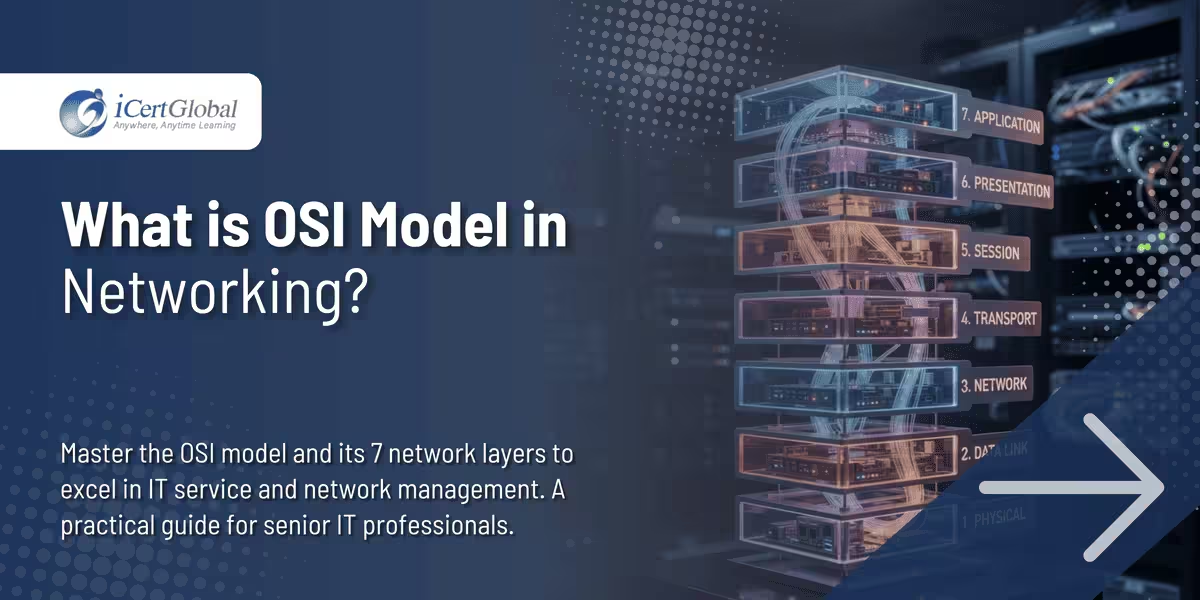
What is OSI Model in Networking
What is OSI model in networking? Learn the 7 layers, protocols, devices, how data flows, and how OSI...
7 Strong Advantages of ITIL Certification
Learn the top benefits of ITIL certification and how it boosts your IT career and organizational value....
Ensuring Tech Support Functions in Businesses
Learn how businesses keep their technology like computers and internet running well with ITSM and ITIL....
The Importance of COBIT in IT Management
Learn what COBIT is and why it matters for managing technology in businesses. ...
Guide to the Service Desk Manager Role
Learn about the key responsibilities, skills, and career path of a Service Desk Manager....

Top Highest-Paying Programming Languages to Learn in 2026
Explore the top high-paying programming languages for 2026 and gain in-demand skills to boost your career, stay competitive,...
Top 5 Frontend Frameworks to Watch in 2026
Master frontend frameworks to accelerate your career. Compare React, Angular, Vue, Svelte, and Next.js to build modern web...
Data Science for IT Process Management and Optimization
Harness the power of Data Science in IT Process Management to streamline operations, improve decision-making, and maximize efficiency...

