





DMAIC Explained Through a Realistic Process Improvement Example
Master the DMAIC process with a practical, step-by-step example. Learn how to solve process issues, pass your exam,
Stop being just a "bug finder." Get the global credential that proves you're a professional tester and gets you the interview.
Are you tired of being rejected for QA roles despite years of testing experience? Do recruiters dismiss you because you lack "formal certification"? Are you stuck doing manual testing while certified testers get promoted to automation and test architecture roles? This program exists to fix that injustice. The testing industry has a dirty secret: experience alone doesn't cut it anymore. Companies use ISTQB certification as a filter mechanism. Without it, your resume gets binned before a human even reads it. HR systems are programmed to prioritize certified candidates. You can have a decade of testing experience, but if you're not CTFL-certified, you're invisible to 60% of quality opportunities. We're here to make you visible. This isn't another generic testing course with outdated Waterfall examples and theoretical mumbo-jumbo. We teach you the ISTQB syllabus through the lens of real-world testing scenarios - Agile sprints, CI/CD pipelines, exploratory testing, and risk-based approaches that modern teams actually use. Our instructors are testing professionals who've broken production, caught critical bugs, and built testing strategies for actual products, not just PowerPoint presentations. We've engineered this program for working testers who can't afford to quit their jobs to study. You get flexible weekday evening and weekend batches, all fully interactive and recorded. Beyond the training, you receive targeted exam preparation: 1000+ practice questions that mirror the actual ISTQB exam style, 8+ full-length mock tests, and performance analytics that identify your weak areas. We don't just teach you testing; we guarantee you pass.
Learn from an officially recognized training partner whose curriculum is vetted and approved by the International Software Testing Qualifications Board.
Stop learning from academics who've never shipped software. Our instructors are active QA leads, test managers, and SDET professionals working on real products.
Choose from weekday evening batches, weekend-only training, or intensive 3-day bootcamps designed specifically for employed testing professionals.
Master the ISTQB syllabus efficiently with 24+ hours of structured, hands-on training that cuts through theoretical fluff and focuses on what's actually tested.
Crush your weak spots with 1000+ exam-style questions, 8+ full-length simulators, and detailed performance reports showing exactly where you're losing marks.
Get immediate answers from ISTQB-certified testing professionals through dedicated Slack channels - no generic support agents, only people who actually understand testing.
The Certified Tester Foundation Level (CTFL) Training Program is an internationally recognized certification that demonstrates an individual's knowledge and skills in software testing. Evaluating the effectiveness of software testing techniques is a critical aspect of the certification, which requires professionals to possess a solid understanding of testing principles, including the concept of risk-based testing. This involves identifying and evaluating potential risks associated with a software product, and developing strategies to mitigate them. In Cicero, IL, companies such as Caterpillar Inc.
and Navistar International Corporation rely heavily on software testing to ensure the quality of their products. The CTFL training program provides professionals with the knowledge and skills necessary to evaluate software testing techniques and identify areas for improvement. By understanding the importance of testing and quality assurance, professionals can develop and implement effective testing strategies that meet the needs of their organization. The CTFL training program aligns with industry standards, such as the ISTQB (International Software Testing Qualifications Board) framework, which provides a standardized approach to software testing.
By following this framework, professionals can ensure that their testing processes are efficient, effective, and aligned with best practices. In Cicero, IL, companies that adopt the CTFL training program can expect to see improved software quality, reduced testing costs, and increased efficiency in their testing processes.

Get a custom quote for your organization's training needs.
The Certified Tester Foundation Level (CTFL) Training Program has significant implications for career advancement in the software testing field. With this certification, professionals can demonstrate their expertise and commitment to software testing, making them more attractive to potential employers. According to the Bureau of Labor Statistics, employment of software quality assurance analysts and testers is projected to grow 22% from 2020 to 2030, faster than the average for all occupations.
This growth is driven by the increasing demand for high-quality software products and the need for companies to ensure that their products meet customer expectations. In Cicero, IL, companies such as Abbott and Baxter International rely on skilled software testers to ensure the quality of their products. By obtaining the CTFL certification, professionals can increase their earning potential and advancement opportunities in this field.
The CTFL training program covers topics such as testing techniques, testing process, and test management, providing professionals with a comprehensive understanding of software testing principles.
Stop randomly clicking through applications hoping to find bugs. You'll learn systematic black-box and white-box techniques - equivalence partitioning, boundary value analysis, decision tables, and state transition testing - that ensure comprehensive coverage and reduce redundant test cases.
Learn to write defect reports that developers actually act on instead of marking as "Cannot Reproduce." You'll master severity vs. priority distinctions, root cause analysis, and defect lifecycle management that prevents bugs from slipping into production.
Build realistic test strategies that account for actual project constraints instead of fantasy timelines. You'll develop risk-based testing approaches, learn to estimate testing effort using proven techniques, and create test plans that stakeholders trust.
Identify ambiguous, incomplete, and untestable requirements before development starts. You'll learn to ask the right questions during refinement sessions, spot gaps that cause production defects, and become the quality gatekeeper your team desperately needs.
Understand when to automate and when manual testing is more effective - something most "automation engineers" get catastrophically wrong. You'll learn the test automation pyramid, ROI analysis, and how to avoid the maintenance nightmare of over-automated test suites.
Adapt traditional testing principles to modern delivery models without sacrificing quality. You'll master continuous testing practices, learn to integrate testing into CI/CD pipelines, and understand your role in a cross-functional agile team.
If you're involved in software quality assurance and want to validate your skills with the industry's most recognized certification, this program will get you certified.
In Cicero, IL, companies that hire professionals with the CTFL certification can expect to see improved software quality and reduced testing costs.
The Certified Tester Foundation Level (CTFL) Training Program provides professionals with the knowledge and skills necessary to develop their expertise in software testing. Through the program, professionals can gain hands-on experience in testing techniques, testing process, and test management.
The CTFL training program aligns with industry standards, such as the ISTQB framework, which provides a standardized approach to software testing. By following this framework, professionals can ensure that their testing processes are efficient, effective, and aligned with best practices. In Cicero, IL, companies that adopt the CTFL training program can expect to see improved software quality, reduced testing costs, and increased efficiency in their testing processes.
With this certification, professionals can demonstrate their commitment to software testing and increase their earning potential.


Stop getting auto-rejected by ATS systems that filter out non-certified testers regardless of your actual experience.
Command higher salaries in QA roles - certified testers earn 15-25% more than their uncertified peers in Cicero, IL.
Unlock senior QA positions like Test Lead, QA Manager, and Test Architect that explicitly require ISTQB certification.
Unlike many certifications, CTFL has no formal prerequisites. There are no mandatory education requirements, no minimum years of experience, and no application approval process. This makes it the most accessible entry point into professional software testing. However, accessibility doesn't mean easy - the exam has a 65% pass threshold and tests your understanding rigorously.
No Formal Experience Required: You can take the exam even if you're completely new to software testing, though practical experience significantly improves pass rates.
No Educational Prerequisites: There's no degree requirement. The certification is open to anyone committed to learning software testing fundamentals.
24 Hours of Training (Recommended): While not mandatory, ISTQB strongly recommends completing accredited training. Our program fulfills this recommendation and dramatically increases your first-attempt pass rate.
Pass the 40-Question Exam: You need to score at least 26 out of 40 (65%) to pass. The exam is one hour long, closed-book, and consists of multiple-choice questions testing your understanding of the ISTQB Foundation Level syllabus.
The CTFL training program covers topics such as black box testing, white box testing, and gray box testing, providing professionals with a comprehensive understanding of testing techniques. In Cicero, IL, companies such as Boeing and Motorola rely on skilled software testers to ensure the quality of their products.
The Certified Tester Foundation Level (CTFL) Training Program requires professionals to possess a solid understanding of testing principles, including the concept of risk-based testing. This involves identifying and evaluating potential risks associated with a software product, and developing strategies to mitigate them.
By attending the CTFL training program, professionals can gain a deeper understanding of software testing principles and develop the skills necessary to evaluate software testing techniques. This includes understanding the importance of testing and quality assurance, and developing effective testing strategies.
Develop test strategies that are directly aligned with project risks and business priorities, moving beyond generic "test everything" approaches that result in wasted time. Learn how to define clear test objectives, create realistic effort estimates, allocate necessary resources effectively, and establish entry/exit criteria to prevent premature product release decisions.
Implement tracking mechanisms that offer genuine insight into the progress of testing activities and the current quality status of the product. Master the essential test metrics (defect density, test coverage, pass/fail rates), learn to recognize when testing efforts are falling behind schedule, and understand how to communicate quality status to project stakeholders without minimizing potential risks.
Translate requirements documentation into systematic test conditions and actionable test cases. Learn the process of identifying features that are testable, designing test cases structured to maximize the discovery of defects, and prioritizing your testing efforts based on perceived risk. Understand the critical distinction between test conditions, test cases, and test procedures, which is frequently confused by most testers.
Master specification-based testing methods that do not require internal knowledge of the code: equivalence partitioning to reduce unnecessary tests, boundary value analysis to catch common off-by-one programming errors, decision table testing for complex rules and logic, and state transition testing for systems operating with distinct modes.
Learn structure-based testing that involves examining the internal execution paths within the code. Understand the concepts of statement coverage, branch coverage, and path coverage?determining when each method is appropriate and how to accurately measure them. Apply these systematic techniques to ensure thorough verification of critical areas of the code base.
Acknowledge situations where formal, systematic techniques alone are insufficient and focused exploratory testing is required. Master error guessing, exploratory testing, and checklist-based testing that utilize the tester's intuition and domain knowledge to find defects that the systematic methods may have missed.
Understand the advantages and disadvantages associated with various structures for a testing team. Learn when having independent testing provides added value versus when it introduces process bottlenecks, and grasp the psychological factors that influence testing effectiveness?specifically why developers are often poor testers of their own work.
Create accurate test plans that realistically account for all actual project constraints and limitations. Master various estimation techniques (expert-based, metrics-based, Wideband Delphi), establish risk-based testing approaches to concentrate effort on the most important areas, and devise test strategies that can be adapted across different project environments.
Write incident reports for defects that lead to corrective action instead of being disregarded. Learn the components of a highly effective bug report, understand the management process of the defect lifecycle, master the correct application of severity versus priority, and implement tracking procedures that continuously drive quality improvements.
Navigate the complex array of available testing tools and determine which ones genuinely offer a positive Return on Investment (ROI). Learn the primary categories of test tools (test management, static analysis, test execution, performance, monitoring) and understand their proper application scenarios?recognizing that not every team requires every tool.
Avoid the frequent pitfall of failed tool implementation within an organization. Understand the inherent risks involved in adopting new testing tools without thorough, upfront planning, learn the benefits of pilot project approaches, and master the factors that determine successful tool adoption versus expensive tools left unused on a shelf.
Understand the fundamental concepts of test automation without needing to delve into the specifics of particular tools. Learn the architecture of the test automation pyramid, grasp the conditions under which automation yields a positive ROI versus becoming a maintenance burden, and understand the necessary skills and infrastructure for sustained automation success.
In Cicero, IL, companies such as Caterpillar Inc. and Navistar International Corporation rely on software testing to ensure the quality of their products.
The CTFL training program provides professionals with the knowledge and skills necessary to ensure that their testing processes are efficient, effective, and aligned with best practices. The CTFL training program covers topics such as software testing methodologies, testing tools, and testing techniques, providing professionals with a comprehensive understanding of software testing principles.
In Cicero, IL, companies that adopt the CTFL training program can expect to see improved software quality and reduced testing costs.
Great class, very informative.

Great PMP<sup>®</sup> Bootcamp. I had a great time taking this course. I took the course to prepare to sit for the CAPM<sup>®</sup> but may be able to sit for the PMP<sup>®</sup>. I learnt a lot was challenging. Great course. We need one more day. Content was very detailed.

it was a great class. Lots of energy. And I enjoyed.

Fantastic course to prepare for PMP<sup>®</sup> exam.

As a participant it was smooth sailing for me.

Trainer was excellent. Shared good resources and good experiences.

Good content and training.
I wanted to let you know that I took and passed the PMP exam. Thanks to iCertGlobal and especially my Cincinnati course instructor, who was an excellent teacher and helped me immensely.

Trainer was good. Trainer was very engaged and interacting. Very much satisfied with the training.

I was pleasantly surprised at the quality of this training. Yomi was awesome as a trainer and working to make sure that we understood the concepts. Controlling Cost and Controlling Risk are the most complicated, but Yomi spent time after class working through questions to help others understand. This class also helped to change my perception of the PMP being this MONSTER to something that I can I can successfully do.

Great class with a lot of information and tips to prepare for the exam

It was a great course, covered all the things that i ended up hitting road bumps on. I was the only one in the class, but the trainer was just as involved as if it had been a full class.

I was nervous about taking it online versus classroom; but I am actually glad I took it online. Instructor was very great and gave a good learning experience with his relevant project management experience.
The training was very intense but covered with course material. It was more than I expected.

I thought the class was very informative. The instructor did an excellent job breaking down each chapter to where it was easy to understand. I was also very impressed with his commitment to help us pass ever after the class is over.

Excellent training. Instructor was very knowledgeable and explained information in an understandable way
Quality Materials presented, Instructor very knowledgeable. Exceeded my expectations.
The training is a great introduction into the PMI mindset. Very informative and helpful

Explore our instructor-led CTFL training to learn about the course duration, cost, eligibility, and certification process. You get practical learning, exam-focused preparation, and expert guidance. Ready to get started? Compare CTFL certification training options and choose a classroom or live online format that fits your schedule.
Explore Our CTFL certification training is available in a city near you
Stay updated with the latest insights and trends in your field
Master the DMAIC process with a practical, step-by-step example. Learn how to solve process issues, pass your exam,
Learn how to identify and execute high-impact projects. Master Lean Six Sigma project selection to drive business results
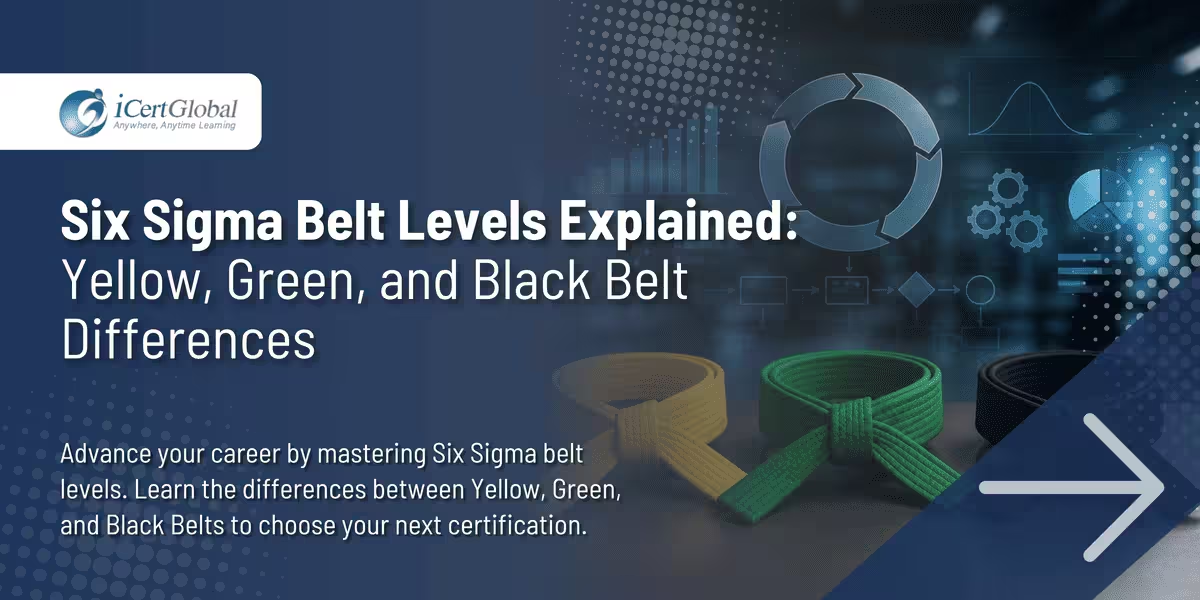
Advance your career by mastering Six Sigma belt levels. Learn the differences between Yellow, Green, and Black Belts

Master the DMAIC methodology and pass your Six Sigma Green Belt Certification Exam. Learn proven study strategies to

Advance your career with Lean Six Sigma Green Belt skills. Explore the top 10 industries actively hiring certified

Master essential lean six sigma principles to pass your certification exam, eliminate process waste, and advance your career.
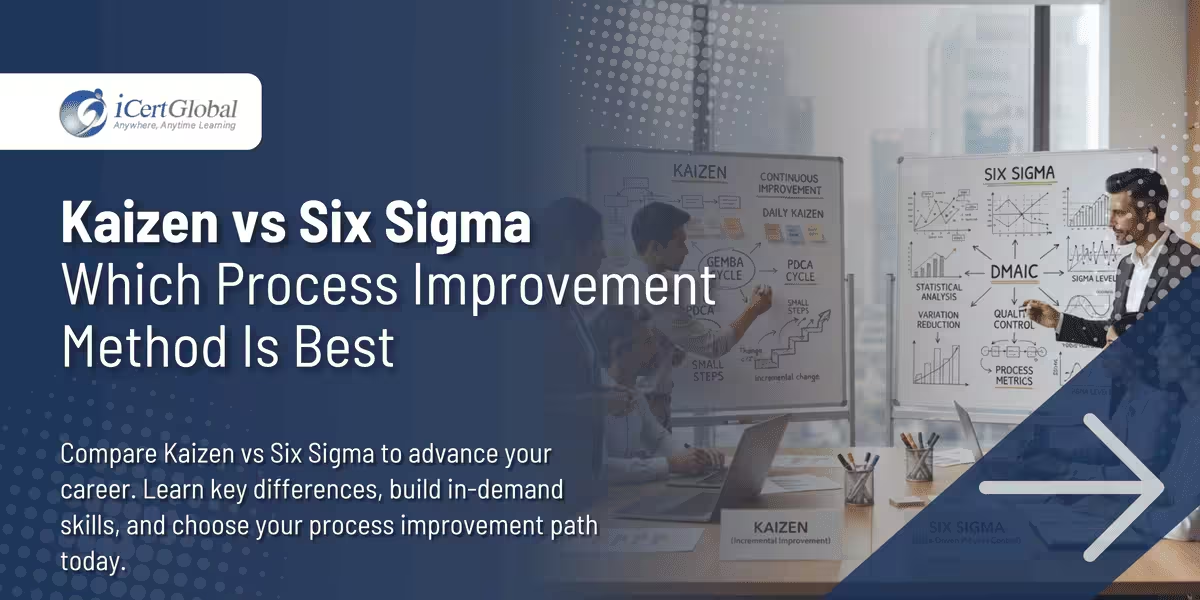
Compare Kaizen vs Six Sigma to advance your career. Learn key differences, build in-demand skills, and choose your
Advance your career by mastering quality management. Discover the key differences between Six Sigma and TQM to choose
.avif)
Master the DMAIC framework and boost your career. Learn how to achieve Six Sigma Green Belt Certification with
Discover the complete breakdown of Six Sigma Yellow Belt Certification costs in 2026. Compare ASQ vs. IASSC fees,
Our experts are ready to help you with any questions about courses, admissions, or career paths. Get personalized guidance from industry professionals.
Request a Call Back

"PMI®", "PMBOK®", "PMP®", "CAPM®" and "PMI-ACP®" are registered marks of the Project Management Institute, Inc. | "CSM", "CST" are Registered Trade Marks of The Scrum Alliance, USA. | COBIT® is a trademark of ISACA® registered in the United States and other countries.

