





DMAIC Explained Through a Realistic Process Improvement Example
Master the DMAIC process with a practical, step-by-step example. Learn how to solve process issues, pass your exam,
Stop managing chaos and bureaucracy. Get the Lean framework to eliminate waste and build a culture of continuous improvement.
You're already identifying waste, spotting inefficiencies, and proposing process improvements - but without formal recognition, your ideas often get overlooked. Lean-certified professionals lead enterprise transformation programs, report directly to operations VPs, and command premium compensation for applying systematic waste elimination strategies that you've already been attempting. Promotions to Operations Manager or Continuous Improvement Lead increasingly require a Lean Management certification, and this is where your career trajectory changes. Our Lean Management Training Program isn't a theoretical course. It's designed by practitioners who've led real transformations across diverse manufacturing and operational environments, including organizations facing legacy systems, union constraints, and budget limitations. These environments involve legacy systems, union constraints, and budget limitations - situations textbooks rarely cover. This Lean management course equips you to implement Lean systems in organizations resistant to change, providing a structured approach that turns operational ideas into measurable results. Unlike programs that teach Lean tools in isolation - like 5S workshops or Kanban boards - our Lean Management certification online program develops operational leaders capable of driving sustainable transformation. You'll master value stream mapping to uncover hidden waste costing lakhs monthly, design pull systems that reduce inventory without causing stockouts, and lead kaizen events that deliver documented, actionable savings rather than temporary improvements. The Lean Management certification validates your skills, but the real advantage is presenting a transformation roadmap with projected ROI that earns immediate executive buy-in. This Lean management course is designed for working professionals in manufacturing, healthcare, IT operations, and service sectors who cannot stop production to study. We offer flexible weekday evening and weekend batches, fully interactive sessions, and real gemba walks at operational facilities. Every session is recorded for later review. Beyond training, you gain ready-to-use value stream mapping templates, A3 problem-solving frameworks adapted from Toyota operations, 24/7 expert support, and hands-on coaching for your mandatory capstone improvement project. This ensures your Lean Manager skills translate directly into impactful, measurable results.
Train through a program that aligns with internationally accepted Lean certification standards, ensuring your credential translates across industries and geographies.
Learn from certified Lean practitioners who've led transformations at scale and can teach you the political and technical realities of change management in complex organizations.
Access weekend-only batches, weekday evening sessions, or intensive 10-day bootcamps that don't require career breaks or extended leave from work.
Participate in actual shop floor walks, value stream mapping exercises, and process observations at manufacturing and service facilities in Longview, TX.
Master the full spectrum of Lean tools - VSM, 5S, SMED, Kanban, TPM, Poka-Yoke, Standard Work - with templates and implementation guides for immediate workplace application.
Access our team of Lean coaches around the clock for guidance on your improvement projects, stakeholder challenges, and measurement system design.
The Lean Management Certification Training Program focuses on equipping professionals with advanced problem-solving skills, specifically value stream mapping, to identify and eliminate waste in processes. By understanding the principles of lean thinking, participants can develop the ability to analyze complex systems and identify areas for improvement. Understanding the concept of kaizen, or continuous improvement, is essential for effective lean implementation.
This involves recognizing and addressing small, incremental changes that can have a significant impact on overall efficiency. Lean tools, such as the fishbone diagram, are also critical for identifying root causes of inefficiencies and developing targeted solutions. In Longview, TX, professionals can apply these skills to optimize supply chain operations and improve product delivery times.
By streamlining processes and reducing waste, companies can increase customer satisfaction and gain a competitive edge in the market.
Participants in the Lean Management Certification Training Program undergo a transformative learning experience, moving from basic understanding to advanced application of lean principles. This growth is facilitated through a structured curriculum that emphasizes hands-on training with real-world examples.

Get a custom quote for your organization's training needs.
Key concepts addressed include the role of leadership in driving lean initiatives, the importance of employee engagement in sustaining lean gains, and the application of lean metrics, such as cycle time and throughput. Participants also learn to analyze and interpret data using tools like the run chart and control chart.
As professionals in Longview, TX, grow and develop their lean skills, they can expect to see significant improvements in efficiency and productivity. By leading lean initiatives in their organizations, they will be empowered to make strategic decisions that drive business growth and competitiveness.
The Lean Management Certification Training Program emphasizes hands-on application of lean principles to real-world scenarios. Participants learn to identify and prioritize opportunities for improvement, develop targeted solutions, and implement sustainable changes.
Stop optimizing individual departments while the overall flow suffers. You'll learn to map end-to-end value streams, identify where value is actually created versus where waste accumulates, and design future-state processes that eliminate non-value-added activities systematically.
Recognize the seven (or eight) forms of waste hiding in plain sight within your operations. You'll develop the diagnostic capability to quantify waste's impact on cycle time, cost, and quality, then systematically eliminate it using targeted Lean tools appropriate for each waste type.
Understand why batch-and-queue systems create inventory, delays, and quality problems. You'll master the principles of one-piece flow, takt time calculation, and pull system design using Kanban that synchronizes production with customer demand and eliminates overproduction waste.
Stop relying on tribal knowledge and undocumented best practices that disappear when key people leave. You'll learn to develop standard work that captures current best methods, establish visual controls that make abnormalities instantly visible, and create management systems that sustain improvements.
Move beyond symptom treatment to root cause elimination using structured problem-solving. You'll master A3 methodology that documents current conditions, identifies root causes through data analysis, develops countermeasures, and establishes follow-up mechanisms that prevent problem recurrence.
Recognize that tools without cultural change create temporary improvements that fade. You'll develop frameworks for managing resistance, building problem-solving capability at all organizational levels, and establishing leader standard work that reinforces Lean behaviors daily.
If you lead operational teams, are accountable for productivity and efficiency metrics, and are ready to drive systematic improvement rather than firefighting problems, this program equips you with the methodology and tools to succeed.
This involves the use of practical tools, such as the A3 report and the hoshin kanri plan, to facilitate structured problem-solving and collaborative decision-making. Participants also learn to communicate the value of lean initiatives to stakeholders and to measure and evaluate the effectiveness of lean improvements.
By applying these skills in practical settings, professionals in Longview, TX, can drive meaningful improvements in process efficiency and customer satisfaction. They will be able to identify and address non-value-added activities, streamline workflows, and optimize system performance.
The Lean Management Certification Training Program has direct applicability to a wide range of industries, including manufacturing, healthcare, and service sectors. Participants learn to apply lean principles to complex systems, identifying opportunities for improvement and developing targeted solutions.


Stop being overlooked for operations leadership roles because you lack the formal credential that validates your improvement capability to skeptical executives and HR gatekeepers.
Command operational respect across departments as leaders recognize that you possess the systematic methodology to drive sustainable change, not just temporary improvements.
Transition from reactive problem-solving to proactive system creation by mastering tools that prevent issues before they arise, ensuring consistency, efficiency, and long-term success.
Lean Management certification is designed for working professionals who lead or influence operations and are ready to drive systematic improvement. Unlike entry-level awareness courses, this program requires demonstrated capability to lead improvement projects and deliver measurable results. Here's what you need to qualify for certification.
Operational Leadership Experience: Most certification bodies require 2-3 years of experience in operations, production, or process improvement roles where you've led teams or influenced operational decisions.
Completion of Lean Training: You must complete formal Lean training covering all core principles and tools; this program fully satisfies that requirement with comprehensive coverage of the Lean Body of Knowledge.
Led & Completed Improvement Project: You must successfully lead at least one significant improvement initiative using Lean methodology, demonstrating measurable operational impact and proper application of tools.
Documented Operational Impact: Your project must deliver quantified improvements in key metrics like cycle time reduction (minimum 20-30%), productivity improvement, quality enhancement, or cost savings with validated before/after data.
Additional Requirements: For comprehensive details on project documentation requirements, measurement system design, and certification body-specific criteria, refer to our detailed FAQ section.
Lean thinking can be applied to various areas of organizational operations, including supply chain management, production planning, and quality assurance. By using lean tools, such as the value stream map and the process flow diagram, participants can analyze and optimize workflows, reducing waste and improving efficiency.
In Longview, TX, professionals from various industries can apply lean principles to drive business growth and competitiveness. By streamlining processes and reducing waste, companies can increase customer satisfaction and gain a competitive edge in the market.
Upon completion of the Lean Management Certification Training Program, participants will be equipped to take on key roles in driving lean initiatives within their organizations. This includes leading cross-functional teams, analyzing and interpreting data, and implementing sustainable changes.
Understand the mathematics of flow and how to synchronize production with customer demand. Learn to calculate takt time from customer requirements, assess whether processes can meet takt, identify bottlenecks that constrain flow, and balance work content across operations. Master the principles of continuous flow, one-piece flow benefits and challenges, and when batch-and-queue is appropriate versus flow.
Shift from push to pull production with Lean Management practices. You'll learn to design Kanban systems for raw materials, WIP, and finished goods to prevent overproduction and reduce inventory costs. Master Kanban card calculations, supermarket layout design, replenishment logic, and the behavioral changes required to implement pull thinking effectively. These skills are essential for any aspiring Lean Manager and are core components of our Lean Management course.
Eliminate the batch size penalty by reducing changeover times from hours to minutes. Learn Shigeo Shingo's Single-Minute Exchange of Die methodology: separating internal from external setup activities, converting internal to external, streamlining remaining internal activities, and eliminating adjustment. Understand how quick changeover enables smaller batches, reduces inventory, and improves responsiveness to customer demand variation.
Build quality into processes rather than inspecting defects out later. Learn the principle of Jidoka (automation with human intelligence), how to design processes that stop when abnormalities occur, and methods for separating people from machines to improve utilization. Master andon systems for visual signaling, escalation procedures that bring help to problems immediately, and root cause problem-solving that prevents recurrence.
Design processes that make it impossible to create defects even when people make mistakes. Learn the hierarchy of mistake-proofing from elimination and replacement through facilitation and detection. Master poka-yoke principles for manufacturing and transactional processes, understand the difference between control and warning devices, and develop creativity in designing low-cost error-proofing solutions.
Document and continuously improve the current best method for every process. Learn to develop standard work that specifies takt time, work sequence, and standard work-in-process. Master standard work documentation methods, visual job instruction training, and the discipline of adherence measurement. Understand that standards are the baseline for improvement, not rigid constraints on innovation.
Create organized, visual workplaces where abnormalities are immediately apparent. Learn to implement 5S (Sort, Set in Order, Shine, Standardize, Sustain) in manufacturing and office environments. Master red-tagging methodology for Sort, ergonomic principles for Set in Order, cleaning-as-inspection for Shine, visual standards for Standardize, and audit systems for Sustain. Understand why 5S is the foundation for flow and quality, not just housekeeping.
Make process status, performance, and problems visible to everyone without asking questions. Learn to design visual boards that communicate production status, quality performance, safety metrics, and improvement activities. Master tier meeting structures (from cell huddles to plant reviews) that cascade information and escalate problems systematically. Develop visual workplace principles that enable management by exception rather than constant supervision.
Reduce equipment breakdowns and prevent capacity losses that disrupt flow and create waste. Learn the eight pillars of Total Productive Maintenance (TPM), emphasizing autonomous maintenance and planned maintenance systems. Master Overall Equipment Effectiveness (OEE) calculations to measure availability, performance, and quality losses. Applying these Lean Management practices allows a Lean Manager to shift maintenance from reactive firefighting to proactive prevention, a crucial skill for any professional completing a Lean Management course or pursuing Lean management certification.
Master Toyota's systematic approach to root cause problem-solving and knowledge capture. Learn A3 structure: background and current condition, goal and gap analysis, root cause analysis using tools like 5-Why and fishbone diagrams, countermeasure development, implementation planning, and follow-up mechanisms. Develop the discipline to document thinking on one page, making problem-solving transparent and improvable.
Lead focused improvement workshops that deliver results in days rather than months. Learn to select appropriate kaizen targets, assemble cross-functional teams, facilitate structured problem-solving workshops, implement changes rapidly using PDCA cycles, and document before/after results. Understand when kaizen events are appropriate versus when systemic transformation requires deeper intervention.
Sustain Lean improvements through disciplined leadership behaviors and systematic capability development. Learn to develop leader standard work that ensures leaders spend time where value is created, coach problem-solving rather than solving problems for people, and reinforce Lean behaviors through daily actions. Master coaching kata methodology for developing scientific thinking capability throughout the organization, creating a culture where problem-solving is everyone's job.
Responsibilities will involve applying lean principles to identify and prioritize opportunities for improvement, developing targeted solutions, and communicating the value of lean initiatives to stakeholders. Participants will also be expected to measure and evaluate the effectiveness of lean improvements, using tools like the balanced scorecard.
Professionals in Longview, TX, with expertise in lean management will be sought after for their ability to drive process improvements and optimize system performance. They will be empowered to lead organizational change and drive business growth through sustainable lean initiatives.
Great class, very informative.

Great PMP<sup>®</sup> Bootcamp. I had a great time taking this course. I took the course to prepare to sit for the CAPM<sup>®</sup> but may be able to sit for the PMP<sup>®</sup>. I learnt a lot was challenging. Great course. We need one more day. Content was very detailed.

it was a great class. Lots of energy. And I enjoyed.

Fantastic course to prepare for PMP<sup>®</sup> exam.

As a participant it was smooth sailing for me.

Trainer was excellent. Shared good resources and good experiences.

Good content and training.
I wanted to let you know that I took and passed the PMP exam. Thanks to iCertGlobal and especially my Cincinnati course instructor, who was an excellent teacher and helped me immensely.

Trainer was good. Trainer was very engaged and interacting. Very much satisfied with the training.

I was pleasantly surprised at the quality of this training. Yomi was awesome as a trainer and working to make sure that we understood the concepts. Controlling Cost and Controlling Risk are the most complicated, but Yomi spent time after class working through questions to help others understand. This class also helped to change my perception of the PMP being this MONSTER to something that I can I can successfully do.

Great class with a lot of information and tips to prepare for the exam

It was a great course, covered all the things that i ended up hitting road bumps on. I was the only one in the class, but the trainer was just as involved as if it had been a full class.

I was nervous about taking it online versus classroom; but I am actually glad I took it online. Instructor was very great and gave a good learning experience with his relevant project management experience.
The training was very intense but covered with course material. It was more than I expected.

I thought the class was very informative. The instructor did an excellent job breaking down each chapter to where it was easy to understand. I was also very impressed with his commitment to help us pass ever after the class is over.

Excellent training. Instructor was very knowledgeable and explained information in an understandable way
Quality Materials presented, Instructor very knowledgeable. Exceeded my expectations.
The training is a great introduction into the PMI mindset. Very informative and helpful

Explore our instructor-led Lean Management training to learn about the course duration, cost, eligibility, and certification process. You get practical learning, exam-focused preparation, and expert guidance. Ready to get started? Compare Lean Management certification training options and choose a classroom or live online format that fits your schedule.
Explore Our Lean Management certification training is available in a city near you
Stay updated with the latest insights and trends in your field
Master the DMAIC process with a practical, step-by-step example. Learn how to solve process issues, pass your exam,
Learn how to identify and execute high-impact projects. Master Lean Six Sigma project selection to drive business results
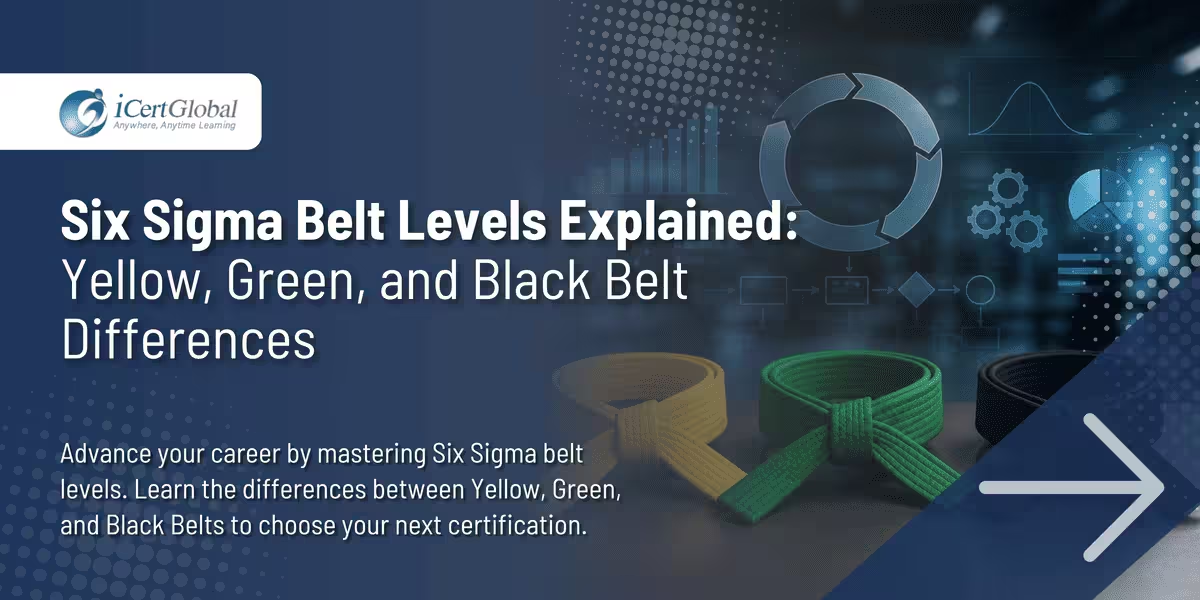
Advance your career by mastering Six Sigma belt levels. Learn the differences between Yellow, Green, and Black Belts
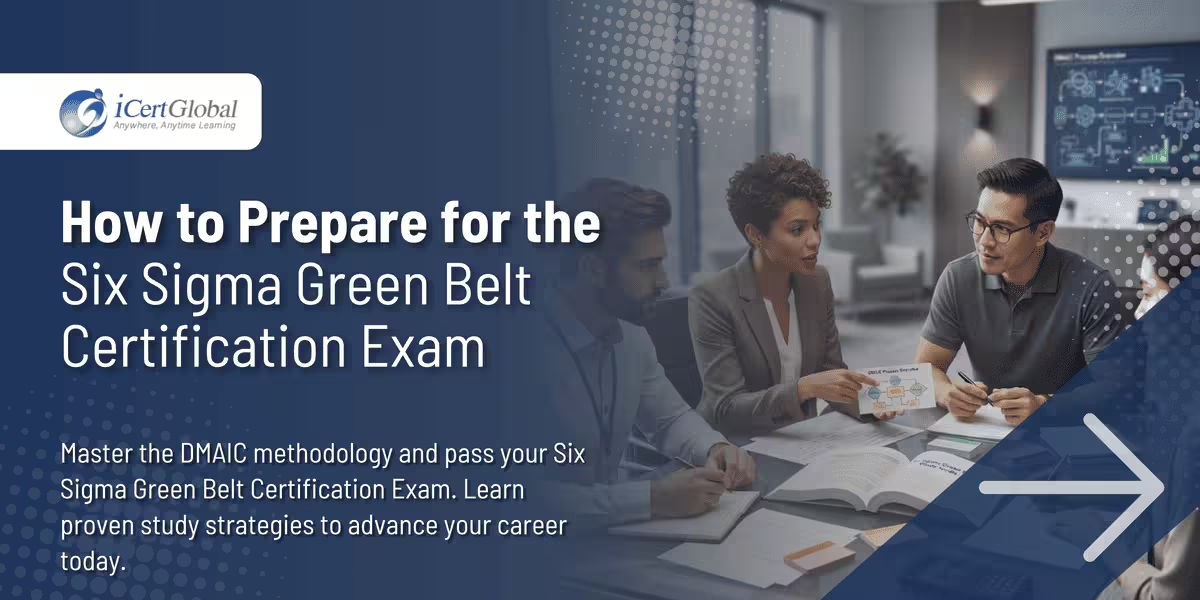
Master the DMAIC methodology and pass your Six Sigma Green Belt Certification Exam. Learn proven study strategies to
Advance your career with Lean Six Sigma Green Belt skills. Explore the top 10 industries actively hiring certified
Master essential lean six sigma principles to pass your certification exam, eliminate process waste, and advance your career.
Compare Kaizen vs Six Sigma to advance your career. Learn key differences, build in-demand skills, and choose your
Advance your career by mastering quality management. Discover the key differences between Six Sigma and TQM to choose
.avif)
Master the DMAIC framework and boost your career. Learn how to achieve Six Sigma Green Belt Certification with
Discover the complete breakdown of Six Sigma Yellow Belt Certification costs in 2026. Compare ASQ vs. IASSC fees,
Our experts are ready to help you with any questions about courses, admissions, or career paths. Get personalized guidance from industry professionals.
Request a Call Back

"PMI®", "PMBOK®", "PMP®", "CAPM®" and "PMI-ACP®" are registered marks of the Project Management Institute, Inc. | "CSM", "CST" are Registered Trade Marks of The Scrum Alliance, USA. | COBIT® is a trademark of ISACA® registered in the United States and other countries.

