





Six Sigma Belt Levels Explained: Yellow, Green, and
Advance your career by mastering Six Sigma belt levels. Learn the differences between Yellow, Green, and Black Belts
Stop firefighting the same problems. Get the data-driven toolkit to solve them permanently and deliver real savings.
Your Six Sigma Green Belt Certification isn't just a certificate - it's the mark of true project leadership. Many professionals working in quality, operations, or process improvement roles face challenges in proving their capability because they lack formal Six Sigma Green Belt certification. You may already see inefficiencies, delays, and defects in your processes, but without the structured tools and statistical methods of Six Sigma, your ideas often sound like opinions rather than data-driven insights. On the other hand, Six Sigma Green Belt certified professionals lead improvement projects with confidence, apply analytical thinking to identify root causes, and deliver measurable cost savings that earn them promotions, recognition, and salaries up to 30% higher. The difference lies not in intelligence, but in structured problem-solving - and that's exactly what this program delivers. This Six Sigma Green Belt Course is not a theoretical statistics class filled with jargon. It is a practical, hands-on program built by experienced Black Belts and Master Black Belts who have led hundreds of successful projects across Syracuse, NYmanufacturing, IT services, and healthcare. They know that real-world organizations have constraints - limited budgets, tight timelines, and complex politics - and they've designed this Six Sigma Green Belt Certification Training to prepare you to handle exactly that. You'll learn how to apply the DMAIC methodology to define improvement goals, measure process performance using data, analyze results to find true root causes, implement sustainable solutions, and establish control mechanisms that prevent problems from returning. Unlike generic training programs, this six sigma green belt certification online course integrates tools, techniques, and strategy into a complete learning experience. You won't just memorize statistical terms; you'll learn to communicate results with clarity and confidence, translating technical findings into business impact that your management understands. By the end of this training, you'll not only hold a globally recognized Six Sigma Green Belt certification but also possess the competence to lead your first improvement project independently - from identifying opportunities to presenting measurable savings to your leadership team. Designed for working professionals in operations, manufacturing, quality, and services, this program offers flexible weekend and evening batches, with every session conducted live and recorded for your convenience. The six sigma green belt certification cost is structured to make professional upskilling affordable, while still maintaining premium-quality training and one-on-one mentorship. You'll get access to real project templates, Minitab practice exercises, control plan formats, and 24/7 support from certified Black Belts. What makes this program unique is its emphasis on guided project execution - most training providers leave you once the theory is over, but we stay with you until your Green Belt project is completed successfully. Earning your Six Sigma Green Belt Certification is more than an academic milestone - it's a professional transformation. It gives you the tools to solve problems scientifically, lead cross-functional teams, and demonstrate quantifiable improvements in cost, quality, and efficiency. Whether you're looking to boost your six sigma green belt salary, prepare for Black Belt certification, or secure leadership positions in process excellence, this program equips you with the practical skills and global credibility to get there. Enroll now in our Six Sigma Green Belt Certification Training and take your first confident step toward becoming a data-driven project leader.
Learn with confidence knowing your training program meets international Six Sigma Body of Knowledge standards and is recognized by employers globally.
Unlock your potential with expert instructors who are certified Six Sigma Black Belts with real-world project leadership experience across multiple industries.
Balance certification with your current job by choosing from weekday-evening sessions, weekend-only batches, or an intensive 5-day immersive bootcamp.
Master the concepts through real data analysis, not just theory, with guided DMAIC project work and statistical software practice sessions.
Gain proficiency with industry-standard tools including Minitab software access, process mapping templates, and comprehensive calculation guides.
Certified Black Belt instructors are available around the clock to resolve your statistical doubts and methodology questions.
The Six Sigma Green Belt Certification Training Program is designed to equip professionals with the necessary tools and knowledge to identify, analyze, and rectify process defects. By the end of this training, participants will possess a solid understanding of the Lean methodology and statistical process control. This program introduces participants to the Six Sigma DMAIC framework, which emphasizes data-driven decision making, process analysis, and continuous improvement.
The curriculum includes coverage of key statistical process control tools, such as the normal distribution and the central limit theorem. Participants learn how to apply these concepts to real-world problems, leveraging software tools like Minitab and Excel. In Syracuse, NY, manufacturing professionals can apply their newfound skills to improve quality and efficiency in production processes.
This can lead to increased productivity, reduced waste, and enhanced customer satisfaction. Furthermore, the skills learned in this program can be applied across various industries, from healthcare to finance, wherever process improvement is a priority.

Get a custom quote for your organization's training needs.
Over the course of the Six Sigma Green Belt Certification Training Program, participants engage in a series of case studies and projects that put their knowledge to the test. These hands-on exercises enable participants to develop and refine their analytical and problem-solving skills, applying statistical techniques to real-world problems. The program emphasizes the importance of defining and measuring processes, analyzing data, and controlling and verifying results.
Participants learn how to use control charts, scatter plots, and other visualization tools to identify trends and patterns in data, as well as apply hypothesis testing and confidence intervals to inform decisions. The goal is to equip participants with the skills to identify areas of improvement and develop targeted solutions. In practical terms, participants learn how to apply these skills in their own work settings, such as identifying opportunities for process improvement, calculating return on investment for new projects, and developing effective communication plans.
By the end of the program, participants are better equipped to contribute to and lead process improvement initiatives in their organizations.
Stop guessing whether your process is stable or drifting. Learn how to build and interpret control charts, recognize variation patterns, and distinguish between common cause and special cause variation so you know exactly when to intervene and when to maintain normal operations.
End the cycle of treating symptoms instead of real issues. Master analysis tools such as fishbone diagrams, 5 Whys, and hypothesis testing to uncover and eliminate the true drivers of defects and variation in your processes.
Understand whether your process can actually meet customer requirements before investing in improvement. Learn how to calculate and interpret Cp, Cpk, and other capability indices to assess process performance and customer satisfaction impact.
Stop adjusting one variable at a time and hoping for the best. Learn factorial and advanced experimental design techniques that reveal interaction effects and allow you to optimize multiple factors simultaneously - reducing project duration and increasing results.
Realize that waste elimination is as important as variation reduction. Learn to identify the eight wastes, create value stream maps, and integrate Lean methodology with Six Sigma for complete operational and process improvement.
Technical skills alone are not enough. Develop frameworks for stakeholder coordination, handling resistance to change, and benefit measurement to ensure your improvements are adopted, sustained, and deliver real ROI.
If you're responsible for operational excellence, process optimization, or quality improvement in your organization, this program is engineered to give you the recognized credential and practical skills employers demand
The Six Sigma Green Belt Certification Training Program is designed to address a critical skill gap in modern organizations: the ability to drive data-driven decision making and process improvement. Many professionals struggle to identify and analyze defects in processes, often relying on anecdotal evidence or intuition. This program fills this gap by equipping participants with the statistical knowledge and analytical skills necessary to identify and prioritize areas for improvement.
The curriculum covers key statistical concepts, such as regression analysis, hypothesis testing, and design of experiments. Participants learn how to apply these concepts to identify and quantify the impact of process variations. By addressing this skill gap, participants return to their organizations better equipped to drive meaningful change and process improvement.
This can be particularly valuable in industries like healthcare, where efficient processes are critical to patient safety and outcomes. In Syracuse, NY, manufacturers can apply these skills to improve production efficiency and quality.


Get past HR filters and land interviews for quality management and process improvement roles that match your experience.
Show documented ROI through measurable cost savings and defect reduction that translates directly into bonuses and promotions.
Move beyond reacting to problems and start preventing them using data-driven process design and statistical control.
Unlike PMP, the Six Sigma Green Belt certification does not enforce strict experience prerequisites through a governing body. However, that does not mean it is suitable for everyone. To be effective as a Green Belt, you should have certain foundational capabilities in place before pursuing the credential.
Basic Statistical Understanding: You don't need advanced mathematics, but you should be comfortable with foundational concepts like mean, standard deviation, and probability. If terms like "normal distribution" feel overwhelming, the coursework will be challenging.
Operational Process Exposure: This credential is intended for professionals who work within real business processes. If you have never documented workflows, collected process data, or participated in improvement initiatives, the methodology may not connect meaningfully.
Project Completion Requirement (Varies by Certification Body): Some certifying organizations require candidates to complete and present an actual DMAIC improvement project. Our training includes a guided, full-scale project simulation designed to satisfy this requirement for most bodies.
Certification Body Differences (ASQ, IASSC, Others): Each organization has unique eligibility, exam patterns, and evaluation criteria. Refer to our detailed FAQ section for a clear, side-by-side breakdown of requirements before selecting your certification path.
The Six Sigma Green Belt Certification Training Program is applicable to a wide range of industries and sectors, from manufacturing and healthcare to finance and services. By equipping professionals with the skills to drive data-driven decision making and process improvement, this program empowers organizations to stay competitive in a rapidly changing market. The program's emphasis on statistical process control, Lean methodology, and project management provides a solid foundation for process improvement initiatives in various settings.
Participants learn how to apply these principles to complex problems, leveraging tools and techniques to drive meaningful change. The goal is to equip professionals with the knowledge and skills to tackle a wide range of challenges, from reducing variability to enhancing customer satisfaction. In industries like healthcare, the program's focus on patient-centered care and quality improvement can be particularly valuable.
By applying the skills and knowledge acquired in this program, healthcare professionals can drive meaningful change and improve patient outcomes. In Syracuse, NY, professionals can apply these skills to a range of industries, from manufacturing to education.
Ensure your data can be trusted before making decisions. Conduct Gage R&R studies to determine whether your measurement system is detecting real variation or simply noise. Establish data reliability before progressing in the DMAIC cycle.
Assess how well your process meets customer specifications by calculating and interpreting capability indices including Cp, Cpk, Pp, and Ppk. Understand how capability results guide the urgency and scope of improvement interventions.
Create efficient data collection systems that reflect process reality without unnecessary effort. Apply sampling principles, differentiate continuous vs. discrete data, and use stratification to uncover meaningful variation patterns.
Visualize and interpret process behavior using histograms, boxplots, and scatter diagrams. Learn when to use mean, median, or mode and how to detect outliers that may require deeper investigation.
Determine whether observed differences in your process are statistically meaningful. Apply t-tests, ANOVA, and chi-square testing while understanding p-values, confidence intervals, and error risks.
Quantify relationships between variables using correlation and regression analysis. Learn to avoid the common mistake of assuming correlation implies causation and focus on true drivers of variation.
Replace trial-and-error improvement techniques with data-driven factor testing. Implement factorial experiment designs to identify interactions between variables and optimize performance faster and more accurately.
Reduce inefficiency by identifying and eliminating the eight types of waste (DOWNTIME). Integrate Lean principles alongside Six Sigma to achieve simultaneous quality and efficiency improvement.
Evaluate solution alternatives based on cost, feasibility, risk, and projected impact. Conduct controlled pilot tests and validate results before full-scale implementation.
Use control charts to differentiate normal variation from signals requiring corrective action. Apply X-bar & R, I-MR, p-, and c-charts appropriately and use Western Electric rules to detect instability.
Create practical control plans that sustain improvements over time. Document key process parameters, ownership accountability, monitoring methods, and standard operating procedures (SOPs) that frontline users will actually follow.
Ensure improvements are adopted and maintained through stakeholder engagement, training, and clear accountability. Track and communicate project financial benefits to demonstrate organizational value and reinforce credibility.
The Six Sigma Green Belt Certification Training Program is highly relevant to professionals seeking to advance their careers or transition into new roles. By acquiring this certification, participants demonstrate their commitment to driving process improvement and data-driven decision making. This program is particularly valuable for professionals seeking to move into leadership positions or transition into roles such as process engineer, quality manager, or operational excellence specialist.
The skills and knowledge acquired in this program provide a solid foundation for career advancement, particularly in industries where process improvement is a priority. By completing this program, professionals demonstrate their ability to drive meaningful change and improve performance. In Syracuse, NY, professionals can apply the skills and knowledge acquired in this program to a range of industries, from manufacturing to healthcare.
By leveraging this certification, professionals can enhance their marketability and competitiveness, driving their career forward and contributing to organizational success.
Great class, very informative.

Great PMP<sup>®</sup> Bootcamp. I had a great time taking this course. I took the course to prepare to sit for the CAPM<sup>®</sup> but may be able to sit for the PMP<sup>®</sup>. I learnt a lot was challenging. Great course. We need one more day. Content was very detailed.

it was a great class. Lots of energy. And I enjoyed.

Fantastic course to prepare for PMP<sup>®</sup> exam.

As a participant it was smooth sailing for me.

Trainer was excellent. Shared good resources and good experiences.

Good content and training.
I wanted to let you know that I took and passed the PMP exam. Thanks to iCertGlobal and especially my Cincinnati course instructor, who was an excellent teacher and helped me immensely.

Trainer was good. Trainer was very engaged and interacting. Very much satisfied with the training.

I was pleasantly surprised at the quality of this training. Yomi was awesome as a trainer and working to make sure that we understood the concepts. Controlling Cost and Controlling Risk are the most complicated, but Yomi spent time after class working through questions to help others understand. This class also helped to change my perception of the PMP being this MONSTER to something that I can I can successfully do.

Great class with a lot of information and tips to prepare for the exam

It was a great course, covered all the things that i ended up hitting road bumps on. I was the only one in the class, but the trainer was just as involved as if it had been a full class.

I was nervous about taking it online versus classroom; but I am actually glad I took it online. Instructor was very great and gave a good learning experience with his relevant project management experience.
The training was very intense but covered with course material. It was more than I expected.

I thought the class was very informative. The instructor did an excellent job breaking down each chapter to where it was easy to understand. I was also very impressed with his commitment to help us pass ever after the class is over.

Excellent training. Instructor was very knowledgeable and explained information in an understandable way
Quality Materials presented, Instructor very knowledgeable. Exceeded my expectations.
The training is a great introduction into the PMI mindset. Very informative and helpful

Explore Six Sigma Green Belt Our PMP certification training is available in a city near you
Stay updated with the latest insights and trends in your field
Advance your career by mastering Six Sigma belt levels. Learn the differences between Yellow, Green, and Black Belts
Master the DMAIC methodology and pass your Six Sigma Green Belt Certification Exam. Learn proven study strategies to
Advance your career with Lean Six Sigma Green Belt skills. Explore the top 10 industries actively hiring certified
Master essential lean six sigma principles to pass your certification exam, eliminate process waste, and advance your career.
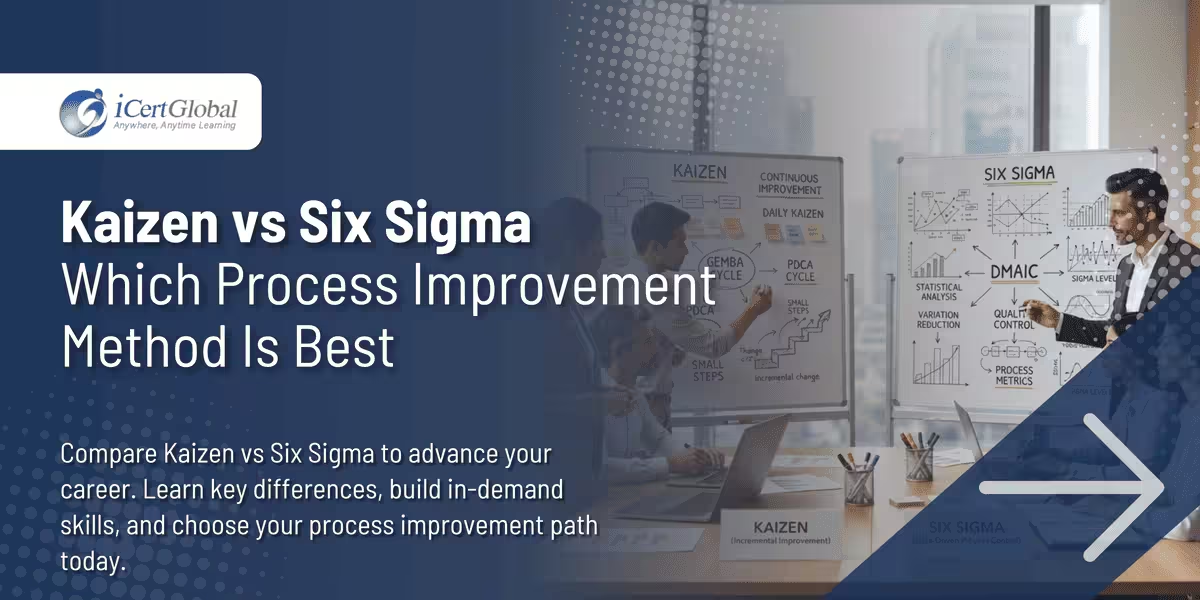
Compare Kaizen vs Six Sigma to advance your career. Learn key differences, build in-demand skills, and choose your
Advance your career by mastering quality management. Discover the key differences between Six Sigma and TQM to choose
.avif)
Master the DMAIC framework and boost your career. Learn how to achieve Six Sigma Green Belt Certification with
Discover the complete breakdown of Six Sigma Yellow Belt Certification costs in 2026. Compare ASQ vs. IASSC fees,
Master lean six sigma to reduce costs and improve quality. Expert insights for leaders on process improvement techniques
Master the 5S methodology to eliminate waste and boost efficiency. Learn how the 5S system in lean management
Our experts are ready to help you with any questions about courses, admissions, or career paths. Get personalized guidance from industry professionals.
Request a Call Back

"PMI®", "PMBOK®", "PMP®", "CAPM®" and "PMI-ACP®" are registered marks of the Project Management Institute, Inc. | "CSM", "CST" are Registered Trade Marks of The Scrum Alliance, USA. | COBIT® is a trademark of ISACA® registered in the United States and other countries.

