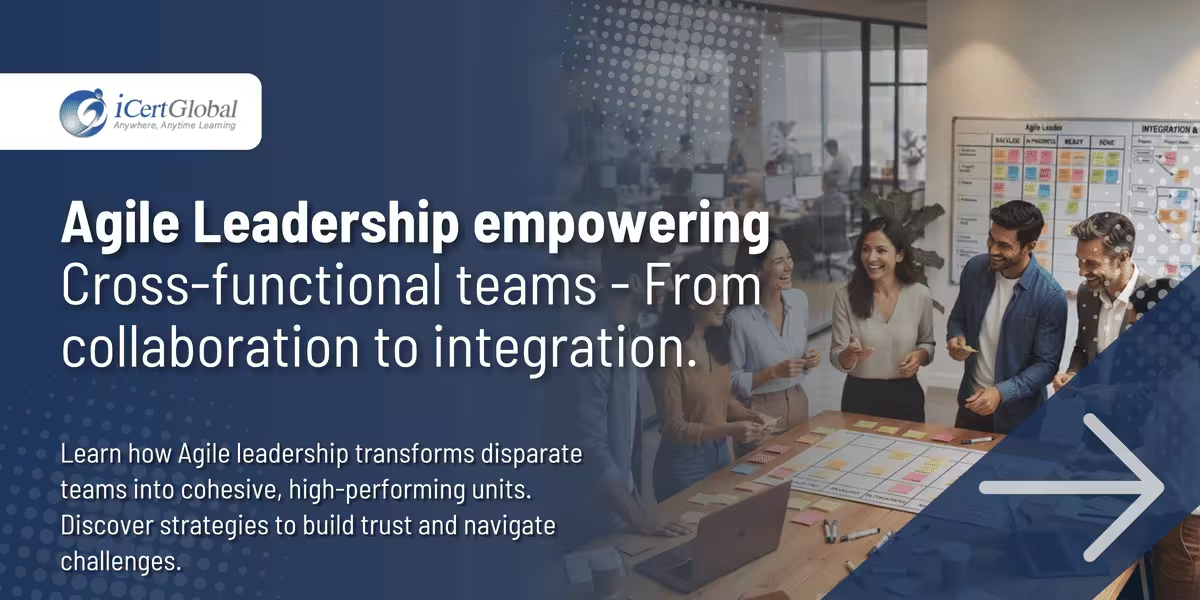
Quick Summary
Agile leadership transforms modern enterprises by replacing rigid top-down management with supportive servant leadership, empowering cross-functional teams to dismantle operational silos and achieve a 71% project success rate. By cultivating psychological safety, decentralizing decision-making, and prioritizing value-driven metrics over output volume, agile leaders eliminate organizational friction to drive continuous delivery. Mastering core competencies like agile coaching, system thinking, and impediment removal enables leaders to build high-performing teams while advancing their professional trajectory with industry credentials like Certified ScrumMaster (CSM) and PMI-ACP.
Introduction
Agile leadership plays a vital role in organizational growth by empowering cross-functional teams to break down operational silos and drive true integration. According to research from the Project Management Institute (PMI), organizations that prioritize adaptable leadership report a 71% success rate in meeting project goals compared to those relying solely on rigid structures. While modern enterprises deploy agile frameworks to improve responsiveness, methodology alone cannot guarantee strategic alignment. As a practitioner, mastering these adaptable leadership behaviors transforms individual contributors into high-performing units that consistently deliver measurable value.
In this guide, you will discover:
- The exact definition of agile leadership and how it differs from traditional management.
- Key agile leadership behaviors, core skills, competencies, and practical cross-functional scenarios.
- Actionable strategies to build psychological safety and resolve alignment challenges.
- Proven metrics for measuring team success and advancing your career through professional certification pathways.
What Is Agile Leadership?
Agile leadership is a modern management approach focused on empowering self-managing, cross-functional teams, fostering psychological safety, and driving continuous adaptability to deliver maximum customer value. Rather than directing daily tasks, agile leaders remove organizational obstacles and establish strategic boundaries. Crucially, an agile leader can emerge from any organizational role without requiring formal managerial title.
By stepping back from micromanagement, leaders enable team members to take direct ownership of outcomes. This environment encourages rapid feedback loops, enables decentralized decision-making, and equips enterprise teams to navigate market volatility effectively.
Traditional Manager vs Agile Leader
Understanding the distinction between traditional management and agile leadership helps organizations move away from rigid top-down structures while maintaining operational discipline and accountability.
| Dimension | Traditional Manager | Agile Leader |
|---|---|---|
| Decision-making | Centralized; decisions made top-down and passed to execution teams. | Decentralized; team empowered to decide execution strategies within clear guardrails. |
| Role in the team | Directive authority and task assigner; monitors individual compliance. | Servant leader and coach; removes roadblocks and enables team autonomy. |
| Handling conflict | Enforces top-down decisions or defers to institutional protocol. | Facilitates constructive dialogue to uncover root causes and shared consensus. |
| Response to change | Views change as risk; enforces adherence to original baselined plans. | Embraces change as opportunity; adjusts priorities iteratively based on evidence. |
| How success is measured | Conformance to plan, budget adherence, and output activity volume. | Delivered customer value, team health, and continuous flow of outcomes. |
| View of failure | Punitive attitude; focuses on assigning blame and minimizing deviation. | Learning opportunity; treats setbacks as feedback to refine processes. |
What Does an Agile Leader Actually Do?
Set Direction Without Dictating Tasks
An agile leader communicates clear strategic vision and high-level business goals while granting product, engineering, and marketing team members complete operational authority over how execution occurs. For instance, when launching a user portal, the leader defines user acquisition targets while allowing the technical team to determine the architecture, sprint breakdown, and release strategy.
Establish Useful Boundaries and Decision Rights
Leaders define decision boundaries, budget constraints, and quality guardrails without micromanaging day-to-day work. By explicitly clarifying rights—such as permitting engineering teams to deploy minor bug fixes independently while reserving security compliance sign-offs for joint review—leaders speed up operational delivery.
Remove Organizational Impediments Beyond Team Control
Cross-functional teams often encounter systemic friction outside their authority, such as inter-departmental resource contention or delayed vendor sign-offs. An agile leader actively intercedes at the executive level to clear these organizational bottlenecks, keeping team momentum intact.
Ask Planning Questions Instead of Demanding Commitments
Rather than imposing strict deadlines, agile leaders ask targeted planning questions regarding capacity, risk factors, dependencies, and trade-offs. Asking questions like "What assumptions underly this delivery estimate?" helps teams evaluate their work realistically without feeling forced into unviable schedule commitments.
Know When to Intervene and When to Step Back
Effective agile leaders recognize the line between offering support and overstepping boundaries. They intervene when systemic blockers threaten delivery or team health, yet step back during internal task allocation to foster problem-solving and self-organization within the team.
Agile Leadership Skills and Competencies
Servant Leadership and Systems Thinking
Agile leadership centers on servant leadership—prioritizing team empowerment, growth, and continuous enablement over directive control. Combined with systems thinking, leaders optimize organizational workflows holistically rather than focusing on isolated departmental silos.
Emotional Intelligence and Agile Coaching
High emotional intelligence allows leaders to build strong interpersonal trust, active listening, and empathy. Applying professional agile coaching practices helps team members evaluate challenges critically and develop self-reliance.
Facilitation and Conflict Resolution
Cross-functional viewpoints naturally generate debate. Agile leaders act as neutral facilitators, leveraging structured dialogue to turn differing perspectives into creative problem-solving outcomes without relying on authoritative mandates.
Decisiveness Under Uncertainty and Transparency
In rapidly changing markets, agile leaders maintain decisiveness using partial data while remaining transparent about risks. Sharing project roadmaps, delivery metrics, and operational challenges openly cultivates trust across teams and stakeholders.
| Core Competency | Practical Application | Impact on Cross-Functional Teams |
|---|---|---|
| Servant Leadership | Focusing on team enablement and obstacle removal. | Drives intrinsic motivation and self-management. |
| Adaptability | Pivoting strategies based on rapid feedback loops. | Reduces sunk costs and aligns with market needs. |
| Emotional Intelligence | Active listening and empathetic stakeholder engagement. | Strengthens team trust and psychological safety. |
| Agile Coaching | Guiding teams through reflective questioning. | Builds sustainable technical and process autonomy. |
| Facilitation | Structuring joint planning sessions and retrospectives. | Aligns conflicting multi-departmental goals. |
| Decisiveness Under Uncertainty | Making informed, timely choices despite ambiguity. | Prevents organizational inertia and execution delay. |
| Transparency | Maintaining open channels regarding progress and metrics. | Eliminates information silos across organizational tiers. |
| Systems Thinking | Optimizing overall end-to-end delivery flows. | Prevents local optimization at the expense of global value. |
From Collaboration to True Integration: The Agile Journey
Collaboration vs Integration Comparison
While basic collaboration involves separate functional groups communicating periodically, true integration unites engineering, product management, and marketing into a single unit aligned around shared value delivery.
| Dimension | Collaborative Teams | Integrated Cross-Functional Teams |
|---|---|---|
| Shared Goal | Siloed functional goals with occasional touchpoints. | Single customer-centric metric and unified delivery objective. |
| Ownership | Handed off sequentially across departmental boundaries. | Joint end-to-end accountability from ideation to release. |
| Decision Speed | Slower; requires multi-tier functional approvals. | Rapid; localized decision-making within team guardrails. |
| Handling Dependencies | Managed through formal request tickets and status queues. | Resolved internally through dynamic cross-skill coverage. |
| Response to Change | Requires renegotiating functional handoff terms. | Adapts real-time during backlog refinement and planning. |
Leveraging Agile Frameworks Across Teams
To establish seamless integration, organizations leverage established approaches detailed in our Scrum, Kanban, XP, and SAFe guide. Scrum offers iterative cadence and clear events; Kanban provides visual workflow control and capacity management; Extreme Programming (XP) promotes technical engineering rigor; and the Scaled Agile Framework (SAFe) aligns multi-team enterprises around strategy execution.
Building Psychological Safety in Agile Teams
The Foundation of High-Performing Cross-Functional Teams
Psychological safety is the shared belief that a team is safe for interpersonal risk-taking. Research conducted by Dr. Amy Edmondson at Harvard Business School, reinforced by Google's Project Aristotle study, demonstrates that psychological safety underpins cross-functional success. In psychologically safe teams, individuals freely report operational errors, raise conflicting views, and experiment without fear of embarrassment or retribution.
Practical Leadership Actions for Psychological Safety
Agile leaders cultivate psychological safety through structured behaviors:
- Conduct Blameless Retrospectives: Focus on process vulnerabilities rather than assigning individual fault when incidents occur.
- Acknowledge Mistakes and Vulnerability: Model humility by openly admitting mistakes and sharing lessons learned.
- Establish Help-Seeking Norms: Normalize seeking support early during sprints to prevent isolated delivery bottlenecks.
- Invite Dissenting Views: Solicit non-conforming feedback during backlog refinement to identify unseen operational risks.
Common Challenges in Cross-Functional Agile Teams and How Leaders Solve Them
Resolving Conflicting Stakeholder Priorities
Challenge: Product, sales, and technical teams push competing agenda items into execution sprints.
Leadership Action: Implement objective prioritization frameworks (e.g., WSJF or Value vs. Effort) and align stakeholders around a single prioritized product backlog.
Bridging Cross-Functional Communication Gaps
Challenge: Specialized departmental jargon leads to misunderstandings regarding project features.
Leadership Action: Establish standard domain terminology, run joint user story mapping, and hold frequent cross-functional refinement sessions.
Overcoming Legacy Organizational Structures
Challenge: Deeply entrenched functional silos enforce cumbersome multi-stage approval processes.
Leadership Action: Secure executive sponsorship to grant localized decision rights directly to cross-functional product squads.
Navigating Resistance to Organizational Change
Challenge: Personnel accustomed to traditional directive management resist self-organizing expectations.
Leadership Action: Communicate transparently about change motives, offer structured agile coaching, and celebrate early small wins.
Supporting Distributed and Hybrid Agile Teams
Challenge: Time-zone variances and remote communication dilute team cohesion and flow visibility.
Leadership Action: Mandate centralized asynchronous documentation, leverage digital Kanban boards, and build virtual team-building routines.
How to Measure Agile Leadership and Team Success
Value-Driven Team Performance Metrics
Measuring performance in agile environments requires focusing on outcome value, operational flow, and sustainable team health rather than individual activity counts.
- Cycle Time and Lead Time: Measures the duration from work item commitment or request to final delivery, reflecting operational agility.
- Customer Value Delivered: Evaluates actual customer usage, NPS improvements, or revenue gain post-release.
- Delivery Predictability and Flow: Evaluates the ratio of planned vs. completed backlog items across consistent sprint cadences.
- Team Health and Retention: Assesses team morale, psychological safety scores, and voluntary retention over time.
Understanding Velocity and Avoiding Misuse
Team velocity represents the amount of work completed during an iteration, used primarily as an internal capacity forecasting tool. Velocity must never be compared across different teams, as each team estimates work relative to its unique context. Treating velocity as a comparative productivity metric distorts story point estimation and compromises code quality.
| Metric | Primary Focus | Common Misuse Risk |
|---|---|---|
| Lead / Cycle Time | Flow speed and process bottleneck reduction. | Rushing reviews at the expense of technical quality. |
| Customer Outcomes | Delivered business value and user satisfaction. | Focusing on short-term metrics over systemic code health. |
| Team Velocity | Internal sprint capacity estimation. | Comparing across teams or forcing target velocity increases. |
| Team Morale Index | Sustainable workload and employee engagement. | Ignoring qualitative retro feedback in favor of survey scores. |
Common Agile Leadership Mistakes
- Reverting to command-and-control directive management when project stress increases.
- Treating tentative sprint estimates as fixed contractual delivery commitments.
- Changing sprint priorities mid-iteration without assessing trade-offs or team impact.
- Intervening immediately to solve tactical problems that the team should solve independently.
- Rewarding individual heroics while ignoring sustainable, collective team accomplishments.
Illustrative Scenario: Agile Leadership in Action
(Illustrative scenario demonstrating cross-functional realignment)
Before: A financial software enterprise struggled with delayed product releases. Product management demanded new compliance features, engineering wrestled with architecture debt, and marketing prepared product launch campaigns based on unverified delivery dates. Unaligned priorities resulted in friction, missed deadlines, and low team morale.
Leader's Action: The agile leader brought representatives from product, engineering, and marketing into a joint mapping session. They established a unified prioritization matrix, clarified localized decision rights, and interceded with executive leadership to remove non-essential compliance sign-off gates. The leader focused the team on delivering a single viable release increment.
After: Cross-functional transparency reduced friction across departments. The team successfully delivered the core release increment two weeks early, achieved higher code quality, and built a sustainable model for future sprint planning.
How to Develop Agile Leadership Skills
Practical Leadership Habits and Facilitation
Developing effective agile leadership capabilities requires deliberate practice, feedback, and active coaching. Leaders must transition from directing outcomes to facilitating dialogue, learning to manage systems rather than controlling individual tasks.
Certification Pathways for Professional Growth
Continuous learning and recognized professional credentials validate your expertise and equip you with practical tools to drive organizational change. Essential agile pathways include:
- Coaching Practice: Developing empathetic, non-directive questioning methods to guide self-managing teams.
- Servant Leadership Habits: Consistently prioritizing team enablement, transparent communication, and roadblock removal.
- Facilitation Mastery: Learning consensus-building methodologies to align conflicting stakeholder demands.
- Certified ScrumMaster (CSM): Establishes strong foundational knowledge of core Scrum values, team facilitation, and operational coaching.
- PMI-ACP (Agile Certified Practitioner): Demonstrates comprehensive mastery across diverse agile frameworks including Scrum, Kanban, Lean, and XP.
- Advanced Certified ScrumMaster (A-CSM): Deepens advanced coaching, scaling methods, and organizational change facilitation skills.
Conclusion
Agile leadership is not about maintaining rigid control or having every solution, but about cultivating an environment where self-managing cross-functional teams take ownership and solve complex challenges. By transitioning from directive management to supportive, outcome-driven facilitation, you enable your team to deliver consistent business value while positioning yourself as an indispensable driver of organizational success.
Developing practical agile leadership skills equips you to remove operational bottlenecks, enhance cross-functional integration, and accelerate your personal career trajectory. Validate your expertise and take charge of your professional growth by pursuing industry-standard credentials such as the Certified ScrumMaster (CSM), PMI-ACP, and A-CSM.
Ultimately, modern leadership is defined not by top-down authority, but by your ability to create an environment where cross-functional teams thrive independently.






Write a Comment
Your email address will not be published. Required fields are marked (*)