
|
⚡ QUICK ANSWER The PMBOK 8th edition marks a shift toward integrating artificial intelligence and advanced digital workflows within the project management framework. It prioritizes hybrid methodologies and outcome-based delivery over rigid process groups. This latest version aligns project governance with rapid technological disruptions to ensure practitioners remain effective in complex environments. |
According to a recent global survey, 67% of high-performing organizations are now putting more emphasis on power skills and digital fluency than on traditional technical expertise. With automation causing substantial disruption in project management, professionals pursuing PMI training must adapt to evolving PMBOK standards and digital workflows. By the end of the decade, there will be 33% more demand for project managers adept at utilizing these new frameworks. Therefore, mastering these standards will become an essential requirement for senior executives.
In this article, you will learn:
- The Core Philosophy Shift in PMBOK 8th edition
- Critical PMBOK 8th edition updates to Domain Performance
- How PMP exam changes Impact Your Certification Strategy
- Navigating the PMBOK Guide latest version for Strategic Alignment
- Leveraging Project management process improvements for Organizational Value
- PMI framework updates: AI and Data-Driven Decision Making
The Core Philosophy Shift in PMBOK 8th Edition
Project Management has applied great advances in how projects were executed predictably and linearly to a complete evolution where the Project Management Body of Knowledge (PMBOK) is now truly dedicated to providing multiple approaches and solutions to any situation, making the PMBOK an agile framework. As someone with over 10 years of project management experience, this recent release from the PMBOK has made clear to me that the biggest change from the previous editions to this edition is how we will now approach each situation based on our individual experience and knowledge and also through our thinking rather than relying on a standard process for all situations.
Another significant difference in this release of the PMBOK is the shift from the mechanics of completing tasks to emphasizing the Value Delivery Organization (VDO) as well as our approach to completing projects. We have all come to realize that projects were not stand-alone efforts but will be part of a continuous stream of value to the organization; therefore, we must begin to adopt a new mindset that balances the traditional methods of project governance with the need for speed in completing projects.
Critical PMBOK 8th edition updates to Domain Performance
Updates on the way that project performance domains can be perceived have changed. More particularly, the importance of both team development and stakeholder engagement are two of the foundational components of project success. In the following table, you will see comparisons between old focus areas and current focus areas.
|
Performance Domain |
Previous Focus (7th Ed) |
PMBOK 8th Edition Update |
|
Stakeholder |
Engagement and Communication |
Collaborative Co-creation |
|
Team |
Management and Leadership |
Autonomous Digital Synergy |
|
Development |
Predictive / Hybrid |
Adaptive AI-Enhanced Lifecycles |
|
Planning |
Scope, Schedule, Cost |
Value-Stream Mapping |
|
Project Work |
Process Compliance |
Flow and Bottleneck Resolution |
|
Delivery |
Quality and Scope |
Outcomes and Benefits Realization |
The updates will help project management software support project managers use the reporting of metrics not only as a method of tracking what has happened, but also to help direct their project based on the company's overall strategy. The reference to "Flow" suggests that doing an effective job of eliminating friction from the project is considered just as important as actively managing project resources.
How PMP exam changes Impact Your Certification Strategy
The significance of examining the project management professional (PMP) examination after its recent revisions cannot be understated. As such, it is essential for project managers that want to define their skills through this certification to comprehend and adapt to these changes. The question composition of the examination has evolved and now features a larger portion of questions covering themes associated with digital literacy and the implementation of generative technologies in project and calendar execution workflow processes. Moreover, the traditional delineation dichotomy between predictive and agile methodologies has now become virtually impossible to distinguish; thus leading to blended or hybridized methodologies being the new standard in project management methodology selection and application practices.
As such, project management professionals will now be required to demonstrate their ability to select methodologies or tools based upon the context rather than utilizing one standard methodology for all projects. Therefore, when preparing for the test, focus should be devoted to demonstrating situational judgment and applying PMI specific updates from the PMI Framework in volatile project environments.
Navigating the PMBOK Guide latest version for Strategic Alignment
The latest iteration (5th Ed.) of the PMBOK Guide has been architected to be an ongoing document; it will be regularly updated via “digital platforms”, like PMI Standards+.” This allows the PMBOK Guide to remain relevant as new technology continues to develop. Therefore, for executives at the top of the hierarchy, the PMBOK Guide is no longer a book that you can read once; it is a structure that allows for continual use throughout the duration of your project.
One of the most significant advances to the PMBOK Guide is “Resilience” being identified as one of the standard dimensions of all project attributes. This will establish a measurable success factor for the integrity of the project with respect to how well it can continue to maintain its objectives when there are outside influences (such as a change in the economy or a new technological breakthrough). In order to facilitate this new dimension it will also require the implementation of a new, more sophisticated and comprehensive methodology for assessing risk (e.g., moving from preventing risk to creating an “antifragile” or functioning in a state of “antifragility” to long-term).
Leveraging Project management process improvements for Organizational Value
The PMBOK 8th edition introduces significant project management process improvements that focus on reducing administrative overhead. By utilizing automated data collection and real-time reporting, project managers can spend more time on high-value activities like mentorship and strategic stakeholder alignment.
- Continuous Feedback Loops: Implementation of real-time data to adjust project trajectories instantly.
- De-centralized Decision Making: Empowering teams to make tactical decisions within a governed framework.
- Predictive Analytics: Using historical data to forecast potential roadblocks before they manifest.
Case Reference: Global Logistics Expansion
An international logistics company took advantage of the new edition “Flow” principles during their supply chain transformation process by substituting hard stops (milestones) with ongoing assessments of value streams, resulting in a 22% reduction in time to market and compliance with all relevant regulations.
PMI framework updates: AI and Data-Driven Decision Making
The current conversation about the updated PMI framework revolves around how Artificial Intelligence (AI) will be incorporated. The 8th edition gives you a way to visualize how human intelligence and machine learning work together, as well as what roles project managers can take on to enhance their integration; for example, project managers can assume the role of "orchestrators" of technology rather than being solely end-users.
Real-World Example: Developing infrastructure
In a recent smart city project, the management team applied updated PMI standards to incorporate digital twin technology into project management processes; this enabled the team to simulate construction variables in real time, resulting in a 15% decrease in material waste. The responsibility of the project manager transitioned from manually overseeing a project to utilizing the outputs produced by AI-based simulations for high-level strategic decisions.
UX Planning: Project Governance's Evolution
Suggested Visual: A circular "Value Loop" diagram illustrating how Data, AI, and Human Leadership all interact within PMBOK 8th Edition; the center of the diagram is "Business Value," with concentric circles representing Performance Domains, showing continuous feedback as opposed to the linearly starting and finishing lines.
PMBOK 7th vs 8th Edition
|
Basis of Comparison |
PMBOK 7 |
PMBOK 8 |
|
Main Focus |
Focused more on project management principles |
Focuses on practical project execution and real-world application |
|
Style |
More theory and concept-based |
More practical and action-oriented |
|
Principles |
Includes 12 principles |
Simplified into 6 practical principles |
|
Performance Domains |
8 Performance Domains |
7 Performance Domains |
|
Guidance for Project Managers |
Flexible but less detailed |
Provides clearer guidance, tools, and techniques |
New Updates in PMBOK 8
Modern projects involve multiple stakeholders, remote teams, digital collaboration tools (Jira, Slack), along with a mix of delivery approaches ( Agile and traditional). This often gives rise to collaboration and communication challenges.
The PMBOK Guide 8th edition equips project managers with tools, actionable guidance, and techniques they can tailor according to the project’s complexity, requirements, and size. It enables project managers to deliver outcomes that align with business and stakeholder requirements. Most importantly, it helps project managers to work smoothly across all 3 project environments: predictive, hybrid, and Agile.
- Five Focus Areas
The PMBOK 6th edition’s five process groups have been reintroduced in PMBOK 8 under the heading ‘Focus Areas.’ Focus areas cover five phases of project management, including initiating, executing, monitoring, planning, and closing. These phases are flexible and adaptable - this makes them suitable for Agile, hybrid, and predictive methodologies.

- Clear Principles
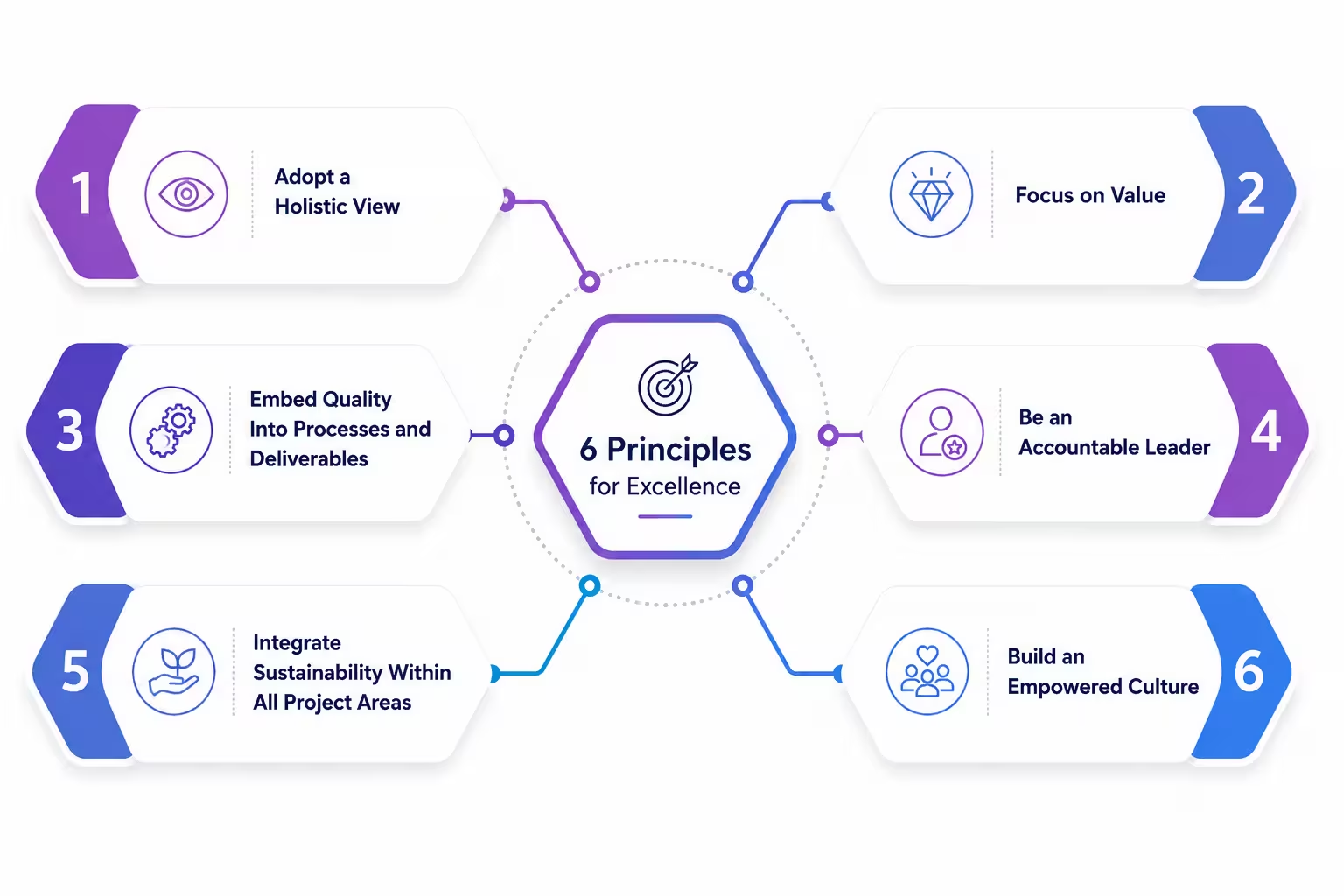
The latest version places importance on practical, actionable, and simplified principles over abstract ideas. The new edition includes 6 principles, reduced from the twelve principles in the previous version. Project Managers can apply these principles to their projects directly - it guides them on how to lead teams, think critically, and make decisions.
- Modern Topics
The 8th edition of PMBOK has been drafted from the perspective of modern project managers who find it difficult to navigate technology-driven changes. It integrates emerging trends like AI with project management practices
Artificial Intelligence: It emphasizes how AI can be leveraged for planning, identifying risks, and predicting outcomes.
Procurement Practices: It helps project teams understand how resources are procured, along with compliance frameworks.
Project Management Offices: A PMO’s main objective is to ensure the project is being carried out in alignment with the organization’s ethics.
Sustainability: The goal is to ensure the project is being carried out with the help of environmentally friendly practices.
- Seven Performance Domains
PMBOK 8 has replaced the traditional Knowledge Areas with seven performance domains that cover all areas of project management. It eliminates ‘prescriptive ideas’ and outlines 40 practical ideas that can be implemented to handle projects

How PMBOK Supports Three Key Project Management Methodologies
- Waterfall Approach
The waterfall approach is ideal for construction, manufacturing, or infrastructure-based projects, as the requirements are fixed. It highlights a traditional way of managing projects where scope, budget, and schedule are predefined.
PMBOK 8 supports Waterfall projects with the help of five Focus Areas. Projects are planned at the beginning, and project tasks move through initiation, planning, execution, monitoring, and closing phases.
- Agile Approach
Agile is a flexible approach where work is carried out and delivered in short cycles known as ‘sprints.’ The focus is to gather feedback from stakeholders and tailor project management practices to meet evolving stakeholder requirements. Instead of completing tasks sequentially, value is delivered incrementally (small steps).
It’s suitable for software development teams where collaboration, stakeholder engagement, and adaptability play a major role.
The PMBOK latest edition fosters a culture of continuous learning, collaboration, and coordination through the 6 project management principles. The inclusion of 7 performance domains, including governance, scope, stakeholder, resources, risk, finance, and schedule, equips Agile teams with the tools required to identify risks early, respond to changes quickly, and monitor performance.
- Hybrid Approach
Hybrid project management encourages project managers to apply both adaptive (Agile) and predictive (traditional) approaches to carry out a project. For example, in a technology-based project, tasks like hardware procurement can be carried out through a sequential and predictive process. Whereas software development tasks can be handled with the help of flexible Ag/ile practices as requirements evolve through testing and feedback.
As per PMBOK guidelines, project managers have the autonomy to tailor techniques, tools, and frameworks as per the project’s complexity level, stakeholder requirements, and industry requirements.
Learn more about PMBOK in project management.
Why is PMBOK 8th Edition Important for Project Managers?
- Deliver Business Value
While older versions required project managers to deliver projects within the specified budget and timeline, PMBOK 8 encourages them to deliver value. Project managers should ensure that the project outcomes delivered are in alignment with customer expectations and organizational goals.
- Modern Project Environments
Modern projects require more than rigid methodologies as teams today are working across diverse locations, technologies are evolving quickly, and customer requirements are changing every day. PMBOK’s latest edition allows project managers to address modern issues through flexible and realistic practices.
- Manage Uncertainty and Changes
Projects often encounter unexpected risks, challenges, and changing requirements. A thorough understanding of PMBOK 8 helps project managers think critically, identify risks, and develop flexible strategies to respond to uncertainty.
- Use of AI and Emerging Technologies
PMBOK 8 highlights why the use of modern tools is integral for project management. It equips project managers with the knowledge required to deploy data-driven systems, AI tools, and automation techniques in project execution.
- Promotes Flexible Project Management Practices
The latest edition emphasizes there’s no one-size-fits-all approach to project management. Rather, it equips teams to customize processes, methodologies, and tools according to the project’s complexity, stakeholder needs, industry, and project size.
Real-World Applications: Case Studies in Framework Alignment
To recognize the true value of these standards, it's important to see how they can be applied to address real world problems.
Real-World Applications: Case Studies in Framework Alignment
Example #1: An attempt to improve the company's infrastructure.
In this example, a very large telecommunications company that was having continual delays with their deployment of 5G, was having problems with vendor coordination. The company developed a centralized command center through the use of PMBOK Guide standards in procurement management and integration management. This allowed them to establish a standardized reporting frequency and standard metrics that all twelve (12) vendors would use. Ultimately, this will lead to a reduction of lead time by an approximate fifteen percent (15%) from the date of project inception to date of completion within a six month (6) time period.
Example #2: Refocusing the Software Development Process.
Through the use of PMI project management standards, a fintech start-up that was suffering from scope creep was able to redefine their change control board. The company utilized the "Value-Driven Delivery" principle by prioritizing changes in features that would have the greatest immediate impact on the marketplace, instead of those that had been originally thought. Through this process, the company will save approximately $200,000.00 in lost development time related to low value features.
Conclusion
The PMBOK 8th edition represents a necessary leap forward for a profession that stands at the crossroads of human leadership and technological advancement. By shifting focus toward outcomes, flow, and AI integration, the standard provides a roadmap for navigating the complexities of the modern business world. For experienced professionals, mastering these changes is not just about keeping a certification current; it is about maintaining a competitive edge in an era where the only constant is change. Embracing the PMBOK 8th edition ensures that your projects deliver not just outputs, but lasting strategic impact.





Write a Comment
Your email address will not be published. Required fields are marked (*)