
Quick Summary
Earning your PMP certification is a highly rewarding career milestone, but with a 30% to 40% first-time failure rate, success requires moving past everyday workplace habits to fully adopt the structured PMI mindset. To pass with confidence, you must master the Agile and Hybrid methodologies that now make up 60% of the exam while aligning projects with strategic business value. By committing to a structured study plan and taking realistic practice simulations, you will build the mental stamina needed to conquer this exam and unlock your full professional potential.
Introduction
As the future of project management becomes more data-driven and agile, implementing strategic pmp exam tips to earn your credential in 2026 is essential to stay competitive and master modern delivery practices. To pass the PMP exam, you must prioritize understanding how projects align with organizational strategy, while balancing the Agile and Hybrid methodologies that dominate the current assessment. Success requires moving beyond rote memorization to internalizing the PMI mindset, focusing on stakeholder value, and practicing under realistic conditions to build the mental stamina needed for the 180-question, 230-minute exam.
The global project management software market is projected to reach 9.81 billion dollars by 2026, yet industry data reveals a sobering reality: approximately 30% to 40% of candidates fail their first attempt. This high failure rate is rarely due to a lack of hands-on experience, but rather a misalignment between real-world workplace habits and the specific governance frameworks required by the Project Management Institute (PMI). By structuring your study plan around authoritative pmp exam tips and proven prep resources, you can master the PMI perspective, avoid the experience trap, and secure your professional certification with confidence.
The Rising Stakes of Project Leadership
The professional landscape for project leaders is undergoing a significant phase of maturity. As organizations move away from rigid, process-heavy structures toward outcome-oriented delivery, the certification standards have followed suit. For a professional with over a decade of experience, the challenge often lies in unlearning localized "office rules" and adopting a standardized, global perspective. This guide provides the high-level strategy and actionable pmp exam tips needed to navigate these updates and secure your credential with confidence. Learn more about our comprehensive PMP certification training program and take the next step.
In this article, you will learn:
- The fundamental shifts in the 2026 Exam Content Outline (ECO).
- Strategic preparation techniques for the three core domains.
- How to navigate the increased emphasis on Business Environment.
- Practical methods to master Agile and Hybrid delivery models.
- Mental conditioning and time management for exam day.
- The role of AI and sustainability in modern project questions.
- Common pitfalls experienced professionals must avoid.
- A step-by-step framework for first-time success.
Understanding the 2026 Exam Content Outline
The Exam Content Outline (ECO) is the formal blueprint published by the Project Management Institute (PMI) that defines the core competencies, tasks, and exam content outline domains assessed on the PMP exam to ensure alignment with modern project management roles.
Step-by-Step Framework for PMP Success
- Conduct a baseline assessment using a retired exam question set from a PMI authorized training partner.
- Map your current knowledge gaps against the three updated domains.
- Establish a consistent study rhythm of at least ten hours weekly, incorporating high-quality project management professional prep materials.
- Study the PMBOK Guide 8th edition alongside the Agile Practice Guide.
- Complete three full-length simulations utilizing reputable, realistic question banks to build testing endurance.
- Analyze every incorrect mock answer to identify logic errors and refine your application of the PMI mindset.
Mastering the Three Core Domains
Domain I: People
In the current version, the People domain focuses heavily on soft skills and leadership within diverse, often remote or hybrid, teams. It is no longer enough to manage a schedule; you must demonstrate how to lead a team through conflict, support virtual collaboration, and mentor stakeholders. For senior professionals, this area often feels intuitive, yet the exam requires specific actions—such as prioritizing emotional intelligence over simple task delegation. Applying robust pmp exam tips in this domain involves shifting your perspective to collaborative facilitation.
Domain II: Process
While the direct emphasis of traditional execution has shifted, the Process domain remains the technical heart of the certification. The key here is "tailoring." You must know when a predictive approach is superior to an agile one and how to blend them into a hybrid model. Questions often present a scenario where a project is failing because the wrong methodology was applied, and you must identify the corrective path.
Domain III: Business Environment
This is a highly critical area for modern candidates. You will face questions on how projects support organizational strategy and the impact of external factors like market shifts or new regulations. Understanding "Value Delivery" is paramount here. You are not just delivering a product; you are enabling a business benefit. Integrating strategic pmp exam tips helps candidates evaluate corporate governance from the eyes of a true business partner.
The Impact of AI and Sustainability
A notable addition to the curriculum is the integration of Artificial Intelligence and Sustainability. You will likely encounter scenarios where AI tools are used for predictive analytics, risk forecasting, or resource leveling. Similarly, Environmental, Social, and Governance (ESG) factors are now woven into the decision-making process.
Real-World Case Reference: The Sustainable Infrastructure Shift
Consider a large-scale urban development project. In previous exam cycles, the focus would stay strictly on the triple constraint: scope, time, and cost. In the current context, a successful candidate must also account for the long-term social impact and environmental compliance as part of the "Business Environment" domain. Failing to address these "externalities" in a scenario-based question would likely lead to an incorrect answer.
Navigating Agile and Hybrid Realities
With 60% of the exam now covering Agile or Hybrid approaches, your familiarity with Scrum, Kanban, and Disciplined Agile is mandatory. Many experienced Project Managers from traditional industries like construction or manufacturing struggle here because they view Agile as "unstructured." On the contrary, the exam treats Agile as a highly disciplined framework focused on iterative value and rapid feedback loops.
Practical Use Case: Transitioning from Waterfall to Hybrid
Imagine a software-integrated hardware project. The hardware follows a predictive lifecycle (Waterfall), while the software development is iterative (Agile). The exam tests your ability to manage the "integration points" between these two speeds. You must know how to synchronize a monthly Sprint Review with a quarterly milestone report without creating a bottleneck. Reviewing agile-specific pmp exam tips can help clarify these hybrid workflows.
Mental Conditioning and Time Management
The PMP is as much an endurance test as it is a knowledge assessment. You have roughly 76 seconds per question.
- The "First Instinct" Rule: Experienced managers often overthink scenarios based on their specific past failures. Trust the PMI-recommended path instead of second-guessing yourself.
- The 60-60-60 Strategy: Aim to complete each block of 60 questions in about 75 minutes, leaving a small buffer for the two 10-minute breaks.
- Stamina Training: Do not just take practice quizzes. You must sit for at least two 180-question sessions to understand the "brain fog" that sets in after question 120. Using quality project management professional prep simulators is essential.
Avoiding the "Experience Trap" and Common Mistakes
The most common reason senior professionals fail is using their personal experience instead of the PMI standards. In your office, you might escalate a budget issue immediately to your director. On the exam, the "best" answer might be to first evaluate the impact on the management reserve or consult the change management plan. Always ask: "What does the formal process dictate?" rather than "What would I do at my desk on Monday morning?"
To build a foolproof study plan, candidates must recognize the most common mistakes to avoid on the pmp exam:
- Misunderstanding the Question: Failing to identify whether the scenario is predictive, agile, or hybrid leads to choosing the wrong methodology toolset.
- Choosing Answers Based on Real-World Experience: PMI expects you to act as a proactive project manager operating in an ideal world with structured procedures. Avoid choosing shortcut methods used at your current workplace.
- Poor Time Management: Spending more than 90 seconds on a single question early on often leads to rushing through the final 40 questions.
- Overthinking Questions: Assuming every query has a hidden trick or complication causes candidates to second-guess straightforward answers.
- Ignoring Key Words in Questions: Missing transitional words like "FIRST," "NEXT," "BEST," "MOST," or "EXCEPT" can completely reverse the correct logical path.
- Insufficient Practice: Relying solely on book-reading without running simulated diagnostic exams to build your 230-minute test stamina.
- Not Reviewing Incorrect Answers: Just knowing your score isn’t enough; you must deeply analyze why your chosen answer was wrong and why PMI’s answer is right.
Reviewing these failure points is one of the most effective pmp exam tips to adjust your mind-frame prior to taking the actual exam.
PMP Decision Logic Flowchart
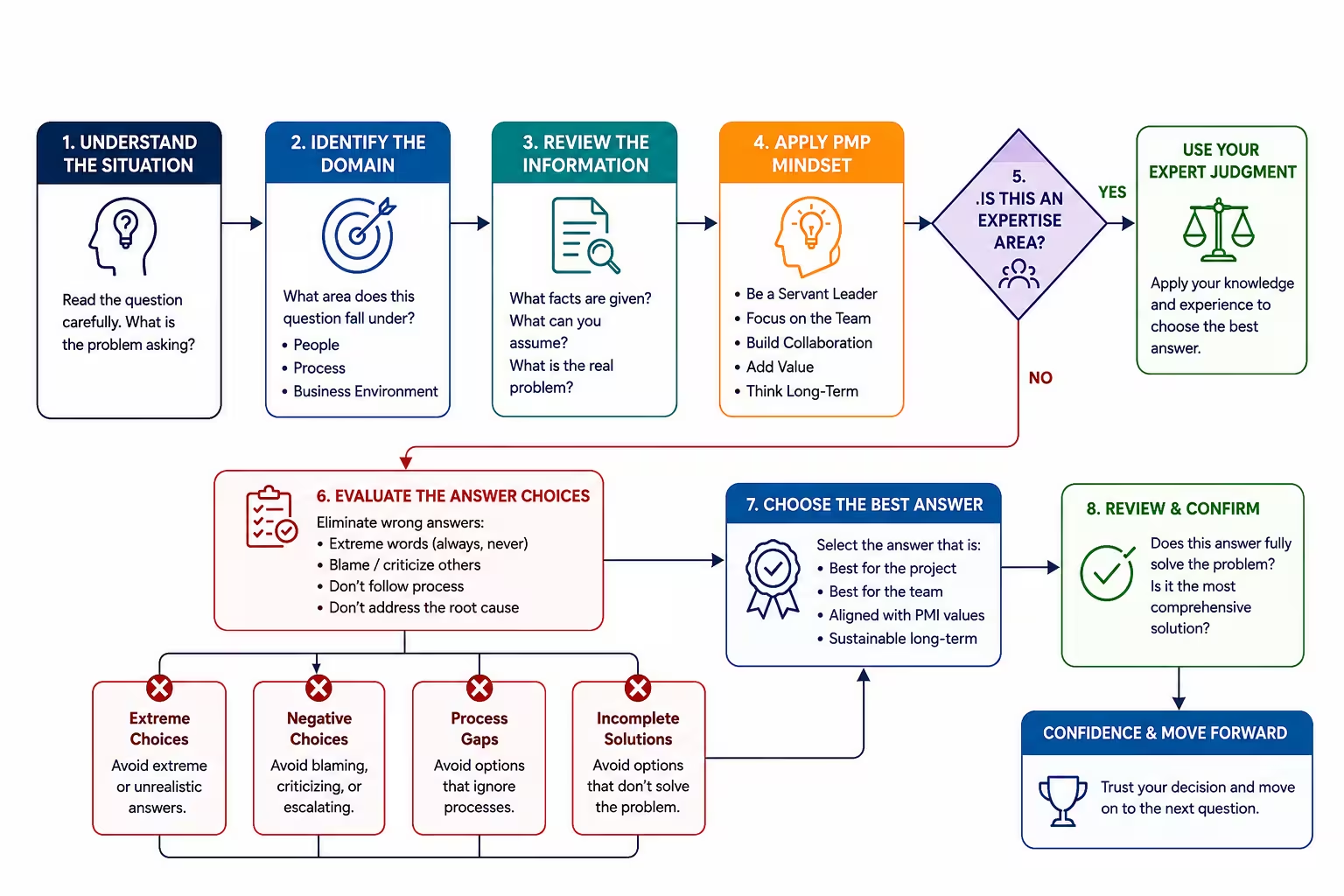
Best PMP Exam Tips and Study Resources
Your choice of preparatory materials can make the difference between passing and failing. Avoid generic test materials and build your study plan around highly credible, standardized resources. Here are the top-recommended study guides and tools:
| Resource Name | Core Purpose / Utility | Why It is Essential |
|---|---|---|
| PMBOK® Guide – 8th Edition | Official reference manual by PMI containing core standards and project performance domains. | Addresses the shift from process groups to value-based principles, crucial for current exam questions. |
| PMI® Study Hall™ | PMI’s official practice exam tool, simulator, and flashcard collection. | Features actual questions written by PMI, providing the exact tone, complexity, and layout of the real test. |
| Agile Practice Guide | Co-authored by PMI and Agile Alliance, focusing specifically on agile and hybrid frameworks. | Directly covers the 60% of exam questions centered around agile practices, Scrum ceremonies, and Kanban boards. |
| iCertGlobal PMP Exam Simulator | Robust exam engine with practice questions aligned to the latest Exam Content Outline domains. | Provides deep diagnostic reports and identifies exactly which domains require further study. |
Utilizing these tools alongside proven pmp exam tips will systematically eliminate knowledge gaps and maximize retention.
PMP Self-Study vs. Online Live Bootcamp
Choosing the right preparation path depends heavily on your schedule, budget, and personal learning preferences. To find the optimal strategy, let's compare the three main approaches to PMP prep:
| Feature / Criteria | Self-Study | Online Live Training | Bootcamp Training |
|---|---|---|---|
| Learning Style | Independent, self-paced reading and practice. | Interactive, structured virtual classrooms. | Intense, immersive fast-track curriculum. |
| Flexibility | Maximum; you set your own hours and timeline. | Moderate; fixed class times, customizable dates. | Low; pre-scheduled, consecutive-day dedication. |
| Instructor Interaction | None; self-guided learning. | High; real-time Q&A and active discussion. | Extremely High; continuous interaction with a certified trainer. |
| Cost Considerations | Lowest; only pay for books and simulators. | Moderate; includes courseware and training hours. | Premium; higher fee offset by rapid success rate. |
| Structure & Accountability | Low; requires high personal motivation. | High; scheduled weekly check-ins and classes. | Very High; intensive, rigorous daily schedule. |
| Best Suited For | Highly disciplined self-starters with ample time. | Working professionals needing interactive structure. | Candidates wanting to pass immediately in days. |
When weighing pmp self study vs online live bootcamp, think about your timeline. If you have only a few weeks to prepare, an intensive bootcamp led by a PMI authorized training partner is your most reliable route.
PMP Exam Day Checklist and Proctor Rules
Navigating the procedural requirements of the testing provider is just as important as mastering the syllabus. Minor administrative oversights can lead to a canceled exam session. Below is your essential pmp exam day checklist and proctor rules guide to guarantee a stress-free check-in.
| Category | Pearson VUE Testing Center Rules | Online Proctoring Rules |
|---|---|---|
| Check-In Timeline | Arrive at least 30 minutes before your scheduled appointment. | Log in 30 minutes early to perform system checks and upload photos. |
| Desk & Area Restrictions | Locker provided for all belongings. Nothing permitted at the testing desk. | Desk must be entirely clear of papers, electronic devices, or writing tools. |
| Allowed Tools | Erasable booklet and calculator provided by the center staff. | On-screen digital whiteboard and built-in calculator only. |
| Breaks | Two scheduled 10-minute breaks. You are allowed to leave the room. | Two scheduled 10-minute breaks. You must not leave webcam view outside scheduled breaks. |
Your Exam-Day Action Checklist:
- ID Requirements: Bring two forms of valid, unexpired identification. The primary ID must contain your photograph and signature (e.g., passport, driver's license) and match your registered name precisely.
- Pearson VUE Check-In Process: Be prepared for security scans, including pocket inspections, glasses inspection, and signature verification. Do not bring watches, jackets, or notes into the test room.
- Online Proctoring Environment: If testing at home, ensure a quiet, locked room. Your webcam and microphone must remain on at all times. Avoid muttering or reading questions aloud, as this can trigger a proctor warning or termination.
- Allowed at Desk (Online): Only your computer, power cable, mouse, and a glass of water in a clear container. No secondary monitors or tablets are allowed.
- Preparation Steps: Complete a system test on your computer a day before the exam. Rest well and eat a light, high-protein meal prior to taking your exam.
Following these standardized Pearson VUE testing center rules eliminates administrative friction so you can dedicate all of your mental energy to answering questions. Use these pmp exam tips to keep calm under security monitoring.
What Happens If You Fail the PMP Exam
While no candidate plans to fail, it is critical to understand the contingency steps if your score falls below the passing line. Failing on your first attempt is not the end of your certification journey. Here is a factual overview of what happens if you fail the pmp exam:
| Policy Parameter | Details & Regulations |
|---|---|
| Allowed Attempts | You are allowed up to three (3) attempts within your one-year eligibility period. |
| Required Waiting Period | There is no mandatory waiting period between your first and second attempts. You can reschedule as soon as your failure report is fully processed. |
| Retake Fee (PMI Members) | $275 USD per attempt. |
| Retake Fee (Non-Members) | $375 USD per attempt. |
| What if You Fail 3 Times? | You must wait one calendar year from the date of your last attempt before you can reapply for the certification. |
If you receive an unsuccessful result, study your diagnostic scorecard. The diagnostic report rates your performance in each domain as "Above Target," "Target," "Below Target," or "Needs Improvement." Use this scorecard to isolate your weak areas, adapt your strategy with the help of a PMI authorized training partner, and implement targeted pmp exam tips to achieve a passing score on your subsequent attempt.
Conclusion: Elevate Your Career with PMP Success
Earning your PMP credential in 2026 is a powerful investment in your professional future that requires a strategic pivot toward business value, agile flexibility, and the integration of modern delivery practices. It goes beyond adding letters to your resume; it demonstrates to global employers that you possess the structured skills, leadership mindset, and practical expertise required to execute complex, hybrid initiatives successfully. By leveraging reliable pmp exam tips, establishing a disciplined study plan, and selecting the right prep resources, you can avoid the common "experience traps" and approach exam day with absolute confidence.
Whether you choose self-study, an interactive bootcamp, or live online training, consistency remains your greatest asset. The journey is demanding, but the resulting professional authority and salary potential—which remains significantly higher for certificate holders—justify the investment. Elevate your career trajectory, prove your value to organizations worldwide, and take the definitive step toward mastering your profession today with trusted upskilling partners like IcertGlobal.







Write a Comment
Your email address will not be published. Required fields are marked (*)