
Quick Summary
A project charter is the vital foundation of any successful initiative, serving as the official roadmap that aligns your team and authorizes resources from day one. By clearly defining your SMART objectives, scope boundaries, and key stakeholder roles, this short guide prevents costly scope creep and keeps your budget on track. Securing a formal sign-off from your project sponsor empowers the project manager with the authority needed to drive seamless, high-impact execution and advance your career.
Introduction
Whether you are launching a marketing campaign, developing a new product, or managing a cross-functional team, project success starts with a strong, authorized foundation. Without a clear direction, teams easily lose alignment on goals, timelines, and responsibilities. This is where a formal project charter becomes essential, ensuring every stakeholder, sponsor, and team member is completely aligned from day one.
A project charter serves as your single source of truth when budgets shift, new requests emerge, or project deadlines are challenged. It provides clear, high-density insight into the project's purpose, scope, key players, and authorized resources. According to the Project Management Institute (PMI), referencing this critical document throughout the project lifecycle prevents unauthorized scope changes and keeps execution on track.
This guide will walk you through the precise definition of a project charter, its key components, and how to write one that earns immediate stakeholder buy-in. You will also learn how this document differs from other project management artifacts, explore real-world examples across multiple industries, and master the exact approval workflows that drive career-defining execution.
Table of Contents
- What is a Project Charter in Project Management?
- Project Charter vs. Project Plan vs. Business Case vs. Project Proposal
- Why is a Project Charter Important?
- Key Components of a Project Charter
- How to Create a Charter for a Project?
- Project Charter Approval Workflow
- Project Charter Examples
- Common Mistakes to Avoid When Writing a Project Charter
- Best Practices for Writing a Project Charter
What is a Project Charter in Project Management?
A project charter is a precise document that clearly outlines why the project is being undertaken and how it will be executed. This document highlights the project’s purpose, key stakeholders, scope, timeline, and budget. It validates the project and formally authorizes the project manager to utilize organizational resources, finances, and personnel.
Created during the project initiation phase, the charter serves as a rock-solid foundation for subsequent project planning. All stakeholders and senior-level sponsors have access to this document, ensuring comprehensive organizational alignment from the very start.
Throughout the project’s lifecycle, the project charter acts as a continuous point of reference. It helps team members make rational, guided decisions and work towards a common goal. Project managers reference this document to resolve disputes early on, which proactively prevents budget overruns and scope creep.
The primary elements outlined in this document typically include:
- Identified project risks and assumptions
- Project purpose, limitations, and boundaries
- High-level budget overview
- Strategic business advantages of the project
- Key performance indicators (KPIs) and success metrics
- Core stakeholder groups and roles
Project Charter vs. Project Plan vs. Business Case vs. Project Proposal
To maintain strong project governance, it is essential to understand how the project charter differs from other foundational project management documents. While they may seem overlapping, each document serves a unique purpose, is created at a different stage of the project initiation lifecycle, and targets specific audiences.
Here is a detailed comparison to help you distinguish between these critical documents:
| Document | Primary Purpose | Timing / Phase | Primary Focus | Role / Impact |
|---|---|---|---|---|
| Project Proposal | To pitch a new project idea and secure initial interest or funding. | Pre-Project Phase (Conceptualization) | High-level benefits, problem statement, and estimated ROI. | Initiates interest; acts as a sales pitch to sponsors or clients. |
| Business Case | To justify the financial and operational viability of the project. | Pre-Initiation Phase (Justification) | Cost-benefit analysis, market demand, and strategic alignment. | Defines the business "Why"; used to get investment approval. |
| Project Charter | To formally authorize the existence of the project and assign authority. | Project Initiation Phase (Formal Launch) | High-level scope, key stakeholders, project sponsor, and PM authority. | Empowers the Project Manager; binds the sponsor and team. |
| Project Plan | To guide execution, monitoring, and control of project tasks. | Project Planning Phase (Detailed Blueprint) | Work Breakdown Structure (WBS), resource allocation, schedules, and risks. | Provides the granular "How" to manage everyday project activities. |
By understanding these differences, a project team can avoid the common trap of over-complicating a project charter with tactical scheduling details that belong in the project plan, or omitting key financial alignments that should have been carried over from the business case.
Why is a Project Charter Important?
A project charter ensures that the resources, time, and budget allocated for the project’s completion directly support the organization’s long-term goals. The document promotes transparency by allowing stakeholders to understand the project’s objectives and limits from day one.
It offers clear insights into deliverables, ensuring teams can use the document as a persistent benchmark to reduce confusion, justify investment decisions, and secure long-term stakeholder support.
1. Supports Decision-Making
It outlines the authority structure of a project, offering clarity into who has the authority to approve changes. Team members can evaluate this structure to understand who is responsible for specific decisions, thereby streamlining the change request process.
2. Streamlines Stakeholder Communication
A project charter serves as a centralized document that offers proper visibility into the project’s timeline, resource requirements, goals, and scope. This encourages stakeholders, team members, and project managers to communicate clearly. Consequently, it minimizes misunderstandings and prevents deviations from the original plan.
3. Aligns with Organizational Goals
Commonly known as the strategic roadmap, this formal document helps verify if the time, resources, and budget allocated to a project support the company’s long-term goals. When the steering committee and other decision-makers have a clear idea of how the project deliverables contribute to business objectives, securing continuous organizational support becomes significantly easier.
Key Components of a Project Charter
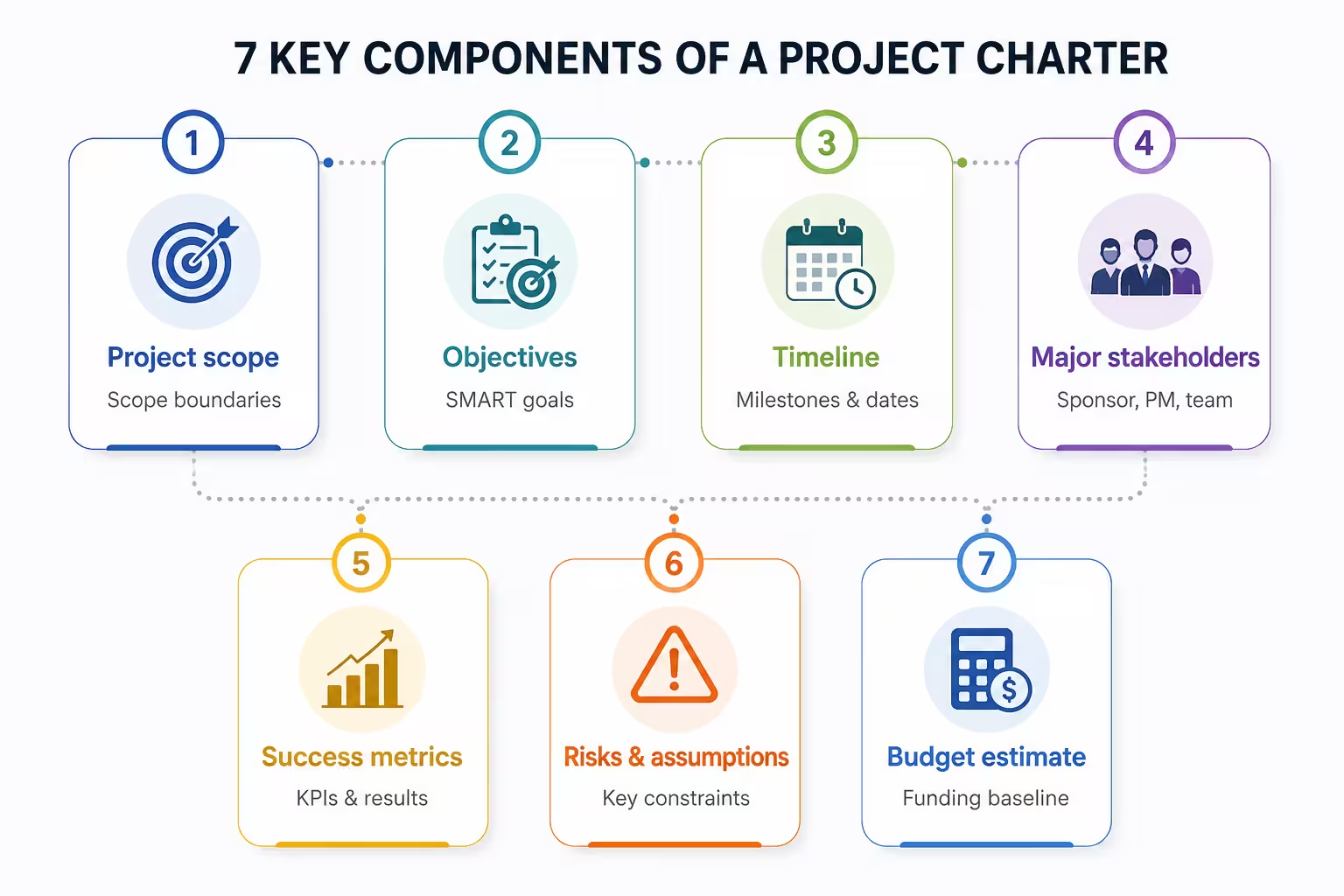
To write an effective charter, you must include several crucial, standardized elements:
- Project Scope: Outlines the project’s boundaries, clearly mentioning what is included in the project and what is explicitly excluded.
- Objectives: Clearly highlights the SMART (Specific, Measurable, Achievable, Relevant, Time-bound) targets your team is aiming to achieve.
- Timeline: Establishes a high-level master schedule including key milestones and delivery dates.
- Major Stakeholders: Documents a basic stakeholder directory, identifying the project sponsor, project manager, core team members, and key external players.
- Success Metrics: Establishes standard KPIs against which the project’s progress and final results will be measured.
- Identify Risks & Assumptions: Critically evaluates the project environment to list high-level dependencies, constraints, and potential roadblocks.
- Budget Estimate: Outlines the preliminary funding allocation and financial baseline required to complete the work.
How to Create a Charter for a Project?
Follow these fundamental, professional steps to draft a robust project charter:
1. Define Project Goals
When writing a project charter, it’s important to highlight the strategic outcomes the project is expected to deliver. Ensure these goals are S.M.A.R.T. (specific, measurable, achievable, relevant, and time-bound) to give stakeholders a compelling, clear reason to invest.
2. Establish the Project Scope
Draft a definitive scope statement. This statement is critical for setting boundaries, outlining exactly what is "In-Scope" and "Out-of-Scope" to prevent scope creep during execution. At this stage, take into account major deadlines, high-level budgets, core deliverables, and primary assumptions.
3. Identify Key Stakeholders
Collaborate with team members, end-users, and sponsors to align expectations. Documenting their names, responsibilities, and influence levels in a preliminary stakeholder directory ensures that no vital group is neglected.
4. Develop an Implementation Plan
Draft a high-level implementation sequence that breaks the project down into manageable phases. This plan should encompass:
- High-level risk management and mitigation concepts
- Basic quality control measures
- A streamlined communications and reporting structure
- A milestone-based master schedule
- Initial resource allocations
5. Establish a Budget Baseline
Formulate an estimated project budget by categorizing projected labor, equipment, licensing, and material costs. Be sure to establish a practical contingency reserve to cover unexpected costs, referencing past project data and industry benchmarks to justify your financial assumptions.
Project Charter Approval Workflow
Drafting a project charter is only half the battle. To gain the formal authority necessary to spend money, allocate resources, and schedule work, the charter must pass through a strict approval workflow. Below is the step-by-step lifecycle of a project charter:
| Workflow Step | Responsible Party | Description & Key Actions |
|---|---|---|
| 1. Initiation & Drafting | Project Manager or Project Sponsor | The Project Manager drafts the charter based on input from the business case, proposal, and sponsor. If a PM is not yet assigned, the Sponsor may draft the initial scope. |
| 2. Peer & Stakeholder Review | Key Stakeholders, Core Team Members | The draft is shared with key technical and business stakeholders to crosscheck constraints, confirm resources, and validate high-level deliverables. |
| 3. Feedback & Iteration | Project Manager | The draft is modified to integrate recommendations, resolve conflicting goals, and clarify boundaries (what's in-scope vs. out-of-scope). |
| 4. Formal Sign-Off | Project Sponsor & Executive Steering Committee | The Project Sponsor and decision-makers formally review and sign the charter. In PMP guidelines, only the Sponsor has the official authority to sign and issue the charter. |
| 5. Authorization & Activation | Full Organization | The charter is published in a centralized location. The Project Manager officially receives the mandate to assign resources and proceed to the granular planning phase. |
Once the final signature is secured, the project transitions immediately from "initiated" to "active," giving the project manager the leverage needed to negotiate with functional resource managers for team assignments.
Project Charter Examples
Project Charter Example 1: Website Development Project (Digital/Marketing)
Project Overview
This project aims to design and develop a modern, user-friendly company website to improve online presence, enhance customer engagement, and support business growth. The goal is to create a responsive, SEO-optimized website that delivers a seamless user experience while aligning with the company’s branding and business objectives.
Project Objectives
- User Experience Improvement: Design an intuitive and responsive interface for better usability across devices
- Performance Optimization: Ensure fast loading speed and smooth navigation
- SEO Enhancement: Improve search engine visibility and rankings
- Content Management: Enable easy content updates through a CMS
- Lead Generation: Integrate forms and CTAs to capture customer inquiries
Project Scope / Deliverables
- Website UI/UX design (wireframes and prototypes)
- Front-end and back-end development
- Mobile-responsive design
- CMS integration (e.g., WordPress)
- SEO setup (meta tags, keywords, structure)
- Contact forms and lead capture features
- Testing and quality assurance
- Final website launch and deployment
Project Roadmap
- Phase 1: Planning & Requirements Gathering - Define project goals, scope, and stakeholder requirements
- Phase 2: Design - Create wireframes, UI mockups, and obtain design approvals
- Phase 3: Development - Build front-end and back-end functionalities
- Phase 4: Testing - Conduct usability testing, bug fixing, and performance checks
- Phase 5: Launch - Deploy the website and monitor initial performance
Assumptions
- Stakeholders will provide timely feedback during design and development
- Required content (text, images, branding assets) will be shared on time
- Budget and resources will remain stable throughout the project
- No major scope changes will occur after approval
Stakeholders
- Project Sponsor (Business Owner)
- Project Manager
- Design Team
- Development Team
- Marketing Team
Budget (Estimated)
- Design: $3,000
- Development: $7,000
- Tools & Hosting: $1,000
- Contingency: $1,000
Total Estimated Budget: $12,000
Success Metrics
- Website launched within 12 weeks
- Page load time under 2 seconds
- 20% increase in website traffic within 3 months
- 15% increase in lead generation
Approval
This project charter is approved by the project sponsor and stakeholders, authorizing the project to begin and allowing the use of organizational resources.
Project Charter Example 2: Construction Project
| Component | Project Details |
|---|---|
| Project Title | Apex Commercial Office Building Construction |
| Project Sponsor | Apex Property Holdings Group (VP of Infrastructure) |
| Project Manager | Robert Chen, PMP |
| Project Objective | Construct a modern, sustainable 5-story commercial office building in downtown Dallas to achieve LEED Gold certification. Must be fully completed within 18 months. |
| Project Scope & Deliverables |
|
| Key Stakeholders |
|
| Budget / Resources | $4.5 Million USD allocated ($4.0M estimated baseline, $500k contingency). |
| Timeline / Milestones |
|
Project Charter Example 3: IT & Software Migration Project
| Component | Project Details |
|---|---|
| Project Title | Enterprise ERP Cloud Migration Project |
| Project Sponsor | Chief Information Officer (CIO) |
| Project Manager | Sarah Jenkins, PMP |
| Project Objective | Migrate on-premise ERP architecture to SAP S/4HANA Cloud to minimize system downtimes by 40% and increase data processing speed across divisions. Completed in 9 months. |
| Project Scope & Deliverables |
|
| Key Stakeholders |
|
| Budget / Resources | $650,000 USD (Includes hardware licensing, external consulting, and cloud storage setups). |
| Timeline / Milestones |
|
Project Charter Example 4: Q4 Integrated Product Launch Campaign
Project Objective: Launch the SaaS "ProjectPRO 2.0" platform via a multi-channel campaign to secure 10,000 trial sign-ups and $150k MRR (Monthly Recurring Revenue) within the launch quarter.
Project Sponsor: VP of Global Marketing | Project Manager: Elena Vance
Key Deliverables:
- Paid Media Ads (Google Ads, LinkedIn Campaigns, Retargeting)
- Content Engine: 12 high-intent blogs, 2 webinars, and a whitepaper
- Influencer and PR outreach package sent to 50 key tech leaders
- Custom interactive calculator landing page
Timeline: Total Duration: 4 months. Launch Week: Oct 15th. Post-Launch optimization: Nov 1st - Dec 31st.
Budget: $120,000 USD (including content creation, paid ad spend, and influencer licensing fees).
Common Mistakes to Avoid When Writing a Project Charter
Even seasoned project managers sometimes produce subpar charters. To ensure your project is properly authorized, avoid these common project charter mistakes:
- Making the Charter Too Detailed: Do not turn your charter into a multi-page project plan. It is meant to be a high-level strategic roadmap, not a detailed tactical guide containing operational checklists. Keep it under 3 pages.
- Unclear Project Objectives: Objectives that lack measurable constraints (e.g., "to improve systems") are useless. Always use the SMART methodology to ensure every goal has a metric and a deadline.
- Defining a Vague Scope: Failing to clearly articulate the "In-Scope" vs. "Out-of-Scope" boundaries will invite scope creep during the execution phase, leading to missed timelines and budget runs.
- Missing Key Stakeholders: If critical business teams, database administrators, or customer representatives are excluded from the stakeholder register in the charter phase, they may emerge later and disrupt progress with late-stage changes.
- Setting Unrealistic Expectations: Listing impossible timelines or rigid budgets before proper baseline calculations is a recipe for project failure. Keep figures realistic and establish healthy contingencies.
- Failing to Identify Major Risks & Constraints: Every project faces limitations. Leaving out key assumptions or high-level risk assessments leaves the team unprepared for foreseeable roadblocks.
- Not Clearly Defining Project Authority: The charter must explicitly state the Project Manager's level of authority over budgets, personnel hiring, and final project sign-offs.
- Skipping the Formal Approval Process: Relying on verbal agreements or email threads instead of obtaining physical or digital signatures leaves the project vulnerable to sudden cancelations or funding cuts.
- Using Unclear or Ambiguous Language: Use professional, direct, and active language. Ambiguity in key definitions allows stakeholders to form conflicting interpretations of what constitutes success.
Best Practices for Writing a Project Charter
- An ideal charter should be limited to 1-3 pages. A brief, high-impact document helps keep senior leadership engaged and moving in the right direction.
- Ensure all defined goals are SMART (Specific, Measurable, Achievable, Relevant, and Time-bound).
- Explicitly outline the boundaries of the project, including a dedicated section for "out-of-scope" deliverables to prevent creeping requirements.
- Involve key implementation team members in the drafting process to capture realistic technical estimates and ground-level insights.
- Obtain a formal, signature-backed sign-off from your project sponsor. Email acknowledgments or verbal agreements are not sufficient to authorize resources.
Conclusion: Driving Project Success
A well-crafted project charter is the bedrock of any successful initiative. By clearly defining objectives, scope boundaries, and key roles early on, you prevent misalignment, manage scope creep, and set a direct path toward your project goals. Whether you are leading a small marketing campaign or managing a massive, cross-functional IT infrastructure rollout, mastering this crucial document is a vital step in your professional development.
For project managers seeking to advance their careers, demonstrating proficiency in initiating projects and authoring charters is highly valuable. This foundational skill is a core focus area of top-tier industry credentials, such as the Project Management Professional (PMP)® certification. Successfully navigating these initiation processes demonstrates to employers that you possess the executive alignment skills required to deliver complex projects on time, within scope, and on budget.
Take charge of your career growth today. Master the advanced methods of project initiation and charter design. Validate your expertise and position yourself as an elite leader by enrolling in our industry-leading Project Management Professional (PMP)® Certification Training Course to unlock your next career milestone.







Write a Comment
Your email address will not be published. Required fields are marked (*)