





GCP Certification Path 2026: Beginner to Professional Guide
Map your cloud career with the 2026 GCP certification path. Master in-demand skills, prepare for exams, and unlock
Stop doing repetitive, soul-crushing work. Get the in-demand skill that makes you a strategic automation engineer and unlocks high-value roles in Cincinnati, OH's digital transformation.
You're drowning in redundant tasks. Your day is spent clicking, copying, and pasting - work a machine should be doing. You are a human bottleneck, and your career progression is stalled because your output is measured in execution volume, not strategic value. Meanwhile, organizations across IT, BPO, and finance in cities like Delhi and Chennai are desperately seeking skilled RPA developers who can implement Robotic Process Automation (RPA) solutions, cut costs by 30-50%, and free up human capital for innovation. This skill gap is your opportunity. This is not a course on recording a macro. Our RPA course is engineered to make you an Automation Architect, capable of leading full-scale RPA automation deployments. We teach the practical, end-to-end framework: from identifying the right processes for automation (the most common failure point) to building resilient bots that handle real-world exceptions without crashing. The focus is always on ROI - the time and money your bots save - because that's the only metric that matters to management. Unlike generic tutorials, our program immerses you in Automation Anywhere, the leading RPA tool for major Cincinnati, OHenterprises. You will build and deploy bots that interact with SAP, Oracle, and other legacy systems commonly used in Cincinnati, OH banking and telecom. You'll move beyond simple task automation to tackle complex cognitive processes using IQBot, ensuring you're prepared for real-world enterprise RPA projects. The RPA Certification proves your knowledge; the practical skills prove your worth. We built this program for ambitious professionals who want to lead the automation shift. You can't waste time on irrelevant theory. Our curriculum is fast-paced, hands-on, and focused purely on deployable RPA skills. You'll get pre-built templates, real-world case studies from Cincinnati, OHclients, dedicated cloud labs for practice, and direct mentorship from instructors actively deploying bots today. Stop doing repetitive work; start building the RPA bots that do the work for you.
Master the specific platform used by leading firms in Cincinnati, OH IT and Shared Services, ensuring your skills are immediately marketable.
Get hands-on with a dedicated cloud environment to build, test, and troubleshoot bots without needing to configure your personal machine.
Learn the critical "RPA Assessment" phase - the key to successful projects - to ensure every bot you build delivers tangible cost savings.
Move beyond basic bots by mastering IQBot for complex data extraction and processing, securing you the high-value roles.
Test your deployment skills and conceptual understanding against the rigor required for actual production environments, not just the exam.
Get direct, practical answers from Automation Anywhere-certified professionals, eliminating guesswork when your bot deployment fails.
Automation's Impact on Business Processes Is a Significant Factor in Determining the Success of RPA Implementations. As companies rely increasingly on digital technologies to streamline operations, intelligent automation plays a pivotal role in driving efficiency gains and cost reductions. This holds particularly true for organizations operating in Cincinnati, OH, which can leverage RPA to enhance business agility and decision-making capabilities.
In the context of RPA, process discovery techniques such as process mining help identify high-value automation opportunities. These techniques enable businesses to model and document processes, thereby uncovering pain points and areas ripe for transformation. By applying these concepts, organizations can achieve significant productivity gains and eliminate manual data processing tasks.
Effective implementation of RPA requires a combination of technical and business acumen, making it essential for professionals to acquire in-depth knowledge of automation frameworks and workflows. This entails understanding tools such as UI automation and data scraping, as well as developing expertise in process design and governance. _

Get a custom quote for your organization's training needs.
RPA Adoption Rate Experiencing Rapid Growth Across Industries
RPA adoption has seen a sharp increase globally, with industries witnessing a marked shift toward automation-driven service delivery models. This trend is particularly pronounced in Cincinnati, OH, where the emphasis on digital transformation is yielding noticeable improvements in operational efficiency. The automation market is expected to continue its upward trajectory, driven by factors such as cost savings and scalability.
Key drivers behind this growth include advancements in AI and machine learning, which have improved RPA's accuracy and adaptability. Additionally, the increasing recognition of RPA's value proposition among business leaders is contributing to its widespread adoption. As a result, professionals with RPA expertise are in high demand, and the field is expected to continue experiencing significant growth.
Organizations seeking to capitalize on this trend must develop a clear RPA strategy, including the establishment of governance frameworks and centers of excellence. This requires professionals with a deep understanding of RPA best practices, including process re-engineering and automation tool selection. _
Learn to identify and score processes based on ROI, complexity, and stability. Stop automating the wrong thing; focus on the high-impact 80%.
Go beyond bot development. Master the security, scheduling, auditing, and user management features of the Control Room for enterprise-level governance.
Build bots that don't fail on day two. Learn structured error handling, logging mechanisms, and exception management for robust, production-ready automation.
Move past structured data. Deploy IQBot for intelligent document processing (IDP), handling semi-structured data like invoices and forms to unlock truly complex processes.
Implement secure credential management practices to ensure your bots access production systems without compromising security - a non-negotiable in finance and compliance.
Master the lifecycle from development to production. Learn proper version control, code review standards, and deployment best practices used by Fortune 500 companies.
If your current role is bottlenecked by repetitive work, or if you're tasked with finding cost savings and efficiency in your organization, this program is your mandatory upskill path to becoming an automation leader.
Key Responsibilities of RPA Certificants Include Process Modeling, Automation Code Development, and Quality Assurance
RPA certification holders are expected to possess a range of skills, including process modeling, automation code development, and quality assurance. These professionals must be able to design and implement automation workflows using tools such as robotic process automation and process automation software. This involves understanding data structures and algorithms, as well as developing expertise in version control and collaboration tools.
Effective RPA implementation requires a combination of technical and business skills, making it essential for professionals to develop a deep understanding of process analysis and design. This entails applying concepts such as service-oriented architecture and event-driven architecture to create scalable and maintainable automation solutions. RPA certification holders are expected to demonstrate expertise in areas such as automation tooling and programming languages, including Python and Visual Basic for Applications.
This requires staying up-to-date with industry trends and best practices, as well as developing a strong understanding of business requirements and process governance. _


Get the technical certification that is an explicit requirement for RPA Developer and Architect roles.
Secure compensation levels reserved for professionals who can prove measurable cost savings through automation.
Design the future of work and gain a seat in business process optimization discussions.
The leading RPA certifications, such as the Automation Anywhere Certified Advanced RPA Professional, are designed to be accessible yet technically rigorous. While there are no mandatory prerequisites, true success requires hands-on skill mastery and applied understanding. Here's what you need to know before qualifying.
No Mandatory Prerequisites: There are no formal educational or professional experience requirements to attempt the certification exam - making this a great entry point for aspiring automation professionals.
Recommended Knowledge: A foundational understanding of programming logic and business processes is highly recommended to accelerate your learning curve.
Mandatory Training Requirement: Completion of a comprehensive, hands-on RPA training program like ours is essential to build production-level bots and pass the certification with confidence.
The Real Benchmark: The only true prerequisite is the ability to design, build, and manage a robust bot portfolio that delivers measurable ROI - and this program gives you exactly that capability.
Significant Skill Gap Exists in RPA Implementation and Maintenance
A significant skill gap exists in RPA implementation and maintenance, with many organizations struggling to find professionals with the necessary expertise. This is a pressing concern in Cincinnati, OH, where the demand for RPA professionals is high. The shortage of skilled professionals is hindering the widespread adoption of RPA and limiting its potential benefits.
One of the key challenges is the lack of standardized training programs and certifications, which has led to confusion around RPA skills and expertise. This has resulted in a situation where many professionals are lacking the necessary skills to implement and maintain RPA solutions effectively. To address this skill gap, professionals must develop a strong understanding of RPA concepts and technologies, including machine learning and natural language processing.
This requires a combination of theoretical and practical knowledge, as well as staying up-to-date with industry trends and best practices. _
Master essential commands for data manipulation, file operations, variable creation, and error handling. Build your first non-trivial bot for a standard back-office process and gain practical automation experience.
Deep dive into web automation (interacting with browsers), email automation (sending/receiving attachments), and PDF integration - the backbone of most financial and HR bots.
Utilize PGP/GPG for security, XML/JSON parsing for integration, and the powerful "String Operation" command for data cleanup - skills that separate developers from basic bot recorders.
Implement robust access controls. Define user roles (Admin, Developer, Runner, Auditor) and manage bot deployment permissions - a must for compliance and security in banks and BPOs.
Learn how to schedule RPA automation effectively. Manage workload queues, prioritize critical jobs, and configure alerts for bot failures and performance metrics. Hands-on expertise here is highly valued by top RPA companies.
Securely store and retrieve credentials using the Credential Vault. Understand why hard-coding passwords is a critical mistake and implement industry-standard practices for secure access. These skills are integral for professional RPA Certification and enterprise-grade deployments.
Master System, User, and Credential variables. Implement advanced logic using IF/ELSE statements, LOOPS, and error handling blocks to build resilient, decision-making bots.
Hands-on automation of Excel (advanced data filters, pivot tables), SQL/Database connectivity, and specific commands for SAP/Oracle interaction - the three enterprise workhorses.
Build bots that recover from failure. Implement "Begin/End Error Handling" blocks, define retry logic, and log errors for proactive maintenance and robust automation.
Learn to build reusable, standardized components (Metabots) for complex application interaction. Increase bot development speed and maintainability by utilizing modular design principles.
Dive into Intelligent Document Processing (IDP). Train IQBot to extract data from unstructured documents such as invoices, forms, and contracts - the key to automating processes with variable input.
Master workload management, version control, and audit log analysis for enterprise-grade bot deployment. Learn essential RPA best practices necessary for large-scale automation projects and prepare for professional RPA Certification.
RPA Certification Training Program Prepares Professionals for In-Demand Careers
The RPA Certification Training Program is designed to equip professionals with the skills and knowledge necessary to succeed in in-demand careers related to RPA implementation and maintenance. This includes roles such as RPA developer, automation engineer, and business analyst. Upon completion of the program, participants will be well-prepared to take on leadership roles and drive digital transformation initiatives.
RPA professionals are in high demand, particularly in industries such as finance and healthcare. As a result, the RPA Certification Training Program is an attractive option for professionals seeking to transition into high-growth fields. The program provides a comprehensive understanding of RPA concepts and technologies, including machine learning and data analytics.
Upon completion of the program, participants will be eligible for certification and will possess the skills and knowledge necessary to drive business value through automation. This includes developing a strong understanding of process analysis and design, as well as creating scalable and maintainable automation solutions.
Great class, very informative.

Great PMP<sup>®</sup> Bootcamp. I had a great time taking this course. I took the course to prepare to sit for the CAPM<sup>®</sup> but may be able to sit for the PMP<sup>®</sup>. I learnt a lot was challenging. Great course. We need one more day. Content was very detailed.

it was a great class. Lots of energy. And I enjoyed.

Fantastic course to prepare for PMP<sup>®</sup> exam.

As a participant it was smooth sailing for me.

Trainer was excellent. Shared good resources and good experiences.

Good content and training.
I wanted to let you know that I took and passed the PMP exam. Thanks to iCertGlobal and especially my Cincinnati course instructor, who was an excellent teacher and helped me immensely.

Trainer was good. Trainer was very engaged and interacting. Very much satisfied with the training.

I was pleasantly surprised at the quality of this training. Yomi was awesome as a trainer and working to make sure that we understood the concepts. Controlling Cost and Controlling Risk are the most complicated, but Yomi spent time after class working through questions to help others understand. This class also helped to change my perception of the PMP being this MONSTER to something that I can I can successfully do.

Great class with a lot of information and tips to prepare for the exam

It was a great course, covered all the things that i ended up hitting road bumps on. I was the only one in the class, but the trainer was just as involved as if it had been a full class.

I was nervous about taking it online versus classroom; but I am actually glad I took it online. Instructor was very great and gave a good learning experience with his relevant project management experience.
The training was very intense but covered with course material. It was more than I expected.

I thought the class was very informative. The instructor did an excellent job breaking down each chapter to where it was easy to understand. I was also very impressed with his commitment to help us pass ever after the class is over.

Excellent training. Instructor was very knowledgeable and explained information in an understandable way
Quality Materials presented, Instructor very knowledgeable. Exceeded my expectations.
The training is a great introduction into the PMI mindset. Very informative and helpful

Explore RPA Our PMP certification training is available in a city near you
Stay updated with the latest insights and trends in your field
Map your cloud career with the 2026 GCP certification path. Master in-demand skills, prepare for exams, and unlock
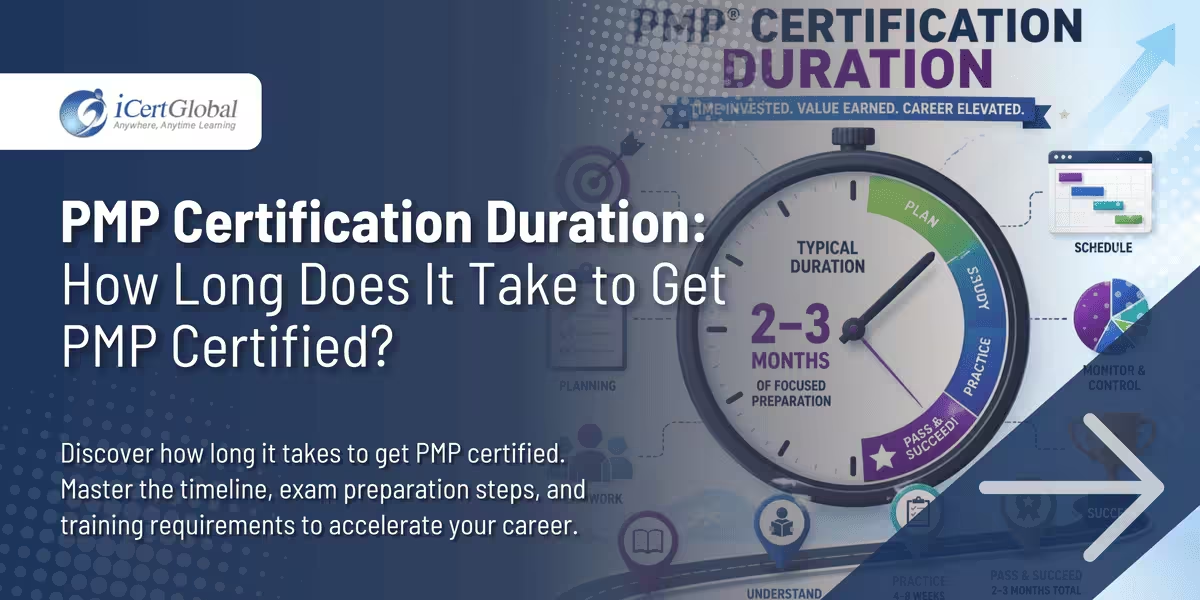
Discover how long it takes to get PMP certified. Master the timeline, exam preparation steps, and training requirements
Master product ownership. Find the complete CSPO certification cost in India, training fees, and career ROI to plan
Master the CEH exam on your first attempt. Use this practical 10-step study plan to build your ethical
Master 10 essential AI prompt engineering techniques to boost your career. Learn how to optimize LLM outputs and
Master risk management and pass your PMI-RMP Exam. Explore proven study strategies, eligibility requirements, and steps to boost
Master the CRISC certification syllabus. Learn the four domains, key exam topics, and proven prep strategies to advance
Master the critical machine learning skills you need to advance your career, pass top certifications, and land high-paying
Master enterprise risk. Learn the CRISC certification eligibility requirements, exam details, and how this credential boosts your salary
Compare CSM vs A-CSM to find the right Scrum certification for your career goals. Explore requirements, salary impact,
Our experts are ready to help you with any questions about courses, admissions, or career paths. Get personalized guidance from industry professionals.
Request a Call Back

"PMI®", "PMBOK®", "PMP®", "CAPM®" and "PMI-ACP®" are registered marks of the Project Management Institute, Inc. | "CSM", "CST" are Registered Trade Marks of The Scrum Alliance, USA. | COBIT® is a trademark of ISACA® registered in the United States and other countries.

