
You are likely constrained by a narrow focus. Perhaps you excel in Incident Management, or you are proficient in Change, yet you are missing the comprehensive perspective. You are constantly addressing issues in Operations while the Strategy team disregards your input. You are attempting to implement services that were inadequately conceptualized. You hold a "Manager" title but lack the "Master" understanding. Conversely, ITIL Expert-certified practitioners are the ones formulating the operational models, defining the service offerings, and engaging with the CEO to articulate the business value of IT. The sector is oversaturated with holders of the Foundation-level credential who believe they grasp ITSM simply because they memorized the definition of an SLA. They are easily replaceable. The ITIL Expert represents a rare commodity. Talent acquisition specialists and CIOs are aware that an Expert has successfully navigated the series of Intermediate examinations and conquered the demanding MALC capstone. They understand that an Expert comprehends the link between Strategy and Design, how Design governs Transition, and how Operation informs Strategy. This is not a foundational workshop. Our ITIL Expert Training Program provides a focused strategic plan engineered to help you accumulate the required credits effectively. Whether you are pursuing the Lifecycle stream (Strategy, Design, Transition, Operation, CSI) or the Capability stream, our experienced specialists mentor you through the intricate network of relationships. We don't merely train you for the exam; we teach you how to adopt the mindset of a CIO. We designed this for dedicated ITSM practitioners who are weary of being overlooked. You will learn methods for harmonizing IT resources with corporate requirements, demonstrating the rationale for substantial IT investments, and directing intricate organizational transformations. Whether you are concluding your v3 journey or preparing to transition to ITIL 4, this marks the highest achievement. The final examination is the last checkpoint?a measure of integration, not mere recall. We equip you with the means to succeed.
ITIL Expert Certification Overview
The ITIL Expert Path: Bridging the Gap from Manager to Master
Why get ITIL Expert-certified?
The Credential That Eliminates Professional Barriers
Demand the "Expert" Level Compensation:
Statistics indicate that ITIL Experts achieve incomes 40?50% greater than individuals holding only the Foundation credential.
Overcome Doubts from Others:
Enter any discussion with the confidence that you grasp the complete service lifecycle more thoroughly than any other participant.
Prepare Your Career for Tomorrow:
Holding the ITIL Expert title automatically grants eligibility for the "ITIL 4 Managing Professional Transition" module, bypassing the requirement of four separate examinations.
ITIL Expert Training Course Highlights
Beyond Simple Training - It's Your Professional Catalyst
Authorized Training Partner
Avoid jeopardizing your certifications with unproven organizations. We possess full authorization from PeopleCert to deliver the entire ITIL Expert curriculum.
MALC Concentration
The Managing Across the Lifecycle (MALC) assessment is the primary obstacle for most applicants. Our curriculum features a dedicated, intense MALC unit to guarantee you overcome this final challenge.
Strategic Credit Formulation
Don't expend effort on modules that provide minimal value. We assist you in totaling your ITIL v3 credits and selecting the quickest, most pertinent route to accumulate 22 credits.
Practical Framework Design
Gain knowledge from educators who have created ITSM environments for the largest banking and telecommunications firms in your region.
Transition from Old to New
Grasp how your Expert-level knowledge translates into the contemporary ITIL 4 Managing Professional status.
Continuous Expert Guidance
Receive support from ITSM Specialists who can help clarify the intricate situations encountered in the intermediate and final comprehensive examinations.
Skills You Will Gain In Our ITIL Expert Training Program
From Theoretical Understanding to Practical Capabilities
Who Benefits from This Curriculum
Optimal Applicants for the ITIL Expert Certification are:
This certification training is ideal for:
If you possess your Foundation level and are committed to transitioning into high-level consulting or senior leadership roles, the ITIL Expert progression represents your essential route to success.
ITIL Expert Certification Training Program Roadmap
Systematic Method for Achieving Success on the Initial Try
Eligibility and Pre-requisites
Path to the ITIL Expert Certification
You cannot simply register for the Expert assessment. It is a progression. You are required to attain it by utilizing the credit accumulation method.
ITIL Expert Course Modules
Comprehensive curriculum covering all exam domains
Service Strategy (SS) - 3 Credits
Lesson 1: Strategy Management
Learn to define the market, develop the offering, and develop strategic assets. Understand how to position your IT organization as a value-center, not a cost-center.
Lesson 2: Financial Management
Master the art of budgeting, accounting, and charging. Learn to quantify the value of IT services in financial terms that the CFO understands.
Lesson 3: Demand & Portfolio Management
Stop guessing capacity. Learn to analyze Patterns of Business Activity (PBA) and manage the Service Portfolio to balance supply and demand.
Service Design (SD) - 3 Credits
Lesson 1: Design Coordination
Learn to coordinate all design activities, ensuring that new services are consistent and integrated.
Lesson 2: Availability & Capacity Management
Master the technical metrics. Learn to design services that meet strict SLA requirements for uptime and performance.
Lesson 3: Security & Continuity
Design for resilience. Learn to integrate Information Security and IT Service Continuity into the very fabric of the service.
Service Transition (ST) - 3 Credits
Lesson 1: Change Management
The heart of control. Learn to manage the lifecycle of all changes, enabling beneficial changes to be made with minimum disruption to IT services.
Lesson 2: Release & Deployment
Master the rollout. Learn to plan, schedule, and control the build, test, and deployment of releases.
Lesson 3: Knowledge Management
Stop reinventing the wheel. Learn to gather, analyze, store, and share knowledge and information within an organization.
Service Operation (SO) - 3 Credits
Lesson 1: Incident & Problem Management
Restore service fast, then fix the root cause. Master the interplay between restoring operations and removing permanent errors.
Lesson 2: Request Fulfillment & Access
Streamline the routine. Learn to handle service requests and manage access rights efficiently.
Lesson 3: Service Desk Functions
Optimize the single point of contact. Learn to structure and manage a Service Desk that adds value, not just answers phones.
Continual Service Improvement (CSI) - 3 Credits
Lesson 1: The 7-Step Improvement Process
Master the loop: Identify, Define, Gather, Process, Analyze, Present, Implement.
Lesson 2: Measurement & Reporting
Learn to create reports that drive action. Understand the difference between data, information, knowledge, and wisdom.
Lesson 3: CSI Registers
Manage the pipeline of improvements just like a project portfolio.
Managing Across the Lifecycle (MALC) - 5 Credits
Lesson 1: Integration of Lifecycle Stages
This is the capstone. Learn how Strategy, Design, Transition, Operation, and CSI interact. Understand the inputs and outputs of every stage.
Lesson 2: Governance & Organization
Master the structures required to govern IT services. Learn about organizational development and sourcing strategies.
Lesson 3: Strategic Case Studies
Apply everything you have learned to complex, multi-stage scenarios. This is the direct preparation for the dreaded MALC exam questions.
Corporate Training
Tailored programs for teams with enterprise support

Ready to transform your team?
Get a custom quote for your organization's training needs.
Upcoming Schedule
Join the next batch that fits your timezone


Course & Support
Everything you need to know about our training options and support
Customer Testimonials
Hear from our successful graduates
"Exceptional PMP Training Experience with iCertGlobal I recently completed the PMP training by iCertGlobal, and I must say it was an outstanding experience. The instructor demonstrated a deep understanding of project management principles and brought real-world experience to the table. The training material's provided were comprehensive and well-organized, offering valuable insights and practical tips. I would highly recommend iCertGlobal to anyone looking for professional PMP Training.. "

John Anderson
"iCertGlobal provided a great learning experience with clear, well organised courses. The trainers were knowledgeable, and the support team was responsive to all my questions. The study material was comprehensive, which helped me pass my certification exam with ease. Highly recommended for anyone looking to get certified. "
James Walsh
"iCertGlobal is the best Certificate Training Organization. you will get good instructor and they will improve leaning sills and give the real time experience examples due to that you will get pass in first try. "
Andy Moran
"The course content, exam prep questions, interactive Q&A, and real-life examples made attending this PMP Project Management training class worth my time and money. The support from iCertGlobal was exceptional and I would like to thank them for accepting my request of meeting the trainer post the session for clearing my doubts."
Tim Malone
"I had a good learning experience with icertGlobal and it had been an amazing development journey. Actually, I accidentally bumped into iCertGlobal while searching for an online course for preparing my PMP examination. With positive reviews all over the internet and quick responses to my questions, I was flabbergasted enough to sign-up immediately. The instructor-led PMP preparatory course helped me both offline and online preparations. All the high-quality materials written in simple layman language was enough to grasp the gist of various topics. The instructors were very knowledgeable as they imparted not only their wealth of experiences but also real life examples. Thanks a lot iCertGlobal for imbibing this great learning experience. "
Jason Walter
"Thank you for your great course, great support, rapid response and excellent service."
Hoda Alavi
ITIL Expert Training in Other Cities
Our ITIL Expert certification training is available in major cities worldwide
Related Blogs
Stay updated with the latest insights and trends in project management
ITIL 4 Foundation vs Practitioner: Certification Path Explained
Compare ITIL 4 Foundation vs Practitioner. Discover which certification aligns with your career goals, boosts your salary, and...
Top 10 IT Service Management Best Practices for
Explore the top 10 IT service management best practices for modern business, from ITIL 5 and AI automation...
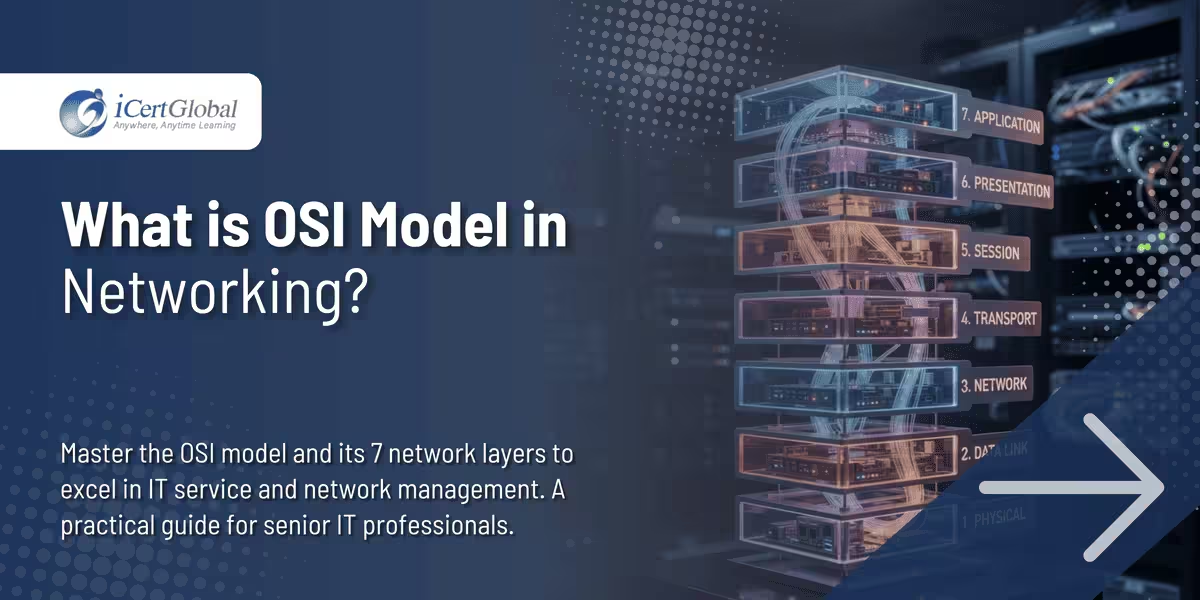
What is OSI Model in Networking
What is OSI model in networking? Learn the 7 layers, protocols, devices, how data flows, and how OSI...

