



ITIL 4 Foundation vs Practitioner: Certification Path Explained
Compare ITIL 4 Foundation vs Practitioner. Discover which certification aligns with your career goals, boosts your salary, and
Stop being a process administrator. Get the elite credential that proves you can architect, design, and govern the entire IT ecosystem.
You are likely stuck in a silo. You know Incident Management, or maybe you are good at Change, but you lack the holistic view. You are fighting fires in Operations while Strategy ignores you. You are trying to transition services that were designed poorly. You are a "Manager" but not a "Master." Meanwhile, ITIL Expert-certified professionals are the ones designing the operating models, defining the service portfolio, and sitting in the boardroom explaining IT value to the CEO. The industry is flooded with Foundation-level certificate holders who think they know ITSM because they memorized what an SLA is. They are commodities. The ITIL Expert is the scarcity. Recruiters and CIOs know that an Expert has survived the gauntlet of Intermediate exams and passed the grueling MALC capstone. They know an Expert understands how Strategy feeds Design, how Design dictates Transition, and how Operation feeds back into Strategy. This isn't a basic boot camp. Our ITIL Expert Training Program is a strategic roadmap designed to get you through the credit system efficiently. Whether you are taking the Lifecycle path (Strategy, Design, Transition, Operation, CSI) or the Capability path, our vetted experts guide you through the complex web of dependencies. We don't just teach you to pass; we teach you to think like a CIO. We built this for serious ITSM professionals who are tired of being ignored. You will learn how to align IT assets with business needs, how to justify million-dollar IT investments, and how to orchestrate complex organizational changes. Whether you are finalizing your v3 journey or preparing to bridge to ITIL 4, this is the apex. The exam is the final gatekeeper - a test of integration, not just memory. We hand you the keys to unlock it.
Don't risk your credits with unverified providers. We are fully accredited by PeopleCert to deliver the complete ITIL Expert roadmap.
The Managing Across the Lifecycle (MALC) exam is where most candidates fail. Our program includes a dedicated MALC intensive module to ensure you clear the final hurdle.
Don't waste time on low-value modules. We help you calculate your ITIL v3 credits and choose the fastest, most relevant path to 22 credits.
Learn from instructors who have designed ITSM ecosystems for the largest banking and telecom giants.
Understand how your Expert knowledge translates to the modern ITIL 4 Managing Professional designation.
Access to ITSM Experts who can help you untangle the complex scenarios found in the intermediate and capstone exams.
Ensuring service quality through continuous process improvement is a critical aspect of ITIL Expert Certification Training Program. Professionals with this certification are expected to design, implement, and optimize IT service management processes to meet organizational needs. By focusing on IT service management (ITSM) lifecycle, ITIL experts can align IT services with business objectives and strategies.
Process owners and managers in ITSM lifecycle are responsible for ensuring that IT services are delivered in accordance with defined service level agreements (SLAs). ITIL experts use IT service catalogs and service level management (SLM) to identify and address areas for improvement. ITIL's Continual Service Improvement (CSI) approach is employed to implement changes and recommend new processes and practices.
In Adelaide, South Australia, organizations like Telstra and Santos rely on certified ITIL experts to manage their IT service management processes, ensuring seamless service delivery and minimizing disruptions to business operations.

Get a custom quote for your organization's training needs.
Acquiring skills in service management and ITIL methodologies is essential for professionals pursuing the ITIL Expert Certification Training Program. This program helps improve knowledge and practical expertise in ITIL practices, frameworks, and tools. By studying ITIL guidelines, such as the ITIL Service Strategy and ITIL Service Design, participants develop a deep understanding of service management principles.
To succeed in this program, students need to have a solid grasp of ITSM best practices, including service desk, incident management, and problem management. ITIL experts must possess skills in data analysis, metrics, and reporting to optimize IT service performance. They should also be familiar with ITIL frameworks, including ITIL Service Transition and ITIL Continual Service Improvement.
By developing these skills, ITIL experts can contribute to improved IT service quality and efficiency, particularly in Adelaide, South Australia's growing tech sector, where companies like IBM and Cisco Systems operate.
You will learn to define services as strategic assets, analyze market spaces, and manage demand and financials like a business owner.
You will master availability, capacity, and continuity planning to ensure services are fit for purpose and use.
You will learn to control assets, manage configurations, and deploy releases without crashing the production environment.
You will refine incident, problem, and access management processes to stabilize delivery and reduce downtime.
You will internalize the 7-step improvement process to constantly align IT services with changing business needs.
You will learn to integrate all lifecycle stages, managing the conflict between stability and responsiveness.
If you have your Foundation and are serious about moving into senior management or high-level consulting, the ITIL Expert path is your mandatory roadmap.
The ITIL Expert Certification Training Program is relevant to various industries, including finance, healthcare, and government, where IT service management plays a critical role. ITIL experts are in high demand as organizations seek to optimize their IT service management processes and align them with business objectives.
In ITIL's Service Transition phase, IT experts use change management processes to implement new services or changes to existing ones. ITIL's Continual Service Improvement approach is also applied to assess and improve existing processes, making it essential to ensure that ITIL experts possess the technical skills and knowledge required.
In Adelaide, South Australia, where the financial services and healthcare sectors are prominent, ITIL expertise is beneficial for ensuring efficient IT service management and alignment with business goals, whether it be at the Australian Institute of Business or Royal Adelaide Hospital.
Data shows ITIL Experts earn 40-50% more than their Foundation-level counterparts.
Walk into any meeting knowing you understand the full lifecycle better than anyone else in the room.
Being an ITIL Expert automatically qualifies you for the "ITIL 4 Managing Professional Transition" module, skipping 4 exams.
You cannot just "take" the Expert exam. It is a journey. You must earn it through the credit system.
Foundation Certificate: You must hold a valid ITIL Foundation certificate (2 Credits).
15 Intermediate Credits: You must earn a minimum of 15 credits from the Intermediate streams (Lifecycle or Capability).
17 Credits Total: You must have at least 17 credits banked before you are even eligible to book the MALC exam.
MALC Completion: You must complete an accredited MALC training course and pass the exam.
Obtaining the ITIL Expert Certification is highly relevant to a career in IT service management. This certification demonstrates a professional's expertise in ITIL frameworks, practices, and methodologies.
Upon completion of the course, ITIL experts can pursue various roles, such as ITSM manager, service desk manager, or IT service continuity manager. By pursuing the ITIL Expert Certification, professionals can enhance their career prospects and earning potential in Adelaide, South Australia's vibrant technology and IT services sectors.
ITIL experts can work for organizations like Telstra, IBM, or Cognizant, where a strong understanding of IT service management is highly valued. As organizations like Santos and Woodside Energy continue to grow and expand their IT services, the demand for certified ITIL experts is increasing, making this certification a valuable asset for IT professionals.
Learn to coordinate all design activities, ensuring that new services are consistent and integrated.
Master the technical metrics. Learn to design services that meet strict SLA requirements for uptime and performance.
Design for resilience. Learn to integrate Information Security and IT Service Continuity into the very fabric of the service.
The heart of control. Learn to manage the lifecycle of all changes, enabling beneficial changes to be made with minimum disruption to IT services.
Master the rollout. Learn to plan, schedule, and control the build, test, and deployment of releases.
Stop reinventing the wheel. Learn to gather, analyze, store, and share knowledge and information within an organization.
Restore service fast, then fix the root cause. Master the interplay between restoring operations and removing permanent errors.
Streamline the routine. Learn to handle service requests and manage access rights efficiently.
Optimize the single point of contact. Learn to structure and manage a Service Desk that adds value, not just answers phones.
Master the loop: Identify, Define, Gather, Process, Analyze, Present, Implement.
Learn to create reports that drive action. Understand the difference between data, information, knowledge, and wisdom.
Manage the pipeline of improvements just like a project portfolio.
This is the capstone. Learn how Strategy, Design, Transition, Operation, and CSI interact. Understand the inputs and outputs of every stage.
Master the structures required to govern IT services. Learn about organizational development and sourcing strategies.
Apply everything you have learned to complex, multi-stage scenarios. This is the direct preparation for the dreaded MALC exam questions.
The ITIL Expert Certification Training Program equips professionals with practical knowledge and skills to implement IT service management best practices. This certification demonstrates expertise in ITIL lifecycles, methodologies, and frameworks, enabling professionals to design, implement, and optimize IT service management processes.
ITIL experts use IT service management tools, such as IT service catalogs, service level agreements, and service desk software, to manage IT services and monitor service performance. The Continual Service Improvement approach is applied to identify areas for improvement and recommend changes to IT service management processes.
In Adelaide, South Australia, certified ITIL experts can apply their knowledge and skills to real-world scenarios, contributing to improved IT service quality and efficiency for organizations like Telstra, IBM, and the Australian Institute of Business.
Detailed discussion with case studies and examples made the training more helpful.

Excellent training, excellent faculty and a good training experience.

It was a great pleasure and privilege with this kind of training.

iCertGlobal team is very friendly and helped me at every step in acquiring my ITIL Expert Certification. Special Thanks to the Trainer for simplifying complex topics and helping us understand the concepts easily. Thanks to the Sales Team for supporting me whenever I required their help, even if it was out of offices time or their weekly offs.

though it was my first training for any certification, I found it very easy to understand each and every step.

Explore our instructor-led ITIL Expert training to learn about the course duration, cost, eligibility, and certification process. You get practical learning, exam-focused preparation, and expert guidance. Ready to get started? Compare ITIL Expert certification training options and choose a classroom or live online format that fits your schedule.
Explore Our ITIL Expert certification training is available in a city near you
Stay updated with the latest insights and trends in your field
Compare ITIL 4 Foundation vs Practitioner. Discover which certification aligns with your career goals, boosts your salary, and
Explore the top 10 IT service management best practices for modern business, from ITIL 5 and AI automation
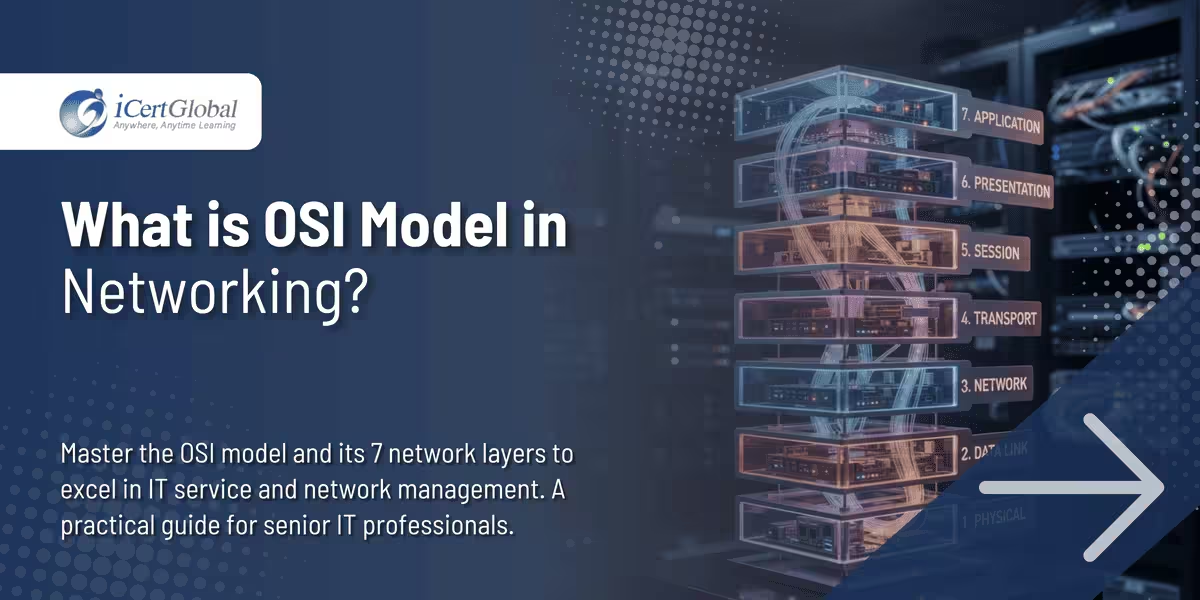
Master the OSI model and its 7 network layers to excel in IT service and network management. A
Learn the top benefits of ITIL certification and how it boosts your IT career and organizational value.
Learn how businesses keep their technology like computers and internet running well with ITSM and ITIL.
Learn what COBIT is and why it matters for managing technology in businesses.
Learn about the key responsibilities, skills, and career path of a Service Desk Manager.

Explore the top high-paying programming languages for 2026 and gain in-demand skills to boost your career, stay competitive,

Master frontend frameworks to accelerate your career. Compare React, Angular, Vue, Svelte, and Next.js to build modern web
Harness the power of Data Science in IT Process Management to streamline operations, improve decision-making, and maximize efficiency
Our experts are ready to help you with any questions about courses, admissions, or career paths. Get personalized guidance from industry professionals.
Request a Call Back

"PMI®", "PMBOK®", "PMP®", "CAPM®" and "PMI-ACP®" are registered marks of the Project Management Institute, Inc. | "CSM", "CST" are Registered Trade Marks of The Scrum Alliance, USA. | COBIT® is a trademark of ISACA® registered in the United States and other countries.

