
ITIL 4 Foundation vs Practitioner: Certification Path Explained
Compare ITIL 4 Foundation vs Practitioner. Discover which certification aligns with your career goals, boosts your salary, and
Classroom Training and Live Online Courses
Stop being a "theory-only" admin. Get the practical, hands-on credential that proves you can actually fix broken IT processes.
Your ITIL Practitioner Isn't a Certificate. It's Your Non-Negotiable Pass to Senior Roles You already have your Foundation certificate. Great. So does everyone else. But you're still stuck in the trenches, watching your team drown in incidents, fighting with change advisory boards that say "no" to everything, and dealing with processes that look good on paper but fail in reality. You know the what of ITIL, but you're struggling with the how. That's why you're still a "Service Desk Lead" while others are becoming "Service Delivery Managers" with 40% higher pay. The industry is full of "paper-certified" professionals who can recite definitions but freeze when asked to actually improve a workflow. Employers are tired of them. They want problem solvers. They want people who can take the "CSI approach" and actually turn it into cost savings and faster resolution times. Your resume gets filtered out because you look like just another generic IT support staffer. That stops now. This isn't another boring lecture series on definitions. Our ITIL Practitioner Training Program is designed by battle-hardened ITSM consultants who have fixed broken IT departments in North Tyneside, England's biggest tech parks and Mumbai's financial hubs. They don't just teach you the "Guiding Principles" - they show you how to use them to shut down pointless bureaucracy, streamline change management, and force your organization to focus on value. We built this for the working professional who deals with real chaos. We cut out the academic fluff and focus on the "Adopt and Adapt" methodology. You'll learn how to navigate Organizational Change Management (OCM) to handle resistance from stubborn teams, use metrics that actually mean something to your CIO, and implement improvements that get you noticed. Whether you are targeting the legacy ITIL v3 Practitioner concepts or the modern ITIL 4 practice modules, this training bridges the gap between knowing the vocabulary and speaking the language of leadership.
More Than a Course - It's Your Career Accelerator
Learn with absolute confidence knowing your program meets the strict global standards set by Axelos and PeopleCert.
Stop memorizing rigid processes. Learn how to adapt the framework to your specific IT context, whether you're working in a startup or an MNC.
Learn from ITSM architects who haven't just passed the exam, but have led massive service improvement plans for Fortune 500 companies.
Master the soft skills that technical courses ignore - how to manage resistance, stakeholders, and office politics during major changes.
Learn to define Critical Success Factors (CSFs) and KPIs that prove your value to the business in hard numbers.
Stuck on a real work problem? Our experts are available around the clock to help you apply what you learn to your actual job.
The relevance of ITIL Practitioner Certification Training Program lies in its role in career advancement. Many professionals seek this certification to demonstrate their ability to improve service management practices in their organizations. This certification is recognized globally for its effectiveness in service delivery and management.
Effective service management is built on the back of high-quality processes. ITIL Practitioner Certification Training Program equips professionals with the necessary knowledge to drive process improvement within their organizations. This includes understanding how to use metrics and data to support informed decision-making, which is crucial in today's complex environments.
In North Tyneside, England, professionals working in the service management industry can greatly benefit from this certification. By attending the ITIL Practitioner Certification Training Program, they can improve their skills and demonstrate their expertise to potential employers.
Tailored programs for teams with enterprise support
Get a custom quote for your organization's training needs.
The ITIL Practitioner Certification Training Program focuses on developing practical skills in service management. This includes understanding the four key elements of service management: people, processes, information, and technology. Professionals attending this course will learn how to develop a service charter and a service strategy, both of which are essential for delivering high-quality services.
Developing a service charter requires professionals to define the service offering, identify the target market, and establish the service provider's role in the market. This involves understanding service portfolio management, which includes selecting and prioritizing services to ensure alignment with business objectives. The use of data and metrics is also critical in this process.
In practical terms, professionals in North Tyneside, England's service management industry can apply their skills in service charter development to improve their organizations' service offerings. By attending the ITIL Practitioner Certification Training Program, they will gain the necessary knowledge to develop a service charter that meets the needs of their customers.
Stop applying quick fixes. You will learn the systematic 7-step improvement process to identify gaps, define measurable goals, and execute changes that stick.
Tech changes are easy; people changes are hard. You will learn frameworks to overcome resistance, manage stakeholder fears, and drive adoption of new processes.
Stop guessing. You will master these universal decision-making rules (like "Focus on Value" and "Start Where You Are") to navigate any complex IT situation.
Move beyond vanity metrics. You will learn to design meaningful KPIs and CSFs that demonstrate the actual business value of your IT services.
Stop speaking "tech." You will learn how to craft communication plans that align IT teams, business stakeholders, and vendors on a single vision.
Stop copying the book blindly. You will learn the critical skill of tailoring ITIL best practices to fit your organization's size, culture, and constraints.
This certification training is ideal for:
If you have your Foundation certificate and are ready to stop being a junior admin and start leading service improvements, this course is your mandatory next step.
The ITIL Practitioner Certification Training Program places a strong emphasis on work responsibilities and the role of professionals in driving service improvement. This includes understanding the concept of continuous service improvement (CSI) and the importance of defining and implementing CSI projects. Professionals attending this course will learn how to use metrics and data to identify areas for improvement and develop plans to address these areas.
One key aspect of CSI is understanding the difference between incremental and transformative change. Incremental change involves making small, incremental changes to existing processes, while transformative change involves making significant changes to the way services are delivered. Professionals must understand how to select the right type of change for their organization.
In North Tyneside, England, professionals working in the service management industry can apply their knowledge of CSI to drive service improvement within their organizations. By attending the ITIL Practitioner Certification Training Program, they will gain the necessary knowledge to develop and implement CSI projects that meet the needs of their customers.
The Credential That Ends the Gatekeeping
Stop getting filtered out by recruiters looking for "Senior" ITSM professionals who can drive change.
End the "theory vs. reality" debate by proving you know how to apply the framework in the real world.
Unlock the "Specialist" salary bands reserved for those who can demonstrate tangible ROI through service improvement.
This certification is the bridge between the entry-level and the expert level. It assumes you already know the basics.
Mandatory Prerequisite: You must hold a valid ITIL Foundation certificate (v3, 4, or 2011). You cannot take the Practitioner exam without it.
No Minimum Experience: While there is no mandatory experience requirement, we strongly recommend at least 1-2 years of work in an IT service management role to truly grasp the scenario-based questions.
Training Requirement: While self-study is allowed, attending an accredited training course is highly recommended due to the practical, case-study nature of the exam.
The ITIL Practitioner Certification Training Program is highly regarded for its ability to enhance professional credibility in the service management industry. This certification is recognized globally for its effectiveness in service delivery and management, and professionals who obtain it are highly sought after by employers. The course covers a range of topics, including understanding the service management lifecycle, managing service relationships, and using metrics and data to support informed decision-making.
To obtain ITIL Practitioner certification, professionals must demonstrate their ability to apply the principles of service management in real-world scenarios. This includes developing a service charter and a service strategy, and creating a business case for service management initiatives. Professionals must also demonstrate their knowledge of metrics and data analysis.
In North Tyneside, England, professionals working in the service management industry can greatly benefit from this certification. By attending the ITIL Practitioner Certification Training Program, they can enhance their professional credibility and demonstrate their expertise to potential employers.
Stop treating improvement as a one-time project. Learn the 7-step Continual Service Improvement (CSI) approach. You will master how to identify the vision, assess where you are now, define where you want to be, and execute the plan. This is the core engine of the ITIL Practitioner certification.
Most IT teams measure the wrong things. Learn to distinguish between Critical Success Factors (CSFs) and Key Performance Indicators (KPIs). Understand how to build a metrics hierarchy that links technical operational data to high-level business goals.
Move beyond ad-hoc fixes. Learn to build and manage a formal Improvement Register (CIR). You will learn how to prioritize improvements based on ROI and business impact, ensuring you are always working on the most valuable tasks.
Learn to ruthlessly cut any activity that doesn't add value to the customer. Understand the "Design for Experience" principle to ensure your services aren't just functional, but usable and intuitive for the end-user.
Stop trying to "rip and replace" everything. Learn to assess current capabilities and build upon them. Master the art of "Working Holistically" to see the end-to-end service, preventing siloed improvements that break things downstream.
Big bang implementations fail. Learn to "Progress Iteratively with Feedback" to deliver quick wins and adjust course. innovative ways to "Collaborate and Promote Visibility" to break down walls between Dev, Ops, and the Business.
Change fails because of people, not technology. Learn the psychology of change resistance. You will explore frameworks to identify stakeholders' fears and motivations, allowing you to navigate the "human side" of IT projects.
Not all stakeholders are equal. Learn to map your stakeholders based on power and interest. specific strategies for engaging difficult stakeholders who have the power to block your initiatives.
Bad communication kills projects. Learn to design effective communication plans that deliver the right message, to the right person, at the right time, using the right medium.
The most critical skill. Learn how to take the rigid ITIL books and adapt them to your specific environment - whether you are a 10-person startup or a massive banking GCC.
The exam is scenario-based. We spend this lesson dissecting complex, real-world case studies. You will apply the principles and CSI approach to solve these scenarios, mirroring the actual exam format.
Master the open-book exam format. Learn time management, keyword recognition, and how to quickly reference your materials to answer situational questions correctly.
ITIL doesn't live in a vacuum. Learn how the Practitioner concepts align with Agile and DevOps. See how "Progress Iteratively" matches Agile sprints, and how "Collaborate" aligns with DevOps culture.
Understand how this certification fits into your broader journey toward ITIL Expert or ITIL 4 Managing Professional. Plan your next steps for maximum career impact.
A full-length, timed mock exam under strict conditions to validate your readiness and identify any final areas for review.
Everything you need to know about our training options and support
The ITIL Practitioner Certification Training Program provides professionals with the practical skills and knowledge necessary to apply service management concepts in real-world scenarios. This includes understanding how to use metrics and data to support informed decision-making, and developing a service charter and a service strategy.
Professionals attending this course will learn how to create a business case for service management initiatives and develop plans to implement CSI projects. In practical terms, professionals in North Tyneside, England's service management industry can apply their knowledge and skills in service management to drive service improvement within their organizations.
By attending the ITIL Practitioner Certification Training Program, they will gain the necessary knowledge to develop and implement service management initiatives that meet the needs of their customers. Professionals who obtain this certification are highly sought after by employers, and by attending the ITIL Practitioner Certification Training Program, they can enhance their professional credibility and advance their careers in the service management industry.
Great class, very informative.

Great PMP<sup>®</sup> Bootcamp. I had a great time taking this course. I took the course to prepare to sit for the CAPM<sup>®</sup> but may be able to sit for the PMP<sup>®</sup>. I learnt a lot was challenging. Great course. We need one more day. Content was very detailed.

it was a great class. Lots of energy. And I enjoyed.

Fantastic course to prepare for PMP<sup>®</sup> exam.

As a participant it was smooth sailing for me.

Explore our instructor-led ITIL Practitioner training to learn about the course duration, cost, eligibility, and certification process. You get practical learning, exam-focused preparation, and expert guidance. Ready to get started? Compare ITIL Practitioner certification training options and choose a classroom or live online format that fits your schedule.
Explore Our ITIL Practitioner certification training is available in a city near you
Stay updated with the latest insights and trends in your field
Compare ITIL 4 Foundation vs Practitioner. Discover which certification aligns with your career goals, boosts your salary, and
Explore the top 10 IT service management best practices for modern business, from ITIL 5 and AI automation
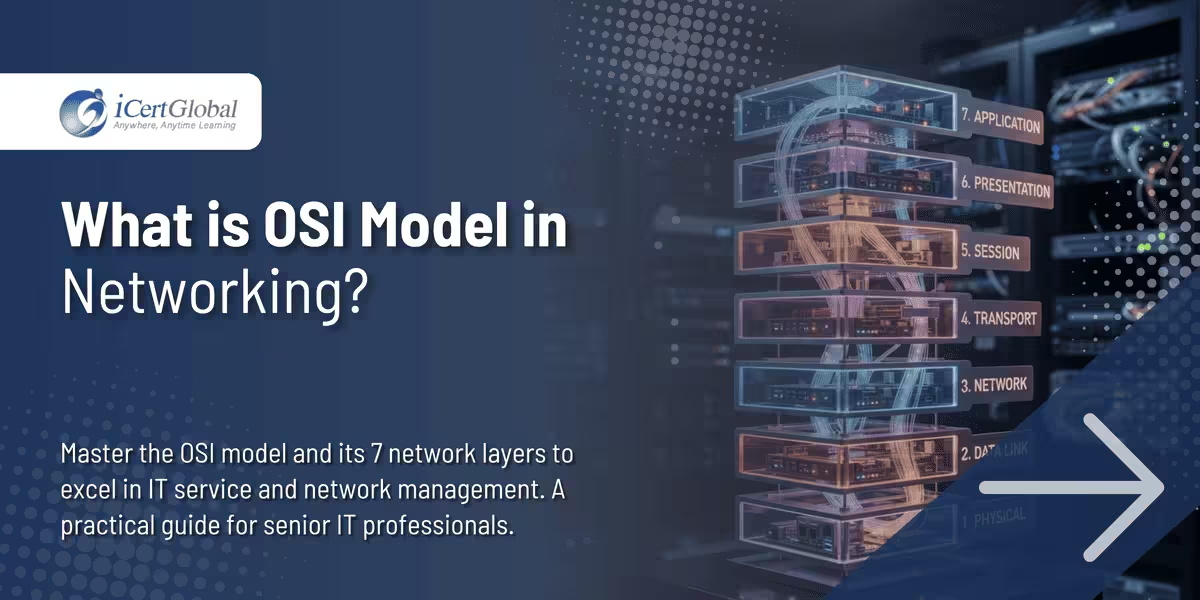
Master the OSI model and its 7 network layers to excel in IT service and network management. A
Learn the top benefits of ITIL certification and how it boosts your IT career and organizational value.
Learn how businesses keep their technology like computers and internet running well with ITSM and ITIL.
Learn what COBIT is and why it matters for managing technology in businesses.
Learn about the key responsibilities, skills, and career path of a Service Desk Manager.

Explore the top high-paying programming languages for 2026 and gain in-demand skills to boost your career, stay competitive,

Master frontend frameworks to accelerate your career. Compare React, Angular, Vue, Svelte, and Next.js to build modern web
Harness the power of Data Science in IT Process Management to streamline operations, improve decision-making, and maximize efficiency
Our experts are ready to help you with any questions about courses, admissions, or career paths. Get personalized guidance from industry professionals.

Live online and classroom training in PMP, ITIL, Agile, Six Sigma and more, with exam support included.
Subscribe to our newsletter for the latest updates on certifications and training opportunities.
Search iCertGlobal for certifications, courses and articles.

"PMI®", "PMBOK®", "PMP®", "CAPM®" and "PMI-ACP®" are registered marks of the Project Management Institute, Inc. | "CSM", "CST" are Registered Trade Marks of The Scrum Alliance, USA. | COBIT® is a trademark of ISACA® registered in the United States and other countries.